
New 3 oscillator synth from StudioLogic – Sledge
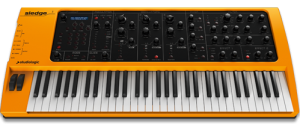
Studiologic, mainly known for their controller keyboards previously, have released their first synthesizer, the Sledge. The Sledge is a 3 oscillator virtual analog synth that includes not only the standard analog waveforms, but a full set of wavetables from the PPG Wave. Also includes a Waldorf-modelled multimode filter, selectable white and pink noise, hard sync, an arpeggiator, fast envelopes, and a basic selection of effects. For many synthesizer enthusiasts, it is the particular interaction of the sound engine and user interface that makes a great instrument. A quick look at Sledge shows you the generous set of controls available to interact directly with the sound engine. When you touch the knobs and switches of the front panel, you will instantly be aware of the meticulous attention to detail our engineers have refined, during many decades building the best electronic keyboards.
You will experience the logical set-up of the synthesizer modules, mirroring the signal flow of a classic analogue synthesizer. But what really distinguishes any synthesizer is its sound. Fortunately, our friends at Waldorf Music have happily shared their experience and know-how on this crucial part of the Sledge Synthesizer.
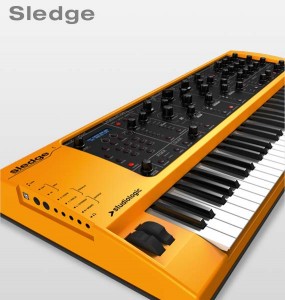
Specifications:
• 32 Pots
• 3 chicken head rotary switches (7 positions)
• 1 rotary encoder with push function
• 2 x 16 digits backlit LCD
• High Quality Pitch and Mod Wheel
• up to 256 Sounds
• fast and efficient sound selection via numeric keypad
• 2 fast LFOs per voice, each with adjustable Speed and Depth
• 1 extra modulation routing for Mod Wheel, with adjustable Speed and Depth
– Shape: Sawtooth, Rectangular, Triangle, Sine, Sample & Hold, Ramp
– Destination: Osc 1, Osc2, Ocs3, PWM / Wave / FM, Volume, Filter Cutoff
• Monophonic mode with single or multiple trigger
• 3 Oscillators per voice
– Range from 64′ to 1′ each
– Shapes: Sawtooth, Square, Triangle, Sine, Pulse (with Pulse Width Modulation)
– Oscillator 1 with 66 Original PPG Wavetables
• Frequency Modulation of sine and triangle
• Oscillator Hardsync (Osc 2 to Osc 3)
• Noise Generator with selectable white and pink noise
• Mixer with Volume and On/Off switch for each Oscillator and Noise
• 1 Multi Mode Filter per voice
– 24 / 12dB
– Lowpass
– Highpass
– Bandpass
– Resonance up to Self-Oscillation and beyond
– Adjustable Keytrack and Drive
• 2 fast Envelopes per voice (filter / amplifier)
• Powerful Arpeggiator
– Latch mode
– syncable to MIDI Clock
– Direction Up, Down, Alternate
– Range up to 10 Octaves
• 2 simultaneuous Effects
– Effect 1: Chorus / Phaser / Flanger
– Effect 2: Reverb / Delay
• sturdy, lightweight enclosure (less than 10 KG)
• high quality, 5 octaves Fatar TP 9 keyboard
• Master Volume Control • Power Switch
• Stereo line output
• Headphone output
• Expression pedal input
• MIDI in and out
• USB connector for MIDI in / out
– uses standard USB MIDI driver provided by host computer OS
– Windows ME minimum, Windows XP or newer recommended
– Mac OS X 10.2 minimum, Mac OS X 10.3 or newer recommended
• Built in power supply
Live from NAMM: Moog Minitaur Analog Bass Synth demo
Moog launch new Minitaur Analog Bass Synth at NAMM 2012.
Minitaur is a powerful, compact Analog Bass Synthesizer that features a classic one knob per function design. It is the first instrument in the Taurus family that does not have foot pedals. At only 8.5″ x 5.25″ and less than 3lbs, the Minitaur puts legendary analog Moog bass into a package designed to fit seamlessly into today’s performance and production environments. There are no confusing or convoluted menus to dig through. Plug in a MIDI controller or hook it up to your computer and start playing immediately.
Arturia MiniBrute videos
More videos on the new all analog synthesizer.
Waldorf announces the Pulse 2 Analog Synthesizer
Waldorf has introduced the Pulse 2, a new analog synthesizer featuring cutting edge and powerful lows in one compact box.
Sometimes they do come back, and this time, it’s with even more brute-strength power onboard. You are looking at a completely analog synthesizer that accurately delivers what synthesizer enthusiasts around the world truly crave. Pulse 2 is the reincarnation of it’s legendary ancestor, the Waldorf Pulse, that dominated the electronic music of the 90s.
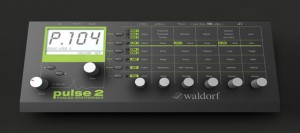
Three analog oscillators in combination with a true analog cascading filter is what Pulse and Pulse 2 have in common. But we didn’t stop there. The filter circuits now also offer Highpass and Bandpass modes. We added analog Filter FM and Ring Modulation along with paraphonic modes that allow up to eight voice chords.
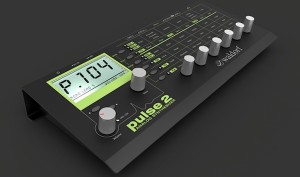
Like the Blofeld Synthesizer, the Pulse 2 is housed in a sturdy metal desktop case. Besides its large LCD display, 8 stainless steel knobs are available to surf through its clearly arrayed parameter matrix, set master volume and edit display accessible parameters.
Pulse 2 features
- 3 analog oscillators + 1 noise generator.
- Pulse width modulation.
- Hard sync.
- Filter FM from Oscillator 3.
- Ring Modulation from Oscillator 3.
- XOR Osc Mode.
- 8/4 Voice Paraphonic modes.
- Cascade Filter.
- 24dB/12db Lowpass, 12db Highpass/Bandpass filter modes.
- Powerful Arpeggiator.
- 8-slot Modulation Matrix.
- USB.
- MIDI.
- External analog signal input.
- Stereo line out.
- Headphone out.
- Backwards compatible with classic Pulse.
- 128×64 character backlit LCD.
- 8 stainless steel knobs.
- 500 Sound Programs.
- Electron-absorbing black case.
All specifications subject to change without notice
NAMM: Video feat MacBeth’s MICROMAC 1 – TEST 1
Here are the details:
Hi there- this is the first *test* of the macbeth micromac- measuring just over a mere 8″ wide- it whacks a punch! This is the first demo that I’ve done of this 3 Oscillator pure analogue synthesizer and on this video- I’m getting to try out a couple of things. Oscillators 1 and 3 have direct outputs to left and right- the filter section has Oscillators, 1, 2 snd 3 pitched 1 octave apart, and a fifth! I guess then I lose the plot and try other things! Anyway- I put up because some folks have wanted to hear it! The micromac is a project that started well over a year ago….and now it is complete! I’m using the all analogue Vortex keyboard to play this thing!
More stuff at NAMM – Discover the KOMA
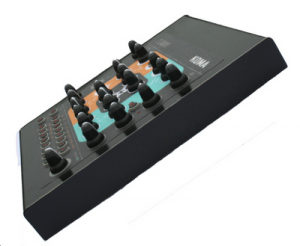
Below is their pitch and specs:
This year, Eowave is attending the NAMM 2012 and will announce the release of the KOMA! 2011 has been full of new releases with the Ribbon, a monosynth/USB/audio controller and the release of the little analogue synth DOMINO in November. We’ll show the KOMA [no relation to KOMA Electronik], an analog bassline synth with memory and a 16 step sequencer that will be ready to ship very very soon!
, a step back into the 80s with a touch of 2012…
KOMA is an analog sequenced bass synthesizer inspired by classic synths from the 1980s with a synthesis section with 256 sound presets and 256 patterns and a step sequencer section.
The synthesis section offers the possibility to mix 4 different waveforms (saw, square, sub, noise) for infinite modulations. The SUB DESYNC mode enables to desynchronize and to detune the SUB and the main oscillator for complex sounds. The filter is a 24 dB resonant low-pass filter. The LFO has 8 waveforms (triangle, ramp up, ramp down, square, random, digital noise, staircase up, staircase down) and can modulate the VCO, VCF or PWM.
To this particular analog sound of the 80s, we added a touch of modernity with controls and parameters to save compositions and performances. The 16 step sequencer has 4 sections: 1 for the notes and 3 freely assignable to a parameter of your choice to create living sequences with sonorities like Vince Clark or Jan Hammer.
With 256 sound presets and 256 patterns locations, the KOMA is a versatile instrument for live performance as well as a powerful composition and sound design tool. Its very intuitive control panel allows the user to edit all parameters in real-time.
Oscillator section
MAIN OSCILLATOR
– Main VCO with 2 waveforms (square and saw), plus SUB (square) and NOISE
– The pulsewidth of the square waveform can be modulated by env2 or by the LFO.
– The main oscillator can be transposed up to 3 octaves
– The main oscillator frequency can be modulated by the LFO or by env3
– Glide
– Mix of the 4 waveforms
SUB
– sub (sub can be 1 or 2 octaves below the master freq).
– The DESYNC mode enables to desynchronize and detune the SUB from the main oscillator.
– In the DESYNC mode, the SUB can be at the same frequency than the main oscillator or 1 octave below.
Filter section
– 24dB resonant low-pass filter for a classical 80s sound
– Variable cutoff and resonance
– The filter can be modulated by ENV2, KB, LFO.
– External audio with a trimmer to feed the filter
LFO section
– The LFO has 8 waveforms (triangle, ramp up, ramp down, square, random, digital noise, staircase up, staircase down)
– Variable speed
– The LFO modulates the VCO, VCF or PWM
– External MIDI clock synchronization
ENV1, ENV2 & ENV3
– ENV1 & ENV2: these 2 envelopes ADSR modulate respectively the amplitude and the filter.
– Attack goes from 2ms to 10 s.
– ENV3: envelope Attack/Decay modulates the VCO
VCA section
– Vca is affected to env1
MEMORY
– 4 banks of 64 sound presets (SAV PRST, SAVE PAT)
– 4 banks of 64 patterns
– 256 sound presets
– 256 patterns
Sequencer
– 16 steps sequencer with 16 LED
– 4 sections: 1 section for gate and note and 3 sections freely assignable to any parameter of the front panel.
– Random feature
– Adjustable tempo
– You can transpose the sequencer via an external MIDI keyboard.
– Each line can have a different number of steps to create complex modulations
– Chain up to 8 sequences.
– Shuffle feature
– External MIDI clock synchronization
Connections
– Audio in
– Audio out
– MIDI in
– USB (for software update and MIDI in&out)”
Hack Me Rockit synthesizer – open source analog-digital hybrid synth
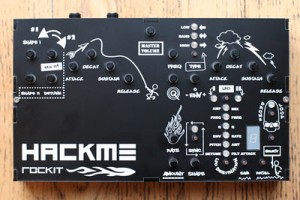
Latest update:
“The Rockit case is finally finished. I got the third and final prototype of the Rockit case in, put it together, and did the happy dance. I’m going to make some small adjustments for the production order, but nothing that will require another round of prototypes. I’m going to put up the case for pre-sale today. I need to hit a threshold of about 50 orders in order to buy it. The lead time from the laser cutter is three weeks, so these should ship in February. The cost will be $50.”
“Rockit is a monophonic, digital and analog hybrid synthesizer. Rockit can make one sound at a time, but it has the capacity to make very simple sounds to very complex and dynamic sounds. Sound generation begins with digital synthesis, moves through analog amplification, analog filtering, and comes out a product of both the digital birth and the analog processing. The digital synthesis is comprised of two oscillators with independent waveform selection. These oscillators can be mixed or played independently and the second oscillator can be detuned from the first in note steps. The analog amplification stage has independent envelope controls for a complete ADSR envelope generator. Rockit’s filter section is an entirely digitally controllable analog filter, meaning all filter parameters are explicitly accessible internally, via knobs and switches, and externally, via MIDI. In addition, Rockit has two Low-Frequency Oscillators for modulating various synthesizer parameters at controllable rates and amounts.
Rockit offers 18 knobs and 8 switches for controlling both the digital synthesis and shaping the analog processing. Rockit is enabled to store and recall 16 patches, storing all knob, switch, and LED settings. Rockit also has a Drone and Loop feature that allows for independent play. For inputs and outputs, Rockit has an audio output and an audio input which routes into the analog filter. Rockit has MIDI In and Out capabilities with all settings accessible via MIDI controller channel numbers. All knob movements are transmitted to the MIDI output on the appropriate MIDI channel number…”
More: http://hackmeopen.com/
Hot of the shelfs – New video from Moog – Introducing Minitaur
Moog Music has announced the release of Minitaur, the newest addition to Moog’s Taurus Bass Synthesizer family. Minitaur is a compact and powerful analog bass synthesizer that features a classic one knob per function layout. Most notably, it is the first instrument in the Taurus family that does not have foot pedals. At only 8.5″ x 5.25″ and less than 3lbs, the Minitaur puts powerful analog Moog bass into a package designed to fit seamlessly into today’s performance and production environments.
For more info, pricing and specs:
http://www.moogmusic.com/products/taurus/minitaur
Moog visited Geddy Lee in his Toronto studio to get his take on the Taurus pedals, old and new. This is the first of a 3-part series relaying touching stories and musical innovations from the start of Rush’s reigning fame to now. In this installment, Geddy talks about his first introduction to the Taurus sound and what he would like to see next from Moog…Minitaur.
Sneak preview of the new Moog Minitaur analog synth
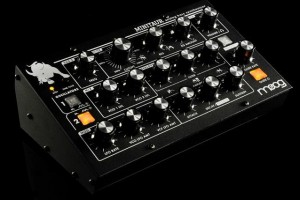
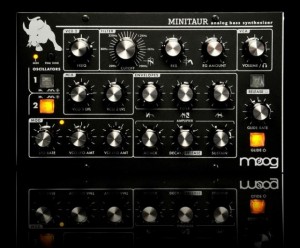
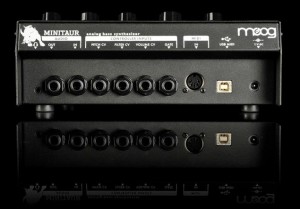
Winter NAMM appears to treat us with a nice analog surprise – a new synth called Minitaur from Moog. Here are the preliminary details:
- 100% analog audio signal path, based on Taurus I and Taurus III synthesizers.
- 2 Taurus VCOs with variable Glide amount
- Sawtooth (original Taurus) or Square waveform selection for both VCOs
- External Audio Input
- Headphone out
- 2 Mixer VCAs for setting the level of the VCOs
- 1 VCF Moog/Taurus-style Ladder Filter w/ VC Resonance
- 1 VCA
- Two Minimoog-style ADSR Envelope generators with the Decay and Release segments controlled by the Decay knob plus a Release On/Off switch
- 1 MIDI-syncable triangle wave LFO for modulating VCF/VCOs
- DIN MIDI In and MIDI over USB out
As of right now these are unofficial photos of Moog Minitaur Analog Bassline Synthesizer! It is said to retail at around 599USD.
The Minitaur is a compact tabletop monophonic MIDI-and-CV-controllable analog bass synthesizer module, based on the design of the Taurus 3bass synthesizer. The front panel of the Minitaur is designed for maximum tweakability, with a knob-per-function design. Schwing!. This isn’t a preset synth – but you can can create and manage patches via MIDI.
The Minitaur has several features added to the classic Taurus synth engine, including an external audio input.
More info will follow as soon as we get it 
Muz3um – New soundpack for the Z3TA+ 2
Muz3um for Z3TA+ 2 by fr4ncesco
“Muz3um, a free bank for Z3TA+ 2 has just been released.
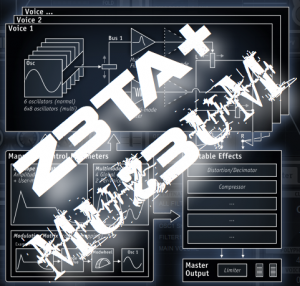
Initially released in 2004, this collection featuring waveforms from analog synthesizers has been completely reprogrammed in order to use Z3TA+ 2 new features, including waveshaping modulation and the new filter types.
Now this collection contains 540 patches, organized in categories (Arps, Bass, Keyboards, Leads, Pads, Sequences) and integrated with Z3TA+ 2 browser. The orginal patches are present too, converted to Z3TA+ 2 format.
Special thanks to
– Chad Beckwith: additional Sound Design & Installer
– Steve at Hollowsun.com: original analog samples
– René G. Ceballos: z3ta+ creator
Muz3um can be downloaded for free at patcharena.com
DATAMASKIN

