
Live performance of SOLSTITIVM V by NORD
“Live performance of SOLSTITIVM V by NORD using analog and digital synthesizers dedicated to my friend ALBA ECSTASY.”
Teaser – MacBeth Mk1 VORTEX Keyboard + Desktop Prototypes
A very quick demo of the both the desktop and keyboard prototypes of the MacBeth Mk1 VORTEX Synthesizer. Both instruments are completely analogue- including the keyboard section! Excuse the playing- and more to follow!
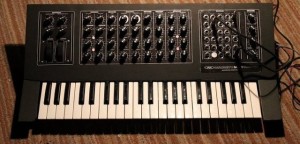
MacBeth Studio Systems’ Ken MacBeth has released a couple of teaser shots of his prototype for the ‘all analogue’ Macbeth Mk1 VORTEX Keyboard Synthesizer, a new monophonic analog synth.
Specs and availability are to come, but MacBeth says that ‘the sound is top, featuring a pure analogue circuits keyboard” and that he hopes to be able to build it at “just under the £2KGBP mark.”
KORG monotribe version 2 : part.1「アップデート方法」
monotribe version 2 特設ページ:http://www.korg.co.jp/Product/Dance/monotribe/version2.html
Background info (Googlish):
The real analog synth and rhythm, a major update with the analog step sequencer monotribe station ribbon of 譲Ri ELECTRIBE! In monotribe version 2 with all new features, you can create ever more elaborate sequences, allowing long overlapping deployments play a complex song. Ver.1 and also played by built-in synchronous mode, a new and different, you can enjoy a new experience for playing more than one sense monotribe.
Note that the analog sticks to monotribe sound, an analog approach can also update Kodawarimasu. Past, as was the PC data loading by cassette tapes, and adopted a voice in how to update using monotribe.
Audio system for updating (WAV) provides encoding and file format. SYNC your audio file and do the update – input to the terminal IN.
In this video, it shows you how to update. And what is trickery or audio files for the update, you can actually hear our.
For detailed procedures and other precautions ※ Please refer to the above special page.
Analogue electronica studio jam
Hard facts:
More live analogue fun from the studio!
Korg ER-1: Drums (through 1176 compressor)
Moog Little Phatty: Bass
Suzuki SX-500: Melody 1
Yamaha TG-33: Melody 2
DSI Evolver: Melody 3
Eurorack Modular: Crazy blip sequences
Eventide Space: Reverb
Eventide TimeFactor: Delay
Kurzweil Mangler: Big dubby falling delay
All recorded via the Soundtracs Topaz to Presonus Studio One. Some minor tweaks and a couple of edits after recording.
SSSSynth iPad App Review
SSSSYNTH is Monophonic Virtual Analog Synthesizer. This is a basic monophonic synth app and it’s free. Version 1.0 does not support CoreMidi. You also can not store any of your settings or patches. Filter section is not smooth. You can hear stepping. Weird white keys, not typical length. Nice delay with filter effect. Oh yeah it’s free!
The new iSynth iPad Synthesizer – Review
“This is my review for iSynth Version 1.0 – iSynth (not to be confused with the iPhone photo editing app) is a virtual monophonic analog-synthesizer for your iPad. iSynth is designed and optimized for live performances. So far NOT my favorite synth. This is version 1 and there is no support for CoreMidi. The key selling point to this synth is the fact that you can stream the audio from it to an AirPlay device. I do not have an AirPlay amplification system so I could not test this feature. Other than that it’s pretty much your basic monophonic dual oscillator synth for the iPad. I did not like how the knobs behaved. They were difficult to control. I also did not like the fact that this synth can not be flipped horizontally. I use an Alesis iO Dock and it is designed to be used horizontally. I also noticed clicking in one preset.”
Features At A Glance:
✔ Dual Oscillator:
– Generating square, triangle, saw tooth and reverse saw tooth waves.
– Octave selector
– Lag processor
– Cross-Fader
– Oscillator fine-tuning
– Oscillator synchronization
✔ LFO Filter:
– Supporting square, triangle, saw tooth and reverse saw tooth waves.
– Filter, vibrato and tremolo modulation
✔ ADSR Volume Envelope Generator:
– Control attack, decay, sustain and release
✔ ADSR Filter Envelope Generator:
– Control attack, decay, sustain and release
✔ Low Pass Filter:
– Frequency cutoff from 10 kHz
✔ Arpeggio Modul:
– Up to five notes
– Select between up, down, up/down and random playing
✔ Keyboard:
– Switch between 4 octaves
✔ Patches:
– Shiped with default patches
– Save unlimited user defined patches
– Share your patches with others via iTunes filesharing
✔ AirPlay:
– Stream directly from iSynth to any AirPlay compatible device
iSynth is available for $1.99 for a limited time
http://ipadloops.com/wireless-synthesizer-ipad/
Time machine: ROLAND JUNO-60 Analog Synthesizer 1982
http://youtu.be/Jhn7itB7JQU
Among the first in Roland’s amazing JUNO family! Six analog voices of polyphony and patch memory storage!! The Roland Juno-60 is a classic six voice polyphonic analog synthesizer with 56 patch memory for your sounds. Although the sound architecture is rather basic, it has an excellent analogue sound. The Juno-60 can produce great basses / sequences with its fast envelopes. It can also produce warm smooth pads with its excellent filters.
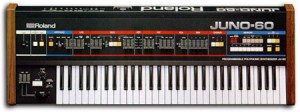
The Juno-60 was used by many professionals like Eurythmics, Howard Jones, the Madonna producers, Paul Van Dyk and many more… it has the DCB interface – the predecessor of MIDI. With a DCB to MIDI interface it is very easy to integrate the instrument in a midi setup.
To my ears the JUNO-60 sounds far better than the very similar JUNO-106 (I had both). The Juno-60 has snappier envelopes and a fater chorus. The difference is clearly notable. IMO the Juno-60 ist the best sounding Juno. But all Junos can sound great… Please note, I am talking about the original Juno series from the eighties.
I played the JUNO-60 without any additional FX or EQ (except the intro music – this is a multi track recording). Excuse the slight distortion in the first minute.
THE SOUND PROGRAMS IN THIS MOVIE:
Do you have a Juno-60 and want to play with the sounds heard in the video? You can buy the “ANALOGAUDIO1 PATCH BANK” (56 sounds) for 12,99 Euros.
After payment through PayPal you will get a MP3 with sound data for the tape interface of your Juno-60 via email.
The details about the functionality of the tape interface are described in the manual of the Juno-60, which you can download for free.The patchbank will NOT work with the Juno-106, because this one has a different data format.
If you want to buy the “ANALOGAUDIO1 PATCHBANK”, please drop me a mail.
Nice demo of the vintage clone soft synt – 76 Synthesizer
“Demo of this old fashioned styled synth. It’s an interesting sounding app but the dials are difficult to use. Hopefully a future version will clear up a few of the issues that will make this synth a must have. Will not work with a keyboard controller.”
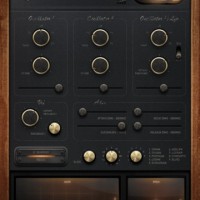
76 Synthesizer is a virtual analog monophonic synth for the iPad. Inspired by synthesizers from the 70’s, the 76 Synthesizer combines playability with style.
For a limited time only, get 76 Synthesizer for 50% off!
Features:
• Three Oscillators with sine, sawtooth, triangle, square waves and switchable filter LFO.
• Voltage controlled filter
• ADSR
• Glide
• Pitch bend/modulation touch pad
• Three octave touch pad for note input with nine different scales
• Eight different effects: reverb, phaser, flanger, chorus, overdrive, delay, tremolo and vocoder— tap the outputs to patch into two effects simultaneously
• Eight different writable presets
• Stunning retro interface
SynthMania brings us “The Girl With Ultramarine Eyes”
A song in the style of 1970s Italian movie soundtracks, with harpsichord, strings, and analog synthesizer – typical instruments used during those years.
Background on Harpsichords:

A harpsichord, also known by the name cembalo, is a musical instrument played by means of a keyboard. It produces sound by plucking a string when a key is pressed. In the narrow sense, “harpsichord” designates only the large wing-shaped instruments in which the strings are perpendicular to the keyboard.[citation needed] In a broader sense, “harpsichord” designates the whole family of similar plucked keyboard instruments, including the smaller virginals, muselar, and spinet.
The harpsichord was widely used in Renaissance and Baroque music. During the late 18th century it gradually disappeared from the musical scene with the rise of the piano. But in the 20th century it made a resurgence, used in historically informed performance of older music, in new (contemporary) compositions, and in popular culture.
Teaser: Therevox ET-4 – a new continuous pitch analog synthesizer
Therevox has introduced the Therevox ET-4 – a new continuous pitch analog synthesizer that is expected to ship in January of 2012.

The Therevox ET-4 is inspired by the Ondes Martenot’s “au ruban” controller .Pitch is controlled by moving an adjustable finger-ring, while amplitude is controlled by two pressure-sensitive keys.
The ET-4 can interface with external synthesizer gear through Control Voltage (CV) outputs for the ring controller and amplitude keys.
A wide range of sounds can also be created with the ET-4′s dual analog oscillators, each with 6 waveforms and 6 octave positions, along with low-pass filtering and real spring reverb. The ET-4 plugs directly into an amplifier and has a separate output for a tuner, for easy and silent tuning changes.
Features & Specs:
- three octave continuous-pitch controller with CV output (1V/oct)
- two pressure-sensitive keys for oscillator amplitude with CV outputs
- two analog oscillators with 6 waveforms including sine, triangle, rectified-sine (similar to “octiviant” on the Ondes Martenot), 50% square, 30% square, 10% square (or white noise on oscillator 2)
- 6 octave settings for each oscillator
- oscillator sync
- low-pass filter with cutoff control via knob and external expression pedal
- spring reverb
- silent tuner output with oscillator selector
- 110/120V or 220/240V available
The Therevox ET-4 will retail for US $1199. Details at the Therevox site.
DATAMASKIN

