
Time machine: ROLAND JUPITER-4 Analog Synthesizer 1978
The Roland Jupiter-4 “Compuphonic” from 1978 was an affordable four voice polyphonic programmable synthesizer. It has 8 presets and 8 RAM memories. The Jupiter-4 was the first of the Jupiter series and was also the first synthesizer which featured an arpeggiator.
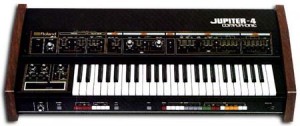
I played the Jupiter-4 dry, and also sometimes with a bit reverb and delay.
The JP-4 was played by Depeche Mode, Vince Clarke, Tangerine Dream, Frank Duval, Gary Numan, Tomita, Kitaro, Duran Duran and others.
The Jupiter 4’s basic architecture was 4 identical voice cards, each with a VCO (with sub-oscillator), resonant low pass VCF (Roland IR3109 IC, which could self-oscillate), and VCA. Modulation included an ADSR envelope and LFO. The LFO, routable to oscillator pitch, pulse width, filter cutoff and amplifier, was notable for being able to reach audio frequencies, allowing for crude FM and AM synthesis.
The Jupiter 4’s two most distinctive features were provided by virtue of its “compuphonic” digital control of the four voice cards, made possible by two Intel 8048 chips:
- An arpeggiator, with a choice of up, down, up/down, or random mode. The arpeggiator can be prominently heard in Duran Duran’s 1982 hit single “Rio.”
- Four voice assignment modes, which, as well as simple 1 VCO-per-voice polyphony, included the ability to effect 4-VCO unison when one key was pressed, 2-VCOs per voice when two keys were pressed, and 1-VCO per voice when three or four keys were pressed. This effect can be heard on tracks such as “Seconds” by The Human League and “I Dream of Wires” by Gary Numan.
The final signal path also included a simple high pass filter and a stereo chorus effect. The Jupiter 4 had 10 preset sounds and also featured 8 memory locations for user-created patches.
Despite not being incredibly popular, it did manage to find its way into the hands of some musicians, most of which were associated with the New Wave and synthpop music scenes (see below). Phil Oakey of The Human League eulogised that despite its limitations “the Jupiter 4 will be tatooed on my heart for ever”.
Nice acid sound built on the classic scheme of analog synths
Nice acid sound built on the classic scheme of analog synths: two oscillators, mixer, filter.
Try it yourself in SunVox: http://www.warmplace.ru/soft/sunvox/
Time machine: Detroit The Blueprint Of Techno
This rare video from the late 1990s features Terrence Parker, Mike Huckaby, Juan Atkins, Ritchie Hawtin, Derrick May, Kevin Saunderson, Carl Craig, Rolando, Jeff Woodward, Gary Koral, Josh Glazer, Jon Ozias, Theorem, DJ Dunebugg, (with special cameo appearances by Mike Grant, Brian Bonds, Don Waxmaster D Smooth, Hugh C, and Todd Weston).
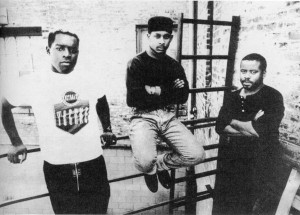
Detroit techno music was originally thought of as a subset to Chicago’s early style of house. However, some critics believe that the Detroit techno movement was an adjunct to house music, named for the new style of music played at a Chicago nightclub called “The Warehouse”. Although producers in both cities used the same hardware and even collaborated on projects and remixes together, Detroiters traded the choir-friendly vocals of House for metallic clicks, robotic voices and repetitive hooks reminiscent of an automotive assembly line. Many of the early techno tracks had futuristic or robotic themes, although a notable exception to this trend was a single by Derrick May under his pseudonym Rhythim Is Rhythim, called Strings of Life. This vibrant dancefloor anthem was filled with rich synthetic string arrangements and took the underground music scene by storm in May 1987. With subtle differences between the genres, clubs in both cities included Detroit techno and Chicago house tracks in their playlists without objection from patrons (or much notice by non-audiophiles).
The three individuals most closely associated with the birth of Detroit techno as a genre are Juan Atkins, Kevin Saunderson and Derrick May, also known as the “Belleville Three”. The three, who were high school friends from Belleville, Michigan, created electronic music tracks in their basement(s). Eventually, they were in demand at local dance clubs, thanks in part to seminal Detroit radio personality The Electrifying Mojo. Ironically, Derrick May once described Detroit techno music as being a “complete mistake…like George Clinton and Kraftwerk caught in an elevator, with only a sequencer to keep them company.
MacBeth MK1 Vortex analog synth demo (prototype)
Here we have a demo of the Macbeth Mk1 VORTEX Desktop Analogue Synthesizer Module. For those who know the format- this is a 5U, 6 Space compact flat unit! It started out as the ‘micromac’- an ambitious idea. This is a a complete **starter** modular synthesizer in a very small area. Anyway, well it’s done. Here is a video of this thing. Personally I’m pleased- this small unit can provide the user with the sound of a big modular system- it’s an entry point fot those wondering. The video content itself meanderders and only the die-hard will watch to the end! Some synth manufacturers give tiny examples of the sound of their gear- I tend to long drawn out stuff to give the potential user the feel of the instrument being used in a permance way. I’m rock and roll myself, so please excuse the personal feel to this thing!
Arctic Keys soon to be released for iOS

One Red Dog Media has announced that their new virtual analog synthesizer for the iPad, Arctic Keys, has been submitted to Apple for approval.
Arctic Keys is a four-voice synth, offering extensive modulation capabilities, an arpeggiator, a sequencer and deep MIDI options.
Details:
Tweak. With all the synthesizer parameters immediately available on one page, you get instant feedback as you tweak.
The two LFOs each have three modulation destinations. Each LFO may also be free running or sync’ed to tempo and the timing rate adjusted.
The modulation matrix allows for deep routing between the Mod Wheel, aftertouch and 16 x 4 analog-style gated step-sequencer.
Perform. The classic arpeggiator is complimented by the 16 x 4 gated step-sequencer. Play a note to trigger the sequencer.
Step through a sequence to play short melodic lines or let it modulate the synthesiser. Each of the 4 tracks have an assignable modulation destination and loop point.
Adjust the velocity by tapping along the length of the key from top to bottom. Change the key mode to mono for retro lead lines.
Share. The live phrase recorder lets you save your performances as 44.1KHz 16-bit WAV files and as a Standard MIDI File.
The MIDI File includes all the knob’s control change information along with the notes you play.
Use Sonoma AudioCopy or Intua Audio Sharing to paste recorded audio directly into other apps.
E-mail the patches you make or share them over Wi-Fi
Pricing and availability are to come.
Specifications:
- Synthesis: analog modelling
- Polyphony: up to 4 voices
- Oscillators: 2 per voice, alias free, saw, triangle and square with pulse width, hard sync, ring mod, noise generator
- Filter: 1 multi-mode resonating filter with 4 filter types
- Envelopes: filter and amp ADSR envelopes
- Modulation: 2 LFOs with multiple wave shapes, sample and hold, 3 routable destinations per LFO
- Effects: master effect processors: 3-band EQ, Distortion, Chorus, Stereo Delay
- Arpeggiator: classic apreggiator with octave shift, MIDI-sync-able
- Sequencer: 16×4 gated step sequencer with multiple modulation destinations, MIDI-sync-able
- Keyboard: glissando, scroll, multi-touch poly pitch bend and aftertouch
Features:
- KORG WIST
- Sonoma AudioCopy
- MIDI Learn
- Live phrase recorder with audio and MIDI export
- File and patch sharing via iTunes File Sharing, e-mail and Wi-Fi
- Supports external MIDI in and out via CoreMIDI Networking and USB with the Camera Connection Kit
- Audio background operation
- Virtual MIDI cabling
- Open Music App Collaboration compliant
Pure-Pone – Free VST synth
The Pure-Pone Synthesizer is a virtual analog synthesizer. FM, SYNC and RING modulation in connection with the super wave oscillator gives a phat basic sound.
2 x modulations matrix, a 12/24dB multimode Filter and a delay / chorus unit works for sound design.
Free version with one voice. That is the only limitation.
Pure-Pone – http://www.vstplanet.com/News/11/Pure-Pone.htm
Developer: tubeohm.com
JUNO-60 : It don’t get more analog than this… :-)
Background information:
http://www.stephenhobley.com/blog/2011/09/18/fixing-up-a-…
I just refurbished my JUNO-60 – this video is me taking it for a test drive after reassembly. No sequencer, just the built in arpeggiator and the “hold” function. The keys were stripped and washed, the switches and faders were given the full DeOxit treatment, and the dead internal battery was replaced with a lithium button cell. Finally the factory programs were reinstated using a WAV file. The effect is an analog tape delay provided by a Tascam 32 reel to reel. Looping the signal from the playback head to the record head. It don’t get any more analog than this… 
(Actually this is just as much a test of doing a 2×2 synchronous video matrix as it is a test of the synthesizer)
Here’s a new analog treat for your iPad

Fermion–much like a true classic hardware analog synthesizer–makes all synthesis parameters concurrently visible, available and tweak-able, for greater real-time performance control.
For playing hard core dance and techno, nothing beats the classic sound of a monophonic synth. Easily create and play sounds like a classic Moog or or a Roland TB-303.
Features
* Monophonic— plays one note at a time l]
* Oscillator Module
* Dual oscillators
* Square, Triangle, Sawtooth, Reverse Sawtooth waves
* Octave selector, supporting 5 octaves
* Glide between notes (Lag Processor)
* Oscillator fine tune (more than one full octave)
* Oscillator sync
* Low Pass Filter Module
* Modulation module
* Tremelo/Wave
* Vibrato/Pitch
* Filter
* Envelope Generator module
* Supports ADSR (Attack, Decay, Sustain, Release)
* Volume
* Filter (amount of low pass filter)
* Arpeggio
Fermion is a based on the open source project Mobilsynth by Allen Porter. Developers are encouraged to visit the website and contribute. For more information about the Mobilsynth, visit http://code.google.com/p/mobilesynth/”
interplay: john foxx and the maths (analogue video mix)
This new video uses analogue equipment in its creation, similar to the way John Foxx And The Maths have used analogue synths to make their music.
The pure analogue mix uses only video feedback and film processed through a 1980s video synth called a Chromascope. It gives an effect different from anything that can be done with software and matches the warmth and purity of the sounds used.
Continuum Fingerboard and modular synth – eight improvisations
Here’s what author has to say about it:
No Midi. The Haken’s internal sound “clinical oscillator 1” was routed to the Analogue Systems RS-35 External Processor and Doepfer A-119 to generate pitch cv, envelope and triggers.
Awesome how minimal changes in finger pressure brings about so much voltage control with the Wiard JAG distributing cv to different modules simultaneously. The Blacet Frequency Divider together with Malekko Wiard Noisering and Doepfer Wasp filter made for bass rumbling, f(h) SOS through spring reverb module provided noisy delay patterns, TipTop Z5000 was used for reverb and additional delay. Also: ADDAC Complex Random, Analogue Solutions CVT, MFB Triple Osc, Doepfer LPG, Hinton Switchmix, PlanB M13.
DATAMASKIN

