
Skyline – Analog Keys and Rhythms for Kontakt

Rhythmic Robot has released Skyline Analog Keys and Rhythms for Kontakt.
Skyline is sampled from a rare Italian GIS Skyline keyboard. The Skyline was an early 70s analog keyboard-and-rhythms combo machine with 3 combinable keyboard tones (giving it a grand total of 7 sounds) and six preset analog rhythms. It was a strikingly designed instrument, with a contoured and beveled matte black case standing on twin columns attached to a pedestal base. The casing also housed an amp and twin speakers, which helped to take the edge off the transistor sound and gave the Skyline a surprisingly sweet, warm tone.

Rhythmic Robot’s sampled version of the instrument samples all of the tones and their combinations, ensuring that combined tones sound exactly as they do on the original Skyline (rather than recreating them in Kontakt). It also contains the Preset Rhythms, which have been sliced and are fully sync-able to host DAW tempo – and also can be combined for multi-rhythms. In addition to the Preset Rhythms there are individual kit piece hits for the rhythm tones, which have been multi sampled and are triggered randomly to avoid machine-gunning.
Skyline incorporates some carefully-chosen effects accessible from the front panel, with Compression and Level controls for the Rhythm section, and Tube saturation, Vibrato and envelope Attack and Decay for the keyboard sounds, plus a lush Chorus. Although the original Skyline was mono, the sampled version includes a subtle stereo spread from the low notes to the highs. Output can be run through an amp cab simulator for an extra “live” feel.
Features:
- All 7 possible keyboard tones sampled at 24-bit.
- All 6 analog preset rhythms sampled.
- Rhythms freely combinable and will automatically sync to host tempo.
- Compression and Level controls for rhythms.
- Tube saturation, Vibrato, envelope Attack and Decay, and amp cab simulation built in.
- Stereo spread tracks keyboard position for subtle width.
Price: £8.95.
Compatible with Kontakt version 4.2.3 and above (including Kontakt 5). Not compatible with Kontakt Player.
Endeavour Evo Keyboard Controller
This keyboard can sense finger position on the key,and this data can drive any software or hardware synth capable of responding to polyphonic aftertouch. Evo also comes with a software synth designed to take full advantage of the controller’s capabilities, and sends data over Ethernet to keep latency around 1-2ms maximum.
MusikMesse 2012 – Samson Graphite 49 & Carbon 49 demonstration
“Samson’s Graphite 49 USB MIDI Controller gives you all the performance and production control you need to get the most out of your music software. Combining an intuitive 49-key semi-weighted keyboard with a feature set that is both useful and accessible, the Graphite 49 is a sleek, powerful tool that allows you to express your most dynamic musical ideas.
The Graphite 49’s semi-weighted keyboard provides musicians with a responsive and expressive platform that is designed to feel more like an instrument than a controller. It comes equipped with velocity-sensitive keys that accurately capture the dynamics of a performance. Aftertouch offers customizable control over a variety of effects and parameters, for example the addition of growl to a saxophone or vibrato to strings. With 49 keys, the Graphite 49’s pitch range is perfect for performing, while remaining highly portable.
How does the idea of a USB MIDI controller that works flawlessly with the iPad sound? This is exactly what Samson’s Carbon 49 USB MIDI Controller is all about.
The new device offers players a semi-weighted keyboard, 49 velocity-sensitive keys, and dedicated Transpose and Octave buttons.
The unit is designed from the ground-up with iPad in mind and features an iPad stand, and is easily coupled with your favorite MIDI apps via Apple’s Camera Connection Kit. The Carbon 49 can even be directly powered by your iPad, for a fairly mobile solution.”
Roland Model 101 + VM Superdelay = Old meets New
Little improv of the model 101 going through the superdelay on “tape” mode.
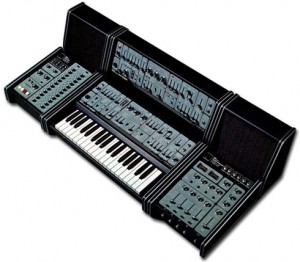
The System 100 is a great and classic analog synth! It’s a beautiful semi-modular monophonic synth consisting of 5 module components: the Synthesizer 101, Expander 102, Mixer 103, Sequencer 104, and Monitor Speakers 109. The Synthesizer 101 section is the heart of the system, from which you could add-on any of the other modules of your choice. Different combinations of these components can be used to create systems of varying potential.
The Synthesizer 101 section is a fully self-contained analog mono-synth. It features a 37-note keyboard (with no performance controls, velocity or aftertouch), and lots of sliders to tweak. Its design is similar to the SH-series analog synths. Controls for the VCO, LFO, VCF lowpass/highpass filters, VCA with ADSR, Noise, and Portamento/Glide effects are all within hands reach. There’s also a handy A-440Hz tuning oscillator, like on the Minimoog.
Hardware:
Roland System 100 Model 101
Empress Effects Vintage Modified Superdelay
Software:
Valhalla Room
Play Hatsune Miku Songs Live! With The Yamaha Vocaloid Keyboard
Play Hatsune Miku Songs Live! With The Yamaha Vocaloid Keyboard
The keyboard is made possible by the relative simplicity of Japanese phonology, with only fifty or so possible syllables in the language altogether. Syllables are selected by simultaneously pressing a Roman alphabet key with a D-pad-shape modifier for one of the five Japanese vowels — so, for example the “K” key with an “A” directional press would result in a “KA” consonant. This is all done with the left hand, with the right hand controlling each syllable’s pitch via a standard keyboard layout, and there’s an LED display to confirm character input. The interface seems simple and logical for Japanese speakers, though it will take some practice to get right — Yamaha says that several players so far have been able to play nursery rhymes after around three hours with the device.
DigInfo TV – http://diginfo.tv
17/3/2012 interaction 2012
Yamaha
VOCALOID Keyboard
The keyboard is still in development with no solid plans for a commercial release, and the prototype still looks pretty rough from a design standpoint. The company says it’s more likely that it would provide the sound chip inside for other companies to use in their own hardware. However, if a product ever sees the light of day it could well be the next step along the way to Vocaloid domination of J-pop.
MusikMesse: Clavia unveils the new Nord Electro 4D SW 61 keyboard
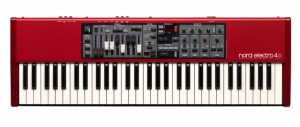
This week at Musikmesse 2012, Clavia DMI AB will be unveiling its new Nord Electro 4D SW 61. This announcement comes just in time for the 10th anniversary of the very first Electro keyboard.
Lightweight and full of improvements, the Nord Electro 4D SW 61 has a 61-key semi-weighted waterfall key bed, plus the same sturdy, drawbars found on the Nord C2D for full hands-on control. The keyboard also offers support for both of the company’s expanding Sound Libraries.
As far as sounds go, the Nord Electro 4D delivers a number of improvements: The Organ section features a new tone wheel engine derived from the flagship Nord C2D organ. Click-modeling has been improved and there is a new Rotary Speaker simulation with a new Drive. In addition, the Nord Electro 4D supports Long Release suitable for legato playing and selectable String Resonance. Handling programs is said to be easy with four Program Banks and four Live Locations. The Effect section now includes a flexible new Delay Effect with tap-tempo, rate, amount, and a stereo Ping-Pong mode. Lastly, the USB port on the Nord Electro 4D SW 61 doubles as an USB-MIDI interface.
Changes in the Nord Electro 4D SW 61:
- The Organ section features a new tone wheel engine derived from the flagship Nord C2D organ.
- The Click-modeling has been improved and there is a new Rotary Speaker simulation with a new Drive.
- The Nord Electro 4D supports Long Release suitable for legato playing and selectable String Resonance. According to the manufacturer, handling programs is easy with four Program Banks and four Live Locations.
- The Effect section now includes a flexible new Delay Effect with tap-tempo, rate, amount, and a stereo Ping-Pong mode.
- The USB port doubles as an USB-MIDI interface.
The Nord Electro 4D SW 61 will make its official debut at Musikmesse in Frankfurt, Germany this week, March 21 to 24, 2012 at the Nord Booth (B90, Hall 5.1). Learn more at nordkeyboards.com.
Keith McmIllen 12 Step Foot Control Keyboard
A single octave MIDI controller device designed to work on the loor and be played with your feet. Plenty of programmability makes it quite a versatile unit.
User quote: “The 12 Step is a great way to send note data to my DAW without taking the hands off the main controller. The biggest and most pleasant part is how accurate the velocity sensitivity feels. You can get some really nuanced performances out of this thing, more than I ever expected from a foot controller”
The Miselu “neiro” – new portable, net-enabled social music device
The Miselu “neiro” is a portable, net-enabled social music device with a musical keyboard and a wide multi-touch display, and a variety of musical apps and cloud services.
This mobile companion invites users to perform, create, learn, discover and share — from anyplace they go. Social is integral to the Miselu “neiro” and permeates through all applications. The open platform environment will also enable developers and users to build their own custom apps and solutions.

Yamaha is providing the upcoming “neiro” with the Yamaha AudioEngine (TM) Series Sound Chip NSX-1. This powerful synthesizer engine delivers a quality that almost matches the sound of real musical instruments. The DSP chip offers a larger variety of sound effects such as reverb, chorus and EQs that create a rich sound experience.
More info at miselu.com
Music: ”Ken Ishii presents Metropolitan Harmonic Formulas – After The Rainstorm (feat. Jazztronik) (Yogurt & Koyas Remix)” from Sublime Records
Rainboard: Rebang
This video is an original composition and performance (David Gerhard) using the Rainboard. The Rainboard is a DIY dynamic isomorphic keyboard. It can interface the Musix iOS app in order to change layouts and adjust settings. As well, it can be played on its own after a layout is set. More details can be found at http://rainboard.shiverware.com or sign up for the Rainboard newsletter: http://eepurl.com/g3G0r
Yamaha PSS-9 – Free Samples
Yamaha PSS-9 – http://www.vstplanet.com/News/2012/Yamaha_PSS-9_Drum_Kit
Developer:hardballsrecords.com
Background information:
The keyboard has an audio out socket built in so no mods were needed to play it through effects boxes. With a keyboard like this, it’s all about what you can do with the sounds once they are outside of the keyboard. As an experiment, I’ve multitracked an entire composition with this and it actually sounded reasonable. It has PCM drum samples which are pretty good with the right effects applied, and the string sounds can take on quite an analogue nature if external chorus and delay are used.
The most realistic sounds are probably the brass and woodwind sounds – which is what FM synthesis was known for. I personally see each of the programs on the keyboard as a different starting waveform to be altered by external effects.
For such a small keyboard, having eight notes of polyphony across a 32 note keyboard seems a lot. The split voices are good for jamming. This is a great little keyboard for self indulgent jamming wherever the mood might take. It can be run off 6 AA batteries and has it’s own built in speaker which isn’t that loud, but loud enough
Comments About the Sounds:
Basic 2-op FM sounds, about 40 basic ‘single’ sounds then doubled ‘ensable sounds’ to create chorus plus preset split voices. Ensamble and Split voices are based on preset combinations of the first 40 single sounds
DATAMASKIN

