
BK-5 Backing Keyboard Overview
http://www.rolandconnect.com/product.php?p=bk-5
One keyboard, one keyboardist…. With the debut of the BK-5, Roland proudly sets another milestone in the history of auto-accompaniment instruments. The BK-5 features high-quality, fresh sounds combined with an easy user interface and advanced features. It’s the perfect partner for the “one-man band” as well as music hobbyists and amateurs.
- Self-contained, do-everything keyboard with auto-accompaniment engine and built-in sound system
- Wide selection of sounds, Music Assistants, and Rhythms that cover a wide landscape of musical genres (including East-Europe, Latin-America, Asia, and more)
- Friendly graphical user interface
- Onboard effects, including reverb, chorus, EQ, multi-band compressor, and dozens of multi-effects
- Music rhythm compatibility with Roland BK-7m/E-series/ G-series/VA-series instruments
- Compatible with backing formats (SMF, MP3, WAV, and Rhythm) directly from USB memory; instant audio recording onto USB memory
- Automatic chord detection for SMF files
- Video output to share SMF/MP3 Lyrics with friends or the audience on an external screen
NAMM: Taking a closer look at AKAI Max 49, Nord Drum and Casio WX-P1
The Akai Max 49 is unique in the way it combines traditional keyboard controller functions with MPC pads, control voltage support and LED faders.
The Nord Drum is not sample-based, but uses a virtual analog synth engine that’s designed specifically from drum synthesis.
A lot of buzz around the WX-P1 – the first Casio synth release for 20 years.
Akai @ NAMM 2012 – MAX 49
No clue why this video is upside down, but at least you get some good views of AKA’s MAX 49
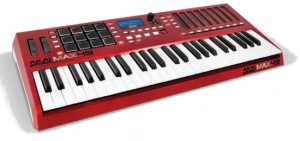
The new Akai MAX 49 Keyboard Controller may look like a typical controller keyboard (albeit well equipped), but it has a number of features that set it apart as one of the most versatile controllers available. Aside from the familiar trigger pads featured on the MPK range of controllers, and the same semi-weighted keyboard, the MAX 49 has features which make it capable of controlling just about synthesiser, past or present.
The Akai MAX 49 is similar in appearance to the MPK range of keyboards, though this model is finished in red. To the left of the unit, 12 velocity sensitive, and backlit trigger pads provide an intuitive way of programming percussion parts, or triggering live samples. These features the swing and note repeat feature made famous on the MPC range of samplers. To the right, 8 touch faders add additional control over the synthesiser or software package currently being used. In terms of controlling synthesisers, the Akai MAX 49 is better equipped than any other controller available. Aside from the more familiar connections, such as a USB socket for connection to a host computer, an a MIDI socket for connecting to other keyboards, sound modules or MIDI equipment, the MAX 49 has a CV & Gate Output, making it capable of controlling vintage (or modern) analogue synthesisers. With the recent increase in popularity of genuine analogue synthesisers, this feature may make it the first choice of controller for those looking to ‘go analogue’ in a live setting.
The Akai MAX 49 ‘s CV connectivity goes hand-in-hand with another of its features: an on-board step sequencer. This allows patterns to be created on the unit itself and sent to whichever synthesiser is being controlled. An arpeggiator also features. For those who are more rooted in the modern studio, the MAX 49 comes complete with a software package called AkaiConnect. This neat utility automatically maps the keyboards controls to VST plug-ins. To further increase compatibility with software packages, the device can operate in Mackie Control and HUI modes.
The Akai MAX 49 is a great controller in its own right, but the addition the step sequencer, arpeggiator and CV and gate outputs provide a means of adding additional features to an analogue synthesiser, as well as providing a central device for controlling both modern and vintage synthesisers. Is this the beginning of an analogue renaissance?
New 3 oscillator synth from StudioLogic – Sledge
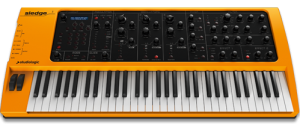
Studiologic, mainly known for their controller keyboards previously, have released their first synthesizer, the Sledge. The Sledge is a 3 oscillator virtual analog synth that includes not only the standard analog waveforms, but a full set of wavetables from the PPG Wave. Also includes a Waldorf-modelled multimode filter, selectable white and pink noise, hard sync, an arpeggiator, fast envelopes, and a basic selection of effects. For many synthesizer enthusiasts, it is the particular interaction of the sound engine and user interface that makes a great instrument. A quick look at Sledge shows you the generous set of controls available to interact directly with the sound engine. When you touch the knobs and switches of the front panel, you will instantly be aware of the meticulous attention to detail our engineers have refined, during many decades building the best electronic keyboards.
You will experience the logical set-up of the synthesizer modules, mirroring the signal flow of a classic analogue synthesizer. But what really distinguishes any synthesizer is its sound. Fortunately, our friends at Waldorf Music have happily shared their experience and know-how on this crucial part of the Sledge Synthesizer.
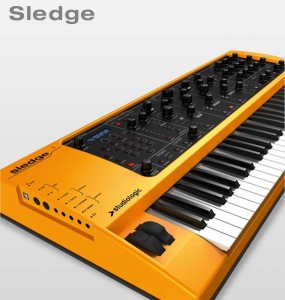
Specifications:
• 32 Pots
• 3 chicken head rotary switches (7 positions)
• 1 rotary encoder with push function
• 2 x 16 digits backlit LCD
• High Quality Pitch and Mod Wheel
• up to 256 Sounds
• fast and efficient sound selection via numeric keypad
• 2 fast LFOs per voice, each with adjustable Speed and Depth
• 1 extra modulation routing for Mod Wheel, with adjustable Speed and Depth
– Shape: Sawtooth, Rectangular, Triangle, Sine, Sample & Hold, Ramp
– Destination: Osc 1, Osc2, Ocs3, PWM / Wave / FM, Volume, Filter Cutoff
• Monophonic mode with single or multiple trigger
• 3 Oscillators per voice
– Range from 64′ to 1′ each
– Shapes: Sawtooth, Square, Triangle, Sine, Pulse (with Pulse Width Modulation)
– Oscillator 1 with 66 Original PPG Wavetables
• Frequency Modulation of sine and triangle
• Oscillator Hardsync (Osc 2 to Osc 3)
• Noise Generator with selectable white and pink noise
• Mixer with Volume and On/Off switch for each Oscillator and Noise
• 1 Multi Mode Filter per voice
– 24 / 12dB
– Lowpass
– Highpass
– Bandpass
– Resonance up to Self-Oscillation and beyond
– Adjustable Keytrack and Drive
• 2 fast Envelopes per voice (filter / amplifier)
• Powerful Arpeggiator
– Latch mode
– syncable to MIDI Clock
– Direction Up, Down, Alternate
– Range up to 10 Octaves
• 2 simultaneuous Effects
– Effect 1: Chorus / Phaser / Flanger
– Effect 2: Reverb / Delay
• sturdy, lightweight enclosure (less than 10 KG)
• high quality, 5 octaves Fatar TP 9 keyboard
• Master Volume Control • Power Switch
• Stereo line output
• Headphone output
• Expression pedal input
• MIDI in and out
• USB connector for MIDI in / out
– uses standard USB MIDI driver provided by host computer OS
– Windows ME minimum, Windows XP or newer recommended
– Mac OS X 10.2 minimum, Mac OS X 10.3 or newer recommended
• Built in power supply
Nektar Technology Panorama P4 Keyboard Controller Delivers Hands-On Reason Control
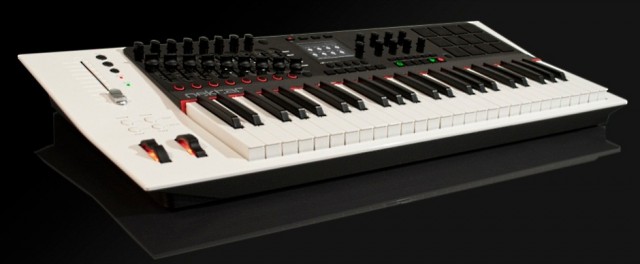
This week at Winter NAMM 2012, Nektar Technology will unveil the new keyboard controller in the most complete version we’ve seen yet; the company even has an anticipated release date of March, 2012.
The Panorama P4 offers the discerning Reason user tactile control and a number of intuitive features that make working with Reason a piece of cake. According to the manufacturer, the established workstation keyboard concepts allow for complete “on device” selecting and editing of sound with direct visual feedback. The keyboard controller is also said to be comfortable and very easy to operate in the studio or during live performances. The front panel is angled, raising important controls so that they are easy to see and reach, as well as providing the ideal viewing angle for reading the centered high-resolution display.
The synth keybed itself has 49 notes, plus a choice of 5 velocity curves (each optimized dynamically but with different response emphasis), monophonic Aftertouch, and a zone function that enables you to program four zones that can be switched on and off during performance.
As for controls, the Panorama P4 has a ton of them — 90 control elements assignable to a MIDI-message. Buttons and pads can be assigned to ASCII messages, allowing for sending shortcut commands to Reason, while 20 preset locations store the assignments of controls for later recall. A preset is linked to a Pad Map, Keyboard Map, and F-Keys Map, so that you can save and load these components independently of the individual presets.
For percussive performances, 12 Velocity- and pressure-sensitive pads are included, which can be programmed using the “Learn Note” function and then saved to any of the 20 Pad Map locations. The Velocity Spread feature spreads 1 note across all 12 pads, each with its own fixed Velocity, which allows for nuanced dynamics. Meanwhile, the Scale-Function assigns each pad to pitches within a defined scale for percussive performances with any sort of keyboard sound, while freely changing intervals or transposing the whole set.
Why you need it – It’s the controller’s dedicated Reason control, of course. The Panorama P4 is said to offer completely transparent and with unlimited access to all areas. Every single Reason device is mapped with parameters and their values clearly visible in the display. Switching between Mixer, Instrument, and Transport mode reconfigures the entire control surface by just pressing one button. Overall, the Panorama P4 was designed to give Reason the feel of hardware.
Panorama P4 Specifications:
- 49-Note Velocity-sensitive keyboard
- Aftertouch
- Weighted synth-style keybed
- Pitch bend and Modulation wheels
- 4 Keyboard function buttons
- 3.5″ High-resolution TFT display
- 16 Encoders
- 9 x 45 mm faders
- 100 mm ALPS motorized fader
- 10 Assignable LED buttons
- 28 Additional assignable buttons
- 12 Pads with Velocity / pressure sensitivity
- 4 LED mode buttons
- 5 Menu buttons under display
- Pads and motorized fader select buttons
- View and mute buttons
- Sustain pedal jack (pedal not included)
- Expression pedal jack (pedal not included)
- USB port for communication with computer
- USB Micro B connector for extra and external power
- Compatible with Mac OS X and Windows XP, Vista, and 7
Nektar Technology plans on shipping the Panorama P4 in March, 2012 for $599.99 (MSRP) or $499.99 (estimated street price). Visit nektartech.com.
Via GW
Novation Impulse – Full review
Shorn’s back with a look at the new super controller from Novation. With Automap 4.2 integration and semi-weighted keys
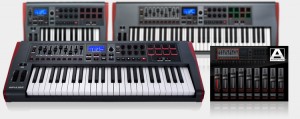
Impulse is a range of professional USB/MIDI controllers. They each have a precision keyboard and a full control surface powered by a brand new version of Novation’s Automap control software – Automap 4 (which makes getting hands-on with your DAW/plug-ins fast and simple). Impulse also has 8 back-lit drum pads which can warp arpeggios, roll beats and launch Live clips.
NAMM: A whole range of new stuff from Clavia/Nord has been revealed – check them all out here
So NAMM has started and NORD brings us lots of goodies – including the previously teased Nord Drum
Nord Piano 2 – 88 key hammer action stage keyboard with Nord Sample Library support


The Nord Piano 2 HA88 lets you easily play, split and layer stunning Grand, Upright and Electric Pianos from the Nord Piano Library with sounds from the versatile Nord Sample Library. All this in a streamlined portable package with 88 Hammer Action Weighted keys.
The Nord Piano 2 comes with a wide range of quality acoustic and electro-mechanical instruments from the Nord Piano Library, all with their own unique character. The included Nord Triple Pedal features a dynamic sustain pedal that can also recreate the mechanical “stomp” and “sizzle” noises that occur when the lifting or releasing the dampener in an Acoustic Grand or Upright Piano. The Advanced String Resonance feature simulates the subtle phenomenon that occurs when piano strings cause other un-dampened strings to resonate, further adding to an amazing level of realism.
The Nord Sample Library offers more than 1000 high quality sample-instruments ranging from Strings, Brass, Synths and Basses to the legendary vintage sounds of the Mellotron and Chamberlin.
Both the Nord Piano and Nord Sample libraries are continuously updated and are available as free downloads for all Nord owners.
All of the sounds in the Nord Piano 2 HA88 are replaceable, making it an instrument that is built to evolve with you. It’s even possible to create your own sample instruments using the Nord Sample Editor.
We think technology should be transparent to the user, which is why the Nord Piano 2 has dedicated buttons and knobs for all functions the performing musician needs instead of confusing menus.
We’ve made it amazingly simple to layer and split sounds, and there’s a volume pedal input for sneaking in those strings while you keep playing.
The Nord Piano 2 also sports an extensive effects section, covering everything from Phaser, Wah-wah, Flanger, Chorus and Delay effects to a 3-band Equalizer, Amp Simulations, Compressor and Reverb
The Nord Piano 2 will be shown at the AM&S Nord Booth #6464 at NAMM Show 2012″
Nord C2D Combo Organ – Dual manual organ with drawbars


Complete with 2 sets of physical drawbars per manual the Nord C2D is the ultimate portable organ for musicians that play with their drawbars as well as the keys. The new left-hand preset sections offer an unsurpassed level of hands-on control and the upper manual and panel has been tilted for better ergonomics. A LCD-display has been added for easier access to programs and settings.
The Nord C2D features a redesigned simulation of the characteristic mechanical key clicks that are an essential component of the classic tone-wheel experience. Furthermore, the redesigned percussion model offers increased control over the percussion levels when playing near-legato.
The Nord C2D also includes a redesigned Rotary Speaker simulation of a vintage 122 unit.
Naturally, the Nord C2D also includes both the Vox and Farfisa transistor organ simulations and the sampled Baroque Pipe Organ from the acclaimed Nord C2 Combo Organ.
The Nord C2D will be shown at the AM&S Nord Booth #6464 at NAMM Show 2012″
Clavia releases Nord Drum Virtual Analog Drum Synthesizer


The Nord Drum is a revolutionary 4-channel drum synthesizer that is the result of a creative collaboration between Clavia and drum/music technology enthusiasts Bruniusson & Berg. With an amazingly vast sonic palette and an astounding level of playability it is guaranteed to change your perception of what’s possible with synthetic, sample-free percussion.
The Nord Drum lets you create classic retro-futuristic percussion with analog waveforms or use the harmonically complex waveforms together with different colors of noise for results that both sound and respond stunningly organic. The Nord Drum is designed with the performing musician in mind and its extreme dynamic range and super-fast triggering add to the feeling of playing a real instrument.
4 high-sensitivity inputs and MIDI lets you play the Nord Drum with a wide range of Electronic Drum Pads, Acoustic Drum Triggers and MIDI-pads/Sequencers for easy integration into any existing drum-kit or the starting point for something completely new…
The Nord Drum will be shown at the AM&S Nord Booth #6464 at NAMM Show 2012″
Ultraportable – Mobile Keys Overview | Line 6
Meet the world’s first tri-platform keyboards—Mobile Keys™ 25 and 49 by Line 6. Whether you want to create with an iOS device, Mac or PC—or move between all three—you can count on Mobile Keys controllers to deliver an exceptional playing experience. Mobile Keys 25 and 49 feature full-sized, velocity-sensitive keys, a solid feel and a refined look, making them perfect for any desk, stage and studio.

Line 6 co-founder and digital audio innovator Marcus Ryle, told us: “With Mobile Keys 25 and 49, not only do you have two extremely portable options for playing and recording on the go with your iPhone and iPad music apps, but you can move seamlessly between your iOS music apps and your Mac or PC, as well.”
The keyboards require no additional hardware to function–they plug right into an iOS device’s dock connector. They’re bus powered, so they need no external power supply or batteries. The two keyboards are equipped with pitch bend and modulation wheels for additional sonic control, and they also have a pair of 1/4-inch TRS jacks for plugging in sustain and expression pedals. Both keyboards also have USB jacks and are USB class-compliant, allowing seamless connection with Mac and Windows desktop and laptop computers.
Pricing and Availability:
Suggested retail price for Mobile Keys 25 is £99.99, and Mobile Keys 49 is £129.99, and both are shipping early 2012.
More information:
RC CIRCUIT BENT POKAR SYNTHESISER MICRO LFO DRONE KEYBOARD
A new circuit bending synth, enjoy:
FROM SMALL MACHINES COME A MIGHTY SOUND
FITTED WITH 1/4″ JACK OUTPUT
EXTREME PITCH CONTROL
SQUAREWAVE LFO
Easy MIDI turns your Mac keyboard, trackpad and mouse into a powerful MIDI keyboard controller
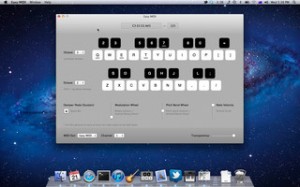
After a year flodded with specific apps targeting the iOS side of the coin – it is nice to see someone taking a stab at improving or updating the controller side of thins for OSX users. Nikolozi Meladze has released Easy MIDI, an app that turns your Mac keyboard, trackpad and mouse into a powerful MIDI keyboard controller. It sends MIDI notes and control messages to any soft synth or DAW such as GarageBand, Logic Pro, Ableton Live, Cubase and Digital Performer. This is very useful when you want to jot down some musical ideas quickly and easily whilst travelling, sitting in a coffee shop or even on your couch at home.
Easy MIDI even allows you to control iPad apps that support CoreMIDI or hardware synth via MIDI interface.
Easy MIDI features
- Send MIDI notes and control messages to any DAW or MIDI driver.
- Notes can be triggered using alphanumeric keys.
- Over 3 octaves under your fingertips.
- Easily change keyboard octave with up/down arrows.
- Visual feedback eliminates the need to look down on your Mac keyboard.
- Sustain on/off can be triggered with a space bar.
- Vertical scroll changes note velocity.
- Pitch bender can be controlled with a pinch zoom gesture or a vertical mouse drag.
- Modulation can be controlled with a rotation gesture or a vertical mouse move.
- Adjustable Easy MIDI window transparency.
Easy MIDI for Mac is available to purchase for $29.99 USD.
DATAMASKIN

