
MacBeth – test stylus keyboard
More from MacBeth:
Here is a very short video fearuring a small two octave stylus control keyboard! The outputs are Glide 1 (1v/octave), Glide 2 (1V/Octave), Standard 1VOctave, Negative (reverse going) 1V/Octave and finaqly +5V gate. The keyboard is driving the soon to be released MacBeth micromac analogue synthesizer. It’s a handy accessory for any modular synthesizer user! The copper plate that I’m using is highly reflective!
Jordan Rudess’ singing keyboard
Here’s Jordan’s comment about the video:
“After three days of experimentation, I was finally able to make my keyboard sing!”
Fsynthz releases ProgAte free MIDI router VST
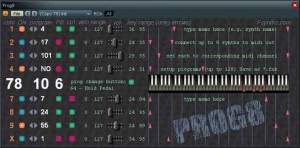
ProgAte is a MIDI processor/router, which allows you to control up to 8 synths with one MIDI keyboard.
“You send midi program changes, together with all the rest midi events, to ProgAte. ProgAte splits and filters the stream, remaps the ProgChange messages – and outputs the processed midi stream, one channel per synth (up to 8 for one instance of ProgAte).”
Pricing and Availability:
Free download
More information:
LOGAN STRING MELODY String Machine 1974
The Logan String Melody is one of the earliest string keyboards (string machine). It was produced in in Italy. In Germany, some units were produced under the “Hohner International” label – like the one in the video. The String Melody was inspired by the ARP / Solina String-Ensemble. It has strings in 3 footages (CELLO, VIOLA, VIOLIN), which are mixable via volume faders. ATTACK and SUSTAIN of the strings is tweakable. Each half of the keyboard has these features. Two monophonic bass presets can be added to the left half of the keyboard.
“The String Melody is fully polyphonic and has a decent analog string tone. 3 footages can achieve bombastic string pads. I would wish it had some kind of vibrato…
The one you see in the video is a String Melody I. Some years later, the String Melody II was produced, which has some preset sounds in addition. I’m told that the mark II sounds different.”
ARP Omni-2 – the classic Joy Division keyboard
“When I was a teenager in the mid-1980s, like many of my teenager friends I was very fascinated by Joy Division, in particular by their album “Closer”. I remember that in those days I used to put Closer on the turntable, turn off the lights in my room, and fall asleep to the music. The music from Closer was very beautiful and hypnotic, and left a big impression on me. In particular I loved the synth strings used in that album. It was the ARP Omni-2, also used in other songs by the band. A great album, a great performance by the band, a masterful production by Martin Hannett, and a big influence for my music since those days..”
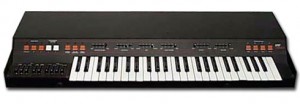
The Omni is an analog synth with preset Orchestral String sounds. It has polyphonic Violin and Viola waveforms as well as monophonic Bass and Cello waveforms. It is split into 3 sections: Strings, Synthesizer, and Bass synth – all simultaneously available. It has traditional and simple VCA, VCF, and LFO controls for contouring your sounds as well as a nice chorus that really thickens up the string sound. It has no program memory.
ARP later released the Omni Mk 2. It was basically the same machine as its predecessor, except for a few minor enhancements and a cosmetic Orange & Black color-scheme upgrade. And it did have a much more advanced triggering system for the VCF and VCA for more expressive results.
The Trinity – A Korg Trinity Demo
THE TRINITY
Korg Trinity Pro-X 88 Keys Music/Video Demo by Ares Kalogeropoulos. Korg Trinity is a commercially successful synthesizer music workstation released by Korg in 1995. It was also the first workstation to offer modular expansion for not only sounds, but also studio-grade feature such as SCSI, ADAT, various sound engine processors, audio recording capability, and more. It was considered one of the most comprehensive music workstations, in term of features, at the time. It is affectionately referred to as the silver beast by many of its owners.
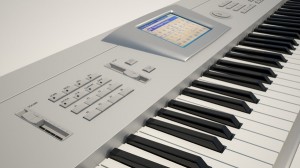
The Trinity workstation features a massive set of effects (100 Insert effects & 14 Master effects), a large graphic touchscreen (320×240) and a complete 16-track sequencer, as well as double sound generation system:
- ACCESS (Advanced Control Combined Synthesis System). A PCM-based sound synthesis with 16 bit – 48 kHz PCM playback on a 24Mbyte ROM. However, since 2:1 data compression has been used, these are equivalent to 48Mbyte of samples held in conventional RAM. The PCM data includes well over 1,000 individual samples comprising 374 multisamples.
- MOSS (Multi-Oscilator Synthesis System). The sound generation system of the Korg Prophecy and Z1 with: analogue modelling, VPM (Korg’s version of FM synthesis) and physical modelling (brass, reed, plucked string, bowed string, organ, electric piano modelling)
Along with the Korg Prophecy, the Korg Trinity synthesizer was a descendant of the original OASYS synthesizer, an acronym for Open Architecture Synthesis System, which was a mega-synth prototype that the company previewed in 1994 but never marketed. The foundation of the system was an open concept DSP system where the OS could load various unrelated models of different synthesis and physical modelling sound generators. It was a multiple digital signal processor (DSP) architecture, with the entire system clocking in at over 900 million instructions per second. Korg later adapted some of the core technologies and released three initial products: Trinity, Prophecy and Wavedrum.
All Sounds/patches made with Korg Trinity.
Multitrack Recording on a DAW.
Software Reverb and Delay added.
DSI Poly Evolver Keyboard Demo
Background information:
Only using a single PEK voice. Oscillators turned on/off for variation parts, using Output Pan for stereo affects. Sequenced/recorded live, from the PEK. Tiny amount of compressions and EQ (bass rolloff). No external effects – delay is from the PEK. All drums from Jomox 888 / 999.

The Poly Evolver Keyboard is DSI’s flagship synthesizer, a nearly-knob-per-function knockout that sounds unlike any other synth out there—except another Evolver, of course! Don’t like a high-end hardware synth that requires wading through endless menus to program? Not an issue with the Poly Evolver’s 78 knobs—60 of them potentiometers—and 58 buttons, incuding a keypad for direct access of programs.
An analog/digital hybrid, the four-voice Poly Evolver features four oscillators per voice—two analog and two digital—in a unique stereo voice architecture with a real Curtis analog low-pass filter per channel. The digital processing does not simply add effects at the end of the signal chain, but is tightly integrated with the analog electronics for tuned feedback, distortion, bit crushing, and synced delays. It can also process external audio and has separate stereo outputs for each voice.
The Poly Evolver is capable of producing sounds ranging from classic analog to more brash and edgy digital sounds. It is also multitimbral, with the ability to play up to four parts simultaneously through separate stereo outputs. And it can process external audio.
The Poly Evolver is not a generic “slab” workstation. If you’re looking for realistic pianos and strings, keep looking. But if you want a truly unique, inspirational, real instrument, look no further.
- Each voice is a complete Evolver with four oscillators per voice, two analog and two digital.
- True stereo signal path with separate Curtis analog low-pass filters in each channel for each voice. Each voice has its own independent effects (feedback, delay, distortion, high-pass filter, etc.).
- Highly accessible sound control for easy, intuitive operation: 78 knobs and 58 switches.
- Clocked, pulsing blue LEDs and hardwood end-panels.
- Each voice has an independent 16 x 4 step sequencer. Everything (sequencer, LFOs, and delay) syncs perfectly to MIDI.
- In Program mode, all four voices play the same sound. In Combo mode, voices can be allocated however desired: stack all 4 for a huge unison sound, split or layer the keyboard in any configuration, and/or play one or all sequences at the same time. Each voice can respond to a different MIDI channel.
- Each voice has its own stereo output in addition to the mix and headphones outputs.
- Stereo audio input that can be routed to any or all of the voices, enabling parallel audio processing of external stereo or mono signals. The output of one voice can be routed to the input of another for interesting double-processing effects.
Music Computing releases ControlBLADE Gen2
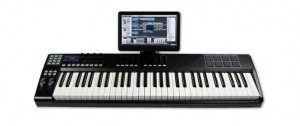
Music Computing has announced its new ControlBLADE Gen2 line of all-in-one music keyboard production stations. Priced from $1,899, the company says that the line represents a new standard in value and performance.
Victor Wong, CEO, Music Computing, told us,, “At Music Computing, we strive to bring the latest technologies to our users. The release of the new ControlBLADE Gen2 models reinforces that fact and our commitment to being the very best at what we do.”
Here’s the details in Music Computing’s own words…
ControlBLADEs are all-in-one music production stations complete with piano keys, drum trigger pads, knobs, sliders, thousands of sound presets and software for live and studio use. They allow users to compose, record, mix, and master songs that are ready for radio or direct Internet distribution.
The new Gen2 ControlBLADEs are powered by high-performance computer cores utilizing Intel® Core i-series® third-generation (Ivy Bridge) processors that are perfect for today’s demanding musicians and the virtual instruments and software application they use. Options include i5 and i7 quad core versions. The Windows 7 (64-bit) operating system is pre-configured for music production and can run virtually any software application or plug-in. Capable of running over 500 plug-ins at once, sequencing thousands of tracks simultaneously, and storing millions of sound presets, the ControlBLADE packs a serious punch for the money.
ControlBLADEs are also available for Mac OS X, which are powered by the latest Mac® mini from Apple®. Both i5 and i7 processor options are also available as well as a variety of RAM, hard drive, SSD drive, and other upgrades.
The ControlBLADE is available as 25-Key and 61-Key models. About the same size as a typical keyboard controller and weighing only 22-lbs (61-key) / 13-lbs (25-key)…FULLY LOADED, the ControlBLADE brings true portability to the keyboard production station world.
New with the Gen2 models is the option for the ProTouch™ piano keybed. The new ProTouch keybed brings higher levels of playability and better feel to the ControlBLADE line via high quality semi-weighted keys with after-touch. The optional upgrade is priced at: $199.
ControlBLADEs all come with built-in Wi-Fi standard. This mean the user can be online anywhere there is a hot spot. Send and retrieve files, log into remote servers, collaborate with others, or download new software and sounds directly into the ControlBLADE. Users now have the freedom to create virtually anywhere they like.
Upgrades for Gen1 models to the new Gen2 versions are available.
Pricing and Availability:
See website.
More information:
Roland Jupiter-50 review
Check our exclusive video to see the first, full, in-depth review of the new Roland Jupiter-50. Dan ‘JD73’ Goldman shows off the Jupiter-50’s sounds and digs deep into the synth engine, before revealing his final verdict on the performance keyboard.
Rolands pitch:
With its unprecedented fusion of synthesis and acoustic instruments, the new-generation Roland JUPITER has changed the way we play, react to, and feel a keyboard. By combining the supreme expression of the JUPITER-80 with the travel friendliness of the JUNO series, the new JUPITER-50 brings SuperNATURAL sound and pro performance to every stage and studio.
- – Stunning SuperNATURAL sounds powered by our most advanced sound engine
- – Travel-friendly design; 76-note weighted keyboard
- – Fast, friendly user interface with intuitive color-coded buttons and sliders
- – Registration function for saving and selecting sounds instantly
- – Pro-quality multi-effects and reverb
- – Expressive performance controllers, including D-BEAM, pitch/mod lever, and control input jacks
- – USB Song Player/Recorder
- – USB audio/MIDI functionality; bundled with SONAR LE and JUPITER-50 Control Surface plug-in for SONAR
Closer look at the Akai MAX49 keyboard controller
Here are three brand new videos featuring the new controller from Akai, more info below:
MAX49 from Akai Professional places revolutionary MIDI and CV control at your fingertips. With an intuitive layout and included AkaiConnect automatic-mapping software, MAX49 offers an instant, fully immersive experience with your favorite music software and virtually all VST plugins. From its 49 semi-weighted keys and 12 real MPC pads, to its groundbreaking LED touch faders and vintage CV & Gate outputs, MAX49 combines cutting-edge Akai Pro technology with classic capability to give you an unprecedented music-making experience.
CUTTING-EDGE
MAX49 is one of the most unique controllers ever engineered. Right away you’ll notice one of its most distinguishing features: four banks of eight backlit LED touch faders, allowing you to assign up to 32 control parameters. You can use MAX49’s LED touch faders just like analog faders by simply dragging your finger along their touch strips, or you can perform instant leaps in any MIDI value from zero to maxed out and everything in between—an unprecedented, unmatched controller capability.
CLASSIC
MAX49 is also equipped with four banks of 12 backlit MPC pads, giving you a total of 48 assignable pads, allowing you to integrate legendary Akai Pro production capability into live performances and recording sessions alike. These backlit, velocity sensitive pads come with classic MPC Swing, Note Repeat, Full Level and navigation controls to give you all the tools you need to create music at your highest level.
MAX49 comes ready to command any controller hardware or software from any era: USB MIDI, traditional 5-pin DIN MIDI and even Control Voltage and Gate outputs are onboard, allowing you to control everything from today’s most advanced music software, to analog modular synths from as far back as the 1960s. Mackie Control and HUI protocols are also built in to give you instant compatibility with many industry standard DAWs.
DATAMASKIN

