
CD or Vinyl – why not both

Photo courtesy of Axis Records
June 17th, 2010 – Jeff Mills has released his new album Occurence on a disc that’s a CD on one side, and a vinyl pressing on the other. That means you could theoretically play the vinyl side on a record player. It looks like you’ll need to use a plug to hold the “record” in place though since the hole in the middle is made for a CD player rather than a record player. Still, it’s a great idea and has already created a lot of buzz. It’s a unique product that I’d imagine even casual fans will buy just to have as a curio.
Deep inside the Ohm Studio
Ohm Force has unveiled its first live demo of Ohm Studio, a real-time collaborative music making application in addition to a web based collaboration platform and a music driven online Cohmunity.
Following the announcement of the Ohm Studio – a real-time collaborative DAW/sequencer – Ohm Force is unveiling today the first Ohm Studio live demo, showing some of Ohm Studio’s collaborative features in action. It’s a standalone application for Mac OS X and Windows (in the video the prototype runs on two MacBooks) that will allow musicians from around the world to produce/edit tracks together in real-time.
This video was made at the Ohm Force headquarters (Paris, France) while the Ohm Server is in USA (they use the AWS solution by Amazon). Both laptops were logged into the same Ohm Studio session. Notice that all actions done on one side were automatically synced to the other side.
As announced at the Ohm Studio’s website, Ohm Studio will be a full fledged DAW/sequencer and we’ll be progressively revealing its features at www.ohmstudio.com. This “amateur” live demo is the first of a series, new video content will be released during next weeks/months. Anyone interested on participating in the beta-test can still apply for it at Ohm Studio’s website.
More information: Ohm Force / Ohm Studio
Apple Unleashes iPhone 4 – Music Fans Gain Power, Speed, Clarity
Apple’s iPhone 4 is the biggest upgrade yet for the handset. Highlight features include a front-facing camera, a 960-by-640 “retina display” that shows image and text more crisply, the same A4 processor that powers the iPad, and a 5-megapixel still camera that also shoots high-definition video.
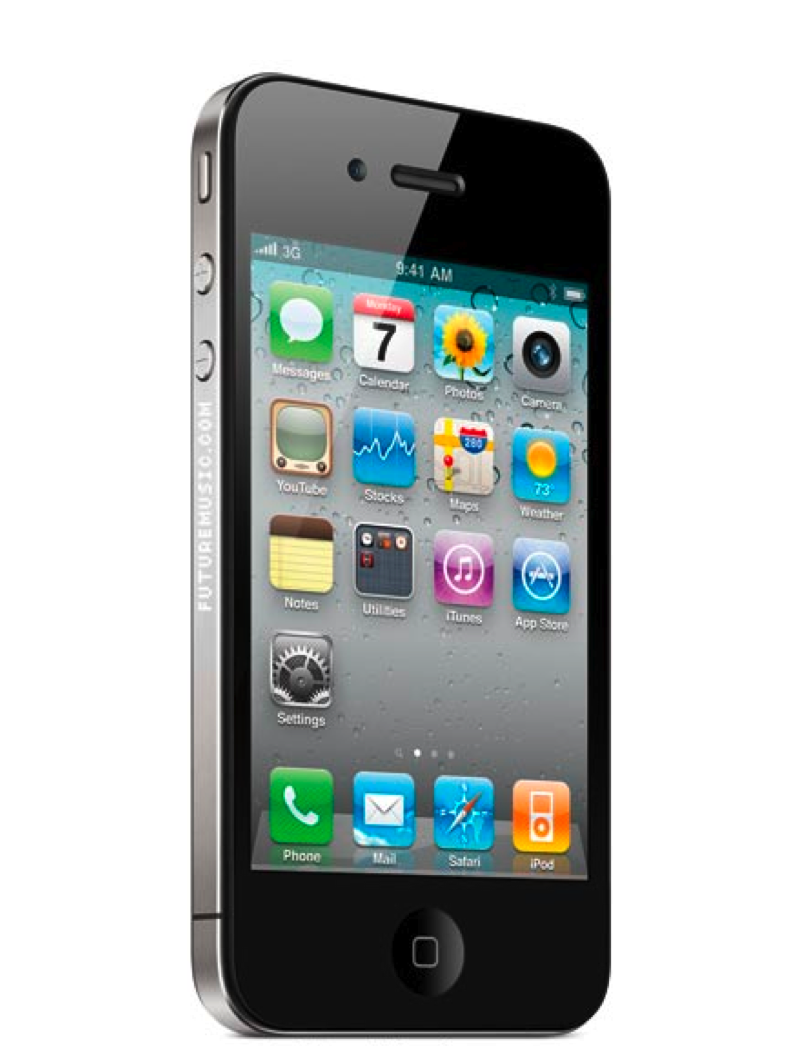
The overall look and feel has changed as well: Both the front and back of the iPhone are composed of a sturdy glass that Apple claims is 13 times harder than plastic. Overall, the case is 24 percent thinner than the current iPhone 3GS.
There are more music apps for the iPhone than for any other mobile music platform. There are drum machines, MPC-style workstations, synth, 24-track recorders, audio editors and more.
Social networking has become an essential tool for musicians.
Apple succeeded where other companies have failed in building the iTunes music store and turning it into the top music store in the world
Is it as good as an HD video camera? No – but it’s still pretty astonishing. And Apple also announced iMovie for the iPhone, which lets you edit HD video
iPhone 4 features the world’s most sophisticated mobile computing platform, iOS 4
How much money will you make on your music?
Well here’s the answer….

Future tech music
This is a pretty nice piece of recap on the progression of next gen musical instruments.
The intersection of music and technology is a wild, fascinating frontier. Ever since the first computer-synthesized sounds were created, people have struggled and succeeded — to varying degrees — to reshape how we think about musical instruments.
Today, thanks to innovators such as Ray Kurzweil and Robert Moog, we have a wider range of digital music machines than the inventors of keyboard instruments could have ever dreamed.
But innovation didn’t stop there. Drum machines, music-making software and even mobile phones now compose melodies, thanks in a large part to the men in this video. One of the creations included in these demos is the LinnStrument
Check out this showcase of futuristic instruments and the philosophies of those who make them, and let us know what you think about the future of musical instruments in the comments.
So what is Master Linn up to?
Roger Linn posted this sneak preview of an amazing new musical instrument prototype – the LinnStrument – that features a multi-touch pressure sensitive control surface:
My particular interest is in a new instrument that while capable of entirely new sounds and playing techniques, is also able to reproduce the sounds, virtuosic performance capabilities and subtleties that we’ve come to know and love from traditional musical instruments, but without all their problems and limitations.
I’ve come up with a prototype of an instrument design that I like.
The prototype consists of a multi-touch, pressure-sensitive, high-resolution USB touch surface from a company called TouchCo (details below), plus a Max/MSP patch written by me and my wife Ingrid, and an OSC/TUIO driver written by a friend and fellow music/art/technology enthusiast named Tim Thompson.
Linn writes:
I came up with this design in 2006 and development has been slow because my small company has limited resources to develop such a complex product. (Any interested investors?)
Also, there aren’t many musicians who see anything wrong with current instruments, so not too many people would buy it anyway. A key expense is in developing a multi-touch, pressure-sensitive, high-resolution, fast-response, low cost touch surface technology.
Then in 2009, a new company called TouchCo introduced a technology for a multi-touch, pressure-sensitive, high-resolution input surface that’s also very low cost, quoting $10 per square foot in high volume. In fact, I’m using one of their technology evaluation units for the input surface in the video above. Unfortunately, Amazon bought them in January 2010 in order to add touchscreen technology to Kindle, then immediately shut them down and took their product off the market.
Alas, until someone else comes up with a similar touch technology or Amazon decides to make the TouchCo technology available, development of our product will be limited to refining our Max/MSP patch. One promising new technology we’ve evaluated is a touchscreen from Stantum (same company as JazzMutant, makers of the Lemur) that senses surface area of your fingers, which is not a bad alternative to sensing pressure because your finger surface area increases as you increase pressure. However, I found that their current resolution wasn’t high enough for what I’m trying to do, plus true pressure sensing is better for musical control.
So given this situation, I decided to call this a research project and publish what I’ve done so far in an effort to get more people interested in and thinking about new musical instruments. Maybe even Jeff Bezos will read this and see that in the grand war between Kindles, iPads and Android tablets, it wouldn’t be such a bad thing to permit some sort of controlled usage of the TouchCo technology.
Note that the demo above is a prototype – see the image below for an idea of what a finished LinnStrument might look like:

Nice filter demo of the Tetra
It’s a very basic demo of my DSI Tetra with its Mac OSX editor. I tried to demonstrate what this little instrument can do. It has got very complex architecture, like Prophet 08. Now you can see some basic procedures with its modulation matrix and LP filter…
Reason on iPad, maybe according to the CEO
According to the latest CM magazine as they spoke to Propellerhead CEO Ernst Nathorst-Boos there might be a possibility they are going to develope iPad version of Reason as “iPad is at least as powerful computer as the ones we started making software for back in 90s. And that’s pretty exicting!”
( iPad -1GHz Apple A4 processor )
So what are they waiting for 

CM also spoke to some iPhone/iPod music app developers and in the nearest future we should expect not only iPad version of bleep!Box but also technoBox ( they have already a prototype ) and iSyn !
Thanks to moonbuz and CM
Vince Clarke & Andy Bell On The New Erasure Album
Vince Clarke and Andy Bell filmed in London during the March 2010 writing sessions for their fourteenth Erasure studio album.
Although I am not sure we need another Erasure album….
Peter Gabriel's tutorial on sampling from 1982
The video has some awesome footage of Peter Grabriel and company recording found sound and manipulating sound from the Farilight. He also discusses the use of non-lyrical human voice in music.
And here is one with maestro Herbie Hancock in action:
Herbie shows off while Quincy Jones looks on. Taken from VHS recording of 1984 documentary “I love Quincy” http://ftvdb.bfi.org.uk/sif…
Enjoy !
DATAMASKIN

