
Monotron vs MS-20
korg monotron (2010) and MS-20 (1979)
This japanese guy compared the output of sound.
Cutoff modulation LFO is used for comparison VCLF.
Must say that the 60 USD Monotron is doing a pretty darn good job at it 
Vermona fires of the summer with thier new synth Mono Lancet

The East Germans known as vermona.com have some new hardware on the horizon. First a synthesizer called the Mono Lancet: 2x VCO (triangle, sawtooth, square / sawtooth, rectangle, noise), 24dB lowpass filter, ADSR, envelope generator (VCF, VCA, VCO), LFO (triangle, square, s/h), MIDI for 449 EURO. Next, the Kick Lancet based on the KICK channel of the DRM1 MKIII Waveshaper (sine -> square), FM, trigger inputs (switch, audio, gate), MIDI for 265 EURO. Doepfer Dark Energy and DSI Mopho you have some new friends.
New patch library for the Arturia MiniMOOG
Kid Nepro has introduced the Arturia Minimoog V Collection, a new patch library for the Arturia Minimoog software synthesizer:
Kid Nepro purchased his first original Minimoog back in the mid 80’s and has been using them ever since. We still have one in our studio which continues to get lots of use when we are looking for that certain sound – that only the Moog can provide. So for us, programming a Minimoog is like riding a bicycle – you never forget how to do it! The collection of sounds that we have programmed for the Arturia V collection is done with expert care from someone who knows the Minimoog very well – so you can be sure that the sounds are well crafted and sound great.
The Minimoog V patch library is available for download for $25.
|
The original Minimoog was released in 1970. By the time it was discontinued in 1981, about 13,000 were produced. One of the true landmark synthesizers produced though the 70’s – it’s compact design, great sound and easy to use interface made it popular with both Rock & Jazz keyboard players ranging from Keith Emerson to Chick Corea. The Minimoog was designed to include the most important parts of a modular synthesizer in a small package, without the need for patch cords. The original Minimoog is monophonic and its three-oscillator design gave it its famous fat sound. The Minimoog Model D adapted some of the circuitry (such as the filter section) from earlier modular instruments, but designed other circuitry (such as the oscillators and contour generators) from scratch. You could not save patches in it’s internal memory – so just one sound at a time could be stored and played. Yeah, that’s the way things were back then! Original Minimoogs did not have midi, but you could get several midi retro kits which could be installed to give you basic midi features. Kenton makes a good own which we have installed on our vintage Minimoog.
Kid Nepro purchased his first original Minimoog back in the mid 80’s and has been using them ever since. We still have one in our studio which continues to get lots of use when we are looking for that certain sound – that only the Moog can provide. So for us, programming a Minimoog is like riding a bicycle – you never forget how to do it! The collection of sounds that we have programmed for the Arturia V collection is done with expert care from someone who knows the Minimoog very well – so you can be sure that the sounds are well crafted and sound great. Our Minimoog V Collection is available as a download via our free e-mail delivery. Just open the file in your Arturia software and your ready to roll! Pick the Mac or PC “patches” format when ordering online at our web site. Please contact us if you need any more info. |

The Trekker synth

Intellijel has announced 5 new modular synth modules, which are expected to be shipping this month.
I guess it will be the love of all Star Trek fans, however I suspect he will get into some legal hassle. Remember that the swedish synthpop band S.P.O.C.K. had the same problems, hence the dots between each letter in their band name
- SPOCK: CMOS Boolean Logic device 4HP
- FLIP FLOP: CMOS JK and D flip-flop 4HP
- BUFF MULT: Buffered Multiple 2HP
- MULT: Passive Multiple 2HP
- QUAD INVERT: Quad CV Inverter / Quad Audio Buffer 2HP
- UNITY MIXER: dual 3:1 / 6:1 unity gain mixer (CV /Audio) 2HP
The Density granular synth
Density is a granular synthesis application for Windows and Mac designed to create a wide range of realtime effects.
Density is available now for 25 EUR. Details below.
Density Features:
- 8 granular streams simultaneously.
- Loading up to 12 sound-files (aiff,wav) for each stream (96 tot.).
- Dynamic scrub pad, wrap-around selection, crop, normalize draw, etc….
- Scrub quantize: zero-crossing, bpm, phase and samples.
- Multi sounds buffer windows (resizable), fine scanning explorations.
- Rapid change sndfile, just jumping between the windows.
- Envelope/windowing menage up to 12 shape prototypes.
- Envelope/windowing loading and menage 12 sound-files (aiff,wav).
- Dynamic buffer load/save, normalize, crop, resize length etc…
- Main mixer, 8 channels, 1 master, solo/mute and VST slots.
- Quick-record export master channel, progressive autoname file or directory and re-sampling and quantize outfile.
- Trigger granular streams: foreground, sync, all.
- VST support: one for each channel + one for the master.
- DSP settings and infos report on the statusbar.
- Snapshots memory allocation up to 24 for each stream and 24 for the main mixer.
- Fast snapshots presets for store/recall.
- Simultaneous (streams and main) transition (interpolation), between two snapshots in a given time.
- Clients menage: include/exclude widgets from transitions.
- Four table to draw transitions curves.
- Micro-pad interpolating between four snaps.
- HV_pad (i.e. hyper vectorial pad), combines 9 snapshots (multi dimensional) and provide auto-explore engine (spiral, dunk, reflects).
- MIDI Input mapping: learn/manual functions, range map/rescale, exponential curve.
- MIDI Output sync: enable/disable, continuously/mouse up send.
- Shorts key for voices selection, dragging sliders etc…
- Windows float/no float mode.
- Fully managing the project, save/save as and load.
- Drag and drop audio files (streams and windowing) and drag and drop project folder (main).
- Oscilloscope and spectralscope tools.
Mopho – free VST
For fans of the Mopho but who cannot afford the hardware version
With the MOPHO VSTi it is really possible to get out every sound from this great analog synth!
The Vsti is free: http://code.google.com/p/ctrlr/downlo…
It`s there for windows and OSX!
I was really waiting for that VSTi because MIDI Implementation of MOPHO is not working with every controller, the MOPHO knobs are crappy and now I can finally use the APC 40 to control mophoI recommend headphones to hear the analog quality of this demo
Native Instruments tutorial – Massive
Brian Trifon is back with another electronic music production tutorial, this time focusing on synthesis with Native Instruments Massive synthesizer.
Jomox’ new drum synth
The Jomox MBrane – an “analog acoustic” drum synth, is now available for 279 EUR.
Specs below; see the Jomox site for more details.
Specifications:
- Instrument – Percussion Synthesizer
- Membrane Oscillators – 2 T-OSC, each of tune and dampening adjustable, both couplings in either direction adjustable
- Presets – 110 (10 User RAM, 100 FLASH)
- Sound Engine – Fully analog with storeable parameters
- Envelopes – 2 analog envelopes for membranes and noise that are controlled by one parameter (decay)
- Noise – White Noise, Metal Noise with 65535 different noise pattern combinations
- Gate – Trigger gate time 0.5ms-10ms, up to 4-times multi trigger possible
- LFO – 8 wave forms: Saw +/-, Sine +/-, Tri +/-, Rect +/-, modulates the pitch of one or both the T-OSC, starts always syncronous to the note trigger and is pitch envelope at the same time
- Display – LED 7 segment 3 digits
- Midi – Midi In, Midi Out
- User Interface – 1 data wheel, 1 potentiometer, 5 buttons, 16 LEDs for parameters and functions
- Outputs – 1 mono out 1/4? RCA jack
- Output Level – About 0dBu
- Input – External analog trigger input, sensivity adjustable
- Power Supply – External wall wart adapter 9V DC
- Weight – Ca. 0.5 kg, 1.1 lbs.
- Size – 145×155×35mm
STRANGE Organic Drum Sounds! Synth Notes and Sci-Fi Noises… this new device makes them all. What’s unique is this is a MIDI, CV or sound trigger controllable ANALOG ACOUSTIC DRUM SYNTH! Yes, it’s unique circuitry can imitate the sound of congas, bongos, cowbells, etc. ( as well as various synth madness )
The Bloo free VST
The blooo
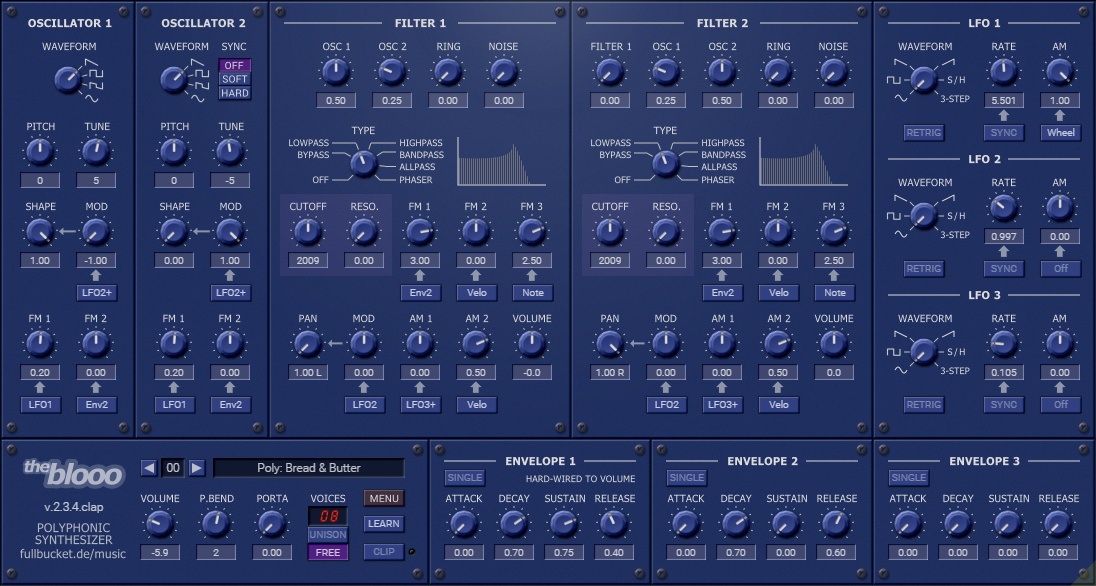
The blooo is a VST™2.4 polyphonic software synthesizer plug-in based on the classic subtractive synthesis architecture. It is written in native C++ code for high performance even on “lighter” systems. Main features are:
- Up to 32 voices polyphony including portamento
- Two band-limited oscillators including Ring modulation and hard sync
- Four oscillator waveforms (sawtooth, pulse, sawpulse, sine) with shape control
- Additional white noise generator
- Two multi-mode four-pole filters (lowpass, highpass, bandpass, allpass, phaser) with resonance and panorama control
- Three envelopes (ADSR) with exponential slopes
- Three low frequency oscillators (LFOs) with tempo synchronization
 Download the blooo Version 1.0 (ZIP file)
 Download the blooo Manual Version 1.0 (PDF file)
In depth on the Roland TB303
If you’re interested in the early history of ROLAND, the Japanese manufacturer of electronic musical instruments and the TB-303 Bassline, you’ll enjoy this 20-minute video. The TB-303 and its design are described in depth, and many examples of popular music made with the machine are presented
Roland TB-303 Documentary BASSLINE BASELINE by Nate Harrison from Jack Time on Vimeo.
DATAMASKIN

