
Reactable hosts Stevie Wonder
Reactable, the table-top object-modeling synthesizer system, enjoys a visit and a little quality time with Stevie Wonder.
The revolutionary Reactable instrument hits the stage with its new incarnation: The Reactable Live! It brings all the possibilities of the original Reactable and makes it portable and easy to setup. The Live! version of the instrument allows you to touch and see the music while performing. The different sound generation and manipulation modules, which are real physical objects, permit infinite flexibility and control in musical expression. Exploring and using modern techniques of music production has never been easier or more exciting.
The Reactable was conceived as an instrument to bring back the expressive possibilities of traditional instruments to musicians who are working with new technologies. It uses concepts of modular synthesis, sampling, advanced digital effects processing, and DJing and combines them with modern human computer interaction, multitouch technology and a tangible interface. The Reactable Live! is a completely new experience in live music performance.
Up close with the Solton SM 100
Here we have a demo of the Solton SM 100. It is the expander version of the Project 100. Drums are made with the Roland TR 808.
The SM 100 is a polyphonic synth with 12 DCO’s ( 2 per voice, 6-voice polyphony ) and a 24 dB filter. 4 waveforms : Pulse with Pulse Width + Saw + Wide Pulse. 2 ENV’s + 1 LFO. Analog Chorus FX.
Multitrack recording with some external effects.

Italian company Solton – probably more well known in electronic home keyboard, auto-accompaniment / accompany rhythm or add-on modules for home organ. Their digital / PCM / GM stuff are still widely available today. Synthesizer wise, the SM100 (and the keyboard version, Project 100) are believed to be the only analogue synths they have ever made. In fact both are not very common, i.e. they’re fairly rare, but it’s not ultra difficult to find one because, due to the poor presets, limited controls and usually the lack of a user manual, most people tend to resell them.
The SM100 is not that unknown because it’s one of those synths that uses Curtis SSM synth chips. In fact, the SM100 is actually a big monster – 6 voice poly, with 12 DCOs! The size of the SM100 is also pretty huge – it’s supposed to be a desktop module – but it’s a lot longer than a standard 19” rackmount, higher than 2u, and quite deep too.
New synth from Mode Machines called SID
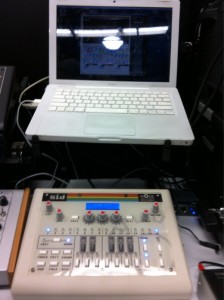
Here’s an upcoming box from Mode Machines called SID. Apparently there’s some controversy over it’s design (link). Chris Randall took the photo above at NAMM. It should go for about $600 USD.
“SID is an 8-Bit desktop synthesizer with a double personality. It’s simplistic layout and ease of use delivers pleasure at the first touch and it’s familiar step sequencer will have you programming patterns and beats in no time. 3 expression knobs control the key features of each Patch for instant results. But don’t let it’s simplicity fool you: The supplied SID STUDIO SOFTWARE enables you to tweak every parameter under the hood! Draw and design your patches with instant feedback from the SID. Also check out the NERD-PANEL, a powerful interactive blueprint which enables you to address the chip one pin at a time – also a great educational tool.” – modemachines.com
For more info: modemachines.com
Arturia MiniBrute sound demo
Here’s a new video featuring some of the intense raw sounds of the recently released MiniBrute at the NAMM show
http://namm.soundsandgear.com we were able to capture some direct sound from the Arturia MiniBrute…this thing is a little monster! Very raw sounding synth.
Demonstration of the PPG wave 2.2 “1982”
Vintage synthesizer demo track by RetroSound
all sounds:
PPG wave 2.2 Synthesizer from the year 1982
recording: multi-track
fx: a little bit delay

The German made PPG Wave 2 series of synthesizers are incredibly great sounding analog/digital hybrid vintage synths. They use digital samples of wavetables and feature analog VCA envelope and VCF filter sections for a classic and warm sound. The Wave 2.2 (pictured above) has oscillators that can generate over 2,000 different single-cycle 8-bit digital waveforms! Covered by knobs, the Wave still looks analog and this comprises the “Analog Control Panel”. More complex and new-wave editing of the wavetables and samples is covered by the “Digital Control Panel” where there are several key-pad buttons and an LCD screen. Another familiar treat to analog junkies is the inclusion of an 8-track sequencer which features automation of pitch, loudness, filter cutoff, waveforms and more. A cool feature – its onboard sequencer will also record any filtering and wave changes, in real-time!!
The more commonly encountered Wave 2.3 followed the 2.2 and had enhanced sample-playback capabilities. The sampler was pretty full-featured for its time and included upgraded 12-bit digital waveforms, Fourier analysis and linear playback of samples. The 2.3 model also featured 8-parts multitimbrality and MIDI implementation. The PPG Waves are know to create excellent pads, brass and bass sounds.
Bax TV takes a close look at the Casio XW P1 Performance synth
Daniel Fisher, checks out the new Casio XW-P1 Performance Synthesizer from the 2012 NAMM Show.
The Casio XW-G1 is a ‘groove synthesizer’ equipped with a keyboard and designed to offer the various kinds of digital equipment used by club DJs, including the ability to create and play back a variety of rhythm patterns and musical phrases.
NAMM 2012 John Bowen Solaris synth
Checking out the monster digital modular synth from John Bowen called Solaris
Background information:
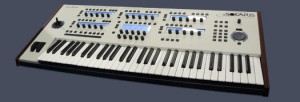
From the beginning, the singular mission for Solaris has been to create nothing less than John Bowen’s personal vision of the ultimate, dream-come-true synthesizer. A vision that draws upon more than three decades of experience in synthesizer design with legends like Moog Music, Sequential Circuits, the Korg Wavestation series and renowned software synthesizers for the original Korg OASYS and Creamware Scope platforms. And it’s a vision to create a truly musical instrument masterpiece that is shared with some of the world’s foremost synthesizer connoisseurs like film composer Hans Zimmer who is renowned for always seeking the utmost in sound creation capabilities.
- 4 Oscillators, each with several types available:
MultiMode, WaveTable, CEM, WAV (sample playback),
VS (single cycle waves), Mini - 4 Filters, each with selectable Inputs. Filter types are:
- MultiMode Lowpass, 24, 18, 12, 6 dB, Highpass 24, 18, 12, 6 dB, Bandpass 24 dB, Comb (2 types), State Variable 12 dB LP, HP, BP, & BR,SSM Lowpass 24 dB , Mini (Ladder) Lowpass 24 dB, Vocal Formant
- 2 Vector Mixers, 2 Rotors (special 4-step waveshape sequences),
2 AM sections (includes Ring Mod) - 6 DADSRs, 1 8-stage loopable envelope
- 4 free LFOs, 1 Vibrato LFO. Each LFO features delayed start,
fade in and fade out times, key sync and Phase control - Phaser, Chorus/Flanger, Phaser, Delay, 3-band EQ effects
Rob Papen shows off the Blade synthesizer
The latest synth from extreme sound mangler Rob Papen is Blade – an additive synthesis engine (around 100 partials) with a user friendly interface based around an XY interface and some cunning gesture based automation for interesting modulation and tonal variation.
Coming soon
More Information
Analogue Solutions VOSTOK MATRIXSYNTH v2 – Modular Suitcase Synth Demo
Here’s an extended look at the Analogue Solutions Vostok MATRIXSYNTH synthesizer.
This demo features a variety of sound types and sequences (traditional and non-traditional) demonstrating the Vostok’s sound palette and variety of timbres. All sounds, with exception of the obvious acoustic drums (used for context), are created on the Vostok using either traditional patching or the pin matrix — or a combination of both.
Sounds are being driven by either the on-board sequencer, MIDI sync (via GATE to CLOCK), or direct MIDI connection to a controller keyboard.
Emphasis for this video was more traditional synth sounds (basses, leads, sequences) as there are plenty of non-traditional (fx, ambient, noise) sound demonstrations on YouTube. The filter section at the heart of the Vostok was also a focal point of this video and is tweaked extensively for the various sound types.
Also, see the Telemetry (mini Vostok) in action at the following link:
http://www.youtube.com/watch?v=rvo5x5G4YJg
KEY FEATURES OF VOSTOK Pure analogue voice circuitry. Suitcase style design. 22×22 matrix pin panel. Rugged Steel construction. Quality chrome catches and cool steel spring handle. Stuffed full of electronics. No front panel space is wasted. Joystick, retro-VU meter, MIDI, jack socket patch points, more, more, more!
NAMM 2012 Studiologic Sledge Polyphonic synth powered by Waldorf
So here we have it, the first video I have found of the new Sledge synth I posted on earlier this week.
http://namm.soundsandgear.com new Sledge polyphonic synth from StudioLogic powered by waldorf, winter namm 2012
DATAMASKIN

