
Roland Jupiter-6 Signature Sounds
The Jupiter 6 is an incredible analog synth. All of the Jupiters have a sound that was unlike any other synthesizer and the Jup 6 is no exception. This sound is due in part to classic analog Roland technology in its filters, modulation capabilities and a thick cluster of 12 analog oscillators at 2 per voice. Easy and intuitive programming via front panel sliders, knobs and buttons for all your tweaking needs.
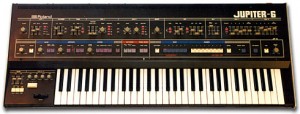
The Jup 6 is a scaled down version of the Jup 8 in terms of programming and polyphony. However the Jup 6 has some major improvements of its own such as newly added MIDI control and better tuning stability! While the Jup 6 does have MIDI, the implementation is very rudimentary and hard to control. The Jup 6 was one of the very first (along with the Sequential Prophet 600) synths to use the then new MIDI protocol, and the implementation on the Jup 6 is far from complete.
http://gstormelectronica.blogspot.com/
A quick demonstration of the Roland Jupiter-6 vintage analog synthesizer. Showing some of the signature sounds that are its claim to fame, and some sounds that may be not so familiar.
Not since 1983 has Roland produced anything quite like it. What sorts of things set the Jupiter-6 apart from its peers?
– Its wild multimode filter capable of Lowpass, Highpass, and Bandpass
– Like a handful of other synths, compound waveform selections are possible for each of the oscillators.
– A feature called Cross Mod: it’s like a third ‘virtual oscillator’ which is a frequency modulator for affecting OSC1. The beauty is that you still have OSC2 to do as you wish.
– Very stable oscillators, and the autotune routine takes about a second to execute! Memorymoog takes around 8 seconds.
– Envelopes: the attack transients are most unique. They aren’t extremely fast, nor syrupy, but I haven’t been able to get any other synth attack to sound the same.
What are these signature sounds the Jupiter-6 does well?
– Buzzy things
– Creamy Sawtooth, silky pad sounds
– Ambient Drones
– Gritty, Dirty, Raw, Nasty, Edgy sounds
– Blippy arpeggios
– Aggressive stabs/leads
– and very rude filter sweeps
Singing With Two Voices Using a Gesture-to-Voice Synthesizer
Singing With Two Voices Using a Gesture-to-Voice Synthesizer
Produced by John Corry, University of British Columbia
Camera: Kevin Doherty
Time machine: ARP Odyssey “Early 70s”
ARP Odyssey mk3 Analog Synthesizer from the 70s
recording: multi-track
fx: a bit delay
background sound: Roland Juno-60
more info: http://www.retrosound.de

While the Minimoog proved to be a runaway success as the first compact studio synthesizer, ARP responded with a compact and user-friendly studio synthesizer of their own with the Odyssey in 1972. An almost equally legendary machine itself, the Odyssey was ARP’s highest selling synth back then, and still is to this day in the second-hand market.
The Odyssey essentially gives you a simplified hard-wired ARP 2600 in a much smaller and affordable package. The Odyssey is a 2-oscillator analog synth (with duo-phonic capability) and it sounds really nice; the Minimoog has three oscillators and is capable of thicker sounds. The Odyssey comes well equipped with all the tweakable features and analog goodness you’d expect: a resonant low pass filter, ADSR envelopes, sine or square wave LFO, and a sample-and-hold function.
The Odyssey also added a few new features such as a high pass filter that could be used in series with the low pass, oscillator-sync capability, and pulse-width modulation. It is a very professional and expressive machine that can create nice analog basses, interesting leads, great effects and sweeping sounds straight out of a Tangerine Dream album!
There were many versions of the Odyssey over the years, each a little different. They can be broken down into 8 models spanning 3 Mark “Mk” version
The Fundamentals of Synthesizer Programming Pt. 3
Moog continues its highly appreciated series in synth programming, here’s part 3:
Moog Music Inc. is proud to present Dr. Joseph Akins’ five part series on the fundamentals of synthesizer programming. Dr. Akins is an associate professor at Middle Tennessee State University and strives to teach his students a complete understanding of synthesizers and computers as tools for modern music production. In this five part series Dr. Akins uses a Voyager to teach the process through which a synthesizer’s sound is generated and the techniques needed to program your own sounds and sonic experiments. In part three of this five part series Dr. Akins goes over signal modifiers and filters.
The Mini Moog Synthesizer with Herb Deutsch
Herb Deutsch, the co-inventor of the first Moog synthesizer discusses the history and functions of the Mini Moog as well as its impact on the music of the time. Deutsch also plays one of his original jazz fusion pieces.
Though its design impacted the industry in a way that set the stage for all the synthesizers that came after it, the Minimoog is probably most famous for its excellent analog sound and arguably the best filters in a portable synth. It featured three oscillators (one of which can be used as an LFO) that could be individually tuned and offered multiple waveforms. The Minimoog is monophonic (only one note can be played at a time) so the three oscillators allow for an incredibly rich sound – three de-tuned oscillators each playing a different waveform can create some pretty thick analog sounds! There are also some very cool modulation possibilities when using one of the oscillators as an LFO.
But you can’t talk about the Minimoog without mentioning its filters. The Minimoog uses a 4-pole (24 dB/oct) low-pass filter with cutoff, resonance, ADS envelope, and keyboard tracking controls. Amazingly, Dr. Moog’s filter design has yet to be surpassed by a better sounding filter. It’s a filter that sounds so warm and smooth that Moog’s rival, ARP, tried to copy it for their 2600 and Odyssey synths.
The Minimoog’s internal wiring configuration and front panel layout has defined the general synthesizer configuration for decades. Every adjustable parameter is so clearly laid out on the front panel that the Minimoog makes a great teaching tool for anyone interested in classic subtractive synthesis. It even has a built-in A-440 tone generator so you can manually tune the oscillators-which is nice since (like mosts analog synths that heat up) the tuning of even this machine can be a little bit unstable. Though input jacks allow you to run your own external audio through the Minimoog’s filters, modulation and amplifier circuits too!
Directed by Michael Sterling
Wasp Special Demo
Nice demo of a really rare synth – the WASP:
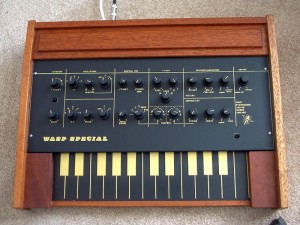
“Here’s a little demo of my old Wasp Special vintage mono synth from the 1980’s. I’m trying to use all of the knobs to show they are fully functioning. This is a rare model of Wasp with a real wood case. It is serial number 00015 which suggests it was one of the first built. I’m using a modified Epiphone Valve Junior amp to play it through. The sound is being picked up by the built in mic on the Vado camera I’m filming with so the sound reproduction isn’t great. I hope you find the video useful. I will be parting company with the Wasp soon.”
Here’s some more details about the WASP:
The Wasp Special is a bizarre monosynth from the late 70s. What an absolutely nasty-sounding synth. It’s easy to love it! ^_^
The Wasp’s filter design “abuses” digital inverters as if they were analog op-amps, leading to distortion, “grunge” and other “nasty” artifacts that define the specific sound of its filter, available in LP, BP and HP flavors…yummy.
The “Special” is a second-generation Wasp from the mind of Chris Huggett, progenitor of the OSCar synth. This one eschews the awful molded-plastic case of the original Wasp for a classy wood chassis but keeps the touch-sensitive keyboard. Surprisingly for something with digital components in the signal path, this is one of the warmest, phattest, dirty-ass synths I have ever heard or played.
The touch keyboard is nowhere near as bad as I feared as it is a capacitance design instead of a crappy membrane! Very easy to get bizarre glissandos and pitch sweeps. Triggering is suprisingly rather accurate. Takes a bit of getting used to, though if you’ve never played a touchplate or capacitance keyboard.
I had to apply a bit of TLC before this one sounded very good, it wasn’t in too bad shape for around 27 years old. A little touch-up on the woodwork…It was a little dinged-up when I got it. Also, it needed some interior work with a soldering iron to get it back to “new” condition electronically – one leg of a cap had come loose from the board, some pots needed serious cleaning and I had to re-mount and re-solder a footage selector switch that had cold solder joints, causing Osc 2 to drop out occasionally. Physically its pretty solid now. I imagine the build quality of the first-gen plastic jobbies was rather “iffy”, at least people have said so…I think I was very lucky to get a post-EDP model.
There’s quite a lot of knobbage for such a “simple” two-oscillator mono…what a terribly underrated and underestimated monster! I would put it up against just about any other 2-osc mono of its day. The filter really is something else and the modulation capabilities aren’t bad – much better than say a Moog Rogue, Prodigy or Roland SH-101, ARP Solus, etc. If you decide you can’t stand the charming capacitance keyboard, Kenton Electronics makes the Pro-KADI which acts as a MIDI-to-Wasp converter. I think people might be suprised when they hear these MP3s, regardless of my obnoxious noodling:
Wasp1.mp3 , Wasp2.mp3 , Wasp3.mp3 , Wasp4.mp3
The Fundamentals of Synthesizer Programming Pt. 2
Moog Music Inc. is proud to present Dr. Joseph Akins’ five part series on the fundamentals of synthesizer programming. Dr. Akins is an associate professor at Middle Tennessee State University and strives to teach his students a complete understanding of synthesizers and computers as tools for modern music production. In this five part series Dr. Akins uses a Voyager to teach the process through which a synthesizer’s sound is generated and the techniques needed to program your own sounds and sonic experiments. In part two of this five part series Dr. Akins goes over operation of a synthesizer’s two main sound sources the oscillators and the noise generator
AudioGL Video 3 – Modular Software Synthesizer and Sequencer
This is a very cool demo of the AudioGL modular, check it out
Another update on the AudioGL project. This video features a crowdfunding announcement, and a software demonstration.
Crowdfunding Campaign:
http://www.audiogl.com
or
http://www.indiegogo.com/AudioGL-Crowdfunding-Campaign
Background information:
AudioGL is a Modular Software Synthesizer and Sequencer. It is designed to allow musicians to create complex compositions with ease. AudioGL has a dynamic 3D interface which focuses on streamlining workflow, so composers can spend less time navigating the interface, and more time writing music.
Here are the specifications of the computer I have been using to develop AudioGL
Make/Model: Lenovo X61 Tablet
Processor: Intel Core 2 Duo 1.8ghz
Graphics: Intel X3100 (low quality integrated graphics card)
Audio: M-Audio Fasttrack Pro & ASIO4All
Display: 1024×768 (Laptop) – 1280×1024 (External)
As you can see, AudioGL does not require a high performance computer. If your system specifications are close to or higher than mine, AudioGL should run just fine for you.
Although the interface is rendered in 3D, it does not consume any more resources than a typical 2D interface. Furthermore, the graphical quality of the interface can be raised or lowered, depending upon your preferences.
The synthesizer is designed towards low CPU usage without compromising sound quality. To provide both, the instruments you create in AudioGL will only consume CPU when they are playing. This makes it possible to create a large composition on an underpowered laptop, provided that you only have so many instruments playing at one point in time.
The Analog Lab NYC-Korg PS-3300-Erik Satie Gymnopedies No 1
“Korg PS-3300 recently repaired and restored by The Analog Lab
The PS-3300 allows you to tune each individual note on the front panel of each module. We decided to take this opportunity to put it in Just Intonation and play some Satie.
The main problem with this unit was all of the connectors for the bus bars attached to the circuit boards were cracked.”
Full story below:
Today at The Lab, we finally finished a project that has been a long time in the making. A complete restoration of a Korg PS-3300. It came in with a simple intermittent issue, but when it rains, it pours. When we dived deeper into this beasty, we knew it was going to be much more than a simple repair.
I already mentioned the intermittent problem, but we soon found an edge connector for one of the circuit cards had been cracked. We saw that a previous owner had attempted to reinforce the connector with an aluminum bracket, but it was already gone. Whilst replacing the edge connector, we discovered that ALL the edge connectors were cracked and in desperate need of replacing. Sooooo, we called up the client and gave him that bad news, and suggested we treat it as a restoration rather than repair. He agreed and we were on our way.
The unit had a very well thought out color code for its wiring system, which was hand wired, but one issue was numerous bus wire connections between sets of cards had to be re-fabricated and connected to the new edge connectors. After all was said and done and the unit was in test mode, we also found a lot of dy solder joints that happened over time. They were all traced down and re-soldered. Of course the power supply caps were getting a little leaky, so they were also replaced.
Finally, we cleaned all the pots and switches on the front panel and re-checked all the new connectors. We burned in the unit for a few days and recorded a video with Gymnnopedies No 1 by Satie.
The client came and was visibly thrilled, and all was well once again.
Details on the NTH Music Synthesizer project
Kevin Holland and John Staskevich have launched a Kickstarter for their NTH Music Synthesizer project.
The NTH is a fun-to-use, sonically-rich, hackable music synthesizer. It features digital oscillators, an analog low-pass filter, an integrated step sequencer, MIDI I/O, and simple, intuitive controls.

The NTH is available for purchase from February 2, 2012 to March 1, 2012 via Kickstarter:
http://www.kickstarter.com/projects/holland/nth-music-synthesizer
Upon successful funding, production of the NTH will begin and the entire design will be open-sourced.
The NTH is available to purchase, starting at a Kickstarter pledge of $250 USD.
More information: NTH Music Synthesizer
DATAMASKIN

