
Introducing the MFB Dominion-X Synthesizer
MFB has updated their site with details on the Dominion-X synthesizer.
The MFB Dominion-X combines analogue synthesis, programmability and modular patching.
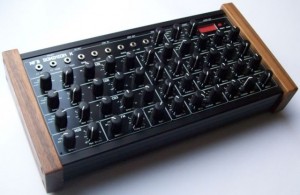
Features:
- Programmable Analogue Synthesizer
- 3 VCOs with wave shaping and ring modulationDual-Sync and Dual-FM features
- 6-fold multimode-filter including 3 low pass configurations with 12/18/24 dB
- patch-section for external CV/Gate-control
- Velocity routing matrix with 11 destinations
- 3 LFOs with 2 LFOS offering one-shot-modes and reset
The MFB Dominion-X is priced at 780, Euro.
Audio demos and details below.
The MFB Dominion X offers three oscillators for maximum flexibility. Each waveform can be varied in symmetry. Besides altering the pulse width of a rectangle, you may also continuously turn a saw tooth into a triangle and a triangle into a sine.
All oscillators also offer ring modulation. In addition, VCO 2 and VCO 3 can be synced to VCO1.
Finally, VCO3 can modulate the frequency of VCO 1 and VCO 2. The analogue oscillator circuit is processor-controlled for stable tuning.
To complete the available sound sources, noise or an external audio input can be added to the VCOs in DOMINION X’s mixer section.
The filter offers six operation modes. Available are three low pass variations with 12, 18 and 24 dB/oct. slopes. Also available are high pass-, band pass and a notch filter with slopes of 12 dB/oct. respectively 6 dB/oct. Variable filter modulations are possible via an invertible envelope, keyboard tracking, LFO, VCO, different MIDI controllers as well as by the use o the CV-input.
The two ADSR-type envelops are internally routed to the VCF- and VCA-sections. In addition, envelope 1 can also modulate the VCO section. LFOs 1 and 2 offer six waveform shapes including sample & hold. They may be switched to one-shot-modes to emulation simple envelopes. A third sine-LFO works in combination with a keyboard’s modulation wheel and can dynamically address the VCO, VCF and VCA sections.
Modulations are assigned by the use of selector switches, located at the destinations. This allows easily setting and re-routing internal modulation paths – ideally for your live-performance.
To integrate external modulators, control- and audio sources, DOMINION X offers nine inputs. Therefore, oscillators, filter, VCA, CV/Gate and mixer can be easily combined with other analogue synthesizers such as MFB’s MEGAZWERG, analogue sequencers such as MFB’s URZWERG PRO or modular synthesizer systems.
An additional selector switch allows assignment of velocity for up to eleven modulation destinations.
The MFB Dominion X offers 128 programmable patches. To support sound programming without an attached keyboard, different demo sequences are available. To use The MFB Dominion X as a filter box for external audio sources, the VCA can be opened permanently. Finally, there is an insert available to integrate an effect or distortion unit into the signal path.
The MFB Dominion X has the following dimensions: 330 x 170 x 60 mm. An external power supply is included.
Teaser picture: The Electronic Music Works EMW-200 Synthesizer
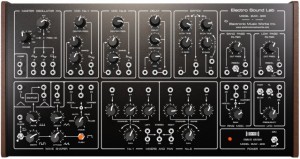
Electronic Music Works has released these sound demos of their upcoming EMW-200 Electronic Sound Lab synthesizer.
The EMW-200 Electronic Sound Lab is conceived as an improved version of the vintage Electronic Sound Laboratories EML-200 synthesizer. The EML-200, introduced in 1969, was a synth sold primarily in the education market, but has been used since by Pere Ubu and others.
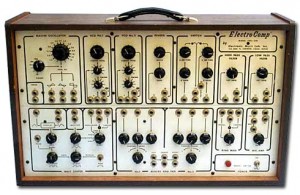
Connecticut based Electronic Music Laboratories (EML) was most known for producing synthesizers along the same lines of Moog and ARP, but most EMLs were destined for the educational market. The ElectroComp 200 was one of EML’s first synthesizers, introduced in 1969. It’s old school but has very sophisticated features for the time (such as a Wave Shaper and stereo sound). It is monophonic and includes two oscillators, independent high- and low-pass filters, two ring modulators, an LFO with sample-and-hold, stereo panning, and built-in spring reverb. The front panel of the 200 is nicely designed and laid out. There are 31 mad-scientist-looking knobs and over 60 patch points! With a little patching, even people new to analog synths will be able to start getting sounds out of the 200—it was originally intended for use in educational institutions.
Note however that the EML 200 is keyboard-less, making it more like an Expander module designed to interface directly with other EML equipment. Most notably, with the Model 300 manual controller which offered a 4×4 key matrix, pitch knobs, and an oscillator with envelope generator and VCA of its own. Today, you can use the 200 with analog synths other than EML with the properly modified CV/Gate connections and converters (its oscillators are a non-standard 1.20v/oct). The EML 200 today is most valuable as a collectors item rather than a piece of studio kit, due mostly in part to its rarity in relation to the more popular Moog and ARP instruments that it is comparable to, as well as being surpassed by the more common ElectroComp 101.
Vintage Synthesizers I PPG wave 2.2
A voyage into the heart of the PPG wave 2.2 Wavetable Synthesizer from the year 1982.
Polyphony – 8 voices | ssm filter chip module based.
It has been used by Trevor Horn, Gary Numan, Art Of Noise, Frankie Goes To Hollywood, Depeche Mode, Propaganda, Saga and many more!
Exploration by Marko Ettlich
Create Digital Music’s MeeBlip SE gets easier to use and MIDI-controllable
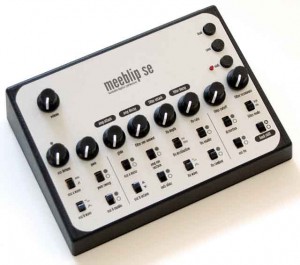
Create Digital Music are building and shipping MeeBlip SE. A spokesperson said, “Whatever the ‘SE’ stands for – seconda edizione, or a meaning of your own choosing – the MeeBlip SE is the original MeeBlip, but better. Building on the first version of our open source synthesizer, we’ve worked with feedback from users to make the MeeBlip more usable and more sonically versatile.”
New in this version:
- A more intuitive, playable control layout. The changes are subtle, but after lots of conversations with users, we worked to make each knob and switch the choice we liked best. (Of course, you can still modify those choices via our open source firmware, if you like.)
- Patch storage. Sure, it was a bit more “pure” never being able to store patches, but this is a digital synth, after all. Now, you can save and recall up to 16 patches right on the MeeBlip, using dedicated front panel load and save buttons. It’s especially nice for live performance.
- Variable pulse width. Instead of a fixed square wave, you can now use the dedicated PWM knob to adjust the timbre of the first oscillator. There’s also a “pwm sweep” switch for enabling an automated PWM envelope, of which we’ve grown rather fond. Hello, thick synth leads.
- Anti-aliasing. You can now use more pristine anti-aliased waveforms, or turn this off for other timbral effects. It gives you another option for coloring the MeeBlip’s sound.
- Control everything with MIDI. It’s simple: if there’s a sound parameter in the MeeBlip, there’s a switch or knob to play with it. And now, the reverse is true, too: if you see a switch or knob, you can control it via MIDI. At last, you can use a tracker or sequencer to program detailed MeeBlip sounds.
Pricing and Availability:
MeeBlip SE Quick Build Synthesizer: $139.95 until March 31st ($149.95 after that)
MeeBlip SE Build Everything Kit; $119.95 until March 31st ($129.95 after that)
MeeBlip micro Kit: $39.95
More information:
Digital Enhancement – sound installation
“Digital Enhancement” is an interactive sound installation consisting of an electrified Symphonion Brevet No. 28, a synthesizer, an amplifier and four headphones. The Symphonion musical box dates back to the beginning of the last century and its mechanical workings are combined with digital technology to convert it into a MIDI sequencer. The original music, embossed on steel plates, can be played on the synthesizer, which is programmed to mimic the sounds of the Symphonion. In order to operate the sequencer, a hand-cranked dynamo serves as a remote control.
Additional Information:
2011, interactive sound installation, hand-cranked dynamo, micro-controller, custom electronic circuit, hardware of antique musical box, embossed steel plate, antique wooden cassette, stepper motor, hardware synthesizer, headphone amplifier, headphones, misc cables.
Project website: mar.li/digital_enhancement.php
Taking a closer look at the Casio XW-P1 Performance Synthesizer
Mike Martin from Casio visited Sweetwater Sound to give a deep overview of the XW-P1 Performance Synthesizer. Mike shows off a lot of sounds, the ability to mix oscillators on the fly, and some awesome sequencing and arpeggiation capabilities. Enjoy the demo, then learn even more about the Casio XW-P1 Performance Synthesizer right here: http://bit.ly/sw_XWP1
The Casio XW-P1 is a powerful six oscillator monophonic solo synth that is ready to gig. You can combine all six oscillators to make a single tone. You get two virtual analog style oscillators, two PCM oscillators, one noise oscillator, and one external oscillator for use with line and mic inputs. Each oscillator has their own filter, portamento, envelopes, key tracking, a master resonant filter, and two LFOs. The XW-P1 is an extremely powerful synth that lets you really edit and tweak each setting. You also have access to the original CZ synthesizer’s waveforms.
Latte – new virtual synthesizer instrument
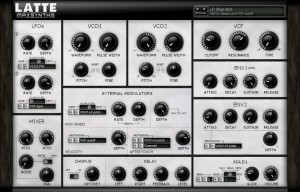
MaxSynths has announced the release of Latte, a virtual synthesizer instrument for Windows.
Latte is inspired by the old synthesizers from the past and is able to produce powerful synth sounds, fat basses, expressive leads, crazy sounds and more.Despite the synth layout looks very simple the modulation options allows to shape the sound in a lot of different ways. One of the most interesting features is the possibility to use the polyphonic aftertouch as a modulation source to create the typical expressive sounds which has been a trademark for the well known synth gurus of the past.
The Saw/Pulse oscillator of Latte, characterized by a powerful and warm sound, has been created specially with the aim to recreate a realistic vintage sound.
Latte features
- 2 Oscillators with custom Saw and Pulse waveforms and noise generator (White and Pink noise).
- 12dB Low Pass/High Pass state variable filter.
- 2 LFOs with assignable destinations.
- Assignable envelope generator.
- Extensive options for external modulation with routable Channel or Poly Aftertouch.
- FX section with Chorus and Delay.
- 16 voice polyphonic.
- Low CPU usage.
Latte for Windows (VST) is available to purchase for 19.90 EUR. A free version (limited to 4 voice polyphony) is available to download.
Moog – The Fundamentals of Synthesizer Programming Pt. 4
Moog Music Inc. is proud to present Dr. Joseph Akins’ five part series on the fundamentals of synthesizer programming. Dr. Akins is an associate professor at Middle Tennessee State University and strives to teach his students a complete understanding of synthesizers and computers as tools for modern music production. In this five part series Dr. Akins uses a Voyager to teach the process through which a synthesizer’s sound is generated and the techniques needed to program your own sounds and sonic experiments. In part four of this five part series Dr. Akins gives an in depth lesson on the envelope generator.
Sytrus Demo: Hybrid Synthesizer – subtractive but addictive
A disruptive innovation in software synthesis, nothing else compares to the diversity Sytrus packs. FM, RM & Subtractive synthesis – have it all!
Sound engine
Meticulously crafted, Sytrus delivers ethereal lush pads, sonorous bells, scintillating highs or simply dirty grunge. The 6 user-definable operators can act as independent oscillators for subtractive synthesis, cross-modulate to create complex FM (Frequency Modulation) or RM (Ring Modulation) synthesis or the 256 partial harmonic editor can be used to additively synthesize virtually any timbre you can imagine. With up to 64x oversampling Sytrus delivers 100% epic sound.
Effects
Sytrus features 3 independent, chainable, filter units, each containing an array of filters (13 types each with 5 cutoff slope settings) and integrated waveshaper (distortion processor).
The filter units are optionally followed by a Chorus, Delay & Reverb unit. 100% Flexibility.
Presets
With over 500 hand-picked presets Sytrus is ready to contribute to any genre immediately upon installation. Sounds cover – Arps, Bass, Bell, Brass, Chromatics, Drum, DX7, Experimental, FX, Guitar, Orchestral, Organ, Pad, Percussion, Piano, Plucked, Sequence, Synth, String, Wind. 100% inspiration.
http://www.image-line.com/documents/sytrus.html
FRACT OSC DevDiary – Explore, Rebuild, Create
CHECK OUT WWW.FRACTGAME.COM FOR MORE INFO
A quick look at some of the things we have planned for FRACT OSC – a first person adventure game inspired by synthesizers (no kidding!). We’re building some really interesting tools that combine exploration, puzzles and musical creation – and we’re really excited to share them with everyone!
DATAMASKIN

