
Freeman Symphonizer Vintage Analog String Synthesizer
http://youtu.be/xhdyM89HUbU
“Vintage Freeman String Synth From 1973… Oh, and to be perfectly clear I’d just as soon as sell my own kids as I would to list my friend here up on Feebay… In case you didn’t catch the unwitty/witty sarcalisms… :/ Let me know though if anyone else has one, I’d be curious… I could also open her up and hopefullty do a better demo down that there a road…”

The Freeman String Symphonizer was a 5 octave synthesizer of the mid 1970s. It was manufactured by the Chicago Musical Instrument Co. and was also known as the Cordovox CSS. Its sound was similar to that of the Arp String Ensemble – cool glassy sounding strings. It had multiple oscillators (one TOS and two master/divider) per key, so it had no restrictions on how many notes could be played at once, unlike most synthesizers at the time, which were often monophonic.
The Freeman had a built in spring reverb which gave the synthesizer a deeper sound. One could chose ‘cello’ (16′), and ‘violin’ (8′) tones. There was a ‘touch’ (delayed) vibrato setting, and a ‘glide’ switch on the foot volume pedal (found also on many Lowery home organs), which dropped the pitch one-half step. It was a heavy machine – about 70 lbs – and was rather durable except for the removable keyboard cover which LOOKED like it hinged up, but rather pulled straight out… resulting in many cracked lid assemblies.
It was used by The Who, Jan Hammer, Chick Corea, Elton John, and Peter Sinfield.
It has been emulated in software by GForce, with their Virtual String Machine software.
micronaut – experiment seven
“In the middle of beta-testing the DSI Tempest, I decided to knock out a quick movie showing the cool pattern-switching and ribbon controller abilities. Also in this video: MeeBlip and DSI TETR4, and Eventide TimeFactor. Recorded to and mixed from 8-track 1/2″ tape.”
Hardware feature The TETR4:
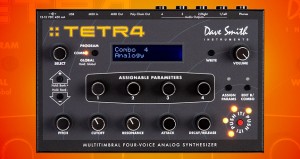
- Affordable, fully programmable poly synth with a 100% analog signal path.
- Classic, real analog sound—including legendary Curtis analog low-pass filter.
- Four-part multitimbral capability with four separate outputs.
- Combo Mode for huge unison patches, stacked sequences, and “modular-style” poly sounds.
- Expandable: poly chain with other Tetras, Prophet ’08, and Mopho for expanded polyphony
- Just 7.9″ x 5″ (20.07 cm x 12.7 cm).
- Free editor for Mac OS and Windows.
Overview
Tetra is our next-generation analog poly synth. Tetra takes the award-winning sound and features of Mopho, multiplies them by four, and packs them in a box less than half an inch larger!
Tetra has multiple personalities. It is a four-voice, analog poly synth, a sort of “mini Prophet.” It’s a four-part, multitimbral synth with separate outputs, essentially four Mophos in one very compact box. And it’s a voice expander for other Tetras or the Prophet ’08.
Outside the Box
Physically, Tetra is similar to Mopho, with four assignable parameter controls per program and a row of controls dedicated to the most commonly used performance parameters. All of the parameters can be accessed from the front panel and Tetra is fully programmable. A free, downloadable editor is available for Mac OS and Windows to facilitate more comprehensive tweaking.
Most of the rotary controls are detented encoders, but Cutoff and Resonance are potentiometers, allowing full sweeps with a single turn. The Push It button is a manual trigger to play notes and latch sequences on without the need for a MIDI controller.
Audio is output in mono, stereo, or per voice, via the four audio output jacks. There is also a headphone out. MIDI communication is by standard MIDI in and out jacks or USB. Poly Chain Out is a special, dedicated MIDI output to chain multiple instruments for increased polyphony.
Under the Hood
The voice architecture is based on the Prophet ’08, but with the addition of a sub-octave generator for each oscillator and a fully programmable feedback loop for each voice. That breaks down to two DCOs, a resonant low-pass filter, three DADSR envelope generators, four LFOS, deep modulation routing, an arpeggiator, and a 16 x 4 analog-style step sequencer per voice. Feedback is capable of producing effects ranging from mild distortion to fairly extreme harmonic instability. (That’s a good thing.) The possibilities are nearly endless. And the audio signal path is 100% analog.
The yellow Mochika gets arpeggiator support
Nice update to this yellowish synth:
Hello world, we have added a gate arpegiator to the Mochika XL with 4 patterns. while playing you can switch between eight notes in real time tweaking a knob. The gate arpegiator can be synchronized by midi at four different sync rates, and also you can change the sync rate while playing in real time tweaking a knob.
Cube synth with wave oscillator
Here’s a little interesting cube, apparently capable of producing some really nice sounds judging by the demo:
“We at EMW, “Electronic Music Works” are almost ready to launch our new product, the WCS-1, a tiny synthesizer with a pretty solid sound.
We have been working for several years on this project with a new type of oscillator that we call Wave Composition Oscillator.
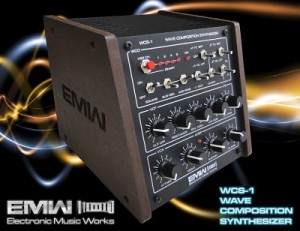
It utilizes digital technology to implement an additive waveform resource.
All other circuits use discrete analog technology.”
Kairatune – crisp and tight electric sounds
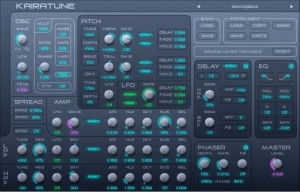
Developer Matti Jokipii has released a new soft synth for Windows, Kairatune:
Kairatune is designed to produce crisp and tight electric sounds for electronic music production. Kairatune is engineered for the demanding producer who needs to push the sound to extremes without compromising audio quality.
Kairatune offers fast and intuitive sound design workflow. The user interface is designed for a musician rather than an engineer and is based on the concept of pitch and beat in contrast to frequency and time. Kairatune lets you travel in the world of beats, notes and intervals instead of the logarithmic mathematics of frequencies and the rarely useful absolute time.
Kairatune is not your all-in-one synthesizer. It’s designed and engineered to be as powerful and versatile as possible in it’s target role as your source for tight bass, unique lead and shiny SFX sounds. At the same time it makes all the effort to be simple enough to use, enabling you to add your personal touch and flavor to the sound and seek for the perfect fit to your mixing preferences.
Kairatune is a free download (VSTi) from the Futucraft site.
MYSTERION VST SYNTHESIZER FREEWARE DEMO
Pianovintage is proud to introduce is brand new VST SYNTHETIZER : MYSTERION
MYSTERION is a free VST plug-in produced by Pianovintage.fr
16 presets – dual osc – filter+lfo + filter& enveloppe
SOON AVAILABLE ON DOWNLOAD
SQ-80 Rack for Ableton Live
This Ableton Live rack was created using samples from a SQ-80 synthesizer on the “Hush” preset. The samples are courtesy of Tom from http://www.waveformless.blogspot.com Please check out his site for lots of great information about electronic music and a weekly sample pack download.
Download the Instrument Rack @ http://bit.ly/freesynth26
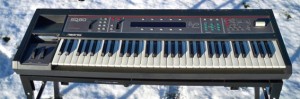
Today is an exciting day for me, it marks six months of releasing these Ableton Live Racks for your downloading pleasure. I want to thank you for your support and kind words, it means a lot to me and has made this a truly exciting project to work on.
A big reason I do this is to meet new people and share ideas and music with people I would otherwise have no way of reaching; I thought that this 26th Ableton Rack should reflect that.
One great soldier of information in the electronic music community is Tom who writes the blog Waveformless. The motto of the site is a “Freeform discussion of electronic music and the techniques and gear used in making it.” I highly recommend checking it out and exploring the vast information from synthesizer news to free sample Fridays. This weeks Free Ableton Live Rack was created using some of Tom’s free samples. Thanks to Tom for sharing these samples and letting me rack them up for everybody’s enjoyment!
I’m not going to pretend I know anything about the SQ-80, I’ve never touched one in my life, but therein lies the beauty of the internet. Tom supplied us with a bunch of samples from the “Hush” preset, as well as a sample of the synth powering down. From there I have merely thrown the samples into Live’s Sampler and mapped out some choice macro knobs. The result is something that I hope you will find useful. (If nothing else, play around with the notes on the extreme high end of the keyboard. That’s where the samples of the SQ-80 being powered down are, and the sounds I am most excited to use in my own productions. Great call on adding that sample, Tom!)
Featuring the new Fenix II synthesiser and the Fenix III sequencer
Here’s a video of the new Fenix II synthesiser and the Fenix III sequencer with some 808 action thrown in for good measure. The Fenix was recorded without effects, it has its own built in analogue delay that I messed with a bit.
The main melody is being played by the Akai MPC 1000 and the Fenix III sequencer is modulating the formant filter.
Fenix II (Synthesizer)
3 VCOs, 3 different VCO’s ( Inputs CV, FM, PWM, Sync e.o, Output square, triagle, sawtooth and some has puls, sub, sine e.o) )
4 different VCFs ( SVF, 24dB Lp, BPF, 12dB Lp). ( Input CV modulation, SVF has Q-CV control
3 EGR and 4 VCAs and 5 LFOs. (Many modules are voltage controlled)
7 Mixers ( 3 audio mixers and 4 DC-Audio mixers).
1 Phaser and 1 Delay (BDD). ( off course voltage controlled)
1 8 step analog sequencer with own clock.
1 Waveshapers, 1 wavemultiplier and 1 full wave rectifier. ( voltage controlled, except for the rectifier )
1 CPR, 1 S&H, 1 Gate delay, 1 Ringmodulator, 1 Slew limiter, 1 fixed +/- 5volt output.
1 Analog noise and 1 Digital noise. ( Digital noise voltage controlled
1 6 Banana to 3,5 mm minijack connectors.
1 Input module with trigger, gate and envelop out.
1 Stereo output module with dual panning and dual VCA. ( off course voltage controlled)
Fenix III (Sequencer)
1 LFO board
3 Sequencer boards
1 CV expander boards (with potmeters)
3 gate expander 1 boards (with switches)
1 gate expander 2 boards (with switches)
1 Banana to 3,5 mm minijack connectors
Studio Electronics CODE with CS80 filter for glitch sounds
The analog experts at Studio Electronics took their classic Omega Engine and couple of fresh ideas to come out with the NEW CODE Synthesizer. Two new great features on the CODE Synth are the new sinewave generators and the new filter control section
Description:
The Studio Electronics CODE OD is an expandable four-voice analog polysynth. With incredible clarity and the ability to save presets, the CODE is great modern synthesizer.
The CODE has similar voice architecture to the S.E. Omega and ATC series synths. It comes standard with Moog and Oberheim filters and can be expanded with optional CS80 and 2600 filter cards. Filters can be added per voice giving you a wide range of available filter flavors. The CODE has and expandable voice system, letting you add voices later. It’s user-expandable up to eight voices. The CODE boasts full midi control with LFO sync and extensive control over the filter section. Each voice has sine, saw, and pulse width waveforms.
There are 2 oscillators per voice, 2 LFO’s for modulation of almost every parameter, and a white noise source. There are three envelopes available. There’s one for filter contour, amp contour, and an assignable EG that can also control audio signals coming into the external input. There is an external input for each voice and stereo outputs for each as well. (Four of each in this case!) This is the newest version, available with the 512 presets, 128 multi-presets including the “Riot” and “Cadix” banks. This also has the OD option, giving you a sweet-sounding amp overdrive. Voices: Mono, 2, 4, or 8 Multitimbrality: 2 voice = 2 part, 4 voices = 4 part, 8 voices = 8 part ; Parameters: patch, number of voices, mono or poly. Audio outputs: one stereo per voice. One main stereo and main mono output. Interface: 32 knobs, 1 rotary encoder, 35 tactile switches, 24 LEDS. Display: 16 x 2 back lit liquid crystal Ocean Blue Display. Memory: 512 sound patches, 128 multi patches in RAM. Weight: 25 lbs. Dimensions: 4 rack spaces, 15 inches deep. Power: 90 – 250 volts AC auto switching.
Voice Architecture
Two voltage controlled discrete analog oscillators and one sub wave of Oscillator 1 Waveforms: triangle, sawtooth and variable width square. All waveforms output simultaneously. Syncing of Osc 2 to Osc 1.
Two voltage controlled discrete analog filters 24db (Moog Filter), 12 db (classic Oberheim SEM). 12db filter has low pass, bandpass, high pass and band reject modes. Each voice has the capability of having four different filters available for use. Additional filters (up to 2 per voice) can be added as desired in any number. Filters do not operate in series or parallel.
Three low frequency oscillators (LFO3 fixed to voice panning) Waveforms: triangle, sawtooth, reverse sawtooth, square, noise, random. Up to three destinations and depths each for LFOs 1 & 2 with range, delay, key trigger, phase, mode (mono or poly), quantize, midi sync.
Three multiple stage envelope generators Attack, decay, sustain and release with inverting and multiple triggering. Envelopes 1 & 2 have additional delay, decay2, and breakpoint parameters. Envelope 1 fixed to filter frequency. Envelope 2 fixed to amplifier level. Envelope 3 is assignable with up to three destinations and depths. ALSO NEW Envelope 3 knobs also can control the inputs of the unit.
Glide Linear or exponential. Parameters: time, mode (auto, legato, glissando), autoglide interval, dynamics, destination.
Unison mode One, two, four, six, or eight voices. Depending on Voice configuration.
Additional Features Oscillator 2 audio frequency modulation. Destinations: Osc 1 frequency, Osc 1 pulse width, filter frequency. White noise generator. Auto triggering external input processor on each voice. Parameters: input level, trigger level, mix level, window.
Modulation Destinations LFOs1 & 2 and envelope 3: VCO 1 & 2 frequency, pulse width, and mix level, VCF frequency and resonance, noise level, Xmod amount, LFOs 1 & 2 rate and depth, VCA level, external mix level.
MIDI Specifications In out and thru. Receives: program change, bank select, glide on/off, glide time, volume, SYSEX. Controllers: dynamics, modwheel, bender, pressure destination and amount (x2). Controller 1 assignment: dyn, mod, pressure, bend, tracking, continuous cont #2 (x2), controller 1 amount (x2). Controller 2 assignment – same as controller 1 (x2), controller 2 amount (x2). Dynamics, tracking, and bender have positive and negative modulation. Fixed continuous controller assignments for all key functions.
Daniel Fisher on Novation UltraNova
A nice run through of the UltraNova filmed by Sweetwater
Brand new Nova-series synth engine based on Supernova II:
• Single part with up to 18 voices, 14 filter types, 36 wavetables, 5 effect slots
• Patch Browse enables you to browse 300 sounds by type & genre
Touch-sense controls enable totally new sound-shaping & performance:
• Trigger envelopes/LFOs/filters/FX by just touching the encoders
• Large rotary control instantly allows you fine control of any parameter
Totally gig-able with 37 full sized keys, a vocoder, and loads of controls:
• Voice optimized 12 band vocoder with gooseneck mic
• High quality key bed with aftertouch for expressive playing styles
Software plug-in editor and Patch Librarian for full visual editing:
• Plug-in editor allows you to view and edit in with software
• Software Patch Librarian a organise, store and share unlimited patches
Built-in 2 in 4 out USB audio interface and it can be bus powered:
• UltraNova can be used to stream audio to and from a host computer
• Stereo main (analogue & SPDIF) and aux outputs, and MIDI in/out/thru ports
DATAMASKIN

