
Nice demo of the Roland D-50 Linear Synthesizer (1987)
Roland D-50 Linear Synthesizer from the year 1987
a real classic synth!
8-bit attack or looped PCM samples and digital oscillators (saw & square), low pass filter, chorus and reverb fx…
this demo shows the different sound possibilities. first a few legendary D-50 patches and in then second part some special sounds.

More on the D-50:
The D-50 is an all-time favorite digital synth that’s still just as popular today as when it first came out in ’87. Once Roland’s hottest digital synth, it competed against the Yamaha DX7, and was much easier to use. By joining 8-bit PCM samples with “LAS” synth-generated sounds, the D-50 is capable of unique and complex sounds. The PCM samples contained the attack transients, while the rest of the sound came from the Linear Arithmatic Synth (LAS) section which sounds very analog, with subtractive-style synthesis and low-pass-resonant filters. Built-in chorus and (for the first time) digital reverb are also included for giving your sounds space and life! It also has a joystick controller for real-time timbre manipulation. The D-50 was great for new and non-acoustic, percussive, ethereal and beautiful pads & sounds.
Both the D-50 and D-550 benefit from the PG-1000 external controller which gives you very plain and simple slider/fader type control of all adjustable parameters of the synth. The D-50 includes MIDI on all 16 channels but because it is monotimbral you can only use one channel at a time. There is an upgrade which will give the D-50 and its rackmount version a full 16 channels of simultaneous MIDI multitimbral data communication. This popular synth has been widely used in all forms of music.
First ever virtual synth plugin based on advanced pulsar synthesis
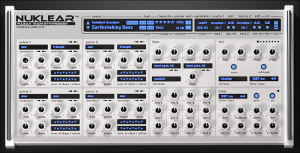
From Hamburg-Audio comes Nuklear, the first-ever virtual synthesizer instrument plugin to be based on advanced pulsar synthesis.
According to the maker of the new plugin, Nuklear comes with unique pulsar oscillators and enriches classic sound synthesis with essential new parameters; by disassociating the note pitch from the waveform length it is possible to create new, previously unheard sounds.
As opposed to classic sound synthesis repetition rate rather than waveform length is solely responsible for the resulting pitch. As Hamburg-Audio notes, the length of the individual “pulsaret grains” is controlled and modulated by a separate parameter, the “pulsaret frequency.”
Overall, the new soft synth offers advanced pulsar synthesis with 4 pulsar train generators and up to 16 voices, 26 pulsar waveforms and 4 pulsar envelope waveforms, 8 low frequency oscillators, 8 ADSHR envelopes, a built-in delay effect with sync option, a built-in distortion effect with 3 distortion types, and a 16-step sequencer with 8 programmable patterns for note and multiple parameter modulation control.
The Nuklear plugin is available in Audio Units, VST2, and VST3 formats for Windows (32-bit and 64-bit) and Mac (Intel).
Hamburg-Audio Nuklear features at a glance:
- Advanced pulsar synthesis with 4 pulsar train generators and up to 16 voices
- 26 Pulsar waveforms and 4 pulsar envelope waveforms
- 8 Low frequency oscillators
- 8 ADSHR envelopes
- Built-in delay effect with sync option
- Built-in distortion effect with 3 distortion types
- 16-Step sequencer with 8 programmable patterns for note and multiple parameter modulation control
Nuklear is now available to purchase for Windows and Mac (VST / AU) for 169 EUR (approximately $236). For more information on Nuklear, please visit Hamburg-Audio’s Web site, hamburg-audio.com.
Sunrizer on iPad – Sinevibes bank demo
This is a showcase of some of the patches from the Sinevibes bank for Sunrizer. You can download the bank for free over here: http://www.beepstreet.com/horizon
Sunrizer synth (previously known as ‘Horizon synth’) is a virtual analog synthesizer that takes the definition of iOs synthesizer to the next level. Thanks to carefully designed architecture and heavy usage of coprocessor it blurs the boundaries between iOs and hardware synthesizers. Sunrizer was built to perform and works perfectly with any MIDI keyboard or sequencer. A lot of research has been done in order to achieve unheard warmth and clarity.
A demonstration of the Monde Synthesizer MS5 Pannerama
About the synth:
“MS5 Pannerama unleashes a world of sound through a powerful, easy to use interface
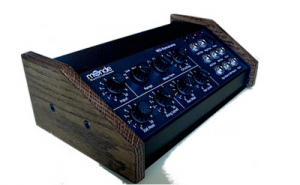
The MS5 Pannerama unleashes a vast array of analog sound sculpting tools right to the fingertips of musicians and recording professionals through an affordable efficient interface. The Pannerama, produced by Ottawa firm Monde Synthesizer Inc., takes a monophonic instrument or microphone and processes it into a sweeping stereophonic soundscape. This ergonomic unit easily fits atop a semi-modular synthesizer or beside a mixer. It allows the musician to continuously vary the effect: moving from slow smooth sine wave panning through to aggressive square wave ring modulation — and everything in between.
‘The Pannerama really broadens your instrument’s palette of sound,” explains Monde’s President and CEO, John Emond, himself a musician. “It possesses a wide range of interfacing capabilities — from analog, semi-modular and digital synthesizers to guitars and expression pedals. We call it the Pannerama because it provides an extensive range of stereophonic panning and ring modulation effects’.
This versatile unit is available in two different packaging options — a desktop unit and a “synth-top” unit. Both are available for just $535.00 plus shipping and handling. For more information (including full technical specifications) or to order, go to www.mondesynthesizer.com.
About Monde Synthesizer Inc.
Monde Synthesizer Inc. is an Ottawa, Canada-based firm specializing in electronic musical instruments and accessories. Our mission is to provide superior analog synthesizer products that enhance vintage electronic music studios and integrate with modern digital audio environments. Our instruments enhance the capabilities of traditional analog musicians and introduce new musicians to real analog sounds and interfaces.”
Really nice free sound bank for the Sunrizer synth
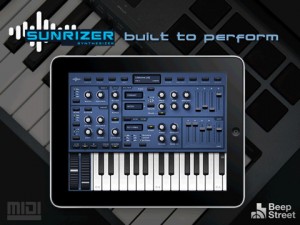
Beep Street has released a free sound bank for Sunrizer synth, featuring sounds by Artemiy Pavlov .
To install it:
- Open Sunrizer on your iPad;
- Open Safari on your iPad;
- Click this link (or browse to http://www.beepstreet.com/Sinevibes.srb);
- Select ‘Open in Sunrizer’ & click yes when you see the install prompt; and
- Enjoy the goodness.
About the synth:
Sunrizer synth (previously known as ‘Horizon synth’) is a virtual analog synthesizer that takes the definition of iOs synthesizer to the next level. Thanks to carefully designed architecture and heavy usage of coprocessor it blurs the boundaries between iOs and hardware synthesizers. Sunrizer was built to perform and works perfectly with any MIDI keyboard or sequencer. A lot of research has been done in order to achieve unheard warmth and clarity.
Highlights
True SuperSaw sound emulation, first found in the legendary Roland JP-8000 synthesizer. SuperSaw is a layered waveform consisting of multiple saw waves which are detuned to create an extremely full and epic sound. It’s possible to use 2 supersaw oscillators per voice * 7 polyphony = 98 saw oscillators playing the same time!
Two independent filters per voice with configurable routing. You can select between various filter types including classic resonant LP,HP,BP,Notch and less common like Comb and Formant. The Morph Group function lets you continuously morph of up to 30 parameters in a sound (including effects), using only the modulation wheel.
Oscillators
2 warm-sounding analog modelled oscillators per voice + 2 sub-oscillators (except SuperSaw). Available waveforms: Saw, PWM pulse,Triangle, SuperSaw.
Oscillator 2 hard-sync and configurable routing. Osc-mix, ring modulator. White noise oscillator.
Flexible multi filters
Two independent filters per voice with configurable routing. You can select between various filter types including: resonant LP,HP,BP,Notch, Comb and Formant. Configurable routing: serial or parallel with bypass option. ADSR envelope, keyboard tracking and full LFO control.
Modulation
Two LFOs per voice. It’s possible to assing each LFO to almost any parameter. 3 LFO running modes: trigger, 1 shot, global. 6 waveforms, phase and fade-in knobs. The Morph Group function lets you continuously morph of up to 30 parameters in a sound (including effects), using only the modulation wheel. Two Modulation ADSR Envelopes for amplitude and filters cutoff. Pitch and modulation wheels.
Effects
A number of effects are built in: distortion, chorus, equalizer, stereo delay. All parameters can be modulated using mod-wheel.
Eventide Space + DSI Prophet 08 = Sunday Improvisation
Just a little improv on the prophet 08 going through the space.
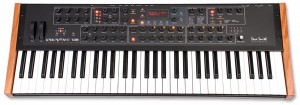
The Prophet ’08 truly signals the return of the classic Sequential Circuits Prophet synthesizers, in a beautiful, modern and ultra-stable programmable analog synthesizer! Building on the Poly Evolver keyboard, the Prophet ’08 offers eight voices of polyphony with a 100% analog signal path. The look is spot-on! Brand new, the Prophet ’08 already looks like it’s a classic vintage piece of history. And its sound really does blow you away!
Dave Smith is considered a legendary figure in the synthesizer world, he founded Sequential Circuits and designed such classics as the Prophet 5 and Prophet VS, and he was a pioneer in bringing MIDI to synthesizers. The new for 2007 Prophet ’08 brings back much of the original technology from those old Prophets (like Curtis filters and analog oscillators), updated of course, to meet today’s musicians needs.
While it doesn’t sound exactly like an original P5, it does sound and behave more like one than any other pretender. It’s cleaner, purer and a little more predictable than its 25 year old predecessors. Actually, it sounds just like the Poly Evolver, minus the digital oscillators.
Regardless, the Prophet ’08 is truly a modern day Prophet series synth. Unlike many (Roland) synths that are attaching vintage model names to their current synths even though they are almost nothing alike (Juno, SH, etc.), the Prophet ’08 is the real-deal next generation version of its predecessors. As DSI says, the Prophet ’08 is the product of evolution, not nostalgia. Of course, it includes features we now take for granted, like velocity and aftertouch. Add to that performance features like an arpeggiator, gated step sequencer, and the ability to split and layer sounds. The modulation possibilities are much deeper than anything Sequential ever produced, making it capable of producing sounds the “classics” simply could not.
It’s here ! The Jupiter-80 is now shipping
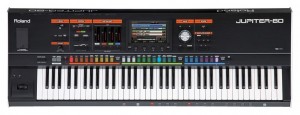
Roland has announced that the new JUPITER-80 synthesizer is now shipping.
The JUPITER-80 represents an unprecedented leap forward in the pursuit of the most authentically expressive electronic musical instrument, just as the legendary JUPITER-8 did when it was launched 30 years ago.
Delivering instrumental realism far beyond any electronic instrument ever created, the 76-key, touchscreen-driven JUPITER-80 integrates the highest caliber of analog modeling, digital synthesis, and SuperNATURAL® expressiveness available in a live performance synthesizer, while its sleek industrial design pays homage to the original JUPITER-8. The combination of Roland’s most advanced synthesis technologies and design features gives keyboardists an amazingly realistic sound and a truly authentic performance feel.
Jupiter-80 features
- Keyboard Section
- Keyboard 76 keys (with velocity and channel aftertouch)
- Sound Generator Section
- Maximum Polyphony 256 voices (varies according to the sound generator load)
- Parts 4 parts (Upper, Lower, Solo, Percussion)
- Registrations 256 (including pre-loaded registrations)
- Live Sets 2,560 (including pre-loaded Live Sets)
- Effects Multi-Effects (MFX): 4 units (parallel connection only), 76 types per each Upper/Lower (total: 8 units), Reverb: 1 unit, 5 types per each Upper/Lower (total: 2 units) Compressor + Equalizer + Delay: 1 set per each Solo/Percussion (total: 2 sets), Reverb: 1 unit, 5 types, Master Effects: 4-Band Equalizer: 1 unit.
- USB Memory Song Player/ Recorder Section
- Tracks 1 stereo track
- Playable File Format Audio File: WAV, AIFF, MP3
- Recording File Format Audio File: WAV (44.1 kHz, 16-bit Linear, stereo)
- Effects 4-Band Equalizer: 1 unit
- External Memory USB flash memory (sold separately)
- Connectors
- PHONES stereo 1/4″ phone type
- MAIN OUT L, R (XLR type)
- MAIN OUT L/MONO, R (1/4″ TRS phone type)
- SUB OUT L, R (1/4″ phone type)
- AUDIO IN stereo miniature phone type
- DIGITAL AUDIO OUT COAXIAL
- FOOT PEDAL HOLD, CTRL 1, CTRL 2
- MIDI IN, OUT, THRU
- USB COMPUTER Audio/MIDI
- USB Memory
- AC IN
- Dimensions/Weight
- Dimensions 1,231 (W) x 439 (D) x 140 (H) mm (48-1/2″ x 17-5/16″ x 5-1/2″)
- Weight 17.7 kg (39 lbs. 1 oz.)
- Other
- Arpeggiator Preset: 128 styles, User: 128 styles
- Harmony Intelligence 17 types
- Controllers D Beam controller, Pitch Bend/Modulation lever, Assignable buttons (S1, S2), Assignable knobs (E1–E4), PART LEVEL sliders (PERC, LOWER, UPPER, SOLO)
- Display Graphic Color LCD 800 x 480 dots (touch screen)
- Power Consumption 25 W
- Included Accessories Owner’s Manual, CD-ROM (USB Audio/MIDI driver), DVD-ROM (SONAR LE), USB Memory Protector, Power Cord
The Jupiter-80 synthesizer is shipping now with a suggested retail price of $3,999 USD.
Checking out the KORG microX Synthesizer
The MicroX is a compact and portable music synthesizer with the typical Korg Triton HI sound synthesis (64MB ROM), advanced control and computer-based music system integration. Although it has the word ‘Micro’ in common with other instruments in the Korg line-up, the more significant family connection is with the X50, a general purpose, entry-level synth that was launched at the same time as the Micro X.
Although its appearance may suggest it’s intended for techno-style music-making, one of the selling points of the Micro X is that it is a keyboard for all seasons. Its 640 preset Programs include a great many ‘conventional’ instruments — pianos, organs, guitars, strings, tuned percussion and so on. Plus you’ve got the GM soundset — which doesn’t float my particular boat, but it would make the Micro X appealing to people looking for an easily portable instrument to use in conjunction with a MIDI file player. But that’s to say that the Micro X doesn’t cut the mustard when it comes to more contemporary styles. Also on offer is a wide variety of digital and analogue-style keyboard pads which are both fresh and inspirational. Korg have developed many of these specifically for this keyboard, so you won’t find them anywhere else.
The overall quality of the voices is very, very good indeed: the pianos are particularly excellent, the organs are exceptional, the strings sublime. Even the acoustic guitars are pretty convincing. Among the more ‘synth-y’ type presets there are loads of fresh-sounding and really quite inspirational sounds. Also worthy of a mention are the drum sounds — a bonus here being that you can assemble them into your own kits.
For ease of selection, all the sounds are grouped into logical categories, which Korg have made easy to navigate with the provision of both a data wheel and what they call a ‘Click Point’. Looking like the miniature air nozzle you get above your aircraft seat, it’s a sort of cross between a joystick, a trackball and a mouse. To help you decide which voice might be right for the job, the Micro X offers an audition button, which triggers the sound with an appropriate musical phrase.
For real-time tweaking, the Micro X provides four controller knobs, plus a button to switch their function between three sets of parameters, giving you fast access to 12 controller parameters in all. Four of these are user-programmable per Program, four control the filter/envelope, and four cover the arpeggiator. When you’re using the Micro X as a controller keyboard, the knobs can be switched to control 12 soft synth parameters or DAW functions. You can program and store up to 64 different setups of this type, and to get you started, Korg give you a set of preset templates covering popular software packages and programs such as Reason, Garageband, Cubase and Korg’s own Legacy soft synth collection.
Novation UltraNova round up – sounds, reviews and more
Although released in April this video provides good insights on the Ultranova synth:
In this video I will show you globally the features and go thru some of its sounds…The Novation UltraNova is a analogue-modelling synthesizer with a powerful effects processor. It is a single-part synth with the latest technology. It has wavetable synthesis, powerful filters, a software editor and a revolutionary new touch-sense performance mode. It’s Also a Soundcard!
I love the sound of this synth, great VST editor pluging and library, love the soundcard feature all the inputs and outputs. Looks cool and fun bleu led wheel lights… 300 onboard sounds, with good sound search engine, upcoming artist soundpacks, Animate — Touch-sense performance knobs and great aftertouch keybed. I would had liked a dedicated Tempo knob and found the vocoder to be average….and yes there is a Unboxing video a then end of the review.
http://www.novationmusic.com/products/hardware_synths/ultranova
UltraNova Patches 1-30 by novationmusic
Exclusive interview – Alan Wilder (ex-Depeche Mode/Recoil) talks on synths, music creation and his upcoming auction
Steelberry Clones got a talk with none other than the synth legend Alan Wilder (ex-member of Depeche Mode and now front man of the electro/synth experimental act Recoil). Few can match the track record of Alan Wilder and few have had such an impact on the synth scene for the past 30 years, or so. Alan Wilder´s Recoil continues this tradition into the 21st century exploring the boundaries of electronic music, and since Alan now is in full preparation of delivering probably the world´s biggest Depeche Mode memorabilia auction at the Zion Arts Centre, we simply had to pose some questions to him regarding his music creation legacy, gear and plans moving forward.
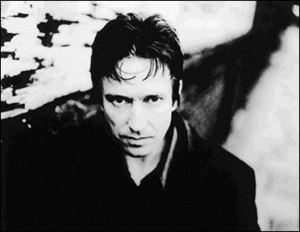
“Collected” is the name of Alan’s big auction on Saturday 3rd September, for detailed information on how to join please follow this link:
So in just a few weeks time, over 400 lots will go under the hammer as Alan Wilder sells a large selection of musical / studio equipment and memorabilia at auction. Many items are very collectable and hold special value having been used extensively in the recording sessions for classic Depeche Mode and Recoil albums, as well as live performances on the ‘Black Celebration’, ‘Music For The Masses’, ‘World Violation’ and ‘Devotional’ tours.
http://youtu.be/EHejxJ1KPxk
But for most synth/electro fans this is truly not just any ordinary auction, but a clear reason why we needed to pose some questions to Alan about the auction in general and about his music making legacy in particular.
Why are you running this auction? is it for charity, or something else?
It’s for the charity of Alan Wilder unfortunately. Let’s be honest, divorce is an ugly thing and the record business has been in crisis for some time now. I’m not over sentimental about retaining every little detail of my musical history. In fact I still have a large collection of essential items, all the releases I have played on, many photographs and unique personal things. But really, I need more space (and peace) in my life and this goes part of the way to achieving that. Indeed I found it an evocative and cathartic experience to sift through all the collectables – the actual sorting and cataloging process brought back great memories and I was able to re-live some key moments which I had inevitably forgotten about, reminding me of how lucky I have been to have enjoyed such a career, doing something I’m passionate about.
http://youtu.be/LiLyiDw6qeg
Will it not be hard to let go of many of these unique items – any particular items that are special to you, that we should keep an extra eye on at the auction?
Yes – many do hold wonderful memories of course but I don’t find myself actually using most of the equipment for example. One of my new year’s resolutions for 2011 was to start streamlining my set-up at The Thin Line Studios. My needs have altered since laptops, soft synths and plug-ins have come to the fore, and therefore passing on some vintage gear and historical items seemed like a good way to start. The Steinway grand piano and the ‘Devotional’ drum kit are two things I’m letting go with a heavy heart. Thankfully I have a second piano, and can’t really justify having two at the moment. And if I feel like picking up drumming again, I guess I can easily find myself another (cheaper) kit. As for something to keep an eye on in the auction, I think the unreleased box set known as DMBS 1-4 is likely to spark major interest. Known as the ‘Holy Grail’, these are the 4 extremely rare white labels from the Depeche Mode boxset that was never released. It was recalled at the last minute for unknown reasons. The Emulators with my own sound samples, the guitar used by Martin Gore for the ‘Devotional’ tour, and my touring wardrobe & stage clothing should all prove very popular. We have art proofs and one-off posters, and already we can see that album acetates are extremely desirable, being so rare. Only one or two are ever produced for a record release and I have quite a few of these iconic records. A few selected teaser items are currently on sale via eBay, and more will be added as we approach the auction. (http://shop.ebay.com/depechemodeatomegaauctions/m.html?_trksid=p4340.l2562)
Will you be joined at the event by any of your old band mates (DM)?
Not a chance:)
How can you part with your first synthesizer, the Minimoog?
I guess you could say that the mini-moog does hold particular value as it’s been with me for such a long time, throughout my career. It was the first synthesiser I bought around 1977, pre-Mode, when I was a member of Dafne & The Tenderspots. It was a big deal for us at the time as it was quite expensive and we couldn’t really afford it until we secured our record deal. It is still probably my all-time favourite synthesiser due to the famous fat 3-oscillator sound, and of course it’s an absolute classic. I continued to use it for many years on early Mode recordings such as ‘Construction Time Again’ and ‘Some Great Reward’ and even had a midi update added during the eighties. However, I also own a ‘midi’-moog, which is the rack-mount version of the original mini-moog. It pretty much sounds the same and serves my purpose in the studio. I found that I wasn’t using the original moog any more, and like many of these items, it has been sitting around gathering dust. Much better then that all these old synths should be cleaned, restored, repaired and passed on, to people who will dote on them, use them again – individuals who will fully appreciate their history and the symbolic (as well as practical) value they hold. And, the moog will no doubt increase in value, like most vintage gear. These synths are like old cars that need to be driven. The way I feel about most items in the auction is how I feel about the gold discs for instance – I never wanted to display them on my walls in some ostentatious way, and I think often the musicians themselves are not too bothered about those things. Gold discs mean a lot more to those who are more peripheral or outside of the original experience, but who are very passionate about what they represent.
Regarding the patch discs for the Emulator’s and Akai’s – have you made some backup of those sounds somehow?
Yes, of course, I have a copy of the sounds for myself.
The sequencer EDP Spider, was that your first sequencer? And does it work? It’s not clear on the web page – they are prone not to work.
I believe it does work but I didn’t have the unusual connecting cable to actually try it out. I guess it was my first and only non-computerised sequencer! Not that I used it much – although it was used to create the bass sequencer part for the Aggro mix of DM’s ‘Never Let Me Down Again’.
Conclusively, if you are Depeche Mode fan or collector of vintage synth gear this is the one event not to miss out on. Now moving on to the music creation side of things we wanted to ask Alan all those questions about his gear, music creation and plans for the future, that comes when having the opportunity to talk a guy that has been a part of shaping the modern synth scene.
Recoil has been on quite an extensive tour recently, can you let us know how it was received and what your forthcoming plans are?
The European shows went really well at the start of the tour, particularly in eastern parts and Germany, Hungary, Poland, France etc. The US shows were a bit up and down, but generally quite successful I would say. I do think USA is the most difficult territory to tour, and it was a bit of a relief to follow that down to South America where the fans are so passionate and the crowds always wild, excitable. It was quite an experience there.
DATAMASKIN

