
EM-Tronic Digital Synth kit
This kit provides you with all the components you need to make a small handheld digital synth. All you need to do is build the kit and find an enclosure to fit it into.
About the EM-Tronic:
With the combination of pitch, speed and mode controls, giving endless combination of sounds this Synthesizer packs quite a punch for it’s size. The best thing is I’ve included the basic software file so you can hack the sound to your hearts content.
The information in this Instructable is all you need to build this synth but if you would just like a kit to put together I have made a few up. EM-Tronic KIT
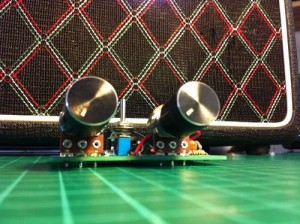
You will need:
*Circuit board ( get one made or just use strip board)
*The ability to program a Picaxe 08m2 Microcontroller.
*Electronic components( resistors, capacitors, voltage regulator, 9v battery clip, switch, potentiometers, 3.5mm socket, knobs,Picaxe 08m and LEDs
*Soldering iron and solder
*Wire cutters
*Allen key to fit the knobs
*An enclosure to fit the kit into if you want one.
Apart from these instructions I’ve included the circuit board schematic(eagle), circuit board layout(eagle) and the software file EM-tronic.BAS. This gives you all the details you need to build your own EM-Tronic. If the files don’t download or I’ve left something out please let me know and I will sort it out.
iPad App – DXi FM Synthesizer Demo
Short demo of some of the sonic features of this FM app by Takashi Mizuhiki. DXi brings FM to your iPad, but it’s closer to the DX27 than the legendary DX7. There are four operators rather than six and polyphony is reduced from 16 to three, from what we can tell. DXi also offers a neat 16-step sequencer and an effective XY performance pad, to mix operators and patterns in real time.
Description
DXi is a FM synthesizer application inspired by 80’s most popular FM synthesizer. You will enjoy creating sounds as well as playing music with this application.
FM synthesizer is still popular among many people by its unique tone. We carefully selected parameters from original synthesizer so you will be enjoy editing tone with them easily. You need to know some technique to tweak the tone, but you will be able to get DXi’s special tone and effects while having some fun!
Creating sound effects is another idea to enjoy DXi.
We loaded 16 step loop sequencer as a bonus feature!
If you remember the days of FM synthesizers, try creating the tone you remember from them.
If you have no experience with any FM synthesizer, we are sure you will be enjoying the unique tone world!
* 4 operators FM synthesizer
* Anti-ailiased oscillator
* 8 algorithms
* Envelope, frequency (Ratio or Fixed) can be set each operators.
* Feedback control on operator number 4.
* 2 master effects (LPF with Resonance and Delay)
* Import/Export function to save the tone you created. (URL schema text string format)
* Audio recording function. And you can transport recorded audio file, .wav, onto Mac/PC via iTunes file sharing.
* Clipboard audio sharing support. You can export recorded waveform to other application via clipboard. It’s compatible with Intua’s clipboard.
* Supports external MIDI keyboards via Core MIDI USB adapters. iPad users can use Camera Connection Kit. And iPhone/iPod touch users can use Yamaha i-MX1.
Sunrizer on iPad – Sinevibes bank update
A few sound examples from the updated Sinevibes bank for Sunrizer, which now comes with 40 patches. To get this bank, make sure you got the latest update of this app, and you’ll find it in the “web library”. Oh yes, make sure to check out Sinevibes products too: http://www.sinevibes.com/
Short info on the Sunrizer:
Sunrizer synth (previously known as ‘Horizon synth’) is a virtual analog synthesizer that takes the definition of iOs synthesizer to the next level. Thanks to carefully designed architecture and heavy usage of coprocessor it blurs the boundaries between iOs and hardware synthesizers. Sunrizer was built to perform and works perfectly with any MIDI keyboard or sequencer. A lot of research has been done in order to achieve unheard warmth and clarity.
Highlights
- True SuperSaw sound emulation, first found in the legendary Roland JP-8000 synthesizer. SuperSaw is a layered waveform consisting of multiple saw waves which are detuned to create an extremely full and epic sound. It’s possible to use 2 supersaw oscillators per voice * 7 polyphony = 98 saw oscillators playing the same time!
- Two independent filters per voice with configurable routing. You can select between various filter types including classic resonant LP,HP,BP,Notch and less common like Comb and Formant.
- The Morph Group function lets you continuously morph of up to 30 parameters in a sound (including effects), using only the modulation wheel.
Small Steps on SynthX 2
http://vimeo.com/30688078
>> One of my very first steps on the awesome SynthX from Wayoutware on my iPad 2. I’ts the first synth I love to play without MIDI keyboard.
Built using Way Out Ware’s award winning virtual analog technology and heavily optimized for the iOS operating system, SynthX delivers a great looking and sounding analog experience to the iPad. A mathematically modeled synthesizer, SynthX contains no samples. As a result, it is very small in size, yet it has an extremely large and professionally design sound library. An effects chain including distortion, flanger, delay and limiter are included. Additionally, a separate identical effects chain is provided to process an external signal connected to the iPad’s audio input. SynthX has been designed from the beginning for the iPad and multi-touch. It has a comprehensive MIDI implementation using CoreMIDI including MIDI Note send and receive and MIDI Beat Clock LFO sync. You can also record your performances within SynthX and use Sonoma Wireworks AudioCopy to share your performance with other iPad apps. It also supports iTunes file sharing which allows you to drag your performances in full quality into your favorite digital audio workstation.
The new Leipzig-S analogue monosynth/step sequencer
Analogue Solutions has announced availability of Leipzig-S, the latest addition to its lengthening line of critically-acclaimed, quality-crafted ‘boutique’ designs from founder Tom Carpenter in the true spirit of vintage analogue synthesisers befitting the true analogue synth enthusiast.
Evolving from its namesake Leipzig (rack-mounting) andLeipzig-k (keyboard-endowed) analogue monosynth predecessors, the rack-mountable/tabletop Leipzig-S literally goes several steps further by incorporating an in-built eight-step analogue sequencer that can be used to produce simple melodic lines as well as acting as a modulation source to affect the filter cutoff (or to create additional effects, depending on other control settings).
VCO1, VCO2, and the VCF are all available as sequencer destinations; seemingly simple, yet favourably flexible, the step sequencer can be creatively controlled (clocked) by multiple sources — at audio frequencies (using VCO2 as a clock source), or using the output of the sequencer itself as an audio source to be ‘played’ via MIDI while the eight step controls then alter the ‘waveform’/tonal content, for example, such are the adventurous advantages of packaging an analogue step sequencer with a true analogue monosynth!
The entire design is traditional early-Eighties analogue (voice and modulation) circuitry, comprised entirely of discrete components and op-amps (bar, of course, the digital sequencer controller and MIDI-CV interfacing); since the Leipzig-S is a strictly no-memory affair, all controls are not quantised, resulting in an authentically vintage sound, replete with musically desirable quirks and subtle artifacts (much in the same way that, say, a valve amp or vinyl record adds sonic character) — unlike some other modern ‘analogue’ synths that arguably sound almost as perfect as DSP analogue modelling.
With electronic percussion having influenced the choice of routings, the Leipzig-S boasts a huge range of modulation possibilities to facilitate creating the widest possible range of sounds, including deep basses, sound effects, analogue loops, and (obviously) electronic drum sounds.
With this, his latest design, true analogue synth enthusiast Tom Carpenter is confident that he has achieved a modern analogue synth that truly does sound vintage!

Leipzig-S features
- Pure analogue voice and modulation circuitry.
- Fat Moog-style filter.
- 2 VCOs (each with Glide and Sub-VCOs).
- Osc Sync and Cross-Mod.
- Flexible modulation routing.
- Analogue step sequencer (with ‘creative’ clocking options).
- Audio input (synth can be used as a sound processor).
- MIDI In (for software sequencer control).
- Rugged steel/aluminium construction.
Leipzig-S is available to order directly from Analogue Solutions for £649 GBP (excluding tax and delivery) — delivery is approximately four weeks from receipt of payment — or through one of their dealers.
Full review of Moog’s ANIMOOG by Mark Jenkins
ANIMOOG the first polyphonic synth software app by Moog reviewed in detail by Mark Jenkins, author of “Analog Synthesizers: Understanding, Performing, Buying – from the Legacy of Moog to Software Synthesis”.
Mark performs using Animoog and other iPad apps at the BIRMINGHAM THINK TANK SCIENCE MUSEUM PLANETARIUM (UK) on Saturday November 26th 2011, tickets on sale now, and on the EAST COAST USA in March 2012. www.markjenkins.co
Btw, here’s one more 
Moog released Animoog today as their first synthesizer on the iPad and I absolutely love it!
This video gives a brief overview of the Animoog’s features and also shows how expressive it is when played with an Eigenharp Pico over MIDI using poly-pressure.
The Eigenharp and Animoog seems like a match made in heaven since the Eigenharp is able to send three independent detailed per-note performance data streams and the Animoog is able to react to this on a per-note level. Also, the visualization of the sound on the Animoog is marvelous, it gives a great representation of what your sound is doing.
The iPad is hooked up to my MacBook Pro using USB MIDI from the Alesis iODock, the Eigenharp Pico is also hooked up to the laptop and sends MIDI from the EigenD application to the ‘dock’ MIDI port. This uses a small MIDI-only Eigenharp Pico setup that loads very quickly and provides 16 MIDI playing keys with poly-pressure and three independent data streams for each key (pressure, left/right, up/down), as well as two 3D controller keys that are somewhat similar to little joysticks and are sending each three independent streams of MIDI CC data also.
Chroma Polaris Analog Synthesizer
“This is a song made entirely from a Chroma Polaris synthesizer (with a bit of FX during mixdown). Not the most thrilling video from a visual perspective (these are just some pics I had taken awhile back for an eBay auction), but uploaded mostly for an example of its sound.”
Hardware close up:
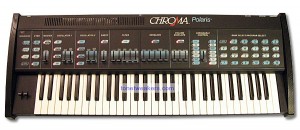
The Chroma Polaris was the second synthesizer made by Fender/Rhodes after they took over ARP, following their classic Rhodes Chroma. It has a classic analog ARP-like sound, kind-of tinny but also fat. Sounds can be layered up to 6 voices. It has typical analog synth controls including a cool ‘sweep’ knob for sweeping through the LFO or analog filter cutoff parameters. It also has a simple real-time sequencer and 132 memory patches.
There’s also a nice and colorful layout with sliders similar to Roland Juno synths, membrane push-buttons and a large velocity sensitive 61-note keyboard making the Chroma Polaris a very nice synth. Fully MIDI-equipped, the Polaris will transmit and receive all its edit controls through MIDI as well as the ability to play up to three patches at once. Unfortunately they are rare and usually hard to find.
Moog’s iPad synth finally released – Animoog
A Tour of Animoog from Moog Music on Vimeo.

Moog’s highly anticipated Animmog has reached the stores and it sure looks like a real treat for synth fans. If you have downloaded it and tried make sure to leave your comments or send us your links to Youtube reviews that you have made.
“Animoog, powered by Moog’s new Anisotropic Synth Engine (ASE), is the first professional polyphonic synthesizer designed exclusively for the iPad. ASE allows you to move dynamically through an X/Y space of unique timbres to create a constantly evolving and expressive soundscape.
Animoog captures the vast sonic vocabulary of Moog synthesizers and applies it to the modern touch surface paradigm, enabling you to quickly sculpt incredibly fluid and dynamic sounds that live, breathe, and evolve as you play them.
Visually captivating and sonically immersive, Animoog brings iPad based music production to the next level. Whether you are new to synthesis or a professional, Animoog’s unique user interface gives you the power to easily create a visually vibrant and sonically rich universe. It is the ultimate tool for total creative expression!

Animoog’s diverse library of timbres is derived from analog waveforms captured from classic Moog oscillators, both vintage and modern, and run through a boutique’s worth of high-end outboard and analog signal processors. These include modular synth panels, Moogerfooger pedals and more.
Animoog is the newest innovation in creative tools from Moog Music, the legendary electronic musical instrument company founded by Bob Moog in Asheville, NC.
We want as many people as possible to experience Animoog. We have decided to make Animoog available for thirty days at the introductory price of $.99. Regular price $29.99.
Key Features:
• Anisotropic Synth Engine (ASE) – An exciting new Moog technology that allows the user to move dynamically through an X/Y space of unique timbres to create an expressive and constantly evolving soundscape.
• Timbre page – Assemble unique sounds in the X/Y space from timbres of a wide variety of vintage and modern Moog synthesizers and pedals. Note: this is NOT simple sample playback.
• Polyphonic Modulation – Simply slide your fingers to control multiple modulation parameters in Animoog right from the keys.
• Polyphonic Pitch Shifting – Easily manipulate the exact pitch of each note in a chord by rotating or sliding your fingers.
• Delay Module – A classic analog style ping pong delay.
• Thick Module – From bit crushing to unison voice detuning and drive, this module adds depth, edge and character to Animoog’s already massive sound palette.
• Moog Filter – The classic four-pole Moog ladder filter with High Pass, Low Pass and Band Pass modes.
• Record Module – Record your performance and overdub new layers, or play along live. Transfer recordings between Animoog and any other apps which support AudioCopy/AudioPaste
• Path Module – Direct ASE through Animoog’s X/Y space to create new expressive and shifting sounds that will blow your mind!
• Orbit Module – Control the rate of orbit in the X/Y space around the path you created for subtle to insane voice manipulation.
• Flexible Modulation Matrix – Amp, Filter and Mod Envelopes, LFO with infinitely variable wave shapes and sync, and four super flexible and assignable modulation slots.
• MIDI in/out – Use your Little Phatty or any other MIDI controller to control Animoog.”
Enjoy
Time machine – YAMAHA SY22 Vector Synthesizer 1990
Analog Audio continues to update us on classic vintage synths, today’s feature is the Yamaha SY22:
The Yamaha SY22 came out 1990. It is an interesting vector synthesizer. Other vector synths are the Sequential Circuits Prophet VS and the Korg Wavestation – but the SY22 was the most affordable of its kind.
Although instruments like Roland D-50 and Kawai K-1 have joysticks to mix waveforms, they are not vector synths. A real vector synth can reproduce the vector moves in a sound program.
Rumors said that some ideas from the developer team of Sequential were implemented, since they worked for YAMAHA for a short period of time.
The SY22 is a quite simple vector synthesizer – also simple to use and to program. The SY22 has no filters at all. Interestingly, 4 elements can built a sound, 2 FM (4-op frequency modulation) and 2 AWM (sample playback).
It also has a built in effect processor for reverb and delay. You can not tweak the effects except intensity.
It’s much more easier to program sounds on the SY22 than on a Korg Wavestation. The programming on a Korg WS is a nightmare, because you have to handle with the 34 patches / 50 performances problem. Also you can’t program vector moves in realtime – like on the SY22.
Of course, a Wavestation sounds “bigger” in the end, but the SY22 sounds not bad, either. The SY22 is great for strange pads and ambient stuff.
I played the YAMAHA SY22 without any additional effects or eq. The most sounds you are hearing in this video are my own creations – so don’t expect these sounds when you buy one…
Featuring Arctic Keys for iPad
Arctic Keys is a synthesizer for Apple iPad.
Music: Carl Helder
All sounds: Arctic Keys
Drums: Molten Drum Machine
Get the Garageband project featuring the music in the video
http://dl.dropbox.com/u/33525372/ArcticKeys-PromoTrack.zip
Arctic Keys has several outstanding features. The first is alias free oscillators with the analog modelling DSP, so no samples are used and no digital artefacts are present. This works great on say a flute patch which can be played at very low key registers all the way to the top of the keyboard without breaking up with that digital whistle you sometimes here in other synths. So this gives a great quality to the audio synthesis, like e.g a Nord Lead.
Secondly we have a step sequencer that can modulate many parameters on the synth. It’s more like a Tetra than a typical dual-oscillator subtractive synth. Plus classic arpeggiator and master effects.
Thirdly we have full CoreMIDI support, MIDI Learn, phrase recording with Sonoma AudioCopy export, wav export, MIDI file export, sharing via e-mail and wi-fi as well as iTunes. All with an attractive easy to use user interface. I’m really excited by it and I hope you will be too!
DATAMASKIN

