
Moog: Phatty Firmware Update OS v3.1
Moog has announced the release of Phatty OS v.3.1, a major firmware upgrade to the very popular and portable Phatty family of analog synthesizers. The upgrade to the Phatty operating system coincides with an aesthetic upgrade for the Little Phatty Stage 2 Edition, as Moog introduces new black sidepieces.
New features in the Phatty OS v3.1 update include the following features that improve power, sound and control:
- Volume Velocity Sensitivity: The ability to map note velocity to output volume with fifteen adjustable levels of sensitivity saved per preset. [Tribute Edition hardware does not currently support this feature]
- Legato Glide: Automatically engage the pitch glide between legato notes. Non-overlapping notes snap instantly to a new pitch. The user is able to play or sequence dynamic bends and slides mixed with cleanly-articulated notes.
- LFO Reset: The ability to reset the LFO cycle at the start of each note. Two LFO trigger modes provide dynamic new modulation possibilities.
- Sustain/Hold Mode: A sustain pedal or control voltage plugged into the CV GATE input jack can now be used to send MIDI Sustain on/off, and to polyphonically sustain MIDI notes from the Phatty keyboard.
- 14-bit MIDI: All Phatty synths can now send and receive high-resolution 14-bit MIDI messages for critical voltage-controlled parameters.
- MIDI Output Filtering: New options control which MIDI CC messages are sent from the Phatty, for maximum compatibility with external gear.
- Expanded MIDI Clock sync options: 22 clock divisions including triplet values for both LFO and Arpeggiator MIDI sync. Clock divisions range from 32nd triplets up to 4 bars.
- Improvements to Arpeggiator:
- Global Arp Setup menu: Set important arpeggiator parameters at a global level. Arpeggiator also remains active when presets are changed.
- Gate Length: Adjust the arpeggiator note length from 50% to greater than 100% (overlapping), for a range of new sonic textures.Arp Clock Send: Arpeggiator can now send MIDI Clock, MIDI Start and Stop messages, allowing you to synchronize other gear to the Phatty internal clock.
- Improvements to Polyphonic Mode:
- New polyphonic note-allocation scheme: Uses a “round-robin” algorithm to share notes across multiple Phatty synths in a natural and very playable way.
- Polyphonic arpeggiation: Multiple ways to use the Arpeggiator across a poly chain of Phatty synths, from tight integration to completely freeform.
Links:
Daniel Miller from Mute interviewed by Richie Hawtin
Daniel Miller (Mute, Label, chairman / founder) Interviewed by Richie Hawtin (M-nus, artist)
Miller founded probably the most successful indie label of all time, and after a period with EMI, is back as an independent. Richie Hawtin interviews the man who signed him to Novamute as Plastikman. In the interview you’ll get to learn some more on the very early career of Miller, a student who protested more than he actually attended classes etc. Also included is Miller’s aversion to presets and musicians not sampling their own drums. And although Hawtin isn’t exactly the best interviewer around, his natural, honest way of treating the different subjects makes it a very interesting listen/watch with the private inside kitchen details as an extra.
Native Instruments goes to West Africa
Native Instruments Discovery Series brings polyrhythmic percussion and melodies to your productions with West Africa. This distinctive Komplete instrument includes customizable drum patterns, solo percussion, and enchanting tonal instruments from Mali and Guinea.
www.native-instruments.com/westafrica
Demonstrating the Mochika XL sequencer section
This video demonstrates the sequencer section of the Mochika XL, showing the 8 different modes including the oscillator mode and the midi synchronization. you can hear the raw mochika sound with no effects, the drums are made with a computer running FL studio, synchronized using a USB to Midi cable.
Specifications
This synth features one analog square and saw waveform VCO (voltage controled oscillator) with a huge pitch range, from subsonic to ultrasonic sound. Glide effect with a large range for radical portamento effect. One square and triangle waveform LFO (low frequency oscillator), that modulates the VCO for the vibrato effect or the VCF for a tremolo effect, creating old school arcade Atari-like sounds. White noise generator that triggers the VCO and can create percussion like sounds, or mix the the noise with the VCO. Also, it has a built in vactrol based Low Pass and High Pass Filter with cut off and peak controls and a envelope generator with decay control to create a wide sort of timbres and sound possibilities.
Built in 8 step sequencer with global gate time control, note on/off switch and pitch slider for each step.
The built in sequencer also has 8 playing modes:
Oscillator mode, the Mochika becomes a drone oscillator, you can switch in real time between the 8 notes tweaking a knob.
4 step, 6 step, and 8 step sequencer mode.
4 step, 6 step, and 8 step forth and back sequence mode.
Random mode, it generates a large pseudo random sequence, seed of chaos!!!
The Mochika XL features a MIDI input to sync it any midi device sending midi clock signals, the mochika can sync 1, 2, 4 and up to 8 times the tempo of the master clock midi device. All the Mochika sequencer modes, except oscillator mode, can be midi synchronized. Also the instrument is ligthed with 1 bright red led that indicates the LFO Rate, and 8 red leds to indicate the step that is being played. Very useful when you play it on a dark stage.
The Analog Sequencer is packed in a cool laser cut clear acrilic case that shows all the hand made analog circuitry. The instrument is powered directly from 110V or 220V AC depending of the country. Dimensions: 177mm(W), 228 mm(D), 80mm(H. incuded rubber feet and knobs)
Have you purchased a Tenori On – time to get rid of that one too
Yamaha has released a simulation of the Tenori-On on the iPad. works on the iPhone, too. The iOS version of the world-renowned TENORI-ON brings you a completely new musical interface. Even if you don’t know much about music, you can create music intuitively as if you were arranging sounds in space. The music that you see on the 16 × 16 grid of buttons is the music that is performed.
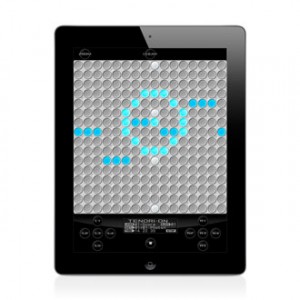
On the 16 × 16 grid of buttons, basically, the horizontal direction is time, and the vertical direction is pitch. By laying sounds on these buttons, you can combine rhythms and melodies to produce music. A button will glow when its sound is produced. The movements of the glowing lights produce a visual performance. 16€ isn’t cheap but cheaper than the hardware was/is. It has all modes and functions of the original. it can sync to other TNRs via the Game Center (from Apple). the data on the Hardware SD Cards can be load to the App as well. not said: if it loads a sample stack of 48 sounds as the original and sending MIDI signals isn’t clear, but for that price I’d assume it has to… Since Yamaha offer a MIDI connection kit it is very very likely it sends MIDI (iOS 4.3). since the built in sounds are quite strange I just like to check for it’s sample upload capability.
There are six different types of performance modes that you can select for each layer. You can make elaborate music by combining different modes. In score mode, the most fundamental of the modes, you can arrange sounds horizontally (temporally) and vertically (by pitch). In the exciting random mode, the sounds that you arrange are not just played in order—the melody and rhythm constantly change as twists are added. In draw mode, you can perform music by tracing your finger across the buttons as if drawing a picture. In bounce mode, the glowing lights are like bouncing balls that produce sound when they fall. In push mode, you can continuously change the sound as you perform. In solo mode, which is fun for solo performances, you can easily adjust the speed of repetition and the pitch.
Impresse your friends by beatboxing them :-)
Totally useless it seems to me, but hey it might be a fun conversation piece. What do you do when two friends show up at home? Cambox them! Cambox is an amazing app on iOS devices. Capture any moment of your life, remix it and share it in seconds. Fun guaranteed.
Available on the App Store
New plugin to add more color and character to your sounds
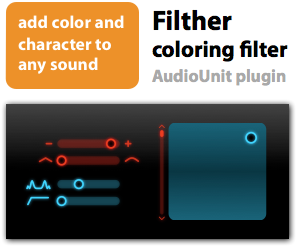
Sinevibes has introduced Filther, an AudioUnit effect plugin designed to add color and character to any sound.
Here’s what they have to say about Filther:
At it’s heart is a steep -48 dB/octave low-pass filter with innovative dual-stage waveshaping distortion. Coupled with an input envelope follower, this filter can do anything from deep low-end isolation, juicy wah-wah to growling sweeps and waveform sculpting. And with clever automatic balancing, Filther always stays incredibly smooth and punchy.
Features:
- Eight-pole, -48 dB/octave low-pass filter with dual-stage waveshaping distortion.
- One-pole finishing high-pass filter.
- Input envelope follower with adjustable sensitivity and smoothness.
- Intuitive, resolution-independent user interface.
Filther is available now for $19. Audio demos and a demo version are available at the SoundVibes site.
How the city of Eindhoven is turned into music
Who wouldn´t want one of these at home? A physical model of the city of Eindhoven is rolled onto a drum and attached to a piano. Buildings with each a unique form and dimension hit the piano keys. The tall buildings in the city centre have a heavy touch; the low-rise villas to the South create considerably gentler sounds.
More info: http://akkogoldenbeld.com/
OSC Physics Demo
OSC Physics sending data to Max/MSP and Ableton Live.
Max receives OSC messages from the iPad and visualizes and converts it midi. Midi messages are sent to Ableton Live to control audio effects.
So, how many keys do you need on your MIDI – thousands??
This is a velocity sensitive MIDI isomorphic keyboard. 192 total keys. The project came out of Louisville Soundbuilders, a fortnightly meeting of circuitbenders, synth engineers and experimental musicians. After seeing a couple of my failed variations of a single-bus isomorphic keyboard, Tim was intrigued enough to design one even better. He designed multiple PCBs that sandwich together with multiple switch types for velocity sensitive keypresses.
More development on the way! We’re working on molds/methods for making hexagonal keycaps. And I’m working on an Arduino-based controller as an alternative to the midibox controller Tim has working already.
Watch the progress at http://soundbuilders.lvl1.org
DATAMASKIN

