
Do you want to be a true Wireless DJ ?
The check this iPad app out!
iPad touch controller for DJs, works wirelessly with Traktor Pro or anything else, easy to set up

Multi-touch mixer and decks
Faders, EQ, headphone and playback controls, needle search and pitch bend — it’s all there.
Magic Stripes for pitch bending and direct manipulation
We have a better idea than simulating a jog dial: Magic Stripes. One finger for pitch bending, two for ultra-precise tempo adjustment.
Brand new video from I:Scintilla
Official music video for “Swimmers Can Drown” by I:Scintilla from the album “Dying & Falling”. I:Scintilla is a post-industrial music band from Chicago, Illinois, consisting of Brittany Bindrim (vocals/lyrics), Jim Cookas (guitar/programming), Vincent Grech (drums), and Brent Leitner (guitar/programming).
Directed by Chris Folkens. Ordering info available at http://www.iscintilla.com/
MashTactic mashup tool!
MashTactic is a plug-in that can separate various parts of a full audio mix.
Many sounds, include vocals can be cut or isolated from a track.
* 8 stereo areas of sharp cut-off filtering.
* Adjust levels separately in all selected zones.
* A great tool for mashup music makers, as vocals and other sounds can be identified and manipulated within a full mix.
* Works on transients, allowing the user to emphasise or cut percussive sounds giving control over punch in drum tracks.
* Great for analysing balance and frequency mix of a track you’re composing.
Coming soon to:
http://www.quikquak.com
SynthStudio Packs becomes freeware
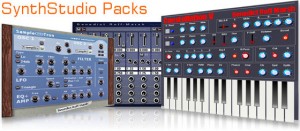
Benedict Roff-Marsh has announced that SynthStudio Packs and PreRoll Recorder are now available as a free download.
The time has finally come. I have had a great run with SSP but the time has come for it to cease being payware and to go free. For the next wile I will still hold SSP & PRR on my site and they can be downloaded free – with the hope some will buy some of my music or show their appreciation in some other way.
I really want to thank all the people who have supported the SSP not only in purchasing and using but in promotions and generally adding to the Pack. I value each and every one of you and it is with some tugging of the heartstrings that I make this move.
Please enjoy (or continue to enjoy) SSP I + II + II + IV + PRR
The SynthStudio Packs include various VST instrument and effect plug-ins for Windows PC.
Updated multi-functional vocal channel strip effect plugin
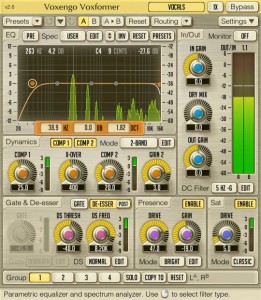
Voxengo has released version 2.6 of Voxformer, a multi-functional vocal channel strip effect plugin for Windows and Mac.
The most important change this version implements is the addition of 3 new saturation modes that extend the sound coloration palette you can use to process your tracks.
Changes in Voxformer v2.6
- Added 3 new modes to the saturation module.
- Plugin’s popup-windows now recover last position after reopening.
- Mouse backward and forward buttons can be used for filter type and parameter value selection.
- The “Alt” key can now be used to adjust knob parameters synchronously in several channel groups.
- The “Min Infrastructure” user interface display mode added.
- The “Flat Level Meters” level meter display mode added.
- The “Show All Filter Shapes” global switch added.
- Version change history information window added.
- The “Do Not Show Latency Changes” global switch added.
Voxformer for Windows and Mac (VST/AU) is available to purchase for $69.95 USD.
Background info:
Voxformer is a multi-functional vocal channel strip plug-in for professional audio applications. Combining several professional quality processing modules, Voxformer was designed to be a comprehensive solution for all your vocal processing needs – be it spoken or sung vocals.
The coolest feature of Voxformer is its one-knob vocal compressor. Using only a single knob, you can get a tight, open and definitive professional vocal sound with an excellent articulation in no time. You do not have to worry about common ratio and make-up gain controls since they are automatically selected by the advanced compression algorithm while attack and release parameters are stored in a mode preset. Moreover, Voxformer features two compressors of this type, allowing you to apply either a two-band or a two-stage (serial) vocal compression.
Voxformer also features the de-esser with selectable center frequency and threshold. Multi-band noise gate is available, which, in a manner similar to the compressor, was designed to bring ease of tuning while providing excellent sonic results. For those who like a saturated vocal sound, Voxformer implements a special module which applies a smooth saturation. Another useful feature Voxformer has to offer is the presence boosting module, which you can use to add some shine and space to the vocals.
As a finishing touch, Voxformer offers you a flexible easy-handling 5-band parametric equalizer (pre/post selectable) with a real-time output stage fast Fourier transform (FFT) spectrum analyzer display. In most cases Voxformer can be used for processing of a wide range of instruments beside vocals.
Music for a little Robot
KORG DS-10 is a music creation program for the Nintendo DS that emulates the Korg MS range of synthesizers. The DS-10 creates sound with two analogue synthesizer emulators, each with two Voltage-Controlled Oscillators (the Korg MS-10 had only one VCO). The VCOs feature a sawtooth, a pulse (with a non-modifiable pulse width), a triangle and a noise waveform. There is also a four part drum machine that uses the same sound creation techniques as the synthesizers. The sounds made by each of the synthesizer emulators are modified using virtual knobs to change the value of standard synthesizer parameters such as cutoff frequency and waveform shape. Additionally there is a screen where users can patch certain parameters to be modified by an LFO, the envelope generator, or VCO2. Those new to Korg synthesizers may find the original Korg MS-10 Manuals[4] useful in understanding the function of its components.
In this video:
100% Korg DS-10 European version (no PLUS version)
Flipnote Studio on Nintendo DSi XL + Nintendo 3DS
video recording: JVC Everio GZ-HM330
sound recording: Lenovo Laptop + Audacity
Until now I checked out Nintendo DSi music applications like RYTMIK, Rhythm Core Alpha, Music On: Drums and Music On: Retro Keyboard. This time I tried to make music with Korg DS 10.
Feel the power of voltage
In this video:
A first try with a Strymon El Capistan delay which is voltage controlled by Yusynth Quadrature LFO. A CGS Master Divider module takes the clock input from a Mobius Future Retro and Q962 Sequential Switch to send various division of time to several sequencers and such. Dinsync clock controls an STG Time Suite and a CGS Harmonic Sequencer sends pitch voltages for all the melodic stuff.
KORG PROPHECY sound demonstration
The Korg Prophecy is considered one of the earliest (mid-nineties) “virtual analog” (a.k.a. VA) synthesizers, although its synthesis capabilities went beyond many of its VA contemporaries.
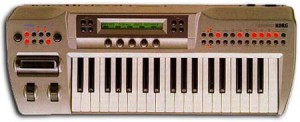
Along with the Korg Trinity, this little synth is a direct ancestor of the ill-fated OASYS project. It was a small 3-octave monosynth, a pioneer of the late 1990s “return-to-analog” trend. Offering assignable knobs, a “log controller” (a mix-up of a modulation wheel and ribbon controller assembled like a “sausage”) and many other control sources, it invited players to tweak and shape the sound both easily and quickly. Deep editing, however, wasn’t as straightforward, because the sound engine contained no less than 13 DSP-modeled oscillator types, each one offering too many parameters to adjust. Probably, the most valuated and used DSP models were the analog model (based on the classic osc+filter+amp scheme, although with many powerful enhancements), the VPM model (some sort of FM synthesis which cleverly avoided Yamaha’s FM patent) and the “physical modeling” algorithms. The latter deserves special mention. In the mid to late 1990s, it was believed that digital “physical modeling”, which recreated the sound of acoustic instruments (brass, strings, woodwinds, etc.) using DSP algorithms instead of samples, would eventually replace sample-based synthesis of those instruments, because of its unprecedented realism and expressiveness. As time passed, physical modeling seemed to lose its appeal to both manufacturers (because of the cost of investigation and implementation) and final users, who complained about the realism of the models and limited polyphony. Also, more complex playing techniques were required to play the models in a convincing way. Nevertheless, the Prophecy’s low cost and broad implementation of sound generation techniques earned it a significant place in synthesizer history.
Technically, the Prophecy offered one-note monophony, a decent set of effects (including distortion, wave shaping, delay/reverb and chorus/flanger), and 128 memory locations for user sound programs. No disk drive or sequencer was included, but its integrated arpeggiator was a source of “instant gratification”, as some magazines put it. Standard MIDI features and a pair of audio outputs were also offered.
Korg made a major breakthrough at the time, offering a low cost expansion card for Trinity users, which incorporated the whole sound engine of the Prophecy into the already powerful workstation. Gone was the arpeggiator and some minor features, but the editing was much improved through the Trinity’s big touchscreen, and the workstation’s effects processing was a huge improvement over the Prophecy’s basic set.
Strictly analog: Kebu – Pulsar
Background info: “This tune is the second single from my upcoming album. I composed the tune already in 2008 and the tune is a tribute to one of my biggest influences, Jean Michel Jarre.
Only analog synthesizer were used in recording the tune. The tune was also recorded by analog gear only and mixed with an analog mixer. The tune is from Kebu’s upcoming debut album, which is planned to be released in 2012.”
You can buy this single from Ubetoo for 0.99 euro:
http://www.ubetoo.com/store/kebu/pulsar/a2136
Equipment used: Hohner String Performer, Roland Alpha Juno, Roland Juno 60, Korg Mono/Poly, Korg Poly-61, Moog Prodigy, Logan String Melody, Arp Axxe, Touched by Sound DRM1, Vermona DRM1 MkIII, Roland TR-808 (snare attack only), Electro Harmonix Small Stone, Lexicon MPX500, Allen&Heath GS1, Yamaha MT4x. Cubase & Live only used as MIDI sequencers with the tape sync handled by a Roland TR-626.
Modular Crickets
Waveshape audio rate FM into highpass filter, frequency modulated by Heisenberg smooth output.
DATAMASKIN

