
Chip tunes: GaMBi Trailer
GaMBi is an iOS app for chiptune fans, performers, DJs, and remix artists, allowing deep customization of classic video game sound and connection with other music-making apps via channel control, AudioCopy and Audiobus.
Shown in the trailer is footage of the Audiobus-compatible app, Loopy. Learn more about Loopy here: http://loopyapp.com/
New album from Interpol

The first studio audio from Interpol’s upcoming album “El Pintor”, their first in 4 years, will be out on August 18th. “All The Rage Back Home” can be already be heard/viewed below. The video was directed by Paul Banks and Sophia Peer. “El Pintor” will be released on September 8th.. One may notice that the title of the album holds the same letters as the band’s name of course.
Vinyl fans can already order the album itself right here onAmazon UK


WASP synthesizer (Electronic Dream Plant ) demo – recording WASP synth sample library
WASp – vintage analog synthesizer by Electronic Dream Plant . Recording Wasp synth sample library
purchase at http://tikov.com/samplelibraries.htm
thanks ReSet Sakrecoer for synth www.sakrecoer.com
The Wasp is a quirky little synthesizer that, despite its toyish look, is a quality instrument capable of fun and funky analog sounds. It really is black and yellow too, just like the insect it is named after. Probably its most distinguishing feature is the 2-octave keyboard which uses non-moving touch-sensitive keys. The flat little keys are sensitive only to your electro-static touch. It’s a nifty technology for 1978, but in reality they are unreliable and difficult to play. Other unique touches include a little speaker built-in to the synth and EDP’s own pre-MIDI connector ports for linking it to other Wasps and EDP gear.
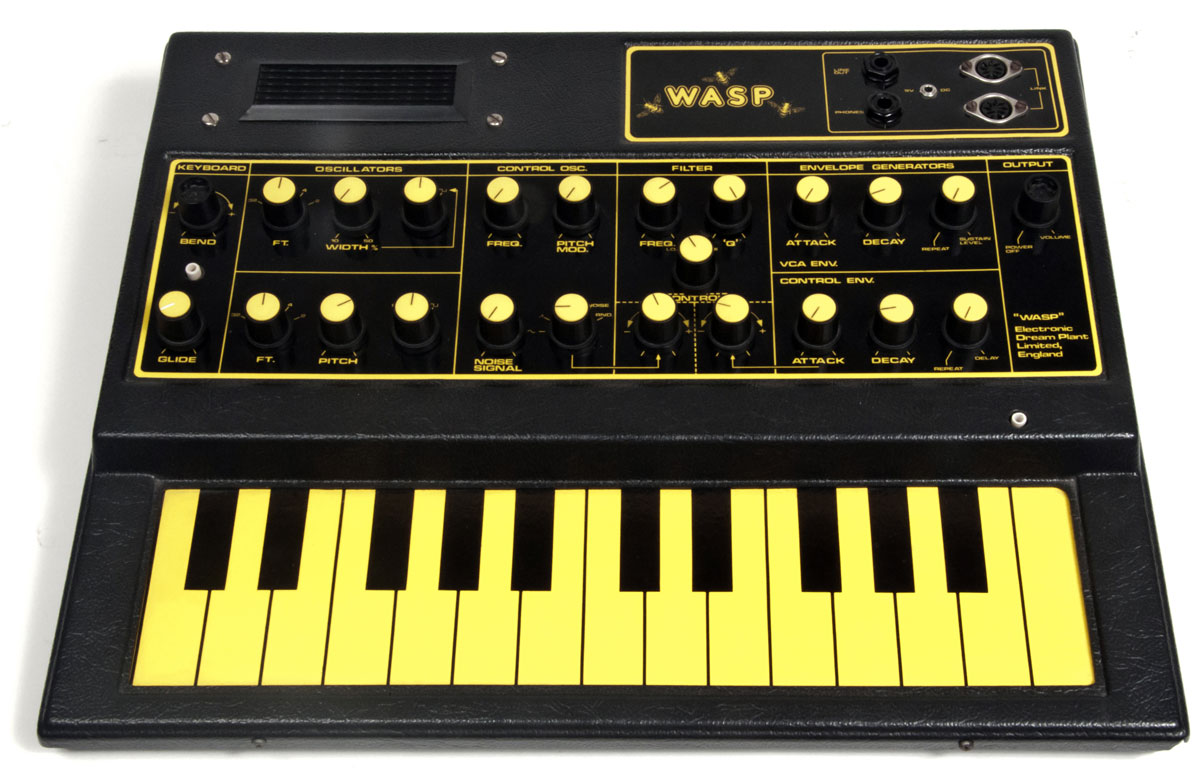
A look under the hood, however, reveals some nice surprises. The WASP is monophonic and powered by two digital oscillators supported by analog filters, envelopes and controls. This makes it one of the earliest compact digital/analog hybrid mono-synths, and it sounds great! The Wasp offers flexible subtractive synthesis. It’s pretty easy to dial up some cool bass, synth, and other classic monophonic sounds. Its designer, Chris Hugget, also designed the Oxford Synthesizer Company’s venerable OSCar Synthesizer.
Vermona ER-9 — analog rhythm machine
1976 made in GDR
Playing all the presets in a moderate tempo dry without FX.
The noisy beginning and end are due to the stormy wheather  the noise does not come from the machine!
The ER-9 was built by Vermona from East(!)-Germany aka DDR in the early 1980ies (or even late 1970ies?). It has 16 Rhythms which can be mixed by pressing multiple Switches and 9 Instruments: Bassdrum, Tom, Bongo, Claves, Cowbell, Snare, Cymbal, Highhat and Maracas. The first 6 Instruments are built with a double-T-Matrix, mostly around just ONE transistor. All voices are mixed into a 2-transistor-mixer. Extremely clean, simple and efficient.
Inside there are multiple cards which are stuck into simple sockets. Most cards are housing 2 or 3 voices. On top of the cards are trimpots for calibration. On most cards one is for calibrating the damping of the doubleT-Network-oscillation or simply spoken: decay for BD, Tom, Bongo, Clave or Cowbell, which has 3 Oscillators, most analog drumcomputers including 808 just have 2 for the cowbell. If you stumble upon a ER-9 and the owner sais “it just makes a constant tone when i plug it on” i guess it is just a decalibrated pot letting one voice selfoscillate.
Propellerhead: ‘Take’ Creative Vocal Recorder for iPhone
For more about Take:
http://www.propellerheads.se/take
Sing, rap, hum, strum. Take lets you capture your musical ideas – anytime, anywhere. Take combines the drop-dead simplicity of your voice memos with features custom-tailored to vocalists’ needs. Record harmonies along with your voice, blend in effects to sweeten the sound and sing along to inspiring beats and rhythms.
- Sing, hum, rap, strum. Take captures your musical ideas—anytime, anywhere. With a single tap you’ll be recording, beatboxing, overdubbing, riffing, writing, trying out song ideas that you’ll want to share with the world.
- Feel the groove. Stay on the beat. Keep in time. Inspiring built-in clicks, loops and beats to kick start your creativity.
- Add new parts, double them up, create harmonies, sketch out the song
- Three tracks to build on your tune and flesh out your ideas
- Surprise yourself with how good you sound.
- Processing and effects that make your iPhone’s mic shine.
- Share on Facebook, Twitter, email.
Designed by Propellerhead Software—makers of Figure, Apple App of the Year 2012—Take is a creative recorder for musicians. It’s got the same drop-dead simplicity you’ve come to expect with your voice memos, with features custom-tailored to vocalists’ needs—like the ability to record harmonies along with your voice, blend in effects to sweeten the sound and sing along to an array of beats and rhythms. Take will soon become your go-to sketchpad for musical ideas.
Note: Take is optimized for the built-in microphone on your iOS device. Wear headphones to hear your backing tracks. Best results come from using headphones (the ones without an integrated microphone) and recording into your iPhone/iPod/iPad mic directly.
Universal Audio – Thermionic Culture Vulture Plug-In

Universal Audio has announced the Thermionic Culture Vulture Plug-In for their UAD Powered Plug-Ins platform and Apollo audio interfaces.
The British-made Thermionic Culture Vulture has long been admired for creating studio-grade, high-gain valve distortion. After a multi-year engineering effort from Universal Audio, producers and engineers can now track and mix with the only authentic circuit emulation of this one-of-a-kind valve distortion tool.
The Thermionic Culture Vulture plug-in models the original hardware’s three distinct all-valve circuit topologies and features Universal Audio’s first ever pentode tube circuit model. The Culture Vulture plug-in also offers two features not found on the original hardware — a Dry/Wet Parallel Mix control and a Link function for a perfectly matched stereo image to maximize workflow and preserve balances.
In addition, the all-new Thermionic Culture Vulture plug-in features presets from famous Culture Vulture users.
Thermionic Culture Vulture Plug-In Key Features:
- The world’s only authentic emulation of the legendary high gain, dual-stage valve distortion unit
- Can subtly alter or completely transform a single track or an entire mix with valve coloration
- Dial in rich harmonic content with three diverse valve topologies — including UA’s first ever pentode tube emulation
- Includes parallel Dry/Wet processing and Link controls not found on the original hardware
Pricing and Availability. Available for purchase from UA’s Online Store for $299, the new Thermionic Culture Vulture Plug-in is part of the new UAD Software v7.8. (Requires a UAD DSP Accelerator Card or Apollo Audio Interface available from authorized dealers worldwide).
First Look at the new Modulus 002 in action
modulus.002 takes British synth power polyphonically to world stage, the press release below:
BRISTOL, UK: breakthrough British electronic musical instruments manufacturer Modulus is proud to announce availability of modulus.002 — the first analogue/digital hybrid polysynth to have been designed, developed, and manufactured in the UK for four decades — as of July 10…
Even though the technology for mass-market synthesisers was patently pioneered in the UK in the leafy London suburb of Putney at the tail end of the Swinging Sixties, the last time that a polyphonic/multitimbral analogue synthesiser was designed, developed, and manufactured in the UK — actually within Wales — was way back in the late Eighties. It is with utmost pride, therefore, that Bristol-based Modulus has not only succeeded in bringing back that pioneering spirit to Blighty with the mighty modulus.002 but has admirably succeeded in doing so by creating an amazing modern-day musical instrument that truly represents one giant leap for ‘synthkind’ with a sizeable number of notable new features to its innovative name. No easy task in climatically cynical conditions during an era of increasingly shortened attention spans, synth-wise or otherwise. Been there, done that, bought the (Moog) T-shirt, some might cynically say!
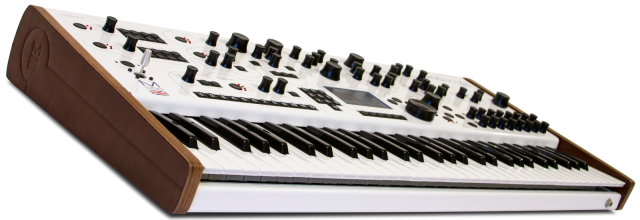
Yet surely soothsaying is a better bet in this case? Why? Well, modulus.002 even sports some world firsts! So what makes modulus.002 tick, then, and what, exactly, is it that makes it so special in comparison to today’s commercial and ‘boutique’ offerings from other manufacturers, both bigger and smaller? Let’s look at some straightforward facts for starters…
As an analogue/digital hybrid keyboard synthesiser (using an aftertouch-enabled premium Fatar semi-weighted, five-octave key mechanism), modulus.002 provides 12 discrete voices of polyphony with full multitimbrality if so desired. As such, it features two NCOs (Numerically-Controlled Oscillators) per voice for exceedingly high resolution and stability with wide-reaching waveform selections, together with two sub-oscillators, individually (and uniquely) switchable from a traditional square wave to having the same waveform as the main NCO to effectively produce four oscillators per voice; a Modulus-designed 24dB/octave four- pole transistor ladder filter featuring some very unusual morphing or ‘polesweeping’ effects, enabling ear-opening transitions from 24dB/octave four-pole to 6dB/ octave one-pole filtering and anywhere in between; one LFO per voice as well as a global LFO; wide-ranging modulation options, all accessible directly via the front panel — no navigating convoluted and confusing menus; a pure analogue signal path from the oscillators right the way through to the combined XLR/TRS balanced/unbalanced outputs (with all 12 voices individually available for external processing via a dedicated D-Sub connector); two audio inputs enabling internal audio processing from the VCF onwards… and that’s only scratching the surface. Not literally, of course!
While all voice control parameters are accessible via a well-thought-through front panel that is both attractive and intuitive in use thanks to sticking to traditional synthesiser workflow, what lies beneath is really remarkable. Radically departing from the norm, modulus.002 is blessed with an unrivalled user interface based around a high-quality 4.3-inch screen with wide viewing angle. It is context sensitive, whereby the control parameter of any control knob touched by the user is immediately displayed onscreen. Synthesiser savants and audio aficionados will surely unite in their appreciation of the sonic depths that this well-specified speedy dream machine can deeply dive into!
Forget about an analogue renaissance here, however; let’s talk truly revolutionary design features for a moment. modulus.002 represents a unique approach to synthesiser design, taking traditional analogue circuitry combined with modern, reliable digital developments and marrying it all to a completely new control platform. Phenomenally, modulus.002 brings cloud functionality to a synthesiser for the first time! The Ethernet port means modulus.002 can be connected to a network to enable updates via the Internet — no more MIDI SysEx dumps to get you down in the dumps — and access to the modulus.cloud means user profile settings, sound patches, sequences, and other content can be easily replicated to a cloud-based server platform to enable rapid resynchronisation to another modulus.002, regardless of whether it is owned by the same user or a collaborator at a remote location. Let’s be honest here. We’re well into the 21st Century now, so why not provide modulus.002 users with data management features that are expected as the ‘norm’ in modern consumer technology devices, yet have hitherto eluded the electronic musician? Makes sound sense to the Modulus team, that’s for sure! And we’re sure it will make sound sense to modulus.002 users, too.
So what other notable modulus.002 features are worth making a song and dance about? An inbuilt MIDI-sync-able 16-track, 12-row, 32-step sequencer with 16 front panel-positioned step-time editing controls can give any hardware rivals already out there a serious run for their money. For sequences can not only be transposed dynamically while running but sophisticated so-called ‘mini arpeggiator sequences’ created using the arpeggiator’s Hold mode can be speedily saved as sequences for latter recall and editing using the sequencer. Moreover, modulus.002’s Animator allows any control to be sequenced, enabling complex filter transitions, waveform changes, and modulation matrix changes to be sequenced. Lest we forget, 12 ‘quick recall banks’ are accessible directly from dedicated front panel buttons. Build up set lists of presets, sequences, and animations, making modulus.002 a live performance partner par excellence.
Plain and simple? Far from it, it seems! So who better qualified, then, to explain the whys and wherefores of taking a truly thrilling synthesiser design from the drawing board to an equally enthralling production-ready product launch like this in under a year than company co-founder and principal designer Paul Maddox, a top-tier talent with proven production pedigree, best known within the synthesiser industry for his well-received MonoWave, a limited-run, 19-inch rack-mountable, MIDI- controllable monosynth inspired by Germany’s legendary PPG Wave series — arguably amongst the most coveted high-end synthesisers of the early Eighties — featuring two digital oscillators with 256 samples per waveshape and an analogue 24dB transistor ladder filter, as well as his more recently-released VacoLoco range of ‘pocket synth’ designs. Do tell. Why now? Why the big step up to the brave new world of modulus.002? Muses Maddox: “This came about because I’ve had a long-held dream to build a polysynth since I was knee high. I’ve nearly got there several times, but it was a golden opportunity in July last year when my business partner, Philip Taysom, and myself sat together and said, ‘Now is a good time to do it.’ Both Philip and myself are passionate about synthesisers, and we feel that the synthesiser market has been neglected for a long time in terms of high-end, pro — in quality and feel — instruments. I quite often equate this to a PRS guitar. There is nowhere in the synthesiser industry that I’m aware of where you can go and buy the equivalent of a PRS. That’s what we’re aiming at — top quality, top to bottom.”
So there you have it, folks. With top-quality components sourced and designed throughout its robust, road-ready construction coupled with upmarket design flourishes like leather-bound end cheeks — quite possibly another world first, modulus.002 is a fighting force to be musically reckoned with. British synth power is alive and kicking, and Modulus has just fired its impressive opening synth salvo that more than lives up to its Machines for Musicians tagline. It’s aim is true, so watch this space…
modulus.002 is available to purchase for £2,995.00 GBP (plus VAT). EU pricing — correct at time of writing — is €3,795.00 EUR (plus VAT). US pricing — correct at time of writing — is $5,200.00 USD (plus local sales tax). Contact California-based agent Geoff Farr (geoff@modulusmusic.co.uk) for all United States sales enquiries. All other enquiries relating to the rest of the world should contact info@modulusmusic.co.uk.
Feel free to visit www.modulus.me for more detailed modulus.002 information
PATCH IT ” The Sonic Cloud Patch” Part Two
An extended example of improvised patching with a medium scale Doepfer system. This example is titled “The Sonic Cloud Patch” Part two of five. Sound and Video by Raul Pena.
Tuna Knobs – turn every touchscreen into a MIDI / DJ controller with real physical knobs
Tuna knobs are control knobs that stick to any touchscreen and let you control DJ and music making apps like you would with dedicated music hardware. Tuna Knobs are designed to give you the tactile precision you need when making music, while giving you the versatility of mobile applications.
Making music is the passion of millions of people and nowadays it’s possible to make music anywhere due to great apps and accessible tablets. However the downside of using a touchscreen is that you miss the authentic feel of twisting a knob on professional DJ gear. Tuna Knobs wants to bring back that feeling to the tablet so you can enjoy the mobility and versatility of your touchscreen with the precise and expressive experience of professional hardware. On top of that Tuna Knobs are small enough to take with you wherever you go so you can transform your tablet into a true DJ station anywhere.
We need your pledge to make these a reality!
A Stylus in the shape of knob, with a small axis in the middle and a suction cup on the bottom. Made to control (music) apps with virtual knobs on every touchscreen device.
So Tuna Knobs stick to your touchscreen using a micro suction cup and translate a turning movement to a touch command. Simply stick them on your screen and you are ready to start twiddling away. Tuna Knobs use conductive rubber to translate turning a knobs into the right signal for your touchscreen, not dissimilar to how a stylus works.
New de-luxe edition out with Goldfrapp

Digital deluxe edition of Goldfrapp’s recent album “Tales Of Us” inlcuding the recording of the live performance at Air Studios London. More about the album below:
Goldfrapp release their stunningly beautiful new album ‘Tales Of Us’ through Mute on 9 September 2013. Their sixth album, ‘Tales Of Us’ is written and produced by band members Alison Goldfrapp and Will Gregory and was recorded at their studio in the English countryside.
A sumptuous body of work, ‘Tales Of Us’ has been two years in the crafting and is their most narrative, cinematic and intimate recording so far. Nothing in their accomplished back catalogue has hinted at the new lyrical breadth that the band have introduced to ‘Tales Of Us’. All the songs bar one are named in the first person with a cast list of evocative character sketches, the contrary love affairs, the suspense, hallucinations, fairy tales and modern folklores documented and the traces of redemption they find in song take the poetry of Goldfrapp’s delicately considered music somewhere brand new.
A trailer for the album offers the first chance to get a glimpse of ‘Tales Of Us’ and can be seen below.
With its uniquely cinematic narrative, filmmaker Lisa Gunning is creating a compelling and beautiful film to accompany the album, which will be shown in cinemas later this year.
Goldfrapp kick-start a summer of very special live performances with two shows at the Manchester International Festival on 17 & 18 July when they will be performing ‘Tales Of Us’ live for the very first time, accompanied by the Royal Northern College of Music string orchestra. The band will then be performing at Somerset House on 20 July before going on to headline the Lovebox main stage on Sunday 21 July.
DATAMASKIN

