
Cosmosƒ – real-time dynamic stochastic synthesis engine

sonicLAB has announced version 2.2 of Cosmosƒ, a real-time dynamic stochastic synthesis engine.
newest update: Cosmosƒ V2.2 offers a powerful and unique preset morphing mechanism. With 2D / 3D control interface + homogeneous and heterogeneous micro waveform handling, it “rethinks” for you what you know as “morphing”…
A sonic morphing process defines a metaphor of exploring the sonic shape and timbral evolution on intermediate levels. Cosmosƒ V2.2 gives the possibility to manipulate its composants responsable for its bottom-up sonic construction within necessary correspondance, precision and smoothness.
Changes in Cosmosƒ v2.2
- 2D / 3D preset morphing mechanism. Up to 4 different preset parameter space can be morphed by traveling inside a 3D sphere by adjusting the polar coordinates within a unique interface design.
- Stochastic morphing with distribution range for altering the morphing position, speed and interpolation control.
- Built-in mathematical functions to automatically and precisely move the morphing pointer in the space.
- Precise audio rate parameter update with the possibility of reaching amazing morphing speeds (44100times a second!)
- turns Cosmosƒ into a super oscillator by accumulating up to 4 different presets in heterogeneous micro event mixing mode prior to the morphing phase.
Cosmosƒ for Windows and Mac is available to purchase for 89 EUR.
In the city of glass (Doepfer analog modular system)
Background video description:
Hello ! My name is Frederic Gerchambeau. I have made this movie and this music. The music has been made using a Doepfer analog modular system. Enjoy !
I am a (proud !) member of the french association PWM (Patch Work Music) :
http://patch-work-music.blogspot.com/
d16 Group LuSH-101 – Lead and Pad Sounds
The saga continues as Prof. Don discusses more sound programming on the LuSH-101 by d16 Group Audio Software. Various lead tones and a thick super-sawtooth pad are demonstrated.
About LuSH-101:
LuSH-101 is a synthesizer created from modules that can be found in many modern virtual synthesizers, all combined into a single compact and logically intuitive design. However, this basic simplicity combined with its multilayer architecture turns it into an easy-to-use but extremely powerful instrument that can be programmed and tweaked quickly, almost effortlessly leveraging its maximum potential.
The multilayer architecture guarantees that both the sound design possibilities and number of unique situations in which LuSH-101 can be used are virtually limitless. Layered sounds can be created simply by assigning the layers to the same MIDI channel; the results can sound as massive as anything imaginable! Assigning the layers to different keyboard zones allows you to create even the most sophisticated splits. Of course, you can always assign the various layers to different MIDI channels for 8-part multitimbral usage. And, virtually any combination of splits, layers, and multitimbrality is possible with just a single instance of LuSH. With each layer working as an independent synthesizer with its own polyphony, parameters, enhanced arpeggiator, and a palette of only the finest insert effects, LuSH-101 can push your creativity to unprecedented levels!
Want to express yourself even more? In addition to a very sophisticated MIDI-learn implementation, an advanced modulation matrix is built into each layer. Even the Arpeggiator’s MIDI output can be used as a modulation source, unleashing your creativity to build complex sequences and progressions.
Mesh has a new album out – Automation Baby

The duo of Mark Hockings and Richard Silverthorn have been around with their electronic project Mesh for over 20 years now. Numerous albums and singles have seen the light during this period and the duo now return with the new album “Automation Baby”.
The Official Video for the new Mesh Single “Born to Lie”
This is the first single release from the album “Automation Baby”.
Album Release date: 15 March 2013
Want to get involved?
http://www.facebook.com/meshtheband
http://www.mesh.co.uk
http://www.mesh-fanclub.de
Moog Modular System 55
A quick run on the 1974 Moog System 55 Modular Synthesizer property of Conservatorio S. Cecilia in Rome. The 960 sequencer drives 3 saw vcos (row a), the cutoff of lowpass filter (row b); row c is for seq clock modulation. Noise and a fourth square vco for accents and deep sounds. Audio straight from – far in the room – a couple of Genelec monitor. Hats of to Bob Moog.
How to Layer Synths in Ableton Live 9
Two Minute Ableton Live Tip: How to Stack and Layer Synths in Ableton’s Instrument Racks. This tip will teach you how to layer synth sounds and create thick fat and interesting synthesizer sounds, all controlled with one midi clip.
Ableton Live Mega Brute Collection: http://afrodjmac.com/2012/11/07/megab…
The Korg MS-20 Mini – Oscillators
Here is part two of a demonstration of the sound and functionality of the oscillators of the Korg MS-20 Mini.
New single from OMD’s upcoming album: Night Café
Night Café is taken from the forthcoming album English Electric.
Pre-order on iTunes here: http://smarturl.it/iTunesEE
Pre-order physical copies here: http://omd.firebrandstore.com/
Arturia’s SPARK EDM perfromance suite has been released
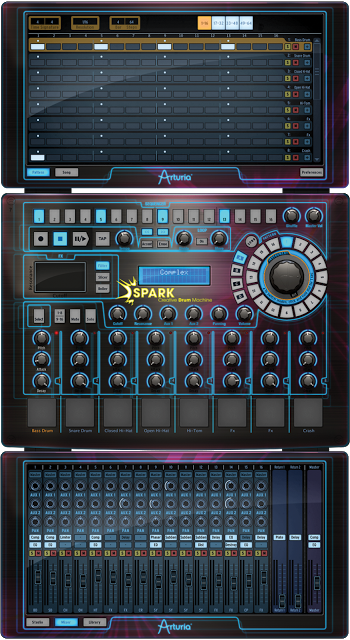
Arturia announces availability of SPARK EDM, a powerful production and performance software suite dedicated to EDM (electronic dance music) production, and EDM, another aptly-named Expansion Pack for its revolutionary SPARK Creative Drum Machine and SparkLE Creative Drum Machine hybrid hardware/software beat production centres, as of March 15…
SPARK EDM can be purchased as a software download for €99.00 EURO/$99.00 USD or boxed for €119.00 EURO/$129.00 USD from Arturia’s Online Shop.
SPARK EDM brings a complete and powerful production suite to the Electronic Dance Music producer.
Featuring a comprehensive library of 30 kits / 480 instruments and 960 patterns , varying from big room floor filling stormers, to underground tech house gems. Spark EDM delivers the drums, stabs, one shots, and fx that will give your tracks the sound they need to produce dance floor hits.
Press release:
Arturia is proud to announce availability of SPARK EDM, a powerful production and performance software suite dedicated to EDM (electronic dance music) production, and EDM, another aptly-named Expansion Pack for its revolutionary SPARK Creative Drum Machine and SparkLE Creative Drum Machine hybrid hardware/software beat production centres, as of March 15…
Capable of standalone operation or seamless integration with any DAW as a VST, VST3, RTAS, or AU plug-in, SPARK EDM caters to the rhythmically remarkable requirements of EDM producers. However, as any discerning dance floor-filling EDM producer knows only too well, EDM, of course, covers a lot of musical ground. So it’s just as well that SPARK EDM comes complete with no fewer than 30 cutting-edge kits — ranging from electro to dubstep, techno to tech house, with much in-between and beyond, it’s all there for the taking!
But that’s barely scratching the creative surface of SPARK EDM. Each of its superb-sounding 480 instruments are based on Arturia’s acclaimed TAE® (True Analog Emulation) synthesis technology and high-resolution sampling, each with 12 adjustable parameters, allowing users to sculpt sounds to their danceable heart’s content — punch through the mix with a filtered kick-ass kick drum, adjust a synth hit’s attack or decay time, re-pitch a tom, and much more besides!
Besides that, SPARK EDM users can customise or simply use any of the 960-plus preprogrammed patterns as the building blocks for kick-starting their next EDM masterpiece. Moreover, thanks to the integrated 16-track mixer, levels, pans, and sends can all be automated, and the mix can be further fine-tuned with 14 high-quality effects (including bit crusher, chorus, delay, destroyer, distortion, flanger, limiter, multi-band compressor, multi-band EQ, phaser, plate reverb, reverb, space pan, and sub generator).
SPARK EDM’s powerful, yet inherently user-friendly interface makes beat- and pattern-creation a breeze — especially when using the onscreen step sequencer situated at the top of the default centre panel. Hardware drum machine enthusiasts will feel right at home here. And thanks to advanced looping modes cleverly combined with the onscreen XY pad’s real-time slicing and filtering controls, users will be producing phenomenal EDM beats with the best of them in no time at all — perfect for live performance!
Speaking of live performance, all of SPARK EDM’s onscreen knobs and pads are easily MIDI-assignable, making them compatible with a variety of keyboard- and pad-based controllers.
At the same time, those SPARK Creative Drum Machine and SparkLE Creative Drum Machine owners out there already hooked on hands-on beat-making need not feel left out in the cold since the EDM Expansion Pack adds those same 30 cutting-edge EDM kits to the already extensive libraries within Arturia’s acclaimed hybrid hardware/software beat production centres. Clearly every beat and sound can be twisted and tweaked therein, thanks to the intuitive and creative workflow that’s at the very heart of the Creative Drum Machine concept.
Quite simply, SPARK EDM and EDM Expansion Pack provide all the drums, stabs, one-shots, and FX needed to produce propulsive dance floor hits! So start afresh with SPARK EDM or expand your Creative Drum Machine hybrid hardware/ software combo… and get the party going on the dance floor.
SPARK EDM can be purchased as a software download for €99.00 EURO/$99.00 USD or boxed for €119.00 EURO/$129.00 USD from Arturia’s Online Shop: http://www.arturia.com/evolution/en/buy/online-shop.html
The EDM Expansion Pack requires SPARK Creative Drum Machine Version 1.5 (or higher), and can be purchased as a software download for €29.00 EURO/$29.00 USD from Arturia’s Online Shop: http://www.arturia.com/evolution/en/buy/online-shop.html“
Time machine: YAMAHA SK-10 String Machine 1979
Synthesizer Demo of the analog synthesizer/string machine YAMAHA SK-10.
The SK-10 was introduced 1979 by Yamaha, Japan. It is the smallest instrument of the Yamaha SK-series.
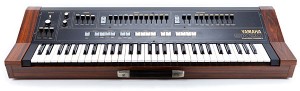
Yamaha’s SK-series are combo-keyboards with synthesizer, organ, brass and string sections. The SK-10 was the first of the SK-series, released in 1979 – the SK-20, 30 and 50D followed in 1980, and the SK-15 in 1981, possibly as a replacement for the SK-10. The SK-10 is the only one in the series that does not incorporate a synth section, but has organ, brass and string sections that can all be played together for more interesting combinations. Very sturdy casing, 4-octave and fully polyphonic the features also include a leslie simulator, vibrato, attack and sustain rocker switches, a slider for ‘brilliance’ and a one-octave transpose switch. Not exactly feature-laden, but a lovely string synth sound. Interestingly, they are often referred to as ‘analog’, but in fact do have a digital section. Its organ has one of the early implementations of Yamaha’s FM technology in a very limited form, concurrent with the GS-1/2 development platforms which eventually led to the DX series.
The ORGAN SECTION is available in all the SK series synthesizers. It offers a full range of stop levers from 1′ to 16′, percussion levers with adjustable decay, and controls for overall sustain, brilliance and decay. This gives you quite a lot to work with in the way of synthesis. The organ’s sound is FM based and it sounds very B3 like. You can add a Vibrato and a noisy but good Tremolo to it. Its sound is all about the 70’s era rock organ, especially with the Ensemble chorus effect in use. It also has a Leslie-speaker output around back.
The PRESET STRINGS section isn’t very sophisticated and offers very limited editing capabilities. It is the string section though, that is worth aquiring this keyboard for.
All the different sections of the SK synths can be layered and stacked via the slider bars. You use the slider bars as a mixer to set the individual volume for each section. All sections have their own separate audio outs (though a mix out is also available). A great thing for live performances is the split keyboard mode. That way you can have, for example, a very nice, punchy bass sound from the synth section and a lead sound coming from the organ or solo sections. Although it has no patch memory, there are push buttons for instantaneous selection of organ, poly-synth and string preset sounds; there are three presets in each section. It also, has no arpeggiator or sequencer, and lacks MIDI. But it’s cheap, easy to use, has a nice sound, full 61-note keyboard, and classic wooden panels.
DATAMASKIN

