
Exploration: B100 2 sketch
Exploring the buchla 100 video 2.
see http://myblogitsfullofstars.blogspot.com/2013/01/exploring.html for more info
Here are a few patches on the Buchla 100. They are mostly based on the semi-random patch from the original user manual which involves using the random voltage source to control the sequencer speed and also the touch plates to add some expression. I didn’t realise how important the 191 sharp cutoff filter is in the system 100 sound, which you can hear most prominently in example 5. I am still waiting for the spring reverb tanks to arrive from Atlanta, so for now I am using a combination of several early digital reverb units (Yamaha Rev7, ART DR1, MXR DR01) blended together
deep inside frauAngelico drum synth
Standuino frauAngelico
sample based drum synthesizer with microsampling possibilities and step-sequencer
Order:
standuino.eu/buy/buy-fraangelico/
More Info:
standuino.eu/devices/instruments/frauangelico/
video by Felix Hüsken youtube.com/flx04
Features:
– sample based polyphonic plaback (6 voices)
– 8 fully adjustable sounds for each preset that can be triggered by midi or by built in sequencer
– microsampling features to adjust the sound ( loop length, shift speed, start, cut)
– bitCrusher, pitchDown, softVolume
– sample rate knob
– step sequencer with record feature, tap tempo, pattern length and shuffle
– it can store 6 double-patterns (32 steps = 8 beats) in each preset
– 4 presets
– jump button
– mute button for individual sounds
– metronome
– optional double pedal input 3.5mm stereo jack connector for shift and monome button
– various sample banks available (TR-808, 8-BIT, BASIC)
– size: 11 x 7 x 4 cm
– 5 knobs
– 3 switch menu buttons
– 4 big performance buttons
– 3 side hack buttons for aditional features
– 1 volume knob
– input voltage: 9V
– MIDI input( MIDI through by special cable)
– jack 3.5mm output
New Voltage Sequencer from Grove Audio

Grove Audio has introduced the GMS777 Voltage Sequencer – a 2×8 or 1×16 step sequencer, which produces a CV output and gate output per channel.
Each channel has a clock input and a separate reset input. Several step functions are programmable using a push button and LED for each step. Stop and skip can be programmed for each step.
There is a separate switchable quantizer for each channel. The output voltage range 0-2V, 0-5V, and 0-10V is selectable from the panel. The module will also support the “Q” bus modules and interface.
The unit will be available in MU, in MOTM and in EURORACK configurations all running about $350.00 range. Pre-orders for delivery in March can be made through an Indiegogo crowd-funding project. The purchaser will have the option of selecting format and knob styles, including the new custom-molded Davies 1900 knobs in ivory.
Experimental: Magic Ceramic Theremin Lamp Doepfer A-178
The first test of the Magic Ceramic Theremin lamp. It is developed as a peculiar piece for the opening of the Exibition of several ceramists in Gallery Artibrak. from november until 28th of December 2011.
A theremin is normally stepless, but in this case an A-156 is used as a quantizer..
Small explanation for those who are not familiar:
In this magic piece of ceramic two antenna’s are integrated. One antenna for the volume and one for the pitch. The instrument does not have to be touched. The volume can be controlled by your left hand (when approaching it the volume increases), the pitch can be controlled by your right hand (when approaching it, the pitch of the sound goes up). By approaching the antenna’s you are influencing the potential difference. Just like the antenna of your transistor radio which functions well or not when approaching it.
The Magic Ceramic is based on the original Theremin invented by Léon Theremin in 1919. That electronic instrument is stepless variable and very expressive. It sounds like an opera voice or violin.
This ceramic version of the instrument has a much more variety than it’s original. You can make the sound stepless or let it be quantized, so that you hear a real tonescale/musical scale. The sinus-tone of the Magic Ceramic is quantized (chopped in pieces), and in the way it is presented now only the Minor notes are heard. (like the black keys on a piano) In this way the steps between the notes are bigger and easier to distinguish. Other possibilities are just Major notes or the complete tonescale, quantized or not. There is also a small sampler added, so when you reach the highest note a spoken voice can be heard.
more info here:
http://www.creativegallery.nl/index.php?option=com_content&view=article&a…
Ableton Tip: Unfold Groups with APC 40
Here is a simple two minute Ableton Live tip on how to fold and unfold groups using the Akai APC 40. All sounds created with the AfroDJMac Wind Chime Synths for Ableton. Available at : http://afrodjmac.spinshop.com/Home/details/167600
Electro act Metroland wishes a Happy New Year
Released 31 December 2012
Virtual Model Mini – new virtual synthesizer instrument for Windows
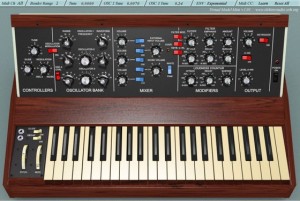
Elektrostudio has released the Virtual Model Mini, a virtual synthesizer instrument for Windows.
Virtual Model Mini features
- Polyphony: Monophonic.
- Timbrality: Monotimbral.
- Oscillator: 3 VCOs, white/pink noise.
- LFO: Oscillator 3 can function as LFO.
- Synthesis type: Analog Subtractive.
- Filter: 24dB/oct, 4-pole lowpass filter, resonance, ADS envelope generator, key tracking.
- Attenuator: ADS envelope generator.
- Effects: Frequency modulation using oscillator 3/noise.
- External Signal: Feedback mode in VSTI version.
The Virtual Model Mini is available as a freeware VST instrument plug-in for Windows.
Happy New Year Electronic videos
Dual HP sine wave generators running with effects, large modules including SSL DDVO, STG Sea Devil, DotCom Q 106/107/108 controlled by the EMW-300, and processed loops all running in real. There was a lot to keep track of so while this was recorded live it was take three.
twitter.com/AtomicShadow
atomicshadow.com
Jingle bells with Cubasis, Animoog and Lemur
Download from the AppStore:
Cubasis – goo.gl/qPYCZ
Animoog – goo.gl/vxRC5
Lemur – goo.gl/xOp5b
TR-606 in Reason
Peff provides a little teaser for an upcoming Reason Refill:
A demo of various drum patterns using the 606 samples in Reason’s Kong Drum Designer. This is for a little refill offering which will be available soon.
Teaser: KORG 50th Anniversary
Not entirely sure what KORG wants us to think when watching this trailer / teaser, but we can all hope that it is a promise of exciting new product releases in 2013.
DATAMASKIN

