
More cool stuff from Roland – A-01 Controller + Generator
Take control of your musical setup with the A-01 Controller and Generator. Connect your gear using standard MIDI, hook up to your computer-based DAW with USB MIDI or play music apps on tablets and smartphones via Bluetooth. You can also drive vintage synthesizers and modular synths via the CV/Gate outputs and step-sequencer. Along with the knob and ribbon controllers, the A-01 also includes an 8-bit monophonic synth engine for creating distinctive synth tones.
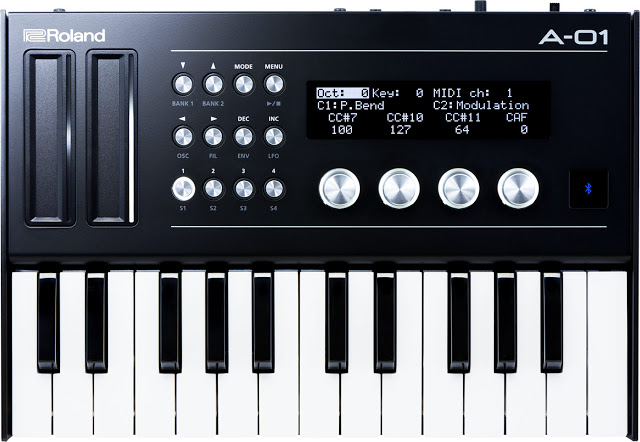
A controller is a vital part of any music production setup, but choosing the right one can be a dilemma. You want a unit with the flexibility to drive all your MIDI and CV/GATE-equipped analog gear. You need to connect to the huge range of music-making apps for tablets and smartphones. And as a modern musician moving from gig to gig, you need to be able to work on projects whenever inspiration strikes. The Roland A-01 ticks all of your boxes—whether you want to warm up backstage, control every element of an elaborate home studio setup, or create original music from scratch, this flexible controller and sound generator is your one-stop solution.
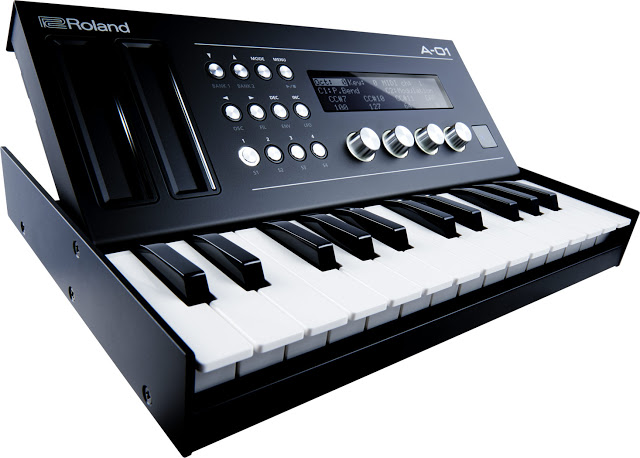
SPECIFICATIONS
Memory
Controller Mode: 16 patches (4 patches x 4 banks)
Synth Mode: 16 tones (8 tones x 2 banks)
Seq Mode: 16 patterns (8 patterns x 2banks)
Connectors
PHONES jack: Stereo miniature phone type
CV OUT jack: Stereo miniature phone type
GATE OUT jack: Stereo miniature phone type
MIDI (IN, OUT) connectors
USB port: MicroB type (MIDI)
Bluetooth
Bluetooth LE
Power Supply
Rechargeable Ni-MH battery (AA, HR6) x 4
Alkaline battery (AA, LR6) x 4
USB bus power
Current Draw
500 mA (USB bus power)
Expected battery life under continuous use:Rechargeable Ni-MH battery: Approx. 12 hours
* This can vary depending on the specifications of the batteries, capacity of the batteries, and the conditions of use.
Accessories
Owner’s Manual
Leaflet “USING THE UNIT SAFELY”
Alkaline battery (AA, LR6) x 4
Options (sold separately)
Keyboard unit: K-25m
SIZE AND WEIGHT
Width300 mm
11-13/16 inchesDepth128 mm
5-1/16 inchesHeight46 mm
1-13/16 inchesWeight950 g
2 lbs 2 oz”
NAMM: Roland has debuted the SYSTEM-500 Complete Set

Roland has debuted the SYSTEM-500 Complete Set. This fully analog modular synthesizer is inspired by the SYSTEM-700 and SYSTEM-100M. Made for Eurorack format, the SYSTEM-500 Compete Set is a comprehensive system with multiple oscillators, filters and effects in a versatile, custom case with top-quality patch cables.
The Roland SYSTEM-700 and SYSTEM-100M modular synthesizers are sought after by synthesizer enthusiasts to this day. Used by pioneering musicians on numerous recordings throughout the seventies and eighties, they combined the best of Roland’s analog synthesizer technology in modular instruments. With the SYSTEM-500 Complete Set, it’s now possible to own a modern version of these classics.
Roland SYSTEM-500 Complete Set Features:
» Complete analog modular synthesizer with multiple oscillators, filters and effects
» Vintage Roland analog sound in a quality modern instrument
» Wood and metal case is portable, stackable and can sit flat or angled
» 512 module with two voltage controlled oscillators with saw, sine and square waves
» 521 module with two voltage controlled filters with selectable high-pass filters
» 530 module with two voltage controlled amplifiers each with multiple CV inputs
» 540 module with two ADSR envelopes and invertible LFO with five waveform types
» 572 module with classic phase shifter, delay, gate delay and invertible LFO
» Numerous CV connections for an array of modulation possibilities
» Built in USA
Designed and built in the U.S., the SYSTEM-500 Complete Set is made to exacting standards, with quality components and attention to detail. It claims to deliver the classic character and playability of a vintage Roland modular synth — with all the advantages of a modern instrument. The Eurorack format also makes it easy to expand or neatly integrate into an existing modular setup. Its versatile wood and metal case can sit flat or tilt, providing plenty of clean, stable power, and blending in with the classic looks of the SYSTEM-500 modules.
The SYSTEM-500 Complete Set includes: the 512 module with two voltage controlled oscillators featuring saw, sine and square waves; the 521 module with two voltage controlled filters featuring selectable high-pass filters; the 530 module with two voltage controlled amplifiers, each featuring multiple CV inputs; the 540 module with two ADSR envelopes and invertible LFO; and the 572 module with classic phase shifter, delay, gate delay and LFO. With two VCOs, two VCFs, two VCAs, two ADSR envelopes, two dedicated LFO sections, and a powerful effects module, the SYSTEM-500 Complete Set is flexible and capable right out of the box. An array of CV/Gate connections and well-placed controls make it an ideal centerpiece for any modular setup.
No pricing or availability has been officially announced.
The Waldorf sallad of modular madness – fresh from NAMM
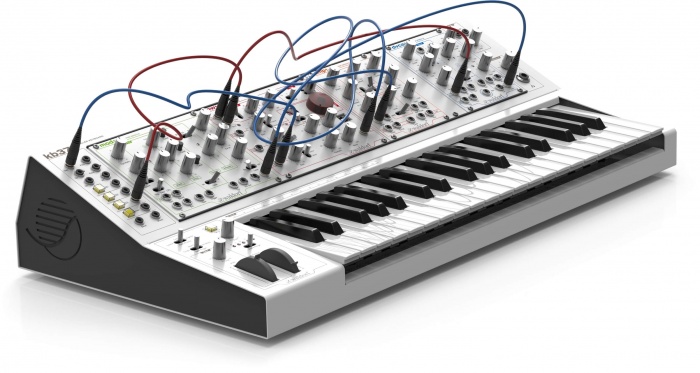
Waldorf Music has introduced its Eurorack Pack, a stylish, state-of-the-art, self-contained modular synth system, comprising the kb37 Controller Keyboard, and three colourful new modules for the Eurorack format to accompany the already-available nw1 Wavetable Module launched last year.
Our developers came up with a keyboard that is both intuitive for the beginner and versatile for the professional. And it’s just as solid and elegant as all our instruments that we build here at Waldorf in Germany. kb37 is a compact and rugged performance instrument. It can house up to 100 HP of modules in its conveniently angled panel that sits right on top of the super high-quality Fatar TP9 keyboard.
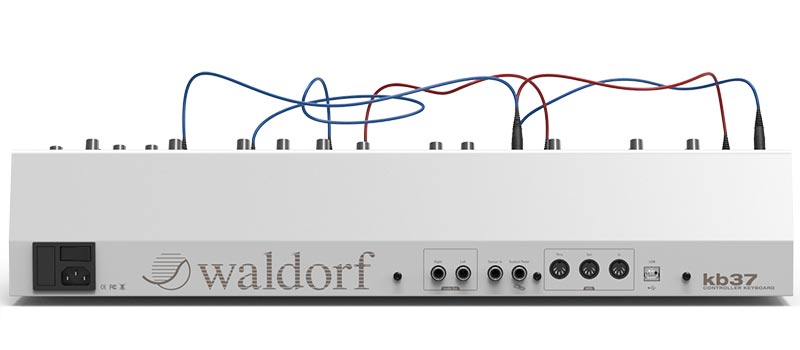
With its high-resolution and temperature stable 16-bit CV interface, it provides extremely flexible control for your modules. MIDI channels are programmable, making the kb37 the perfect partner for both studio and stage. It provides perfect connectivity to all your modules to serve both the player and the sound designer’s desires with an array of real-time control elements such as pitch and mod wheels. The professional, full-sized 37-note keybed transmits velocity and aftertouch.
New modules
- mod1 — Three different modulation sources in one module make the mod1 the control center of your modular patch. From simple envelopes and LFOs to complex looped multi-stage curves, the mod1 delivers rich and endless modulation options – all based on pure analogue circuitry for everything from super- smooth curves to razor-sharp edges that never sound “digital”. From gently undulating LFOs to ultra-precise hard cuts, you get it all based on innovative analogue circuits for a truly musical touch.
- dvca1 — Built around two VCAs with a wide range of options including the most important one: the ability to musically colour the signal. Starting in dry mode, you get high-precision analogue amplification. But then when you turn the Colour knob, you add a warmer and more colourful timbre to the signal based on a finely-crafted state variable filtering circuit. But there’s more: Simultaneous linear and exponential control as well as specialised AC and DC coupled inputs are provided. A positive gain control makes the dvca1 a true “amplifier,” and flexible link modes let you create modulated panning.
- cmp1 — A true high-end analogue compressor not only adds punch to your signal, but it also can be modulated in intriguing and unconventional ways! Side-chaining with a adjustable balance control will open a huge set of modular possibilities. The cmp1 has all the features you expect from a modern compressor including attack and release control, automatic and manual modes, hard and soft knee as well as output gain and bleed amount of the original signal.
The Eurorack Pack products are expected to ship Q3 2016.
» Keyboard & controllers
— Fatar TP9 37-keys keyboard with aftertouch
— Multiple velocity curves
— Pitchbend wheel
— Modulation wheel
— Glide
— Selectable note priority
— Octave up/down switch
— Gate retrigger
» Module section
— Width: 545mm/107 HP
— Eurorack compatible bus
— Bus CV & Gate linkable to CV interface via jumpers
— Built-in regulated power-supply (+12V/-12V, 1.5A)
» CV interface
— 8 CV outputs
— Pitch
— Velocity
— Aftertouch
— Pitchbend
— Modwheel
— 3 user-assignable MIDI controllers
— 3 Trigger outputs
—Gate
—Clock & Reset outputs for MIDI sync
» Connections
— USB with isolation
— MIDI In, Out, Thru
— Sustain pedal input
— Sensor input?/?output
— Stereo line outputs with volume control
— Headphones output with separate volume control
RePro-1 – new monophonic synthesizer instrument from U-he
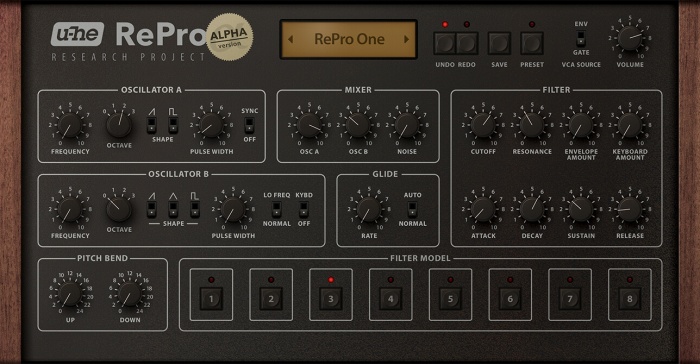
u-he has announced RePro-1, a monophonic synthesizer instrument for Windows and Mac.
The alpha version is going to be research ware, i.e. free like Protoverb. Hence “RePro-1 – Research Project One”. It’ll be a CPU hog because we want you guys to compare the unoptimised filter algorithms. We expect to release the alpha version shortly after the Superbooth in early April 2016.
The final version will be souped up with some extra features (the screenshot may make the guess easy) and it will be released for AAX/AU/VST with highly optimised filters by the end of 2016.
This is a monophonic synth. The final version will be an exceptionally close emulation of some nifty little vintage synth, with some nifty little extras added (but still not polyphonic).
In short: This is *not* coming soon! – But it’ll sound great, and you’re hereby prepared for some participation to happen!
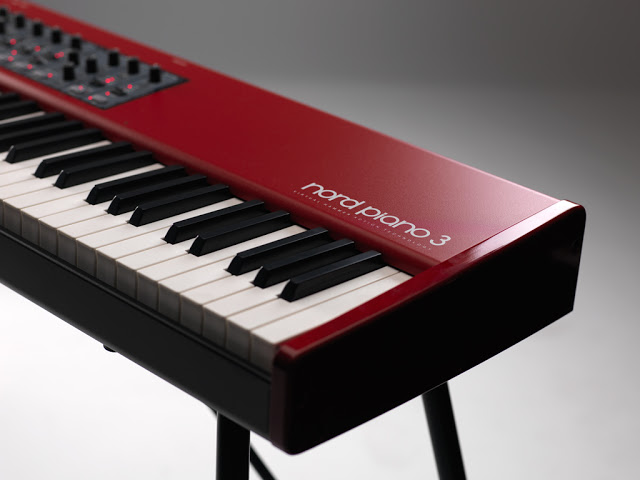
Nord Piano 3 is the new keyboard from Clavia coming at NAMM
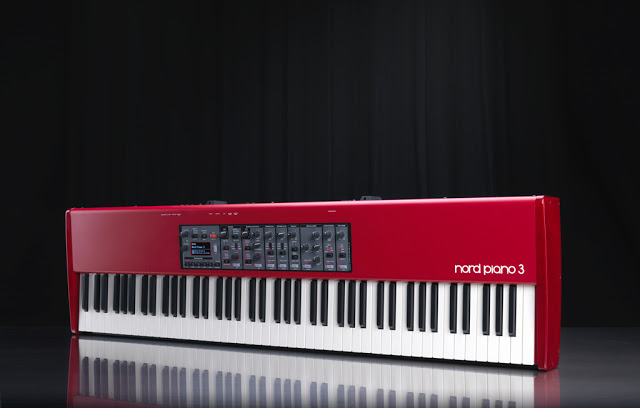
With outstanding new keyboard technology, improved grand weighted action, Ivory touch and expanded memory for the exclusive Nord Piano Library – the Nord Piano 3 takes piano feel and realism to a new level.
The new Virtual Hammer Action Technology simulates the movement of the hammers in a Grand Piano, capturing the characteristics with exceptional dynamics and breathtaking level of authenticity.
General
88-note Triple Switch keybed with improved grand weighted action NEW
Nord Virtual Hammer Action Technology for greatly improved key response NEW
Ivory touch for authentic feel NEW
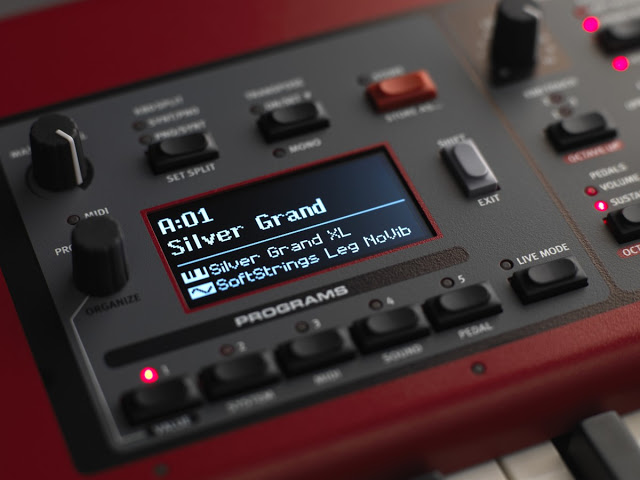
OLED-display for better overview NEW
1 GB memory for Nord Piano Library NEW
256 MB for Nord Sample Library NEW
Layer and split-functionality
Nord Triple Pedal included
Piano Section
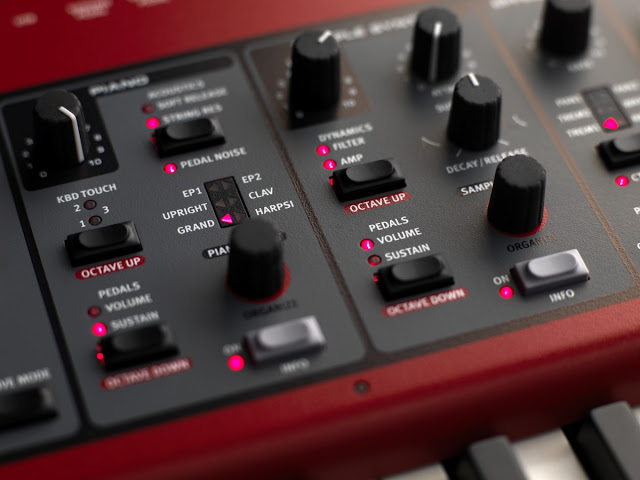
4 Dynamic Curves
Dynamic Pedal Noise with Nord Triple Pedal
Advanced String Resonance (Gen 2)
Soft Release
Sample Synth
Dedicated Sample Synth section with Attack, Decay/Release and dynamic controls
Effects
All effects in Stereo
Tube overdrive simulation
Vibe effect
Separate Reverb/Delay effects
Tremolo, Pan, Ring-Mod and Wah-wah can be controlled with Control Pedal
VIRTUAL HAMMER ACTION TECHNOLOGY NEW
The Nord exclusive Virtual Hammer Action Technology simulates the hammer movements in a Grand Piano delivering outstanding authenticity and dynamic response. The Triple Sensor keybed allows key movements to be determined with stunning precision. The result is a keyboard action that handles dynamic playing with amazing control at any velocity level.
Repetitions
The Nord Virtual Hammer Action Technology enables you to produce a new note without lifting the key completely. This allows for smoother repetitions as the tone is not completely dampened between the strokes, similar to the fluent transitions possible on a Grand Piano.
Extended Triggering Range
The new keyboard technology makes both top and bottom triggering possible, resulting in amazing control when playing percussively as well as pianissimo with the keys half-pressed down.
Dynamic Release
The Virtual Hammer Action Technology also includes velocity sensitive release, dynamically dampening the sound based on how quickly you release the key.
GRAND WEIGHTED ACTION AND IVORY TOUCH NEW
The keybed has added weight for improved dynamic control and features a textured “ivory” surface, providing authentic Piano touch and feel.
The individual Fatar keybeds are meticulously calibrated at the Nord factory to ensure an even response over the whole range.
MODEL
The Nord Piano 3 features a new triple sensor keybed with Ivory touch and improved grand weighted action (A-C).
The Nord Piano 3 weighs 18,2 kg (40,7 lb) and measures 1287 mm (50.7″), 121 mm (4.8″), 340 mm (13.4″).
NORD SOUND LIBRARIES
The Nord Piano 3 features 1 GB of memory dedicated to the exclusive sounds from the Nord Piano Library carefully selected for their specific and individual character. The ever expanding Nord Piano Library is filled with uniquely sampled acoustic and electric instruments, with an outstanding range of velocity levels allowing for exceptional dynamic control.
The Factory Bank features 6 Grand Pianos, 5 Upright Pianos, 11 Electric Pianos, Clavinet and Harpsichords. Replacing the sounds in your Nord Piano 3 is simply a matter of dragging and dropping files in the Nord Sound Manager for Mac and Windows.
The Sample Synth section in the Nord Piano 3 has 256 MB memory dedicated to the Nord Sample Library 2.0 – our essential selection of high quality sampled sounds from a wide range of genres including the exclusively licensed sounds of the Mellotron and Chamberlin.
PRICING AND AVAILABILITY
The Nord Piano 3 will hit the stores in May 2016 with pricing to be announced. Like all Nord keyboards, the Piano 3 is handmade in Sweden with meticulous attention to detail and quality control.
MORE INFORMATION
For more information please visitwww.nordkeyboards.com/piano3“
Three new Eurorack modules from Waldorf will debut at NAMM
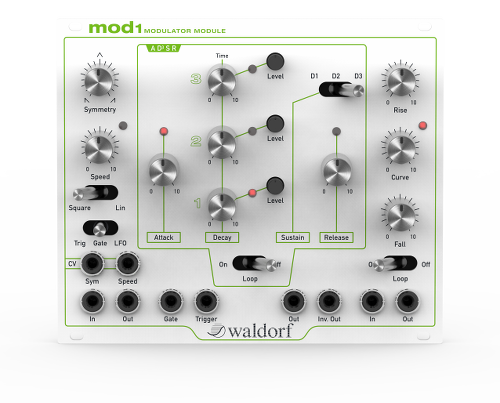
Three different modulation sources in one module make the mod1 the control center of your modular patch.
From simple envelopes and LFOs to complex looped multi-stage curves, the mod1 delivers rich and endless modulation options – all based on pure analogue circuitry for everything from super- smooth curves to razor-sharp edges that never sound “digital. From gently undulating LFOs to ultra-precise hard cuts, you get it all based on innovative analogue circuits for a truly musical touch.”
Specifications
mod1 sideThree highly flexible modulation sources in one module. All based on innovative analogue circuits for snappy attacks and super smooth curves.
1. AD3SR
ADSR envelope with up to three decay stages
Each decay stage with time and target level control
Configurable for 1, 2, or 3 decay stages
Loop mode for looping from attack over all enabled decays stages
Gate and trigger inputs
Positive and Inverted output
2. Symmetry Generator
Two segment modulator with controllable symmetry
CV-inputs for speed and symmetry
Symmetry modulation keeps base frequency
LFO mode with bipolar output
Gate and Trigger envelope modes with unipolar output
Linear or rectangular wave forms
3. Rise & Fall
Two stage envelope “rise & fall”
Flexible curve control for rise stage – from smooth classical RC shape to cutting linear segments
Optional loop mode
Gate input
Signal output
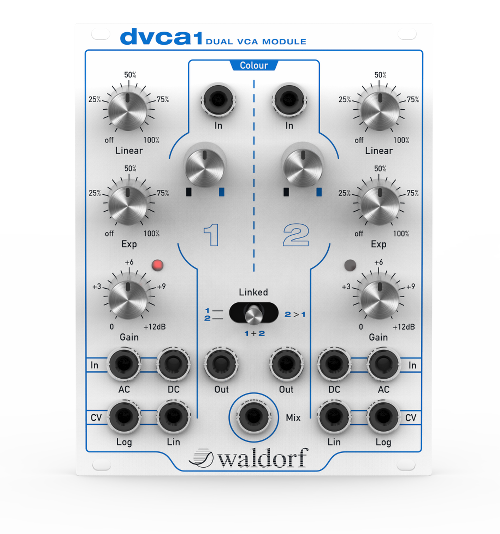
Built around two VCAs with a wide range of options including the most important one: the ability to musically colour the signal. Starting in dry mode, you get high-precision analogue amplification. But then when you turn the Colour knob, you add a warmer and more colourful timbre to the signal based on a finely-crafted state variable filtering circuit. But there’s more: Simultaneous linear and exponential control as well as specialised AC and DC coupled inputs are provided. A positive gain control makes the dvca1 a true “amplifier,” and flexible link modes let you create modulated panning.
Specifications
dvca1 sideTwo true analogue high-end VCAs
Optional colour control based on state variable filter technology
CV-input for colour modulation
Simultaneous linear and exponential control and CV inputs
Additional gain control for adding up to +12dB
Separate AC and DC coupled inputs for audio rsp. control signals
Separate summing output combining both signals
Link mode for parallel modulation of two signals
Anti-parallel link option for panning effects”
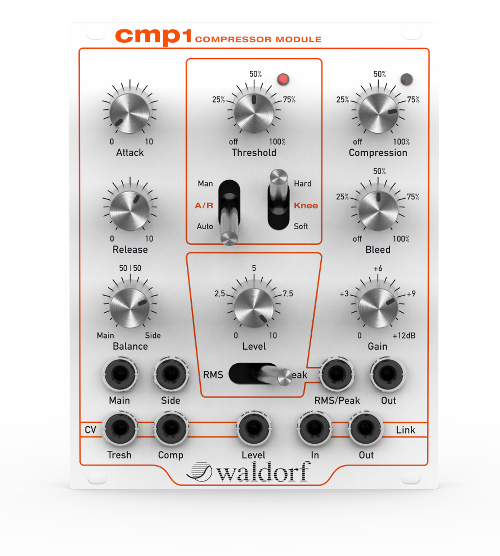
A true high-end analogue compressor not only adds punch to your signal, but it also can be modulated in intriguing and unconventional ways! Side-chaining with a adjustable balance control will open a huge set of modular possibilities. The cmp1 has all the features you expect from a modern compressor including attack and release control, automatic and manual modes, hard and soft knee as well as output gain and bleed amount of the original signal.
Specifications
cmp1 sideTru analogue high-end compressor
Flexible side-chaining
Control path based on controllable balance of side and main signal
RMS and Peak modes
Threshold and compression controllable from panel with additional CV-inputs
Attack & Release in manual or automatic mode
Hard and soft-knee compression
Bleeding control for mixing original signal to compressed output
Overall gain control
Input level control
Separate output of detector signal for use as envelope follower
Additional level control input for optional use as exponential VCA
NAMM 2016: New Oberheim Mini Sequencer will debut at the 2016 NAMM Show
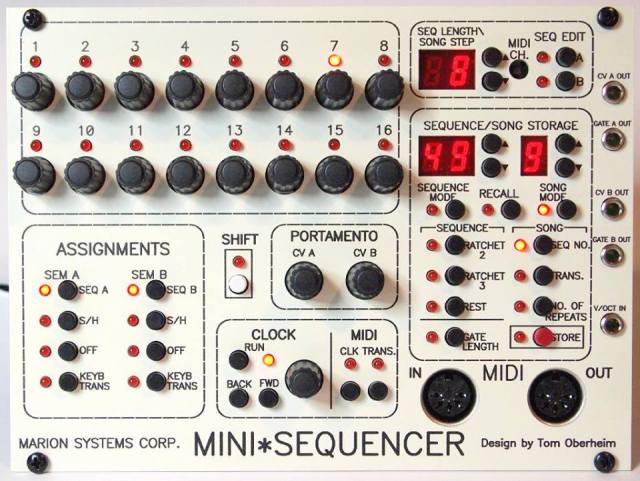
Marion Systems Corporation will be introducing the Oberheim Mini Sequencer at the2016 NAMM Show.
The Mini Sequencer is designed by Tom Oberheim and is a Eurorack format module.
Details, pricing and availability are to be announced. The 2016 NAMM Show is scheduled for later this week, Jan 21-24, 2016.
NAMM Teaser: IK and Gavin Lurssen set to unveil revolutionary mastering product at NAMM 2016
Have your mix mastered live at NAMM by Lurssen Mastering! Details at http://www.ikmultimedia.com/news/news…
More info at http://www.ikmultimedia.com/news/news…
What do you get when a multi-Grammy award winning mastering studio teams up with the global leader in music creation and production tools?
At NAMM 2016, Lurssen Mastering and IK Multimedia will unveil a totally unique mastering product that brings the finesse, expertise and creative insight of the award winning mastering studio and innovative technological leadership of IK to musicians, producers and engineers around the globe. Read more at http://www.ikmultimedia.com/news/news…
Borderlands Granular – Spicing up a pad sound with filter automation
Background video description:
I hadn’t used this cool feature of Borderlands Granular before, so I thought I’d share a little demo. All the grain cloud parameters can be automated using the motion recorder.
I’m just doing traditional synth filter sweeps here, but you can do some pretty wild stuff by motion recording other parameters.
All sounds from custom Animoog guitar timbres – please see my other videos for more details on that malarkey.
Reverb added in ToneStack using ZoneVerb plate setting with Borderlands Granular running as an IAA instrument.
Recorded with QuickTime, no additional processing.
The pad sound and chord change is from the first “x2” video – please check it out:
Rare Nomad Rhythm Maker 12 Vintage Drum Machine Demo
Just taking a listen through the presets of this rare vintage drum machine by Nomad. It features 12 rhythms with tempo and hard/soft control which filters the sound.
All analog and with no effects/processing.
DATAMASKIN

