
Kraftzwerg Speak – Suspense
Background information on this video featuring the awesome Kraftwerg synth
Welcome to the first part of my new series called Kraftzwerg Speak. All the sounds you’ll be hearing in this series are created exclusively on the MFB Kraftzwerg semi-modular analog monophonic synthesizer. This series will be all about creating unique and interesting sounds. If you want to hear music produced by this synth, check out my Kraftzwerg Trance series.
Jupiter-8, Roland Juno-60, Juno-106, Poly 6 – Analog synth song
Gear used is jupiter-8, juno-106, juno-60, Poly 6, td-30 V-drums. Recorded and mixed in Sonar X1. EFX from Sonar.
New video featuring the Arturia MiniBrute
Video description:
Neat new analog synthesizer I just unwrapped for the second time. First one didn’t work, this one does, but I think it may still have some issues/quarks/features. However, perhaps that is all part of the analog experience they didn’t want to leave you without on it.
Akai AX-60 Synthesizer Filter Resonance
A video discussing & demonstrating some design aspects of the Akai AX-60 analog synthesizer, in particular the filter resonance.
The AX-60 has been described as capable of some very ‘industrial’ timbres and one reason for this is the very strong filter resonance of the cem3394 voice chip. The design choice by Akai to use a full 5V CV for the resonance brought this out. Additionally, they used a linear taper slider for resonance, and a linear 5V response to the CV (they could have used a log taper, like I did here, or they could have processed the panel voltage and did a voltage taper conversion in firmware – cheaper! – to limit the resonance CV to the range in the cem3394 data sheet, but they didn’t).
These design choices meant many users probably ended up exploring a more ‘brash’ part of the AX-60’s sound palette than if Akai been more like Sequential Circuits in their limited internal programming of the cem3394.
Oberheim OBXa “Poly Evolution”
The OB-Xa is a massive analog synthesizer with a very familiar and classic Oberheim sound. Its sound, size and power are very similar to the Prophet 5 from Sequential. However this one has up to 8 voices which can be split, layered and stored!
The OB-Xa was available in four, six or eight voice polyphonic models. They all featured patch memories, also in varying degrees. A minimum of 32 patches were available on early models (4 banks of 8). The maximum amount of patch memory storage found on many OB-Xa’s is 120 patch memories. All models of OB-Xa, however, featured the new Curtis chips which offered great stability for an analog synth and they are attributed to its great filters and sounds.
The OB-X was very similar to the OB-Xa except that its voices could not be split or layered and, more significantly, the OB-X had a lowpass-only discrete SEM 12dB/oct state variable filter, which had a great and classic Oberheim sound. The OB-Xa changed that in an attempt to economize manufacturing and increase stability by switching to CEM3320 Curtis chips for its filters. The Xa offered two switchable filter modes: 12 dB/oct (2-pole) or 24 dB/oct (4-pole). This hardware change resulted in a more agressive sound, not quite as creamy as the OBX original, but what still became a “bread and butter” sound of the Oberheim line.
Korg Radias “Reso Synth Experiment”
Nice demo featuring the KORG Radias – a description of the synth can be found below:
The Korg Radias is a Virtual Analog synthesizer that was released by Korg in 2006. It takes advantage of the MMT (Multiple Modeling Technology) that their flagship OASYS synthesizer module employs. The synthesizer itself is similar in design to the MS2000, but offers many more capabilities. It is capable of emulating older digital synthesizers and classic analog synthesizers like the MS-series without any noise or aliasing. The Radias also allows for various external sounds to be fed through its filters and envelopes. It also has the Korg DWGS (Digital Waveform Generator System) that the Korg DW-8000 employs.
The Radias also takes advantage of the KKS (Korg Komponent System) which allows it to be used with the 49-key keyboard or used as a standalone rack module, and the Radias-R unit can be connected to the M3 Music Workstation/Sampler along with its various keyboard models.
The Radias has two oscillators per timbre and a noise generator. Oscillator #1 has nine basic waveforms, with four types of modulation and PCM (64 synth sounds, 128 drum sounds) and Oscillator #2 has four basic waveforms with two types of modulation. The Radias has the ability to stack up to five types of waveforms in Oscillator #1, while using only one voice of polyphony. In Unison mode, you can stack five additional waveforms, while using more polyphony. With this function, you can create some awesome super waveforms-the overall result can contain up to 25 detuned waveforms. The Radias also has two Low-frequency Oscillators (LFO) that add more modulation to the two audio oscillators. These LFO’s provide six waveforms and their speeds can be set manually or by tempo.
The Radias itself has four timbres per program. With a timbre, you can assign one drum program, another can have a lead, a bass, and a vocoder as well; all in one program! Each timbre can contain one synthesizer/drum kit, equalizer, and two multi-effects.
The Radias has two filters that can be used side-by-side, individually, or in a series. They offer Low Pass, High Pass, Band Pass, and Combination modes. Each filter offers 24 or 12 dB modes for the low pass filter. The effects on this unit are remarkable as well. The Radias comes loaded with 33 different effects: Delays, Chorus, Flangers, Compressors, talking modulator, and even the good old Polysix Ensemble effect. You can assign one master effect to the program, while each timbre gets its own two effects, creating a whole world of possibilities. The Radias also offers a 16-band vocoder with a nice Formant Motion recording function that allows you to record up to 7.5 seconds of external audio which can then be triggered via the keyboard.
The Radias has a built in arpeggiator as well, providing six different patterns to choose from. Patterns can be up to 32 steps long and the gate/velocity can be set for each step to get that sound you want! It also has two 32-step sequencers (they can be combined for a 64-step on a single timbre). They can easily be assigned to a drum kit, for example, to use the Radias as a programmable drum machine. The step sequencer supports 8-voice polyphony per step.
Mopho x4 Synth Demo – Dave Smith Instruments
Carson Day demonstrates some factory sounds on the new Mopho x4 polyphonic analog synthesizer. Except for the programs that are obviously played on the keyboard, the x4 is receiving MIDI data from an external sequencer in this demo.
Alpha Juno 2 Ableton Live Pack
The Roland Alpha Juno 2 is a classic analog synth that has been sampled inside and out for Ableton Live. This Ableton Pack features 64 instruments, 72 Ableton Instrument Racks, 9 Ableton Live Sets, and 1.5 GB of samples. Truly massive!
Get it here: http://afrodjmac.spinshop.com/details/157931
About the synth:
This is an upgraded version of the Alpha Juno 1. It adds an extended 61 note keyboard with velocity and aftertouch and an external memory cartridge slot. Other than that it has the same great sound and features as the Juno 1. Sliders and buttons were replaced by membrane buttons and the Alpha Dial which is used to edit and browse through the extensive selection of parameters: DCO digitally controlled oscillators, LFO, bend, ENV, pulse, waveforms, noise, PW/PWM, high pass filter, VCF (filter) with freq/env/res/lfo/kybd, VCA envelope, chorus, and more.
Adequate in the studio or on the stage, the Juno 2 has 64 presets and 64 user memory patches, a nice LCD display, an LFO capable of a very slow rate for some cool sweeping effects, and a great bass sound (especially nice for acid basslines) and noise effects! It also has chord memory which is perfect for rave & techno, portamento and keyboard transposing. The PG-300 Synthesizer Programmer gives you traditional slider control of each parameter for much easier and faster editing.
Tal-U-No-LX – Roland Juno Emulation now released
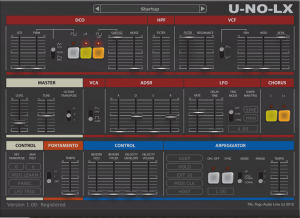
TAL-U-NO-LX is a fully rewritten emulation of the popular hardware with a new engine and GUI. Up to date zero feedback delay filters and carefully calibrated controls make this synth a good replacement for the analog device with all the advantages software plugins have. As an addition, the TAL_U-NO-LX also supports portamento and different filter LFO waveforms and some more useful features. An arpeggiator with different sync modes and hold function is also included. A very fast envelope with a smooth roll-off and emulated inaccuracy gives this synth the typical sound. The synth was calibrated after a hardware device that’s property of TAL.
Special Features:
- Self resonating zero feedback delay filter (24dB LP).
- Filter range up to ~40kHz (depends on the sample rate).
- Calibrated and tuned after TAL’s hardware device.
- Midi learn / automation for all controlls.
- Improved alias free oscillators for an authentic sound also @ 44’100Hz sampling rate.
- Arpeggiator with different sync modes (host, midi clock, not on).
- Portamento and mono mode.
- LFO manual trigger button.
- Sustain pedal support.
- Up to 12 voices.
- New file based preset system for transparent preset management.
- More than 300 factory presets by different sound designers (FMR, Particular – Sound, TAL).
- Original hardware “Factory Bank A” included.
Demo / Full Version:
It’s not possible to save presets in demo mode.
Price USD 35.00 70.00 – 50% introductory price for a limited time!
One unique synth per song: Alesis Andromeda A6
A song made entirely on a multi tracked Alesis Andromeda A6 analog synthesizer.
The song is called Andromeda and is taken from the Firechild album Beyond The Sun.
The album contains 12 songs made on different real analog synthesizers. Each track is only allowed to use one specific synthesizer. Other synthesizers on the album includes , Roland Jupiter 8 , Oberheim Xpander , Waldorf Pulse , Minimoog Voyager , Matrix 1000 , Oberheim SEM Pro , Prophet 08 etc.
Firechild is also known as the swedish artist Evan , but now under the Firechild alias he is going back to his roots, back to the Synthesizer music from the 70s and 80s and artists like Vangelis , Jean-Michel Jarre , Kitaro and Kraftwerk.
DATAMASKIN

