
Analog synthesizers – GRP A4 x8 24 Oscillators in unison
Paolo Groppioni plays eight Grp A4 Analog Synthesizers in unison. Twentyfour wild VCOs under the same MIDI master keyboard control.
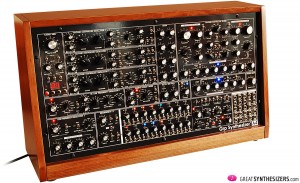
- Voltage Controlled Oscillator 1, 2, 3
- Wide audio range (64’-2’) w. Tune & Fine; six analog waveforms (sine, triangle, triangle & saw, saw, saw & variable pulse summed, variable pulse); manual pw & pwm (from VCLFO1, EG1, S&H, Aft); FM 1 Amt (lin/exp –from VCLFO1, LFO2, VCO1, 2, 3, Noise, S&H, EG1, EG2, Aft, ModW, KeyVel, EnvFoll) w. phase rev; FM 2 Amt (only exp – from VCLFO1, Env Foll); sub oscillator (on VCO 1, 2) -1/-2 oct; hard sync (VCO 1 master); kybd on/off (w. user’s selectable octave offset from MIDI Interface).
- Ring Modulator
- Ring Mod Sources: VCO 2 & VCO 3/Ext Input (user’s selectable).
- Noise Generator
- White & Pink Noise selectable.
- External Input
- Input gain from line to mic level; freely adjustable Gate Threshold (Gate to EG 1-2); enclosed envelope follower (goes into mod buss).
- Audio Mixer
- Separate level controls for VCO 1, 2, 3, Sub 1, 2, Ext Input, Ring Mod, Noise.
- Filter Section
- Dual analog filter section: 24 db/Oct Low Pass Transistor Ladder Filter w. pole selection & 12 dB/Oct State Variable Low, Band, High, Notch Filter.
- Each filter has a separate Distortion/Level control.
- Filter section can be configured in LP 24 Only, SV 12Only, Serial (LP into SV), Parallel, Direct Out (LP 24 goes on Left Audio Out, SV 12 goes on Right Audio Out).
- Low Pass Filter:
- Slope selection (6, 12, 18, 24 dB); Cutoff Frequency; Resonance; Overload LED; FM1 Amt (from VCLFO1, LFO2, VCO 1, 2, 3 Env Foll, Noise, S&H, EG2, Aft, ModW, KeyVel) w, phase rev.; FM 2 Amt (from VCLFO 1); FM 3 Amt (from Step Sequencer, Kybd Track 0-120%; Key Vel On/Off.
- State Variable Filter:
- Mode (12dB HP, 6 dB BP, 12 dB LP, 6 dB Notch); Cutoff Frequency; Resonance; Overload LED; FM1 Amt (from VCLFO1, LFO2, VCO 1, 2, 3 Env Foll, Noise, S&H, EG2, Aft, ModW, KeyVel) w, phase rev.; FM 2 Amt (from VCLFO 1); FM 3 Amt (from Step Sequencer, Kybd Track 0-120%; Key Vel On/Off.
- Voltage Controlled Amplifier
- Dedicaded Envelope Generator (see below); Control Selection (dedicated EG2, ON-hold, External CV); VCLFO1 Amt.
- AutoPan
- AutoPan Off/Internal Clock/VCLFO1; Pan Frequency Control; LED (red = internal clock; blue = VCLFO1).
- Stereo Main
- Master Volume.
- Envelope Generator 1
- Multi Stage Loopable Env (Attack, Hold, Decay, Sustain Lev, Sustain Time-Only in Loop On, Release); Gate Source Selection (Keyboard, S&H, ExtIn/ Step Seq); independent EG Amt for 24 dB LP Filter and 12 dB State Variable Filter, both w. user’s selectable EG polarity.
- EG time goes from 1msec to 60 sec.
- LED: red = EG under Gate sources; blue = EG under Step Sequencer control;
- Loop Envelope: loop from Attack to Release, w. Sustain Time selectable.
- Loop Mode Switch:
- Loop Off: EG as standard AHDSR, no Sustain Time.
- Gate: EG loops from A to S (w. Sustain Time max 60”) as long as Gate is On.
- Auto: EG full loop, from A to R; independent from Gate.
- Envelope Generator 2
- Same as EG 1, without Hold segment.
- Voltage Controlled Low Frequency 1
- Frequency (from very low to 2500 Hz); Waveform (sine, ramp, triangle, saw, square w. variable pulse); FM Amt (exp, w. phase normal/rev); FM Sources (Key, EG1, EG2, LFO2, Seq A, B, A+B, S&H, Aft, ModW, EnvFoll); Sync (Off, Gate, Seq, MIDI – dividing factor selectable from internal MIDI Interface); Shaping LFO out (from: Off, EG1, EG2, Lfo2, SeqA, B, A+B, S&H, Aft, ModW, EnvFoll).
- LFO act as modulation buss for auxiliary sources: EG1, EG2, S&H, Noise, VCO2, EnvFoll. The aux source can be amplitude modulated with the Shaping Select.
- Voltage Controlled Low Frequency 2
- Frequency; Freq Range (Low-Mid-High); Waveform (Triangle, Square); Shaping Select (Off, Aft, ModW).
- Independent Send Modulations for: VCO 1, 2, 3 freq; PWM 1, 2, 3; VCF 24/12 Cutoff; VCA Level.
- Sample & Hold
- Frequency; Frequency Source (Int, VCLFO1); LED (red = Internal, blue = VCLFO1); S&H Source (Pink Noise, White Noise, VCLFO 1, LFO 2, VCO 1, 2, 3); Glide.
- The S&H Clock can be routed to EG firing; there are three options: Off – no routing; Gate – the S&H clock is ANDed with keyb/ext/manual Gate; Auto – EGs always fired from S&H.
- Tuning/MIDI
- Master Tune; Portamento Time; Bend Amount; VCO 1 Portamento On/Off, VCO 1, Bend On/Off; Hold On/Off; A440 On/Off; Retrig On/Off; Manual Gate.
- MIDI Interface: MIDI Channel Select; Keyboard Off Octave Offset; External CV In Octave Offset; MIDI Clock Divider on LFO Reset.
- A4 receives: MIDI Note On/Off, Bend, Modulation, Aftertouch, Key Velocity, Expression Pedal, Damper.
- Step Sequencer
- User’s configurable Mode Select 8×2 or 16×1.
- Clock Source: Int, VCLFO1, Ext, MIDI.
- Clock Divider on all Clock Sources; dividing factor MIDI: 1/1, ¼, 1/4t, 1/8, 1/8t, 1/16; dividing factor TTL: 1/1, /2, /4, /16, /32.
- Sequencer Mode: FW, BW, FW/BW, PNDL, ALT, RND, TRG.
- CV Seq Clock: A, Off, B on internal Clock.
- VCO Seq Enable: VCO 1, 2, 3, Off/A/B/A+B
- VCF Seq Enable: 24dB Off/A/B/A+B; 12dB Off/A/B/A+B.
- Step Repeat: Off, x2, x3, x4.
- Permutations: n,n+1; n, n+1, n; n, n, n+1, n.
- Loop On/Off.
- Hold On/Off.
- Manual Controls: Reset/Step Advance, Run/Stop, Continue
- Pulse Width (legato/staccato) on Internal & MIDI Clock.
- Row A & B Parameters: Glide Amt; Range (x2, x4, x8); Quantizer On/Off.
- Step Parameters: LED; Step Value; Gate On/Off; Step Mode (End, Skip, Normal).
- Connections
- Audio: Mono Out; Phones Out; Left/24dB Out; Right/12 dB Out; Audio External In.
- Filter: CV In 24 dB; CV In 12 dB.
- Amplifer: CV In VCA.
- Synth Control: CV In; Gate In.
- External Modulation Buss: Ext 1/AftT; Ext 2/ModW.
- Sequencer Connections: Row A/B/A+B CV Out; Row A/B/A+B Gate Out; Run/Stop In; Continue In; Loop On/Off In; Clock Input; Clock Output; CV In Clock Modulation.v
Yamaha CS-5 and Roland TR-606 Demo
Here is a demo of the Yamaha CS-5 analog monosynth and the Roland TR-606 analog drum machine. The Yamaha is being triggered via one of the trigger outs on the 606. The CS-5 has an envelope follower of sorts on it’s audio in and that is what I ran the trigger into. Adjusting the gain on the audio-in allows for some odd timing on the pulses; it’s a neat effect.
The CS-5 is a single-oscillator monophonic analog synthesizer with classic filter, envelope and modulation controls. It features 37 full-sized keys, a multi-mode 12 dB/Oct resonant filter, an LFO with sample and hold, and an external audio input you can route through the VCF or VCA sections. The CS-5 is a very flexible and modulate-able analog synth that is quite capable of warm analog bass and bubbly synth effects! The absence of patch storage, MIDI and velocity are just reminders that the CS-5 is old
As you can hear in the video, the CS-5 excels at resonant sounds. The all-black CS synths are easily some of the cleanest sounding vintage synths; this sort of works against them in some ways as people seem to gravitate to the dirty or muffled (“organic”, bleh) synths of that era. It’s sound sits well next to a Roland synth of the same vintage
Roland ProMars synth playing Gary Numan’s “Are Friends Electric”
First cover using the Roland Promars analog synthesizer. Tubeway Army used to use Minimoog for the lead part. The Promars has two VCO’s (and a sub oscillator) even thought it is more limited than the Moog.
This is a cover based on the live version.
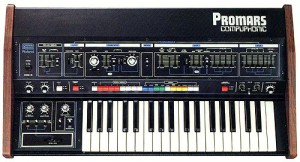
The ProMars CompuPhonic is essentially a classic, monophonic version of the Jupiter 4. It has 10 preset sounds (not too great) and 10 user programmable preset patches. The preset sounds include Bass, String, Clavi, Piano, Voice, Trombone, Sax, Trumpet, Synth I and Synth II. A very standard and well laid out set of knobs, sliders and edit controls give you the power to create some really cool sounds.
There are two individual VCO oscillators that can be de-tuned, a nice VCF (filter) with its own ADSR, a typical VCA envelope section, a nice LFO and a pitch/mod wheel that can effect the LFO, VCF or VCA. It even has a noise generator.
The Promars Compuphonic makes a unique alternative to other Roland SH-type synths since, although it has very SH-type controls and layout, its sound and preset capabilities are more like the famous Jupiter synths and at a fraction of the cost. Nice wood casing and Vintage appeal.
Gear used.
Upper: Roland Promars MRS-2
Mid: Roland JP8000
Lower (Midied to the JP): Kurzweil PC1x
Backtrack recorded on Pro Tools.
Original song composed by Gary Numan
Adrian Utley (Portishead) meets the MiniBrute
Arturia had the privilege to interview Adrian Utley, guitarist and synthesist from the world renown trip-hop outfit Portishead.
In this exclusive video shot in Bristol, Adrian shares his love for the MiniBrute analog synthesizer that he just got, and takes us on a massive sonic journey by hooking it up to his trustworthy Echoplex tape delay.
Check the full version here:
Main feature: http://www.youtube.com/watch?v=X614aeTzq7k
Bonus Synth Tour: http://www.youtube.com/watch?v=YT0l-OsGpgA
Free preamp plug-in and a new analog flux synth
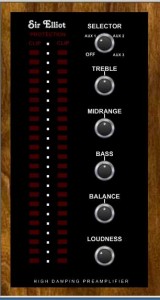
Sir Elliot has released the GPA-2VST plug-in for Windows, a preamplifier described as best suited for jazz, rhythm & blues and lounge music.
Sir Elliot tells us that the GPA-2 is designed to dampen the audio signal and that each Auxiliary input will offer its own tonal characteristic. The new features from the previous model are the following:
- High Damping Factor
- Cross talk
- Output LED Display
- Over Sample Rate Protection
Specifications
- Frequency Bandwidth: +/- 3 dB 22.7 Hz – 22,000 kHz (44.1 kHz – 96 kHz)
- Over Sample Rate Protection: 105 kHz and above
- Cross talk: – 20 dB
- Power Consumption: 7% on a single-core, 3 GHZ, Pentium 4 CPU residing on Windows XP SP3 using a 44.1 kHz white noise audio file.
Pricing and Availability:
Free download
More information:
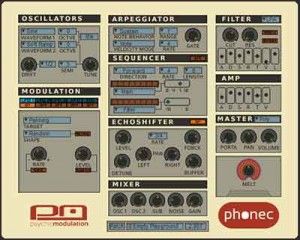
Psychic Modulation tells us that Phonec is best described as an ‘analog flux synthesizer’.
“Inspired by the mystique of video logo synth scores from worn out VHS tapes, Phonec was primarily designed with character in mind. However Phonec is capable of producing a wide range of sounds such as vintage analogue tones, lo-fi synthscapes, ethereal pads, minimal techno sequences, and synthwave leads and basses. Phonec has an intuitive GUI that attempts to strike a balance between form and function, making it a very usable tool that can be a real inspiration to work with. Apart from it’s unique character and smooth workflow, Phonec has several interesting features that set it apart from the crowd.”
Features
- Dual oscillators that can be combined in various ways
- Analog style oscillator drifting
- A unique Melt feature that adds instant character to any patch
- Arpeggiator
- Accent Sequencer
- 3 LFOs (2 monophonic, 1 polyphonic)
- HFO (High Frequency Oscillator)
- 2 Modulation Envelopes
- Echoshifter Delay Unit
- Universal Value Display
- Double Click Parameter Reset
- 128 presets
Pricing and Availability:
Phonec is available for a special introductory price of $34.
More information:
Trogotronic Noise (Trogotronic model 676 & Teenage Engineering OP-1)
All sounds (including drums, percussions etc.) made with Trogotronic Model 676 Fury M Series and sampled, edited & arranged with Teenage Engineering OP-1. Voice with Qneo Voice Synth on iPhone (thru Trogotronic 676) Mixdown & some edits in Logic Pro.
Like any Trogotronic worth its salt the 676 Fury’s functions are not conservative… Meaning, while there are two Main Oscillators, other parts of the circuit can command more complicated frequencies in an intuitive manner. Similarly the Main Oscillators themselves may be applied as filters serving to broaden the utility of the instrument even more so. With regard to BOTH mayhem AND stability 676 Fury’s switch settings offer different parameter reactions: Toggles “down” Oscillators & Track navigate pitch black F-5 electron turbulence; Switched “up” same controls “play nice” in crimson livery with accordance to classical form.The sound? Curiously akin to R. Lee Ermey switching on the kilowatt floods & screaming through an Orange Full-stack set to “11” first thing the morning after an all-night gin bender; i.e. relentless punishment applied to all head-holes within audio range. Add to this the inclusion of 5 CV inputs compatible with sequencers, envelopes etc. and this little box may well become a classic in its own right; “May the Gods save us from this menace; girls and mothers—dress our Fury now in blood-red robes!”
I’m not shure about the sound because I’m not at home & had to mix the track on some cheep iPhone earbuds
Okay – I did this track just 4 fun, messing around with this sick module, thinking the guys from Togotronic still don’t know what it’s doing – I don’t know that too 😀
So let’s go noise!

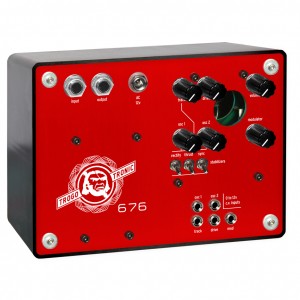
- All Analog Circuit
- 2 Main-Oscillators
- 2 Amplifiers
- 2 Unique Filter/FX parameters (Drive & Modulation)
- Input for use with other audio elements
- 5 Modular compatible CV inputs for patchable parameter control
- 1 Medium Frequency Control Oscillator: Track
- 3 Stabilizer Switches (on for stability, off for mayhem)
- Slovakian Max. Gain, Twin-Triode Vacuum Tube run at high voltage
Synare and WerkBench wake up the neighbors!
WerkBench is available for the iPad in the app store: http://bit.ly/L6jhd9
Here we are using WerkBench to make a groove using sounds from a late-1970’s analog drum synth known as the Synare 3.
The Star Instruments Synare is most famous for its use on disco records as a simple ‘tom-tom’ sound (the first sound I play in this video). Despite its cheesy historical use, the Synare actually a beastly little analog synth with two oscillators (with noise and LFO modes respectively), a self oscilating low-pass filter, and envelopes for filter and volume. I only scratch the surface in this video.
WerkBench is a tool for crafting rhythmic loops from any source material in real-time. WerkBench is great for grabbing sounds on the fly from analog synths that lack patch memory (like the Synare, Monotron, or any modular rig).
About the Synare:
http://en.wikipedia.org/wiki/Synare
Time machine: Moog Prodigy
Moog Prodigy Analog Synthesizer from the year 1979

The Prodigy was an entry-level monosynth from Moog, which has since become a very popular and widely used Bass-synth in techno and electronic music. It was designed as an affordable dual-oscillator synth. It was, however, designed without any help from Bob Moog himself. But that didn’t stop the Prodigy from becoming an excellent analog synth!
Its simple yet effective design employs two voltage controlled oscillators (VCOs) with saw, triangle and pulse waveforms…all classic analog stuff! There’s also a genuine Moog 24dB / octave lowpass filter (emphasis), A/D/S envelope generator, and LFO with square or triangle waveforms and routing to the VCF, VCO or both! Even Portamento, Pitch and Mod wheels. To save money there are no highly flexible modulation routings, no on-board sequencers or arpeggiators, and a simple 32 note keyboard.
recording: multi-track without midi, sequenced by the SCI Pro-One step-sequencer over CV/Gate and synced with the TR-808.
drums: Roland TR-808
fx: a little bit delay and reverb
more info: http://www.retrosound.de
Factory micromac-r test from MacBeth
Yet another teaser from MacBeth, all looks good apparently 
This is the first test that I have done of the micromac-r synthesizer since this test example came back from the assembly plant- all is good! It’s working perfectly! One hell of a lot of sound come from a very micro sized unit!
VINCE CLARKE – The Analogue Monologues – Checking out the Korg MS20
Well !!, and here’s the description:
The Analogue Monologues is a series of mini video-documentaries made by Vince Clarke (Depeche Mode/Yazoo/Erasure). In each webisode Vince talks about one of his analogue synths and explains where the on/off switch is. This series proves, once and for all, that he really doesn’t know much about anything (a must see!).
See all The Analogue Monologues in the ‘Video’ section at Vince Clarke’s official website at http://www.vinceclarkemusic.com
In it, Clarke delivers an amusing narrative, explaining that the synth has “a lot of wholes” in which a user can insert cables “to perpetuate the illusion that I’m technically brilliant and know what I’m doing”. It also features “infamous Korg imposters” (a picture of Rolf Harris) a pink rabbit vibrator, and a special function that only Aphex Twin knows how to use
DATAMASKIN

