
Messing around with an Analogue Systems “French Connection”
Given that it was an early electronic instrument, the Ondes Martenot was singularly playable, so it’s not surprising that composers such as Barry Gray (see the box on the penultimate page of this article) continued to experiment with it throughout the ’50s, ’60s and 70s. Even today, its unique method of control and expression attracts musicians keen to develop new sounds and playing styles. So when Johnny Greenwood of Radiohead asked Analogue Systems to develop a Martenot-style controller for his modular analogue synthesizers, the company was keen to oblige.
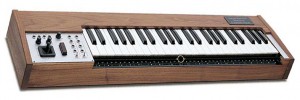
Named the French Connection, Analogue Systems’ design adopts the control mechanisms of the classic Martenot, but leaves the sound generation out, and packages everything in a neat unit designed to sit in front of any of the company’s RS Integrator modular synths or, for that matter, similar modulars produced by other manufacturers. The keyboard itself is four octaves wide, and in front of this you’ll find the wire controller with the small ring through which you insert your index finger. The wire (which is actually a fine nylon cord) is stretched above a fingerboard in which you’ll find small circular depressions that represent the white notes on the keyboard; and protruding metal studs that mark the positions of the black notes.
To the left of the keyboard and the wire controller, there’s a control panel reminiscent of those that you’ll find on other Analogue Systems products. To the far left of this, there’s a sprung X/Y joystick that returns to the central position when released. Above the joystick itself you’ll find two knobs that determine the output range for each axis, with a maximum maximum (if you see what I mean) of approximately 10V. There are four joystick outputs, two each for the ‘X’ axis and for the Y axis. These, like all other Analogue Systems devices, use 3.5mm sockets. To the right of the joystick you’ll find the large, sprung wooden button that also harks back to the original Martenot. If left untouched, this sits in its uppermost position, and generates an output CV of 0V. As you depress it, the CV rises progressively to a maximum of approximately 10V. Again, a knob located above the button itself controls the actual range of operation.
There are just two further controls on the French Connection, and these are the switches located immediately to the left of the keyboard. The first of these determines whether the pitch CV is controlled by the keyboard or by the wire controller. The other determines whether the keyboard produces a conventional trigger and gate, or whether the button produces an amplitude CV. There are eight physical outputs for these – three pitch CV outputs, three button CV outputs, a trigger output, and a gate output. And that’s all there is to it. Add an IEC mains input and an illuminated on/off switch to the right-hand side of the unit, and mount everything in a gorgeous, polished wooden case, and you have a French Connection.
In this video:
I had the oppurtunity to mess around with an Analogue Systems “French Connection”, an imitation of an early electronic instrument called the Ondes Martenot. This controller is CV’d up to an MFB Kraftzwerg. Just a demonstration of some of it’s capabilites. I’ll make a more musical video soon.
Accelerator Chord Sequencing
Background information:
This board is amazing. We started digging into the sequencer functions and there is just so much this beauty can do.
One feature we really like is being able to hold a sequencer step pot and enter a note in. In fact you can enter whole chords into the sequencer memory virtually instantaneously. Just push and hold the desired step’s knob and play the note or chord. Nice!
About the Radikal:
Recent advances in DSP performance and the designer’s relentless perfectionism in the development of sound synthesis algorithms have taken things up yet another level. The result is this brand new polyphonic instrument sporting a sound quality never heard before from digital synthesizers.
Each voice consists of three oscillators, two multimode filters, 6 envelope generators, three voice LFOs and one section LFO. Phasemodulation, time linearity modulation, oscillator synchronisation, ringmodulation, sweepable waveforms and a unique modulation and audio matrix allow for a much bigger spectrum fexibility than the analog subtractive synthesizer counterpart. An additional noise source with independent multimode filtering and variable signal routing has been added for more sonic flexibility. A three band full parametric EQ per voice is a perfect addition to the engine to place that instrument right into the mix. A very nice balanced lightweight keyboard with 61 keys, keyboard split option, aftertouch and velocity sensitivity completes the new synthesizer
The Accelerator is perfectly prepared for Live performances. A lot of synthesizers nowadays do not offer direct patch selection anymore. Instead of using direct access push buttons one has to dial in the desired patch and press enter. The Accelerator makes sound selection instantly available at your fingertips with dedicated patch select buttons. Additionally the unique program chain feature allows for programming a chain of programs that selects the correct patch automatically for you. Another stunning new feature is the the built in acceleration sensor. Movements of the keyboard are converted into modulation data. This brilliant addition allows for controlling parameters like pitch, the filter frequency or modulation depths by lifting up or shaking the keyboard.
How about step sequencers and arpeggiators? The Accelerator would certainly not be a Radikal Technologies synthesizer if the designers had not integrated some sequencing goodies. You can enter some notes into the step sequencer, transpose the sequences with the left hand while performing a solo at the upper end of the split keyboard. Piece of cake! The powerfully warm and crispy sound of this new flagship synthesizer is destined to become the centerpiece of any keyboard setup. For anyone wishing to expand the Accelerators sonic power even more additional voices with up to 2 DSP expansion modules are available. The DSP expansions not only add extra polyphony to the Accelerator, they will also allow the use up to eight independent synthesizer sounds at a time with the integrated multimode feature.
The future of iOS music continued
This is a preview of an upcoming polychord release. In this video, we’re using polychord (BETA) as a MIDI keyboard for nLog Pro (BETA) — all on one iPad, all without any cables. App makers are starting to work together to make all of your iOS music apps play nicely with each other through virtual MIDI. This is still experimental, and it will be a little while until app makers optimize their apps for multitasking, and enable virtual MIDI. It’s very exciting and clearly the future of iOS music making.
If you are a developer, get involved with the open music app group: groups.google.com/group/open-music-app-collaboration
New M-Audio ultra-portable keyboard controller

Avid has announced the availability of the new M-Audio Keystation Mini 32ultra-portable keyboard controller, a 32-note, USB bus-powered keyboard controller designed for musicians on the go. Small enough to fit in a backpack, Avid say that this ultra-portable controller delivers unmatched playability in its class, with features including:
- 32 low-profile mini-keys, enabling musicians to play two-handed parts
- Highly musical velocity curves, allowing keyboard sensitivity customization to individual playing styles
- 4 assignable controls, including a knob, providing real-time control of DAW and virtual instrument functions
- USB bus-powered, plug-and-play connectivity including iPad compatibility (iPad Camera Connection Kit required; check specific apps to verify MIDI support)
Pricing and Availability:
Keystation Mini 32 is available from September in EMEA for £54.99 GBP / €63 EUR $99.95 MSRP in USA.
More information:
Casio WK-7500 keyboard at Summer NAMM 2011
Demo of Casio’s 76 Key Digital Keyboard Workstation
The new Casio WK-7500 offers powerful and extensive features at a price that is unheard of in the portable keyboard market. It offers 800 world-class tones, 250 preset rhythms, 17 track sequencer, 32 channel mixer, as well as audio recording capabilities. Any piece of music you create can be recorded as an audio file on an SDHC card. 9 sliders extend your versatility and provide an impressive 50 drawbar organ tones. Whether you are an amateur or professional musician, the WK-7500 will allow you to create, edit and play your compositions at home, in the studio or on the stage.
Video shared by SOS
Getting in trance with the Nord Stage 2 synth
Mogar demonstrating the potential of the new powerful synth section in the Nord Stage 2, including the new Arpeggiator and the Master Clock sync-features!
Read more about the Nord Stage 2 here: http://bit.ly/nordstage2
Nord Stage 2:
The Nord Stage 2 is compatible with the Nord Sample Library and also the Nord Sample Editor software that lets you create your own sample instruments, for infinite possibilities! Combined with Nord Piano Library compatibility the Nord Stage 2 is an instrument that offers huge expandability.
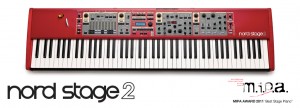
The Stage 2’s powerful new synthesizer engine was built from the DNA of the Nord Wave. Capable of classic analogue synthesis, three operator FM synthesis, Wavetable synthesis and, crucially, compatibility with the Nord Sample Library. The Nord Sample Library not only give Stage 2 owners access to the huge free library of world-class sounds, including the famous vintage Mellotron and Chamberlin samples previously only available to Nord Wave and Nord Electro 3 users, but thanks to the included Nord Sample Editor for Mac and PC, allows user-created samples to be loaded into the instrument and thus opening up a whole new creative world of sound. The Synth engine itself features classic analogue synthesis with dual saw, hard sync and pulse wave modulation, three-operator FM synthesis with 32 different modulation frequencies, Wavetable synthesis with 62 waveforms and Sample based synthesis. A new great-sounding multimode filter features 12 and 24dB low pass, high pass, band pass and notch filters. And with an Amp envelope, Modulation envelope, an LFO, and Unison control, the Stage 2’s synth capabilities are hugely powerful, delivering amazing on-stage sound.
The Synth section also features a new Arpeggiator that can be easily synced to the Stage 2’s Master Clock for perfect timing with other elements of the Stage 2, including its effects.
So, how many keys do you need on your MIDI – thousands??
This is a velocity sensitive MIDI isomorphic keyboard. 192 total keys. The project came out of Louisville Soundbuilders, a fortnightly meeting of circuitbenders, synth engineers and experimental musicians. After seeing a couple of my failed variations of a single-bus isomorphic keyboard, Tim was intrigued enough to design one even better. He designed multiple PCBs that sandwich together with multiple switch types for velocity sensitive keypresses.
More development on the way! We’re working on molds/methods for making hexagonal keycaps. And I’m working on an Arduino-based controller as an alternative to the midibox controller Tim has working already.
Watch the progress at http://soundbuilders.lvl1.org
The world’s most powerful keyboard production station
Judge for yourself, this is how they market it:
The StudioBLADE (Gen2) is the world’s most powerful keyboard production station. Powered by Dual Xeon 6-core processors (12-cores total), 192GB of RAM and 6TB of hard drive space, the StudioBLADE (Gen2) can run over 2,000 plug-ins at once, sequence thousands of tracks simultaneously and hold millions of sound presets. Based on Windows 7 (64-bit), it can run virtually any software or plug-in and is user upgradeable.
Custom configured and ready to use right out of the box, the StudioBLADE is your entire studio in a single instrument. Order direct at http://www.MusicComputing.com
StudioBLADE Sounds v2
http://youtu.be/4C8lRhICYGs
Background on the StudioBLADE: Keyboard production stations can be loosely defined as keyboard workstations that are connected to a computer, which is needed to provide additional processing power and features. While keyboard workstations are suited for live performance and sketching out ideas for a song, keyboard production stations, with built in high-power computer cores, allow users to go from composition to recording to mixing and finally mastering of songs that are ready for radio or direct Internet distribution.

StudioBLADEs are powered by high-performance computer cores utilizing Intel® processors that are perfect for today’s demanding musicians and the virtual instruments and software applications they use. Running Windows® 7 (64-bit), StudioBLADEs are extremely versatile, powerful and perpetually upgradeable. Base models equipped with Intel® Core™ 2 Duo processors can be easily upgraded to the latest Intel® Core™ i5 processors for even more performance. StudioBLADEs can be upgraded from the standard 4GB of RAM memory up to 8GB of RAM. More RAM means the system can run more software application, VSTs (virtual instruments) and tracks. In the past, the high-powered processor usually sat idling, waiting for information to be fed to it. With the 4GB limitation lifted, StudioBLADEs are able to fully utilize every bit of processing power from its Intel processors, making even the base model StudioBLADE, upgraded to 8GB of RAM, out perform any other keyboard production station or workstation. StudioBLADEs are available in 61-key and an 88-key versions, perfect for live or studio use. The keys are velocity-sensitive, semi-weighted action, and are professional in feel and ultra roadworthy. Pitch and Mod wheels as well as octave up and down buttons with indicators are also included.
Built into each StudioBLADE are Music Computing’s ControlDAW™ midi controller and GeoMIDI™ midi mapping software. ControlDaw presents the user with four (4) banks of eight (8) plus one (1) master channel strips each with three (3) mappable encoders with LED indicator light rings, one (1) knobs for panning, solo and mute buttons and a high-quality fader. An 8X8 grid of lighted pads (64 total) is also provided that can be used as drum trigger pads, a Monome (with appropriate software) or as a trigger pad for sequences, etc. Controls for note-repeat enabled software and transport buttons are included as well as real-time feedback between the controllers and software making ControlDAW the ultimate midi controller for music production. Included with each StudioBLADE is a high-quality wireless QWERTY (computer) keyboard and mouse. The optional computer keyboard stand (shown in main images above) allows for great ergonomics in any size work space.
Music Computing’s TriggerGrid™, included with each ControlDAW, is a sample player that allows the user to trigger sampled sounds via controllers such as the ControlDAW or ControlPLAY™. Unlimited number of banks each containing sixty four (64) samples can be loaded and played. Per pad controls included: Frequency, Attack and Release, Gain, Pan and Reverse. Per pad wave editor allows for simple drag to trim/truncate samples. 16 – audio outs for use in a DAW. File formats include: wave and mp3. Save feature allows all 64 pads to be saved as a kit. Unlimited number of kits can be saved that can be instantly loaded for playback. Simple drag and drop interface to populate pads.
Thousands of Sounds: SonicSource™ by Music Computing is a virtual synth (VSTi) equipped with three sample-playing layers, two multi-effect racks, and a library of multi-sampled instruments. The sample playing layers allow blending of waveforms and instruments into a wall of sound or alternatively, the use of the three multi-timbral layers as a workstation. These layers can then be further processed through SonicSource’s powerful multi-effect racks.
In this video:
Hear the audio capabilities of the StudioBLADE as well as some of the many VST (virtual instruments) you can load and play using the StudioBLADE.
Virtual instruments are sound libraries which only keyboard production stations like the StudioBLADE can play and represents some of the best sounds available today.
Getting to know the Yamaha PSS-380 / PSS-390
The Yamaha PSS-390 is the same as the PSS-380 FM-keyboard.There is only a cosmetic difference (colors).Its build one year later than the PSS-380. The Yamaha PSS-390 has been used by artists like Alobar and Tax-5
In this video:
Demo Song: Susan Rom
Sounds & Drums: Yamaha PSS-380
Effects: Behringer FX 600 (Delay)
Multitrack Recording
DATAMASKIN

