
New Delptronics Trigger Sequencer Preview
This is a preview of the new trigger sequencer eurorack module from Delptronics which debuted at NAMM 2013.
It is a very compact 8 HP wide. There are 8 trigger outputs and each pattern consists of 8 steps per output. It has 8 pattern memories, which can be played back in any order and combined into chains of up to 100 steps. The revolutionary pattern editing interface enables you to create any pattern with just two knobs.
For more information, or to be notified when the new module is for sale, go to http://delptronics.com
Medic Modules Ident – new analogue eurorack modules coming soon
Analogue Solutions’ Tom Carpenter shared this short teaser: Medic Modules Ident – new analogue eurorack modules coming soon
Akasha Synth Sound Art (at NAMM 2013)
A short demo at NAMM of the first Akasha Synth object. It’s a modular system with geometric shapes in order to build sounding 3D art objects. The modules or nodes provide analog sound circuits and a digital interconnection that can be controlled by Midi. Touch sensitive pads and bright LEDs show the interconnection VCAs and their modulations. There are triangles, squares and pentagons to obtain any platonic or irregular body or planes.
The synth line comes from the Akasha Modules, it’s synced to an XBASE 999 and controlled by Midi CCs or the internal touch sensitive pads.
Sorry for the noisy environment;)
“I Dream of Wires: Hardcore Edition” 2013 official trailer
“I Dream Of Wires (Hardcore Edition)” – 2013 official trailer.
“I Dream of Wires” (IDOW) is an upcoming, independent documentary film about the phenomenal resurgence of the modular synthesizer – exploring the passions, obsessions and dreams of people who have dedicated part of their lives to this esoteric electronic music machine. Written and directed by Robert Fantinatto, with Jason Amm (Ghostly International recording artist Solvent) serving as producer and co-writer, IDOW is set to receive it’s festival premiere, May 2013.
Preceding IDOW’s official theatrical release, we will be releasing this special, extended cut: “I Dream Of Wires (Hardcore Edition)” (IDOW-HE) will be released independently on BluRay / 2xDVD, and shipped to all IndieGoGo and pre-order customers, June 2013. IDOW-HE is for the hardcore modular synthesizer and electronic music fanatics, and will run approximately 4 hours long (!).
IDOW-HE is a strictly limited-edition item, available to order exclusively through idreamofwires.org from 2/11 – 5/31, 2013. It’s bound to sell out in pre-orders, so don’t sleep…
IDOW-HE BluRay / 2xDVD is available to pre-order now:
idreamofwires.org/order
“Themogene (I Dream Of Wires theme)”, from the forthcoming IDOW original soundtrack album by Solvent, is available to listen/download in its entirety via Ghostly International on Soundcloud:
soundcloud.com/ghostly/solvent-themogene
Additional music/sounds featured in this trailer: Container, Jack Dangers (Meat Beat Manifesto), Richard Devine, John Elliott (Spectrum Spools/ex-Emeralds), Gert Jalass (Moon Modular), Richard Lainhart, Solvent, Jon Sonnenberg (Travelogue), Keith Fullerton Whitman.
“Who said that?” (in order of appearance): Brad Garton, Dean Batute, Maggie Payne, Bernie Krause, William Maginnis, Terry Pender, Jack Dangers (Meat Beat Manifesto), Benge (John Foxx and the Maths), Vince Clarke (Erasure), Daniel Miller (Mute Records), David Kronemeyer, Jon Sonnenberg (Travelogue), Carl Craig, James Holden, Richard Devine, Luke Abbott, Tony Rolando (Make Noise), Flood, Trent Reznor (NiN/How To Destroy Angels), Dieter Doepfer, Dominic Butler (Factory Floor), Paul Schreiber (Synthesis Technology/MOTM), David Kronemeyer, Eric Barbour (Metasonix), George Mattson, William Mathewson (WMD), Tony Rolando, Eric Barbour, Daniel Miller, Drew Neumann, John Elliott (Spectrum Spools/ex-Emeralds), Andreas Schneider (SchneidersBuero), Eric Barbour, Scott Jaeger (The Harvestman), Andreas Schneider, Dieter Doepfer, Chris Carter (X-TG/Chris & Cosey), Charlie Clouser, Danjel Van Tijn (Intellijel), John Tejada, Drumcell, Legowelt, Alessandro Cortini (SONOIO/ex-NiN), John Foxx, Deadmau5, James Husted (Synthwerks), Paul Barker (Malekko/ex-Ministry), Container, Cevin Key (Skinny Puppy), Robert A.A. Lowe, Trent Reznor, Gur Milstein (TipTop Audio), Gary Numan.
idreamofwires.org
vimeo.com/idreamofwires
facebook.com/idreamofwiresdocumentary
TT-303 Controlling Modular
Background description:
Machinedrum is master midi clock to TT-303 which sends CV to Intellijel Rubicon.
Gate is sent to Quadra. Other modules used: Dixie ii, Planar, Dr Octature, uVCA, uFold & uVCF
Reason DAW goes modular
Introduction to the A-Series Modular Synth Rack Extensions for Reason
The A-Series Modular Synth is the first fully modular synth for Reason, where you can design your synths however you want for whatever sound you can imagine. And because all the modules are mix-and-match, all those Reason effects and devices that you already have can go right inside your custom synth.
Connecting the MS-20 Mini to your Modular systems
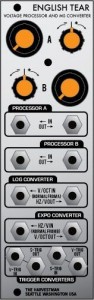
Modular synth manufacturer The Harvestman has announced a new module that’s designed to make it easy to connect the new Korg MS-20 Mini to modular synthesizers.
Here’s the official announcement:
I announce with great satisfaction ENGLISH TEAR, the first in a line of small utility modules.
This module features the expected “voltage processor” attenuverter and big offset knobs, but also includes a full set of functions for interfacing to an MS-20. Easy conversion from exponential volt-per-octave to linear hertz-per-volt and back, as well as V-trigger to S-trigger conversion. Jack normalling fixes the voltage processors to these converter circuits, so you may scale the input voltages as desired. The log/expo converter circuits also have many other uses in your modular system beyond the conversion of pitched voltages.
Pricing and availability are to be determined.
Buchla Music Easel at NAMM 2013
Synth design mad scientist Don Buchla is back, and this re-issue of his Music Easel is a virtually identical copy of the original from the mid-’70s. Esoteric synth expert Gino Robair goes hands-on.
Background information:
Summary Description / December, 1973
The Music Easel is a highly evolved electronic musical instrument. It maintains many of the design philosophies and functional characteristics of its predecessors, the 100 series Modular Electronic Music System and the 200 series Electric Music Box. The Music Easel introduces some substantial innovations in electronic instrument design – innovations that make it a truly expressive real-time instrument for composition and performance.
The Music Easel contains many of the elements commonly used to generate and process sound: a keyboard, sequencer, pulser, preamplifier, envelope detector and balanced modulator; oscillators, gates, envelope generators and filters; facilities for mixing, monitoring and reverberating. Many of these elements possess an unusual degree of sophistication. The keyboard is solid state, with touch sensitive, chromatically organized keys, accurate and reproducible pressure output, tactile feedback, octave shifting, and voltage controlled portamento. A complex oscillator, developed through computer aided simulation studies, is a rich source of complex audio spectra. featuring voltage control of pitch, timbre and waveform, this oscillator provides the Music Easel with a timbral range unapproached by other musical instruments.
The connectives are as important as the elements to be connected. Interconnection within the Music Easel is accomplished with a combination of switching and patching, a system which is flexible, expedient, and open ended. Logical, compact organization and color coded graphic feedback facilitate rapid and effective interaction. Multiple correlations between a performer’s actions and the Music Easel’s responses are readily implemented, enabling a degree of expressive articulation heretofore impossible with electronic instrumentation.
Further augmenting the Music Easel’s real time performability is the capability of permanently storing and immediately retrieving complete instrument definitions (patches) or portions thereof. (An “instrument definition” includes settings of parameters, degrees of articulation, switch positions and interconnections.) Storage entails the installment of resistors on program cards; retrieval is accomplished by plugging in a desired program card and activating a switch.
With its extended timbral resources, unusual expressive capability, and its facility for storage and recall of instrument definitions, the Music Easel opens new horizons to the composer and performer. To appreciate its potential as a new musical instrument the Music Easel must be seen, heard and played.
Music Easels are provided with six blank program cards, an assortment of programming resistors, and a comprehensive instruction manual. Available accessories include additional program cards and resistors and a 12 volt battery pack. Complete with case and charger, this battery pack will power a Music Easel for approximately three hours per charge.
Electrical requirements are 30 watts at 110 volts A.C. or 2 amperes at 12 volts D.C. Preamp input impedance is 1 megaohm; gain is 30 dB. Nominal program output level is 1 volt R.M.S., sufficient to drive tape recorders or power amplifiers. A separate 2 watt monitor output will drive headsets or low level speakers.
Housed in a rugged aluminum case, the Music Easel is built to travel. Weight is 30 pounds; dimensions are 6″ x 17″ x 22″ (carry on baggage for jetliners).
Massive Moog 55 Modular
WNAMM13: Massive Moog 55 Modular – Video Bob Moog Foundation with Mark Doty
Two hot new instruments: Vacuum Pro Polyphonic Analog Tube Synthesizer and Loom Modular Additive Synthesizer
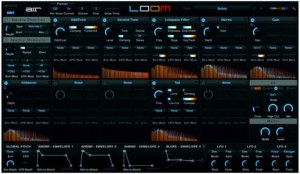
AIR Music Technology has expanded their virtual instrument offerings with the Vacuum Pro Polyphonic Analog Tube Synthesizer and Loom Modular Additive Synthesizer. They tell us that both programs are compatible with 32- or 64-bit Mac or Windows systems, and both support the new AAX plug-in format, as well as traditional VST, AU, and RTAS formats. Here’s their press release with all the details…
Vacuum Pro is a polyphonic analog tube synthesizer that travels light-years beyond the original monophonic Vacuum, first developed by the AIR team as part of the Pro Tools® Creative Collection from Avid®. The new Vacuum Pro is polyphonic, offering up to 160 oscillators plus substantial improvements in both horsepower and features. Loom is an entirely new modular additive synthesizer. While both of these new synthesizers offer an amazing amount of detailed control, each also provides programming aids and shortcuts to create custom user-created sounds quickly. Each contains 250 presets created by the AIR team. The Eco (economy) mode reduces the draw on the host processor, with minimal effect on the final sound.
“We offer the customer the best of both worlds,” said Samara Winterfeld, Principal Product Manager, AIR Music Technology, “The organic sound of a vintage/analog synths, combined with the flexibility/capability of a virtual instrument.”
Vacuum Pro
Polyphonic Analog Tube Synthesizer
The Vacuum part of the name Vacuum Pro relates to the six tube circuits that lend a particularly analog flavor to each of the main synthesis modules–oscillators, filters, mixer, etc. Vacuum Pro combines this vintage, organic sound with the versatility of up-to-date virtual instrument control. The interface is populated by single-function knobs, delivering a vintage feel that reflects the rich analog flavor of the instrument. Modulation effects, delay, and a classic arpeggiator add motion and depth to the sound.
Vacuum Pro sounds are created using one or two parts. When creating parts, the Smart Sound Randomizer allows new values to be created instantly for any or all selected modules. This makes it easy to keep an interesting oscillator sound, for example, while quickly trying out new filter settings. In addition, the Parts Lock feature allows the current settings of any modules (both parts) to be retained when changing sounds, providing a fast way to combine elements from different patches. Best of all, the Easy Sound Design Page reduces the dozens of front panel knobs down to eight, grouping related controls together for rapid results.
Loom
Modular Additive Synthesizer
Loom weaves together a unique sonic spectrum, offering between 128 and 512 individual additive harmonics. Using an innovative modular approach, Loom has made additive synthesis both powerful and easy to control. Loom provides 30 sound modules, each with a distinct function–moving filter, octaver, repeater, second tone, etc. Up to 10 of these modules can be connected in a string. Spectral modulation, extensive envelope control, and multiple LFOs deliver deep control. Onboard effects provide the finishing elements for each sound.
The Smart Morph Page is where Loom really comes to life. In addition to real-time knobs offering sound, dynamic, modulation, and effect control, this simplified editing page also opens up the extensive morphing capabilities of the Loom additive sound engine and effects. Four assignable quadrants on an X-Y display provide incredible morphing control. Custom morphing paths can be plotted using points and segments. These morphing paths can then be automated, placed under MIDI control, and even synced to the tempo of the host program, creating a morphing pattern that takes 8 or 16 bars to complete, as one example. Intuitive color-coding makes the Loom graphical user interface easy to understand
More information:
DATAMASKIN

