
Nice new free mono soft synth for your iPad
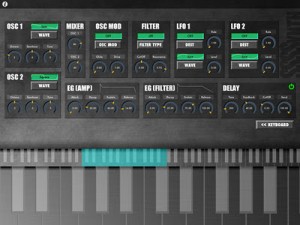
“SSSSYNTH is Monophonic Virtual Analog Synthesizer. Since the basic analog synthesizer’s parameters are implemented, this app is perfectly suitable for beginners! You can easily create impressive phrases from 35 types of keyboard even if you cannot play the piano.
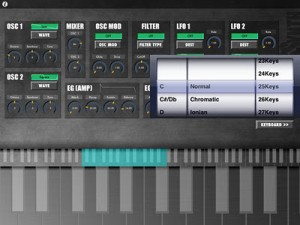
[Specifications]
– OSC x 2
– MODURATION
RING MODURATION
OSC SYNC
– GLIDE
– FILTER x 1
– EG x 2(AMP,FILTER)
– LFO x 2
– FX
DELAY
OVER DRIVE
– KEYBOARD(SCALE) x 35″
New virtual A 303 Clone for Ableton
analogfactory says that ‘Black, fast and toxic’ is the best description for the rackmounted monophonic true analog MAM MB33 synthesizer which was released in the 1990’s. Black Mamba is a replica of this little synth combined with the powerful Instrument Racks of Ableton Live.
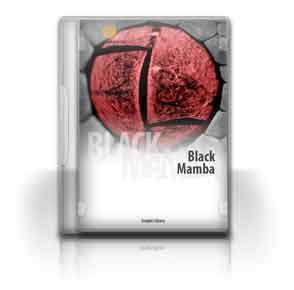
Originally released as a TB303 clone by German company MAM (Music and More), the MB33 had a true analogue single VCO with two basic waveforms – square and saw. analogfactory say that, as the MB33 had the possibility of morphing those waveforms, it was able to create more tones than the TB303.
Black Mamba has been chromatically sampled in 24bit/96khz with high-end Apogee A/D converters and, besides the two basic waveforms, analogfactory has sampled 9 further waveforms using the morph possibilities of the VCO.
Pricing and Availability:
$21.99
More information:
New Analogue Monophonic Synthesizer – Domino
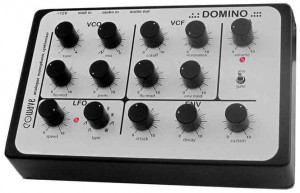
DOMINO is a discrete analogue synthesizer with a VCO in the tradition of MS20 and TB303. They say that the VCO, filter & VCA are transistor made and that this transistor architecture gives DOMINO a unique raw sound – rich and raw at the same time with no need of external effects to give life to the sound.
The VCO offers a mix between sawtooth and square. Pulsewidth can be modulated by the LFO. The filter is a 24dB resonant filter. The analogue envelope range is from 1ms to 10s with attack, decay, sustain/release.The LFO has 8 different waveforms. On waveform 8, the modulation wheel can replace the LFO. MIDI CC 8 to 16 can transform the LFO in a sequencer to modulate pitch, pulsewidth, filter cutoff. The VCA can be modulated by a gate or by an envelope. In the legato mode, playing notes will generate glide between two notes. The glide time can be edited via MIDI CC.
Eowave have added a few more features like an arpeggiator and an accent recognition capability: all velocity values above 100 are recognized as an accent.!
Technical specifications
- 1 analogue oscillator from saw to square with tune and mix
- LFO modulation
- Pulsewidth modulation
- 24dB resonant filter
- Envelope modulation and LFO modulation of the filter
- LFO with Speed and Type parameters
- LFO syncable to MIDI clock
- Envelope with Attack, Decay, Sustain
- Analogue VCA
- Env/gate switch
- Arpeggiator
- Easy to use
- Direct access to all parameters
- Connections: MIDI in, Audio out, Ext power supply, Audio in
- Size : 18,5 x 12 x 5,5 cm
Pricing and Availability:
Price: 250 € excl. VAT
More information:
Free Monosynth from UGO for Windows user
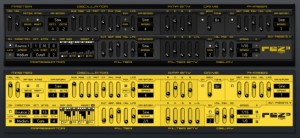
Ugo Audio has released Rez 3, ‘a mean little monosynth’ for Windows.
Here’s what they have to say about Rez 3:
Rez is a seemingly basic synth, but it’s capable of a very wide range of sounds. While Rez has a bunch of cool features, the beating heart of Rez is its filter. It’s made from multiple chained filters acting as a single powerful filter and it’s highly resonant, providing Rez with its distinctive character. Top that off with distortion, a phaser, various oscillator modulations, delay, and a killer programmable arp and step sequencer, and you’ve got a powerhouse of a synth in a very small package.
From funky squishes, beastly basses, and screaming leads, to tight arpeggiations, swirling rhythms, atmospheres, bells, and interesting effects, you’ll find it all here. Additionally, it comes with two skins – Yellow & Black, or Black & Yellow.
Features:
- Virtual analog oscillators
- Sub-oscillator
- Detune (modulatable via aftertouch)
- Programmable phrase arpeggiator
- Step sequencer (arp driven) with four mod destinations
- Highly resonant low pass filter with velocity, LFO, and envelope modulation
While Rez is free, three commercial banks are available for it – each with 128 presets.
Audio demos & the download are available at the Ugo site.
iSynthesizer Pro becomes freeware
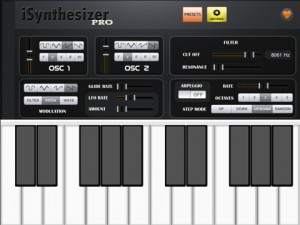
Amitech has cut the price on iSynthesizer Pro (App Store link) down to a free download.
iSynthesizer Pro is a monophonic virtual analog synth that, according to the developer, is designed for live performance.
Features:
- Monophonic, playing one note at a time like a class synthesizer
- Designed for live performance
- Configurable Presets, save your favorite settings
- Oscillator Module
- Dual oscillators
- Square, Triangle, Sawtooth, Reverse Sawtooth waves
- Octave selector, supporting 5 octaves
- Glide between notes (Lag Processor)
- Oscillator fine tune (more than one full octave)
- Oscillator sync
- Low Pass Filter Module
- Modulation module
- Tremelo/Wave
- Vibrato/Pitch
- Filter
- Envelope Generator module
- Supports ADSR (Attack, Decay, Sustain, Release)
- Volume
- Filter (amount of low pass filter)
- Arpeggio
Core Synth HD – free synth for iPad
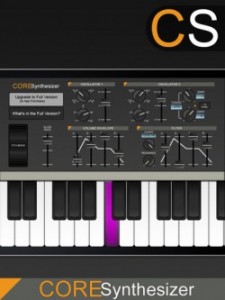
Jasmine Lee has released a free monosynth for the iPad – Core Synth HD.
Get your groove on with Core Synth HD, the definitive monophonic synthesizer for the iPad. With tons of features packed into a small package, Core Synth is great for live performing. A Pitch Wheel replicates perfectly the real thing!
While it’s free and has a lot of features – no mention is made of MIDI support, at this time.
Features:
- Pitch Wheel
- 2 Octave keyboard
- Keys light up in different colors when pressed
- Oscillator Module
- Dual overlapping oscillators
- Four wave patterns: Square, Triangle, Sawtooth and Reverse Sawtooth
- Select from 5 octaves
- Adjust glide between notes
- Fine tune Oscillator 2 with option to sync with Oscillator 1
- Volume Envelope Shaper
- Edit ADSR (Attack, Decay, Sustain, Release)
- Low Pass Filter Module
- Adjust Cutoff and Resonance
- Edit ADSR (Attack, Decay, Sustain, Release)
- Upgrade to the full version within the app for the following additional features:
- 7 Octave Keyboard
- Octave control to move along entire range
- Modulation Wheel
- Patches Module
- Save an unlimited number of individually named patches
- Browse through your collection before applying patch
- Delete unwanted patches
- Modulation Module
- Four wave patterns: Square, Triangle, Sawtooth and Reverse Sawtooth
- Modulate Filter, Pitch or Wave
- Adjust LFO Rate and amount
- Arpeggiator Module
- Arpeggio moves up to 5 octaves
- Four step modes: Up, Down, Up/Down, Random
- Adjust rate
Core Synth HD includes open source code from MobileSynth, developed by Allen Porter.
Introducing the”Drift Box”
“Drift Box” is a compact monophonic synthesizer.
That’s product of REON co.,Ltd in osaka japan.
INSTANT DUBSTEP WOBBLE with Lazerbass in Reaktor 5.5
Lazerbass
The newest addition to the REAKTOR library is a monophonic synthesizer delivering a pure and direct sound without additional effects. The new additive synthesis module means Lazerbass can create a large number of timbres, themselves made up of multiple harmonic or non harmonic partials. The result is a sound of immense quality, equally at home creating spacey sci-fi sounds as full and punchy sub basses ideal for dubstep and other leading-edge electronic productions that need that signature “wobble.”
First glimpse of the Mutable Instruments ShrutHI-1 digital/analog hybrid monosynth
A sneak preview of a new DIY synth project – the Mutable Instruments ShrutHI-1 digital/analog hybrid monosynth.
The video demonstrates some of the presets on ShrutHi-1 Kit #000.
Specs below. See the Mutable Instruments site for details.
2 digital oscillators
- band-limited sawtooth with adjustable phase
- band-limited square wave with adjustable pulse-width
- band-limited triangle wave with adjustable waveshapping
- phase-distortion emulation of a low-pass filtered sawtooth (casio CZ-101)
- phase-distortion emulation of a low-pass filtered sawtooth with high resonance (casio CZ-101)
- phase-distortion emulation of a low-pass filtered sawtooth in the Rocker Launcher’s world in which sine waves are turned into triangles (casio CZ-101)
- mysterious phase-distortion thing (could have been in the CZ-101 if the engineers at casio dared…)
- phase-distortion emulation of a Jew’s harp / Morsing (could have been in the casio CZ-101)
- stack of 4 detuned sawtooth waves (with aliasing)
- simplistic FM (1>2 configuration), with adjustable modulation index and frequency ratio
- wavetables, wavetables, wavetables!
- sweepable table of basic waveforms
- tampura transwave
- PPG harsh creature
- single cycle waveforms taken from D50 patches
- cello transwave
- slap bass transwave
- organ/drawbars single cycle waveforms
- male voice
- user wavetable, can be edited by SysEx messages
- 8bit-like harsh waveforms with wavetable scan
- sine wave with variable amount of bitcrushing
- poor man’s square with pulse-width modulation (plenty of aliasing but fat for basses)
- colored noise (sweep from low-pass filtered white noise -> white noise -> high-pass filtered white noise)
- lo-fi vowel synthesis (think “speak and spell”) with vowel morphing
Mixer
- adjustable oscillator balance
- mixing algorithms: simple sum, simple sum with synchronization, ring modulator, xor modulator, sum with post-mixing tanh fuzz
- extra sources: noise, sub-oscillator (triangle or square) or percussive attack generator (click, glitch, blow, metallic, pop)
Audio quality/resolution
- Internal digital audio signal processing chain: 39062 Hz, 8 bits.
- Internal digital control signals processing chain: 976 Hz, 8 bits.
- Digital outputs: 10 MHz, 1 bit.
Filter
- Exchangeable analog signal processing boards:
- CEM3379: based on the CEM3379, uses the same circuit as the original Shruti-1 with the “click filtering” mod
- SMR4: a 4-pole LPF (very SSM2044-like) and linear VCA built with the widely available LM13700 transconductance amplifier and TL074 op-amp
- SSM2044: SSM2044 4-pole LPF, SSM2164 2-poles HPF + linear VCA.
- (à suivre)
Modulation
- LFOs: 2, with square, sawtooth, triangle, sample & hold, and step sequencer shapes. Syncable to tempo. Adjustable “raise/attack” time. LFOs can be free-running, sync’ed to envelope retriggers, or retrigger envelopes.
- envelopes 2 ADSR
- modulation matrix: up to 12 source -> destination connections. Adjustable modulation amount in the -100% — 100% range
- modulation sources:
- LFO 1/2
- step sequencer
- first / second half of the step sequence
- arpeggiator gate
- mod. wheel
- aftertouch
- pitch bender
- DC offset
- CV inputs 1/2/3/4
- MIDI CC 16 to 19
- noise generator
- env 1/2
- random value resampled at each note on
- note velocity
- note number (eg for filter tracking)
- keyboard gate
- audio signal from the mixer output (decimated at 1kHz)
- modulation destinations:
- filter cutoff
- VCA gain
- pulse width/Parameter osc. 1/2
- wide pitch osc. 1/2
- pitch, applied to osc 1 & 2 simultaneously
- very fine pitch, applied to osc 1 & 2 simultaneously
- oscillator balance
- noise level
- subosc level
- resonance
- PWM CV output 1
- PWM CV output 2
- 2 bits digital value on CV output 1/2
- LFO1 FM
- LFO2 FM
Performance
Clock/tempo generator
- internal clock: 40-240 BPM, with some additional extra fast tempi for effects (270, 300, 360, 480, 600, 720, 960)
- external MIDI clock with divider
- 6 groove templates (swing, shuffle, push, lag, human, monkey) with adjustable amount
Arpeggiator
- 1-4 octave range
- up, down, up&down, random
- 15 preset rhythmic patterns + 1 programmable rhythmic pattern
- warp: creates complex rhythms by cyclical repetitions of steps (eg 1212343456567878 instead of 12345678)
- latch/hold
Sequencer
- 16 steps, with legato/slide, velocity, and modulation
- 4 modes corresponding to different interactions between the sequence and keyboard play: latch / transpose / loop recorder / override
Performance
- custom page in which 4 user-selectable parameters can be assigned to the 4 editing pots
- microtunings/key maps for arabic scales (1/4 tones) and a selection of hindustani ragas
- portamento, legato on/off
- master tune
System and memory
- complete MIDI implementation, including patch editing by CC or NRPNs, patch and sequencer data transfer, full memory backup, wavetable transfer
- MIDI out modes: off, thru, thru+knob movements sent as CC, sequencer/arpeggiator generated events only, polychaining, split (plays notes below split point, forwards the other notes)
- patch memory: 80 patches and 80 sequences stored in EEPROM (no backup battery required)
- firmware update by SysEx
Hardware and connectors
- power: 2.1mm connector, requires 7.5V-9V 300mA supply (can be unregulated). Center pin positive (+), outer collar negative (-)
- audio input/output: 6.35 Jack (Mono audio out), 6.35 Jack (External signal in)
- cv inputs: up to 4 CV inputs for easy experimentation with controllers ( might not be broken out on analog VCF/VCA board )
- cv outputs: up to 2 CV outputs ( might not be broken out on analog VCF/VCA board )
- MIDI: in, out
- serial: extra UART TX pin available on control panel board (might be used in future firmware updates to control extension boards)
- ISP connector for firmware development
- controllers:
- 8 facade LEDs (current page / modulation matrix visualization)
- 6 navigation switches
- 4 pots for patch editing
- clickable rotary encoder for fine parameter adjustment or navigationbacklit 2×16 LCD display
Android music apps gears up
This video captures a demo of a step sequencer application, Monotroid, running on an Android mobile phone-controlled Korg Monotron:
- Android is connected with Arduino by Bluetooth.
- The Arduino is connected with Monotron.
Adding the iPhone app to the Monotroni creates a surprisingly potent combination.
DATAMASKIN

