
The Analog Lab NYC-Moog Modular-Holst | The Planets, Op. 32: I. Mars, The Bringer of War
Here’s a nice video featuring the Moog Modular, enjoy
This Moog Modular was originally owned by Gershon Kingsley and played at the January 1969 performance of the Moog Quartet. Over the years, it was also owned by Ken Bichel and has had numerous additional modules installed.
The Analog Lab in NYC has restored this piece to beautiful playing condition and the unit can be heard in all its glory in this video*. No additional effects were added.
This piece of Musical History is also for sale on eBay, so check it out!
www.theanaloglab.com
*editors note: I know some parts aren’t perfectly in tune…get over it.
Get the Arturia miniMoog for free on the 21st of June

Arturia has told us that they will be giving away for free a special version of Minimoog-V on June 21st Only.
Arturia’s agreement with Moog Music to sell a Moog-branded virtual instrument is ending, so they’re going to update and rename Moog Modular V and Minimoog V as Modular V and Mini-V.
The free version of Minimoog-V Original offers 1,000 presets and features from the latest Minimoog- V update (Version 2.5), but without the additional functionality accessible behind the ‘hinged’ front panel — just like the original Minimoog.
Program for MoogerFooger Synth, Taurus 3 and Theremin
Synth dude in a white coat fiddling with his gear 
The CP 251’s LFO is the heart of the time driven events in this program. It is driving the rate of the Sequencer, the sample and hold that is sent to the MF-101 filter, and is being lag processed and controlling the pitch of the Mf-107 Freqbox. Noise from the CP is also being processed by the 103 Phaser. The q119 is modulating the pitch of the Mf-102, creating a melody, that is fed to the Synthesizers.com VCA, to the 104z Delay and to the board. The q119 is also firing gates to the envgen which is controlling the vca. The Voyager is taking a nap in this piece, but is midi controlling the Taurus Pedals. The touch surface is activating the sequencer. The Theremin was obviously a lacking overdub, but I was in a hurry to finish this program so I could rip the cords out and start over.
Cp251: Lfo squarewave multiplied: 1. Lagged, sent to Freqbox Freq In. 2. Sent to q119 to control rate. 3. Sample and Hold to MF-101 Cutoff Frequency
Noise source sent to phaser, Phaser output to board.
Q119, 1×24 stage sequence modulating the freq input of the mf102. Gate output to Envgen.
MF102: Audio to VCA then to delay then to board.
Voyager: Midi controlling Taurus 3, Touchscreen
Droning Machine
The Freqbox is a very underrated device.
This is very simple programming, just some slight modulation of the waveshape, to an overdriven 101 LPF. Then a random sequence with most of the pots totally CCW seemed to simulate a two person morse code conversation using the Ringmod as a pitch source.
Oscs sent to a synthesiers.com VCA and to the MF 104z Delay prior to going to the board.
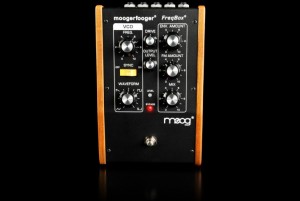
The MF-107 FreqBox is different from other effects – the effected sound is not a processed version of your input signal, but the sound of the input signal modulating an internal oscillator. It contains a VCO with continuously variable waveshape, and the capacity to modulate that Oscillator in the following ways:
– the VCO can be hard synced by the input signal
– The VCO can be frequency modulated (FM) by the input signal
– The VCO frequency can be modulated by an envelope follower which tracks the dynamics of the input signal
– The Amplitude of the VCO also tracks the dynamics of the input signal
Hard sync is a classic analog synthesis technique where the start of an oscillator’s cycle can be reset by another. The oscillator being synced takes on the frequency characteristics of the other oscillator, and when its frequency is swept, it reinforces the harmonics of the fundamental frequency. In the case of the FreqBox, the input signal is used to reset the FreqBox’s VCO.
FM is a technique used to get really rich sounds from simple waveforms. The type of FM used in the FreqBox is linear FM. Sounds range from gong or bell-like tones to sizzly sweeps.
The FreqBox, like all moogerfoogers, works with any instrument to line-level input. In addition to the panel controls there are control inputs for use with expression pedals or control voltages and control outputs for interconnecting moogerfoogers like you would a modular synth.
The demo was recorded with an electric guitar, the FreqBox, a Moog EP-1 expression pedal, and recording software on a laptop. That’s it!
The FreqBox can provide some really unusual processing to all types of signals – guitars, synths, drum sounds, vocals or wind instruments allowing you to enter previously unexplored sonic territory.
MINITAUR + ABLETON LIVE: Minitaur Editor Librarian
In the final part of this three part series, Moog Product Development Specialist, Amos Gaynes shows you how to use the under the hood features of the Minitaur Editor Librarian. Learn how to utilize even more features of your Minitaur for a totally custom experience.
Learn more about the Minitaur at:
www.moogmusic.com/products/taurus/minitaur
Be sure to register your Minitaur to receive your free copy of the Minitaur Editor Librarian at:
www.moogmusic.com/register
Starting Work on an iPad Lemur Template for Moog Phatty Series
My Boulder friend Mark Mosher has released this nice video featuring the Lemur for the Moog:
I’ve started work on an iPad Lemur template for my Moog Slim Phatty. This is a very early version of what I have ultimately planned but the video does show early control with physics as well as bi-directional synch. I’m programming the Lemur via Wifi, the Lemur is attached to the Phatty via the camera kit and straight into the USB port. I also have a Novation Remote SL hooked up via MIDI to play notes on the Phatty. You can also use WiFi via a host like Ableton live to control the Phatty.
In this version of the template, Filter controls are in red. There is an XY for Cutoff and Res with physics controls for Friction, Attraction and Speed. I can also lock the control on the X and Y Axis. To the right Filter EG amount with filter envelopes. Under that Filter Overload.
Next are Arpeggiator controls that are normally hidden under-the-hood in the Advanced Menu. So I can directly control Arp on, Latch, Clock Div, and Arp Octave. To the right of this a little note trigger button.
Lastly I have an Amp Envelope in Blue. Unlike from the front panel of the Phatty, Lemur allows me to control more than one parameter at the same time, like Cutoff and Res, or all the segments of a an envelope.
Moog MINITAUR Mini-Tour
DJ GhostDad discusses the layout and features of Moog’s Minitaur Analog Bass Synthesizer Module.
Thanks to The Cutting Room Studios for hosting
Moog Micromoog demo
A demo of the Moog Micromoog, the “baby” Minimoog with one oscillator and sub oscillator. Plenty of routing capabilities can create standard Moog bass/lead, but also incredibly crazy FX. Micromoog is a single-oscillator mono-synth, designed as a budget performance Moog. But it’s an inexpensive alternative to the Minimoog. In fact, it is often used as just a stand-alone filter processor since it has a filter that is virtually identical to the one found in the Minimoog, and it accepts external sounds for processing through itself (all at a fraction of the price for a Mini)! It also employs a ribbon controller (which was a cool new feature) for pitch bending. Notice that there are still plenty of knobs to give you access to the shape of your sounds! Unfortunately the construction feels kind of cheap.
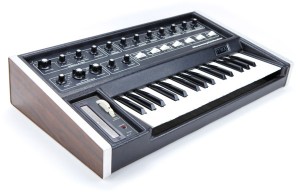
Moog Source goes to Berlin School
A demo of my Moog Source (old Berlin school)
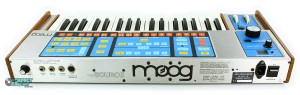
Moog’s Source was their first to offer patch memory storage as well as some other new features. It boasted 16 memory locations so you could finally save and recall your synth patches. A casette-tape jack was also implemented to transfer your patches to and from an external tape and free up the on-board memory for additional new patches. But in an effort to modernize with the eighties, the Moog had replaced all buttons, knobs and sliders with flat-panel membrane buttons and a single data-wheel assignment format. At the time, this may have seemed far-out, but in all actuality it is the Source’s downfall.
Parameters are edited not with hands-on sliders and knobs but by assigning a selected parameter to the dedicated data wheel. This is very tedious and does not allow for true hands-on tweaking during performances nor can you adjust different parameters simultaneously or while playing. These days, the membrane buttons don’t always seem to work quite right either. However, those famous monophonic Moog sounds are still inside this synth which has two fat analog oscillators and the legendary 24 dB Moog filter.
Moog Taurus 1 + Roland VP330 “Beauty & Beast”
Vintage synth demo track by RetroSound:
bass & lead sounds: Moog Taurus 1 bass pedal synthesizer (1976)
analog strings & choir sounds: Roland VP330 Vocoder Plus (1979)
drums: Roland TR-808 (1981)
recording: multi-track
fx: a little bit delay and reverb
I used in the demo the legendary BASS and TAURUS presets and some self-made sounds (reso-bass and lead sounds).
more info: http://www.retrosound.de and
http://www.facebook.com/pages/RetroSound-Marko-Ettlich/265713782347
DATAMASKIN

