
Taking it into the future of gaming, audio and music
The August issue of Develop magazine is available now, including an article with SCEE’s Creative Services Group’s principal audio programmer, Nicolas Fournel talking about his vision of the future of game audio programing:

Nicolas Fournel has an impressive 20 years’ experience developing commercial digital audio software. He started out coding Amiga sample editors in assembler and went on to build audio technology for Factor 5 (including the GameCube SDK audio tools), Konami Hawaii and Electronic Arts, Vancouver before arriving at his current senior position within SCEE’s Creative Services Group.
So, how does he see the current and future state of game audio programming?
He says: “A significant focus for me is audio analysis to help create smarter tools, improve audio engines and enhance or even create gameplays,” he says. “For example you can analyse the spectral content of your assets and export this information to the game as metadata. When sounds are triggered or modified at runtime, you update the spectral matrix – a representation of the game’s overall output in the frequency domain. The audio engine can then make informed decisions: how to dynamically mix the game, to apply (or not) audio shaders to a sound effect based on its audio properties, and so on.
Perceptual voice management is also made possible, supplementing voice priority systems, to decide whether frequency-wise, it’s appropriate to start a new sound or not. If there are already ten very low frequency sounds playing on the left you might not want to add more. Remember – audio engines are deaf. They take decisions that impact the whole gaming experience without ‘listening’.
“Analysis is also the key to creating higher- level tools. The more your application knows about the data you’re manipulating, the better because it can assist with creative choices. Content-aware tools can represent your assets in a meaningful and useful way – for instance, maybe for a debris sound effect
what is important is the distribution of the impacts in time and the overall envelope. For a pitched musical instrument it will be the harmonics and the pitch. Audio analysis can be used to extract all kinds of features from amplitude to spectral shapes and more.“As to enhancing gameplay, an example from my own experience would be when I worked on Lost In Blue, a DS game where the player is lost on an island and has to make a fire. You use the stylus to rub wood together
Read online – Issu.com
Download – Develop August 2010 (PDF)
The Mono/Fury is a VST™2.4 software synthesizer for free
Perhaps yet just another software synth but judging from the description below it sounds pretty interesting. Full Bucket has released the Mono/Fury, a free software synthesizer plug-in for Windows.
The Mono/Fury is a VST™2.4 software synthesizer plug-in for Microsoft Windows® emulating the classic KORG Mono/Poly® analog synthesizer of the early 1980′s. It is written in native C++ code for high performance even on “lighter” systems.

Full Bucket Mono/Fury
Mono/Fury features
- Close emulation of behavior and all controls.
- Monophonic/quadrophonic keyboard action.
- Four band-limited oscillators.
- Four-pole lowpass filter with self-oscillation.
- “Effects” section including Cross modulation and hard sync.
- Arpeggiator with sync-to-host option.
- Additional tweak section.
Full Bucket Mono/Fury is available to download as a freeware VST plug-in for Windows PC.
More information: Full Bucket
Getting the grips on Gestural Music Sequencing
Chromatic Textures, by Unearthed Music, is “a study on the synesthetic nature of our senses of sound and sight.”
Video input is used to produce generative musical phrases. The visual media is analyzed by the GMS (Gestural Music Sequencer) to create the musical forms in real-time.
http://www.vimeo.com/13114656
The software includes adjustable probability distribution maps for the scale and rhythm. Adjusting these settings allows familiar structures to emerge. The settings chosen for this piece cause notes within a particular scale to play more frequently, however, it is still possible for any note within the twelve-tone chromatic system to occur. As a result, dissonant or blue notes can be heard at rare instances throughout the piece.
The Gestural Music Sequencer is a free app for Mac & Windows.
LEGO in action
Stop motion animation
Directed by Chris Bluthardt
Check out the sound webinar with Charles Deenen
Some days ago Charles Deenen gave a webinar talking abou the use Waves plugins for sound design, and also answering some questions from the attendees. The webinar is available for viewing online now!
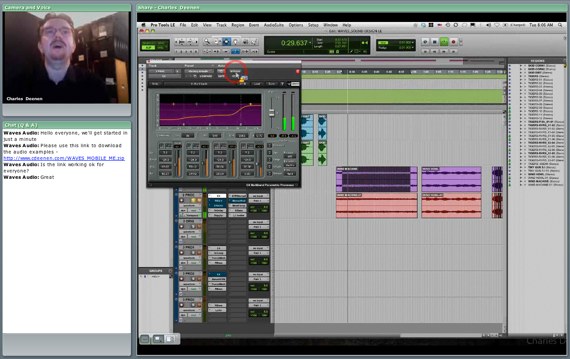
After clicking on a video link you will be prompted to sign into the webinar system. Please use the following information to view any of our previous webinar videos:
Username – webinar
Password – wavesPlease note: Due to limitations of Adobe’s webinar software, skipping through the webinar may cause the video to go out of sync. Therefore, we recommend watching the videos from the beginning, without fast forwarding.
Charles Deenen – Sound Design Webinar
How to get that liquid sound going
This liquid drum and bass tutorial is ideal for producers wanting to learn how to make tracks like Netsky, Logistics, Well Being etc.
Ball-bearing controlled drum sequencer
This video demonstrates BeatBearing – a ball-bearing controlled drum sequencer.
via peterdbennett:
A quick demo of the BeatBearing that I put together for my PhD viva presentation. I captured a lot more footage than this, but had to cut it down for the presentation, I’ll try and get an edit that shows more of the novation launchpad as a pattern selector for the next video!
REVIEW: Beatstation – anything you want it to be
I have had the opportunity to test Toontrack’s new software the Beatstation (will be launched in June), for some time now and I must say that I am excited about this product. Beatstation is equally an inspirational tool, to find the beat and rythms you want, to a full fledge drum machine and bass line player. Supporting a range of different formats it is very easy to import whatever you have into the Beatstation and play around with it.

When you first open it up it reminds me very much of some of the iPad instruments that has been launched recently, but once you have gotten used to it there is a lot more to explore. Running it via MIDI you can really play around with the pre-loaded drum beats or tweak them as you plase, adding your own flavors to the sound.

Speaking of the sound, the drum beats are of excellent condition, especially the snare drums which really kicks it. The easiest way to get started is to load any type of sample or loop, I used some old REX loops that I had in a recent project and added a selection of drum patterns – and this is when the fun starts because you have som many ways of altering the beat and perfect the groove.
The flexibilityto be able to load just about anything and the fact that it works equally well both as a stand alone inspirational sound system and as easy to use VST. I tried it using Reaper as the host and I had no problems hooking it up with Reapers built in Virtual keyboard and start improvising with different sound sets. Another good thing when using Beatstation is that you have the option of configuring the layout of the drums and synths in order to be in sync with what you are accustomed to, the illustartion below shows a bit of an overview on this.


Would i want something more? Well, most of the effects are hidden i drop down menus, see illustration below and for more live situations it might have been better to have a few more controls visible in order to tweak the sound on the fly.

Beatstation seems to fill a gap in today’s plethora of software music instruments, since it focuses on experimentation and your creativity in finding new grooves and rythms.
About Beatstation
Beatstation is a Windows and Mac, stand-alone and/or VST, AU and RTAS compatible virtual instrument. Beatstation plays Percussion Pads, Lead Instruments and Melodic Bass.
It uses a flexible and skinnable open playing surface, records samples, supports external samples (MP3 and WAV), MIDI Grooves and REX Files. The Beatstation expansion format, the BTX, contains high end sampled drum, percussion, bass and lead instruments with MIDI and REX files. Beatstation harnesses the power of percussion samples and melodic instruments in one virtual instrument and has been developed from the feature requests of the current Toontrack users in need of a completely open interface to create their own personlized sound-set as well as for a new generation of music creators.
Beatstation will roll out to stores in June of 2010. Up until store release Toontrack will build an array of videos and tutorials showing the products potential at the product site http://www.beatstation.com.
The analog FACTORY is out

ARTURIA has announced that Analog Experience THE FACTORY is now shipping. Here’s what they have to say…
Analog Experience THE FACTORY is the redesigned and enhanced version of “Analog Factory Experience”. By combining a native software application and a dedicated controller keyboard, it offers a simple, rich and exciting experience.
Musicians just need to plug the keyboard via USB and launch the software. From there they can put their mouse away; everything is easily controllable from the keyboard. As a matter of fact, the user experience is the same as on a traditional Hardware synthesizer, except that Analog Experience THE FACTORY brings many more sounds (3500 high quality synthesizer sounds), a better integration within DAW’s, and all this at a price that is hard to beat.
Analog Experience THE FACTORY includes a high quality 32-key keyboard controller, with premium key-action, channel aftertouch and an aluminum frame that is bristling with controls. Combined to the new MIDI Control Center application, THE FACTORY is child’s play to use with any third-party software or hardware instrument.
Main Features:
- Hybrid synthesizer based on advanced Software/Hardware combination:
- New Analog Factory 2.5 inside the box
- 32 Universal MIDI keyboard with velocity and channel aftertouch
- Plug and play: the Hardware and Software instantly recognize each other and offer perfect integration.
- Analog Factory 2.5:
- 3500 synthesizer sounds that have shaped modern music production
- All presets are carefully selected from the Arturia Classic Synths: the Minimoog V, the Prophet V, the ARP 2600V, the Moog Modular V, the CS-80V and the new Jupiter-8V
- Smart preset manager: quickly filter the presets to your requirements, by instrument, type, characteristics.
- Straightforward editing: each preset’s key parameters are accessible to modify the sounds.
- Full compatibility with major formats and hosts on Mac OS X and Windows XP/ Vista/ 7 (VST, AU, RTAS)
- THE FACTORY keyboard:
- Ultra-thin aluminum and wooden case.
- 32 semi-weighted keys with velocity response and aftertouch.
- Works as a Universal 32-key MIDI keyboard.
- New MIDI control center to set up MIDI integration with any external software or device.
Pricing and Availability:
MSRP: $299 / 249€
More information:
Designing music for games
The first one is a video tutorial where it is explained how to make classic video game sounds, and, in the second one, it is talked about a recent library made for Hollywood Edge, called Game FX.
DATAMASKIN

