
the microTone – microtonal polyphonic synthesizer + controller for iPad
A little demo of the microTone with iRig MIDI and (free) osynth!
http://microtone.ozurkirchen.ch
i connected an iRig MIDI to my iPad with the microTone running. The MIDI signal goes via audio/MIDI interface into my computer where the data is parsed by osynth.
the microTone:
– control one octave fluently without steps. Just glide over the keyboard with up to 10 fingers!
– switch octaves or lowest/highest notes
– the microTone has an integrated polyphonic synthesizer with 8 different sound presets
– send pitch data over MIDI cable to your computer
– send pitch data over WiFi to your computer (receive MIDI or OSC data with e.g. max/MSP or OSCulator)
– receive microTone MIDI or OSC data with osynth: a free synthesizer, made for the microTone.
osynth:
– voice1: saw/sine with hpf
– voice2: white noise filtered with note frequency
– voice3: sine sub-osc
– voice4: sine osc one octave higher
– voice5: wavetable osc
– ADSR
– reverb
– stereo delay
– binaural FX
– pitch random modulator
– recallable presets
– connect the microTone with core MIDI over WiFi or cable
– connect the microTone with OSC over WiFi
Here Comes The Schmidt Polysynth
Here Comes The Schmidt Polysynth – Video Just because..
Mr Schmidt has made this synth to be a Super Synth – and indeed it appears to be just that. This is definitely a case of, if you have to ask how much this is, then you cant afford it. It has presets, it has 7 filters (3 ladder type, 4 state variable 12 dB set up as 2 ‘dual filters’) and 4 Oscs – each osc is a bit different. Something like 107 knobs on the thing!
Waves Element Synth – Video Review and all the specs
Russ takes a look at the new Waves Element virtual instrument synth and asks can Waves do for virtual instruments what they did for plug-ins?
Find out what he thinks with this show and tell video review
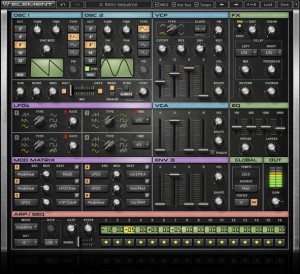
Introducing Element: The first ever synthesizer from Waves. Powered by Virtual Voltage™ technology, Element is an analog-style polyphonic instrument engineered to deliver the fat, gritty sound of the classics, with all the precision, flexibility and control of contemporary digital synths.
Element includes a vast array of convenient features and functions. Like integrated effects. A 16-step arpeggiator / sequencer. MIDI Learn for all controls. And a massive preset library, with total tweakability. Plus, all parameters are laid out right there in front of you, so when inspiration strikes, there’s no need to scroll through page after page to customize your sounds. Searing leads, booming basses, ethereal pads, electro-percussion, sequential motions, mind-blowing FX and lots more: Element does it all.
Features
Powered by Virtual Voltage™ technology
Integrated chorus, delay, reverb, distortion and bit crusher effects
16-step arpeggiator / sequencer
Plugin and standalone components
Controls
Oscillators
OCT determines the pitch range.
TUNE determines the pitch.
FINE fine-tunes the pitch.
TYPE determines the waveform type.
PW determines the pulse width. (Pulse waves only)
VCO selects between virtual Voltage-Controlled Oscillation and virtual Digitally- Controlled Oscillation.
SINE MOD controls the modulation of OSC 1 using a sine oscillator. (OSC 1 only)
FM (Frequency Modulation) controls the amount by which the frequency of OSC 2 is modulated by OSC 1. (OSC 2 only)
PhM (Phase Modulation) controls the amount by which the phase of OSC 2 is modulated by OSC 1. (OSC 2 only)
SYNC synchronizes the triggering the OSC 2 waveform to the rate of OSC 1.
Additional Oscillators & Mix Section
SUB mixes in a triangle wave one octave below OSC 1.
NOISE mixes in white noise.
RING controls the ring modulation of OSC 1 and OSC 2.
OSC 1 / OSC 2 activate each oscillator.
MIX balances the mix between OSC 1 and OSC 2.
MONO toggles between monophonic and polyphonic modes.
RTRG controls envelope re-triggering.
UNISON activates a doubling effect which creates a richer sound.
PORT determines the glide time (portamento) between notes.
LEGATO determines whether glide will always occur, or only when the previous note is still held.
Voltage Controlled Filter
TYPE determines the filter type.
SLOPE toggles between two types of pole filters.
CUTOFF controls the VCF cutoff frequency.
RES controls the amount of filter resonance.
ENV determines the envelope’s cutoff modulation depth.
KBD controls keyboard tracking using C3 as its reference point.
FM controls the amount of frequency modulation on filter cutoff by OSC 1.
ADSR determines the filter’s envelope cutoff behavior after a note is triggered.
VEL sets the VCF cutoff in relation to the Note On velocity.
SHAPE determines the contour of the envelope time constants.
Voltage Controlled Amplifier
VCA envelope controls the note level from trigger to release.
VEL sets the envelope depth in relation to the Note On velocity.
SHAPE determines the contour of the envelope time constants.
PUNCH controls the dynamic transient enhancer.
Low Frequency Oscillators
TYPE controls the LFO waveform shape.
RATE controls the frequency of the free LFO.
TIME controls the rate of the synced LFO, locked to the project BPM.
LED displays pulsate at the same rate as the LFOs.
Envelope 3
VEL sets the envelope depth in relation to the Note On velocity.
SHAPE determines the contour of the envelope time constants.
Modulation Matrix
PHASE inverts the phase, per assignment.
SRC determines the modulation source.
DEST determines the destination of the modulation source.
MOD sets the amount by which the modulation source affects the destination.
Arpeggiator/Sequencer
MODE determines the operational mode.
OCT determines the range, in octaves, of the arpeggiator.
TIME (drop-down) activates the host BPM sync function, and sets the rate using note values.
RATE sets the arpeggiator rate when TIME is set to Free.
GATE determines the length of each sequencer step as a percentage of its note length.
STEPS determines the number of steps in the current sequence.
SWING pushes even-numbered notes/steps toward the next odd-numbered note/step, to create a shuffle/swing feel.
Effects
DIST controls the amount of distortion effect.
PRE/POST is a toggle control which determines the placement of the distortion effect in the signal path, either pre-VCF or post-VCF.
CRSHR is a distortion-like effect which simulates a reduction in the bit-depth and resolution of the sound.
DELAY is a stereo delay allows separate delay times for left and right channels, using note values.
LEFT sets the delay time for the left channel.
RIGHT sets the delay time for the right channel.
MIX determines the amount of delay effect in the mix.
FEEDBACK determines the amount of gain fed back to the delay input.
REVERB controls both the amount and size of the virtual plate reverb sound.
CHORUS determines the amount of chorus modulation.
EQ
HiPASS controls the high pass filter frequency.
LoPASS controls the low pass filter frequency.
100 controls equalization at 100 Hz.
600 controls equalization at 600 Hz.
1500 controls equalization at 1500 Hz.
9000 controls equalization at 9000 Hz.
Global and Out Sections
TEMPO displays the current tempo.
SOURCE determines the clock source.
VOICES determines the number of voices which may be played simultaneously.
HD activates High Definition mode, which extends the digital resolution, resulting in enhanced depth and greater high-end definition.
GAIN sets Element’s overall output volume, after all generators and processors.
METER displays Element’s overall output energy.
9000 controls equalization at 9000 Hz.
Read more: http://www.waves.com/content.aspx?id=12081#image#ixzz2Gw3J6yqS
StudioLogic Sledge 8 Voice Virtual Analog Poly
Sonic takes a look at the new 8 voice virtual analog synthesizer – the result of a collaboration between Studio Logic and Waldorf. What makes it rather unusual is the fact that rather than have few knobs and a lot of menus, it has a large format classic synthesizer panel with one knob per function
Details on the Sledge:
For many synthesizer enthusiasts, it is the particular interaction of the sound engine and user interface that makes a great instrument. A quick look at Sledge shows you the generous set of controls available to interact directly with the sound engine. When you touch the knobs and switches of the front panel, you will instantly be aware of the meticulous attention to detail our engineers have refined, during many decades building the best electronic keyboards.
You will experience the logical set-up of the synthesizer modules, mirroring the signal flow of a classic analogue synthesizer. But what really distinguishes any synthesizer is its sound. Fortunately, our friends at Waldorf Music have happily shared their experience and know-how on this crucial part of the Sledge Synthesizer.
So we implanted the DSP heart of the latest Waldorf modelling technology into Sledge. The result: enough power to put the foundations of your studio seriously at risk! And plenty of detail, to create the richest analogue pads you could ever want. Besides the classic analogue synthesizer waveforms, you will find a complete set of Wavetables, derived directly from the mother of all digital synthesizers, the PPG Wave.
The sum of three fat oscillators, plus a Noise generator, are fed into Sledge’s powerful multimode filter with selectable 24 / 12 dB slope. The highly recognizable Waldorf filter algorithms enable a wide variety of sounds, from smooth to harsh, from fat to distinct, from pure HiFi to badass brutal. Ultra-fast, accurate envelope generators deliver ballsy punch. Two LFOs plus 1 extra Wheel-LFO are on board to offer huge, yet easy to understand, modulation capabilities. And two built-in Effect units deliver sophisticated synthesizer effects, such as Chorus, Phaser and Flanger, as well as a rich Reverb or an analogue style Delay.
And the best part – if you are familiar with the operation of a classic analogue synthesizer, you won’t have to spend any of your precious time reading the manual. There are no double or multiple functions on any of the knobs or pushbuttons. All synthesizer parameters are clearly and ergonomically arranged in front of your eyes and directly accessible under your fingertips. This makes sound design a blast, and takes you back to the pure user experience which you’ll soon realise you’ve been missing.
Specifications:
• 32 Pots
• 3 chicken head rotary switches (7 positions)
• 1 rotary encoder with push function
• 2 x 16 digits backlit LCD
• High Quality Pitch and Mod Wheel
• up to 256 Sounds
• fast and efficient sound selection via numeric keypad
• 2 fast LFOs per voice, each with adjustable Speed and Depth
• 1 extra modulation routing for Mod Wheel, with adjustable Speed and Depth
– Shape: Sawtooth, Rectangular, Triangle, Sine, Sample & Hold, Ramp
– Destination: Osc 1, Osc2, Ocs3, PWM / Wave / FM, Volume, Filter Cutoff
• 8 Voices polyphony
• Monophonic mode with single or multiple trigger
• 3 Oscillators per voice
– Range from 64′ to 1′ each
– Shapes: Sawtooth, Square, Triangle, Sine, Pulse (with Pulse Width Modulation)
– Oscillator 1 with 66 Original PPG Wavetables
• Frequency Modulation of sine and triangle
• Oscillator Hardsync (Osc 2 to Osc 3)
• Noise Generator with selectable white and pink noise
• Mixer with Volume and On/Off switch for each Oscillator and Noise
• 1 Multi Mode Filter per voice
– 24 / 12dB
– Lowpass
– Highpass
– Bandpass
– Resonance up to Self-Oscillation and beyond
– Adjustable Keytrack and Drive
• 2 fast Envelopes per voice (filter / amplifier)
• Powerful Arpeggiator
– Latch mode
– syncable to MIDI Clock
– Direction Up, Down, Alternate
– Range up to 10 Octaves
• 2 simultaneuous Effects
– Effect 1: Chorus / Phaser / Flanger
– Effect 2: Reverb / Delay
• sturdy, lightweight enclosure (less than 10 KG)
• high quality, 5 octaves Fatar TP 9 keyboard
Vintage Synthesizers I Crumar Performer
A voyage into the heart of the Crumar Performer from the year 1979.
Exploration by Marko Ettlich (RetroSound)
fully polyphonic multi keyboard made in Italia
one oscillator for brass (square wave) and two oscillatos for the strings (8′ and 16′)
one LFO with delay length, rate and depth
analog low-pass with resonance for brass and 3-band equalizer for strings
49 keys
used by Duran Duran and more
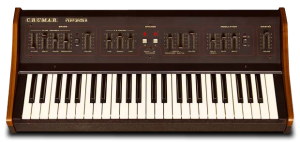
The Performer is a polyphonic analog Strings and Brass machine produced at the end of the 1970’s by the Italian synth company. It is slightly compact with just 49 keys. But it is fully polyphonic – you can play all 49 notes simultaneously! Programming is simple and clearly laid-out with just 15 sliders and a few buttons. A solid black chassis and wood end-cheeks round out this classic and often overlooked string machine.
The Performer is best remembered for its Strings. A simple 3-band equalizer with high, mid and low sliders can be used to give the strings shimmering sparkle or moody dark timbres. The Strings section uses two oscillators per voice with 8′ and 16′ settings. Simple Attack and Sustain sliders give you some control of your string’s envelope settings.
The Brass section is less exciting. It uses a single oscillator with just a square wave to generate a weak Brass sound. It has a low-pass VCF filter with resonance, but it too is pretty weak. Simple Attack and Decay sliders control its limited envelope settings too.
The LFO is pretty nice, with delay length, rate and depth control. It can modulate both Brass and String sections and can be routed either to the VCF or pitch. There are three outputs on the back: main output, brass output and signal output (for external processing) as well as CV and Gate connections.
Time machine: ROLAND ALPHA JUNO-2 Analog Synthesizer 1986
Synthesizer Demo of the polyphonic analog synthesizer Roland Alpha Juno-2. The Alpha Juno-2 is played dry without any additional effects.
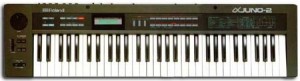
This is an upgraded version of the Alpha Juno 1. It adds an extended 61 note keyboard with velocity and aftertouch and an external memory cartridge slot. Other than that it has the same great sound and features as the Juno 1. Sliders and buttons were replaced by membrane buttons and the Alpha Dial which is used to edit and browse through the extensive selection of parameters: DCO digitally controlled oscillators, LFO, bend, ENV, pulse, waveforms, noise, PW/PWM, high pass filter, VCF (filter) with freq/env/res/lfo/kybd, VCA envelope, chorus, and more.
Adequate in the studio or on the stage, the Juno 2 has 64 presets and 64 user memory patches, a nice LCD display, an LFO capable of a very slow rate for some cool sweeping effects, and a great bass sound (especially nice for acid basslines) and noise effects! It also has chord memory which is perfect for rave & techno, portamento and keyboard transposing. The PG-300 Synthesizer Programmer gives you traditional slider control of each parameter for much easier and faster editing.
^ [xor] synth – prototype
This video features a prototype of a new synth called XOR and is actually a true digital polyphonic synthesizer, details below:
thanks to Tim Barrass for the amazing Mozzi library
sensorium.github.com/Mozzi/
Arduino programming compatible – running on atmega 328
open source
standuino.eu/devices/instruments/xor-synth/
based on fraAngelico synthesizer
Features:
-MIDI Input
-polyphony 6 voices
-velocity sensitive
-selectable wavetable (sine,saw,triangle,noise)
-selectable bitoperator that modulates the wave (xor, or, and)
-overflow distortion
-envelope
-lfo
-presets
Ellipsynth 1.0 Sound scrubbing demo
If you make Ellipsynth monophonic (by setting the polyphony to 1), it’s pretty easy to make a sound scrubber. You can actually do this polyphonically as well, but it’s easier to control with just one voice. Here, I’m not playing with the pitch or the playback speed too much, but you can see what that might get you.
WOPR – new polyphonic virtual analog synthesizer with unique evolving modulation
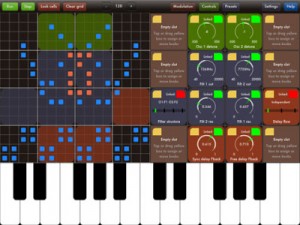
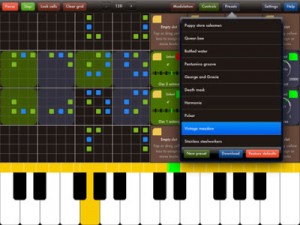
WOPR is a polyphonic, stereo virtual analog synthesizer with totally unique evolving modulation driven by vintage 1970s cellular automata. It’s made for iPad 2 or later only. WOPR is a performance instrument, a stand-alone instrument in the same spirit as the Korg Monotron.
It’s brilliantly playable: the full-width Wribbon keyboard lets you play pitch-perfect notes every time, then bend them like a guitar god to convey your inner pain to the screaming masses.
It’s performance-friendly: you can create customized control panels for comfortable access to parameters. That’s much better than contorting your fingers to fit some tiny panel layout.
WOPR is a seriously powerful analog, but what sets it apart is its modulation grid: you paint a pattern of cells into a grid, set the tempo, hit ‘run’ and let the cellular automata evolve your pattern. You link areas of the grid to any of the synth’s parameters and your patches come to life, rhythmically pulsating as the patterns shift with each beat. Constrain parameters to ranges for tight control over rhythmic modulation, or set them free to dynamically breed new patches.
Being a virtual analogue synthesizer, we’d be remiss if we didn’t include some allusion to the past. Here it is: the modulation grid is a bona fide 1970s invention called Conway’s Game of Life. Look it up, marvel at the infinite variety of patterns, geek out on the math, then put them to work twisting knobs in WOPR.
The core synth engine justifies its powerful modulation. WOPR has:
– 2 pannable oscillators with sine, saw, square and triangle waves. Each oscillator has an incredible range: 32′ to 1′, with +/- 500 cent detune (a perfect fourth either way). There’s also a white noise generator.
– 3 ADSR envelopes, 2 assignable between osc 1 & 2 and the third dedicated to the noise source.
– 2 fruity, resonant 24Db/octave low pass filters, assignable to osc 1 & 2 or to the left and right stereo channels.
– 2 delays, a free-running delay with fine control over low intervals, and a tempo-synced delay running from 32nds to two whole beats. Delays are independent, or can be assigned to feed eachother in any sequence. Howls, rings and reverbs are easy to create; so are good, old-fashioned solid, rhythmic delays.
– 2 octave, full-width Wribbon keyboard: play piano like a guitar, bending individual notes or entire chords. All without losing fixed-key pitch accuracy when you don’t want to bend. Best of all the whole width of your iPad 2 is there for performance.
– 6 voice polyphony. If that’s not enough (maybe you have tiny fingers), it comes with the best note stealing algorithm on the iPad.
– Modulation matrix: use this to link controls to the Game of Life, or simply use it to define a custom control panel for easy performance.
WOPR is version 1.0.0. It doesn’t yet have these features, but they’re being worked on:
– Audio copy/paste (it’s coming soon.)
– A giant preset library. (More are available for free download within the app.)
WOPR’s architecture might change a bit too. It’s young and has a lot of growing up to do. Right now Omnivore is experimenting with stereo BPF & LPF filters that you can insert into various places in the signal pipeline. We’re looking at ways to drive a wavetable library from the grid, too. Feedback is welcome, so please send your requests to feedback@omnivoresoft.com.
Finally, what does WOPR stand for? Anything you like. Wave Oscillator Piano Replacement? Wickedly Optimized for Phat Response? Who knows. All we can say is that it’s the synth David Lightman would choose…
Time machine: Oberheim OB-X “1979”
All sounds self-programmed: Oberheim OB-X Analog Synthesizer from the year 1979
recording: multi-track without midi, sequenced by the SCI Pro-One step-sequencer over CV/Gate and synced with the TR-808.
drums: Roland TR-808
fx: a little bit delay and reverb
more info: http://www.retrosound.de
About the synth:
The Oberheim OB-X is an analog polyphonic synthesizer first commercially available in June of 1979 . It was the first Oberheim synthesizer that was created with internally pre-wired modules (albeit still mostly discrete circuits) and not with the earlier, unwieldy S.E.M.s (Synthesizer Expander Module). Because of this, it was more functional for live performance, and more portable. It was hurriedly introduced to compete with competitor Sequential Circuits’ Prophet-5, which took the industry by storm during the prior year. While the OB-X had moderate success in the limited numbers produced (aprx. 800 units), the design was quickly updated and streamlined with the OB-Xa; the OB-X being discontinued in 1981.
Originally, the “X” in OB-X, stood as a variable for the number of voice-cards – thus, polyphony – installed. Whereas earlier Oberheim modular systems would require multiple S.E.M.s to achieve polyphony, the OB-X condensed the S.E.M. down onto a single printed circuit board called a “Voice Card”. Using this method, along with the Z-80 microprocessor to program the cards, the OB-X was far less laborious to program than it’s ancestors. It came in four, six, and eight-voice models. The starting price for the base model of only 4 voices of polyphony was a steep US$4,595. Besides the generous polyphony, each OB-X came with a memory capable of holding 32 user-programmable presets, along with polyphonic portamento, and polyphonic sample and hold. Also, a first for Oberheim’s polyphonic range were the “paddle” levers for pitch and modulation. This was Oberheim’s answer to the then standard “wheel” style controls seen on the Sequential Circuits Prophet-5. The OB-X would be used by artists such as Nena, Rush, who used it extensively on “Moving Pictures” and “Signals” Queen, being the bands first Synthesizer to appear on an album Prince, who swore by the Oberheim OB line, and Jean Michel Jarre who used it for it’s massive brass-type sounds. The OB line of Synthesizers developed and evolved even after the OB-Xa with the OB-8, and finally the Matrix series of synthesizers.
SonicProjects have created a VSTi emulation of the OB-X, for Windows and Mac platforms called the OP-X, with near-identical sounds to the hardware version. Widely praised as the most accurate emulation of an Analog Polysynth, SonicProjects include multiple versions of the OP-X including two “Pro” versions.
DATAMASKIN

