
Here’s a new analog treat for your iPad

Fermion–much like a true classic hardware analog synthesizer–makes all synthesis parameters concurrently visible, available and tweak-able, for greater real-time performance control.
For playing hard core dance and techno, nothing beats the classic sound of a monophonic synth. Easily create and play sounds like a classic Moog or or a Roland TB-303.
Features
* Monophonic— plays one note at a time l]
* Oscillator Module
* Dual oscillators
* Square, Triangle, Sawtooth, Reverse Sawtooth waves
* Octave selector, supporting 5 octaves
* Glide between notes (Lag Processor)
* Oscillator fine tune (more than one full octave)
* Oscillator sync
* Low Pass Filter Module
* Modulation module
* Tremelo/Wave
* Vibrato/Pitch
* Filter
* Envelope Generator module
* Supports ADSR (Attack, Decay, Sustain, Release)
* Volume
* Filter (amount of low pass filter)
* Arpeggio
Fermion is a based on the open source project Mobilsynth by Allen Porter. Developers are encouraged to visit the website and contribute. For more information about the Mobilsynth, visit http://code.google.com/p/mobilesynth/”
Featuring the Xotica BX-1 Various Demos – Roland GI-20 VG-99 GR-300 GR-700 US-2
Collection of video demos featuring the Xotica BX-1. This is one of a few hand crafted boutique guitars built by Xotica, and custom guitar shop based in Kenosha, WI. Features of this guitar include a Roland GK-3 pickup, Buzz Feiten tuning system, Sperzel locking tuners, Baby Grand Hip Shot bridge, Rockfield pickups and a Honduras Mahogany body with g\orgeous Fiddle Back Maple binding.
Check out Roland’s new SPD-SX Sampling Pad
Roland has introduced the SPD-SX Sampling Pad, a multi-pad percussion instrument with 2 GB of onboard sampling memory and three powerful effects engines.
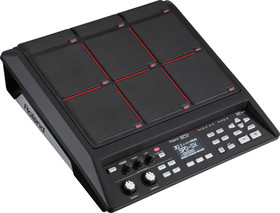
The SPD-SX replaces the popular SPD-S, the industry-leading sampling pad, which has been the overwhelming choice of professional drummers and percussionists. The SPD-SX leads the way with the latest pad-sensing technology, enhanced sampling performance, an assignable click output, and a host of other features.
SPD-SX features
- Unique sampling-pad concept — the only instrument of its kind in the world.
- 2 GB internal memory, enabling approximately 360 minutes of sampling (mono) without requiring external memory.
- Nine velocity-sensitive rubber pads, two external dual-trigger inputs.
- Easy capturing and assignment of audio data through Multi-Pad Sampling.
- Three units of multi-effects onboard, with two real-time control knobs and four dedicated effect buttons.
- Individual Pad Dynamics indicators show pad status and audio-level activity during performance.
- Expanded USB functionality (USB Mass Storage, USB MIDI/AUDIO, USB Memory).
- Wave Manager software included for easily importing, assigning, and organizing samples.
- Large backlit LCD.
The SPD-SX will be available in October with an MSRP of $1199.00 USD.
Nice demo of the Roland D-50 Linear Synthesizer (1987)
Roland D-50 Linear Synthesizer from the year 1987
a real classic synth!
8-bit attack or looped PCM samples and digital oscillators (saw & square), low pass filter, chorus and reverb fx…
this demo shows the different sound possibilities. first a few legendary D-50 patches and in then second part some special sounds.

More on the D-50:
The D-50 is an all-time favorite digital synth that’s still just as popular today as when it first came out in ’87. Once Roland’s hottest digital synth, it competed against the Yamaha DX7, and was much easier to use. By joining 8-bit PCM samples with “LAS” synth-generated sounds, the D-50 is capable of unique and complex sounds. The PCM samples contained the attack transients, while the rest of the sound came from the Linear Arithmatic Synth (LAS) section which sounds very analog, with subtractive-style synthesis and low-pass-resonant filters. Built-in chorus and (for the first time) digital reverb are also included for giving your sounds space and life! It also has a joystick controller for real-time timbre manipulation. The D-50 was great for new and non-acoustic, percussive, ethereal and beautiful pads & sounds.
Both the D-50 and D-550 benefit from the PG-1000 external controller which gives you very plain and simple slider/fader type control of all adjustable parameters of the synth. The D-50 includes MIDI on all 16 channels but because it is monotimbral you can only use one channel at a time. There is an upgrade which will give the D-50 and its rackmount version a full 16 channels of simultaneous MIDI multitimbral data communication. This popular synth has been widely used in all forms of music.
New audio processing SW from Roland
Roland is proud to announce R-MIX, a new era in audio processing software, giving recording professionals and those just starting out the tools to visually and intuitively manipulate stereo mix audio easily in real time. Featuring the newly developed proprietary V-Remastering technology and the highly-acclaimed VariPhrase® technology, R-MIX allows you to see the individual components of a stereo mix as color-coded clouds of harmonic matter and to apply effects or center cancel exactly where and as you wish within the mix. R-MIX can also help musicians learn songs by offering focused access to any desired instrument in the mix and the ability to slow down fast or complicated sections.

By graphically breaking down the stereo mix data into three elements (frequency, panning, and level), R-MIX makes it possible to actually see the instruments inside the mix, using the Harmonic Placement. Change the panning and level, erase, extract, and add effects, and independently adjust the pitch and speed of the playback as desired. Lower the level of the vocal or any other instrument within the mix to create minus-one karaoke files or create remixes using two pairs of stereo tracks. Mastering live recording sources is also possible by adjusting the instrument levels and applying noise reduction and effects, and with R-MIX, you can create the highest quality sound and then export your project as an audio file for music player playback.
Since there is only one R-MIX screen to operate, workflow increases, and there is no need to switch screens. Menus are aligned according to the workflow, easing navigation, and a simple help window for each task allows for manual free operation. Windows/Mac compatibility and the intuitive design also makes it accessible to everyone from serious DAW magicians to novice users and easily integrates into education and video production settings.
R-MIX Tab, a simplified version of R-MIX, will be available for the Apple iPad later this year. This iPad application also uses the V-Remastering technology to extract audio elements and easily creates minus-one data from an audio file.
• V-Remastering
Roland’s innovative V-Remastering digital signal-processing technology gives you total control over the elements within a stereo audio file. Built into R-MIX, V-Remastering makes it possible for you to see each stereo mix as color-coded clouds of energy and harmonic matter, and easily isolate the individual instruments or elements within the mix and change their panning positions and levels. V-Remastering also gives you the ability to erase, extract, or add effects to each element within a mix. V-Remastering enables music-editing capabilities never possible before!
• VariPhrase
In conjunction with V-Remastering, R-MIX employs Roland’s acclaimed VariPhrase technology, which can make your audio “elastic.” The secret to elastic audio is the independent control of pitch, time, and formant*. Smoothly adjust pitch without changing tempo, for example, or adjust tempo without changing pitch. Audio is elastic, and freely under your control in real time. Even more amazing is that all of this can be done without changing the sound quality of the original recording.
*Formant parameter not available in R-MIX.
R-MIX availability and MSRP details are being determined now. For more information, please visit http://www.RolandConnect.com.
Arturia Jupiter 8V review
The original Jupiter 8 was an 8 voice polyphonic analog subtractive synthesizer released by Roland in 1981 responsible many classic 80’s tracks. Arturia have had a crack at recreating this iconic synth in plugin format. I was going to playing some samples but wanted to get you a bit closer so we are going to quickly walk through the original interface and the extras goodies Arturia have added. Sorry there aren’t more audio examples but this episode is already way too long!
Disclaimer: This is no way a complete walk through, please dont get upset because I missed out X function. I know I missed out X function.
Interested to hear what you guys prefer in a review a walk through like this, or more audio examples & over view approach?
Source:
thedspproject.com/arturia-jupiter-8v-review
Arp sequencing on the Roland System 100 model 101
Test using arp sequencer
Awesome for spaced out effects, as well as extremely warm bass and leads. The filter is great, and even though it’s only a single osc. synth, without a sub-osc, it sounds huge. Extremely warm sounds. Because it’s semi-modular, you can get things super spacey. The sounds can actually have a very vocal quality at times. I’ve actually had it sounding like a child crying. Really weird = super cool!
Vintage demo: Roland Alpha Juno 2 Analog Synthesizer (1986)
Roland Alpha Juno 2 Analog Synthesizer from the year 1986. The direct successor of the Juno-106 but with more possibilites.
The first demo shows the different sound possibilities.
“This is an upgraded version of the Alpha Juno 1. It adds an extended 61 note keyboard with velocity and aftertouch and an external memory cartridge slot. Other than that it has the same great sound and features as the Juno 1. Sliders and buttons were replaced by membrane buttons and the Alpha Dial which is used to edit and browse through the extensive selection of parameters: DCO digitally controlled oscillators, LFO, bend, ENV, pulse, waveforms, noise, PW/PWM, high pass filter, VCF filter with freq/env/res/lfo/kybd, VCA envelope, chorus, and more.
Adequate in the studio or on the stage, the Juno 2 has 64 presets and 64 user memory patches, a nice LCD display, an LFO capable of a very slow rate for some cool sweeping effects, and a great bass sound (especially nice for acid basslines) and noise effects! It also has chord memory which is perfect for rave & techno, portamento and keyboard transposing. The PG-300 Synthesizer Programmer gives you traditional slider control of each parameter for much easier and faster editing. “
Revolution-808 drum machine sample library
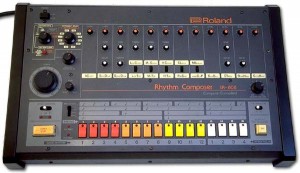
Sounds Outside the Lines has released Revolution-808, a drum machine sample library featuring the sounds of the Roland TR-808.
Although production of the TR-808 stopped in 1983, and only 12,000 were ever produced, by the time Hip-hop had reached popularity a few short years later the 808 – and especially it’s bass drum – became the defining sound of the genre.
The TR-808 is now considered to be the most recorded electronic drum machine of the last 30 years and is still used on countless songs and productions today. From classic R&B and Hip-Hop to Rock and Pop music the TR-808 has been used by artists ranging from Marvin Gaye and Tupac to Pink and Phoenix.
Revolution-808 features
- Intuitive user interface that mimics that actual hardware (Kontakt format).
- 7 Layers of Round Robin sampling for unique variations between individual drum hits.
- Available for Kontakt, EXS24 and all hardware and software samplers that support WAV format.
- Extremely Long sample lengths which preserve the natural sustain of the drums without truncation.
- Sampled at 24bit 96kHz.
- Over 3600 unique samples which cover every possible tonal variation of the original TR-808.
Revolution-808 is available to purchase for $70 CAD. A sample pack version (no sampler patches) is $40 CAD, and a LE version (16-bit/44kHz) is available at $30 CAD. A bundle with Revolution-909 is also available, and a free Revolution-808 demo pack can be downloaded from the product page.
Introduced in 1980 by a popular japanese manufacturer of electronic instruments, the TR-808 was one of the first fully programmable drum machines that featured a sequencer and completely analog generated sounds. Originally intended as a way for musicians to provide rhythm tracks to home demos, the TR-808 was far from the marketing success it was hope to be when launched. Due to it’s analog circuitry it couldn’t compete against the realism of digital drum machines of the time and was seen by many as inferior. Even by the standards of other now vintage drum machines the TR-808 contains no standard MIDI support and all programming had to be done with the internal 16-step sequencer. What was seen as a limitation in the early eighties is now thought of as the TR-808′s greatest strength. The fact that it is a fully analog drum machine means their is a character and depth to the sound which, unlike digital drum machines, evolves as the machine is played and has an unmistakable low end punch and snap
It’s here ! The Jupiter-80 is now shipping
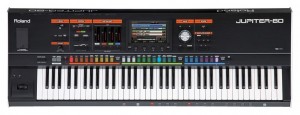
Roland has announced that the new JUPITER-80 synthesizer is now shipping.
The JUPITER-80 represents an unprecedented leap forward in the pursuit of the most authentically expressive electronic musical instrument, just as the legendary JUPITER-8 did when it was launched 30 years ago.
Delivering instrumental realism far beyond any electronic instrument ever created, the 76-key, touchscreen-driven JUPITER-80 integrates the highest caliber of analog modeling, digital synthesis, and SuperNATURAL® expressiveness available in a live performance synthesizer, while its sleek industrial design pays homage to the original JUPITER-8. The combination of Roland’s most advanced synthesis technologies and design features gives keyboardists an amazingly realistic sound and a truly authentic performance feel.
Jupiter-80 features
- Keyboard Section
- Keyboard 76 keys (with velocity and channel aftertouch)
- Sound Generator Section
- Maximum Polyphony 256 voices (varies according to the sound generator load)
- Parts 4 parts (Upper, Lower, Solo, Percussion)
- Registrations 256 (including pre-loaded registrations)
- Live Sets 2,560 (including pre-loaded Live Sets)
- Effects Multi-Effects (MFX): 4 units (parallel connection only), 76 types per each Upper/Lower (total: 8 units), Reverb: 1 unit, 5 types per each Upper/Lower (total: 2 units) Compressor + Equalizer + Delay: 1 set per each Solo/Percussion (total: 2 sets), Reverb: 1 unit, 5 types, Master Effects: 4-Band Equalizer: 1 unit.
- USB Memory Song Player/ Recorder Section
- Tracks 1 stereo track
- Playable File Format Audio File: WAV, AIFF, MP3
- Recording File Format Audio File: WAV (44.1 kHz, 16-bit Linear, stereo)
- Effects 4-Band Equalizer: 1 unit
- External Memory USB flash memory (sold separately)
- Connectors
- PHONES stereo 1/4″ phone type
- MAIN OUT L, R (XLR type)
- MAIN OUT L/MONO, R (1/4″ TRS phone type)
- SUB OUT L, R (1/4″ phone type)
- AUDIO IN stereo miniature phone type
- DIGITAL AUDIO OUT COAXIAL
- FOOT PEDAL HOLD, CTRL 1, CTRL 2
- MIDI IN, OUT, THRU
- USB COMPUTER Audio/MIDI
- USB Memory
- AC IN
- Dimensions/Weight
- Dimensions 1,231 (W) x 439 (D) x 140 (H) mm (48-1/2″ x 17-5/16″ x 5-1/2″)
- Weight 17.7 kg (39 lbs. 1 oz.)
- Other
- Arpeggiator Preset: 128 styles, User: 128 styles
- Harmony Intelligence 17 types
- Controllers D Beam controller, Pitch Bend/Modulation lever, Assignable buttons (S1, S2), Assignable knobs (E1–E4), PART LEVEL sliders (PERC, LOWER, UPPER, SOLO)
- Display Graphic Color LCD 800 x 480 dots (touch screen)
- Power Consumption 25 W
- Included Accessories Owner’s Manual, CD-ROM (USB Audio/MIDI driver), DVD-ROM (SONAR LE), USB Memory Protector, Power Cord
The Jupiter-80 synthesizer is shipping now with a suggested retail price of $3,999 USD.
DATAMASKIN

