
TimeFactor Self Oscillation Drone
Background information:
This is a drone created with an Eventide TimeFactor and a Roland SRV-3030. Sound was generated by the TimeFactor’s self oscillation – nothing was plugged into the input. The output of the first delay unit was connected to the second, and mono output of the second was connected to the A input of the SRV-3030. All adjustments were performed live by hand.
Hardware feature:
The SRV3030 is a smartly styled 1U processor with stereo analogue I/O on both balanced jacks and XLRs. MIDI In and Out/Thru sockets are fitted, and on the the SRV3030D model only, there is digital S/PDIF I/O on phono connectors (but no AES-EBU on XLRs). Control jacks are available for an optional footswitch (bypass) and an expression pedal for controlling input level.
Though the SRV3030 is a highly sophisticated digital reverb unit, the front-panel controls are mercifully few and are mainly dedicated to single tasks rather than being multi-function. The display makes use of instrument icons to show what category a reverb belongs to, and all the editable parameters may be accessed as a single list — there are no forking menus.
At the heart of the SRV3030 are two reverb processors, A and B. These may be used separately as mono in, stereo out processors, or combined in series or parallel. In addition, there’s a pre-reverb compressor within the normal reverb algorithm, plus two further processing blocks, one for the RSS stereo width expansion (based on the algorithms used in Roland’s dedicated RSS 3D sound processor) and an effects block based on modulated delay effects. The effects block may be placed after either or both reverb blocks but, oddly, it can’t be positioned before the reverb input to add ‘spin’ or ‘swirl’ to the reverb.
Corsynth C101 Overview + FM
Corsynth is an small company from the Northwest of Spain dedicated to manufacture modules for analogue modular synthesizers.
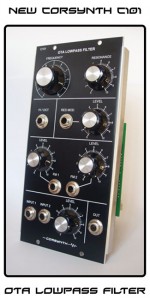
The C101 OTA Lowpass filter is a four pole low pass filter ( 24db/octave ) based on four cascade OTA-stages. The design is similar to the one found in classic synthesizers like Roland System 700, Roland System 100m, Roland SH-1, SH-7, SH-101, Roland Jupiter 8, Jen SX1000 and many more.
When the Resonance control is set at a high value the filter will start to oscillate and the C101 can be used as a sine wave VCO. The filter will track perfectly over at least 5-6 octaves and is also temperature compensated.
In many 4-pole low pass filters the output volume drastically drops when the resonance is increased. The C101 OTA Lowpass filter is specially designed to maintain a constant output level at any resonance value ( with the exception of when the filter is set to auto-oscillation ).
Another important feature is that the C101 has voltage controlled resonance.
C101 main characteristics
- Filter response 24db/octave
- Filter self-oscillate
- Can be used as VCO ( 1V/Octave )
- Voltage controlled Resonance
- Temperature compensated
- Two Frequency Modulation inputs
- Two audio inputs
- 1V / Octave input
Time machine: ROLAND JUPITER-4 Analog Synthesizer 1978
The Roland Jupiter-4 “Compuphonic” from 1978 was an affordable four voice polyphonic programmable synthesizer. It has 8 presets and 8 RAM memories. The Jupiter-4 was the first of the Jupiter series and was also the first synthesizer which featured an arpeggiator.
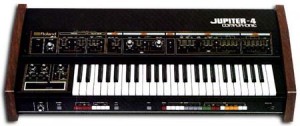
I played the Jupiter-4 dry, and also sometimes with a bit reverb and delay.
The JP-4 was played by Depeche Mode, Vince Clarke, Tangerine Dream, Frank Duval, Gary Numan, Tomita, Kitaro, Duran Duran and others.
The Jupiter 4’s basic architecture was 4 identical voice cards, each with a VCO (with sub-oscillator), resonant low pass VCF (Roland IR3109 IC, which could self-oscillate), and VCA. Modulation included an ADSR envelope and LFO. The LFO, routable to oscillator pitch, pulse width, filter cutoff and amplifier, was notable for being able to reach audio frequencies, allowing for crude FM and AM synthesis.
The Jupiter 4’s two most distinctive features were provided by virtue of its “compuphonic” digital control of the four voice cards, made possible by two Intel 8048 chips:
- An arpeggiator, with a choice of up, down, up/down, or random mode. The arpeggiator can be prominently heard in Duran Duran’s 1982 hit single “Rio.”
- Four voice assignment modes, which, as well as simple 1 VCO-per-voice polyphony, included the ability to effect 4-VCO unison when one key was pressed, 2-VCOs per voice when two keys were pressed, and 1-VCO per voice when three or four keys were pressed. This effect can be heard on tracks such as “Seconds” by The Human League and “I Dream of Wires” by Gary Numan.
The final signal path also included a simple high pass filter and a stereo chorus effect. The Jupiter 4 had 10 preset sounds and also featured 8 memory locations for user-created patches.
Despite not being incredibly popular, it did manage to find its way into the hands of some musicians, most of which were associated with the New Wave and synthpop music scenes (see below). Phil Oakey of The Human League eulogised that despite its limitations “the Jupiter 4 will be tatooed on my heart for ever”.
Tme machine – Oberheim OB-X + Roland VP330 “Zero Gravity”
Vintage synth demo track by RetroSound – “Zero Gravity”
strings and human voice choir: Roland VP330 Vocoder Plus mk2
lead and pad sounds: Oberheim OB-X 8-Voice
recording: multitrack
The Oberheim OB-X is an analog polyphonic synthesizer. It was the first Oberheim synthesizer that was created with internal prewired modules and not with the bulky SEM modules. Because of this, it was more functional for live performance, and therefore more portable. It was introduced in 1979 and was discontinued in 1981. It came in four, six, and eight-voice models. The starting price for only 4 voices of polyphony was a steep US$4,595. Besides the generous polyphony, each OB-X came with a memory capable of holding 32 user-programmable presets, along with polyphonic portamento, and polyphonic sample and hold. The OB-X was in direct competition with the Sequential Circuits Prophet-5. The OB-X would be used by artists such as Nena, Rush, Queen, Prince, and Jean Michel Jarre. It spawned more Oberheim analog synthesizers, such as the OB-Xa, the OB-8, and the Matrix series of synthesizers.
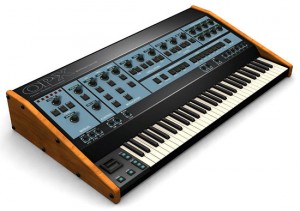
Sonicprojects have created a VSTi emulation of the OB-X, for Windows and Mac platforms called the OP-X, with near-identical sounds to the hardware version.
Free samples of the classic Roland Alpha Juno 2
Roland Alpha Juno 2 sound bank demo by Hardballs
Hardball Records has released a free sound bank, Hoover Sound Bank, that features sounds of the Roland Alpha Juno 2 synthesizer:
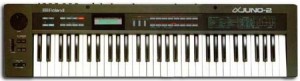
This is exactly the same synthesizer that created the original Hoover sound, patch called “What The”, originally created by Eric Persing for Roland Alpha Juno. Juno 2 is just an upgraded version of Roland Alpha Juno, thus we have the original Hoover sound. Additionally, I have sampled couple of bass sounds, which somebody may find useful.
As usually, each sound is a separate bank for NI Kontakt and EXS-24 samplers.
Each sample was recorded thru the Pro Tools HD from Roland Alpha Juno 2,
without any effects or processing, just clean original synth sound!
All samples are 44.1 kHz, 24 bit, Stereo WAV files.
The audio demo, above, is made using only the synth sounds in this sound bank, plus drums.
You can download the Hoover Sound Bank from the Hardball Records site.
An improvisation in a Valerie Dore / Italo Disco style
An improvisation in a Valerie Dore / Italo Disco style circa 1984. Featuring the Orchestrator, Juno-60, LinnDrum and SH-101
Crumar Orchestrator: string machine
Roland SH-101: bass
Roland Juno-60: synth strings
Linn LinnDrum: drum machine
Reverb: built-in Roland M-10DX digital mixer
Delay on Linn claps: Boss DD-3 digital delay pedal
Hardware feature – Crumar Orchestrator:
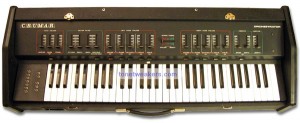
In 1977, Crumar introduced the Orchestrator (called the Multiman-S in Europe), a fully polyphonic orchestral string machine. It has five basic sounds: Brass, Piano, Clavichord, Cello and Violin. The keyboard is split in the middle allowing you to play one combination of instruments with the left hand, and another combination with the right.
All five sounds are available at all times, you simply adjust how much volume you want of each sound. Feature just a single instrument, or create your own orchestral ensemble—you are the Orchestrator! With the keyboard being split, there are five separate instrument volume sliders for the left hand (lower split) and another five for the right hand (upper split).
There is also a sixth sound: Bass. The Bass sound has its own volume slider as well, but it is assigned to only the bottom 27 notes of the keyboard. It is also not the greatest of Bass sounds either, and can sometimes muddy the sound.
There is a filter section but only for the Brass. It uses some pretty old-fashioned terminology: ‘Emphasis’ for resonance and ‘Contour’ for cutoff. There are also Attack and Decay controls for the filter. There is another filter for the Cello and Violin string sounds called ‘Timbre’ which can adjust between a ‘Mellow’ to ‘Bright’ sound—basically it’s a highpass filter. There is a ‘Vibrato’ effect section, basically the LFO, with ‘Speed’ and ‘Depth’ controls. The only global envelope control is a ‘Sustain’ length slider.
The Orchestrator’s best sounds are its Brass (probably because it is the sound with the VCF filter) and the Strings. In fact the Strings sound very similar to the famous ARP Solina. Unfortunately there are no built-in Ensemble effects to really sweeten them up…but that’s what outboard gear is for!
Like most synthesizers of its time, the Orchestrator was built with the performing musician in mind. It is its own flight-case! Its casing is very tough and durable, it has a handle and a cover/lid to keep it protected during transport. And if it looks heavy, it is! Additional options for the Orchestrator included an organ-like 13-note (G-G) Foot Pedal Board, Sustain Pedal, and a Foot Expression Pedal controller for the filter cutoff. There are no CV/Gate options, just connectors for the external pedal controllers.
About section via VSE
One Hundred
Background information: Uploaded my first video to YouTube in May 2008. And now 3 years later I upload the hundredth video. I was a little worried after doing video 99 because I wanted video 100 to be something special. And I think it is. Hope you will like it to.
At first you hear a 5-step sequence on row 1 of the Doepfer MAQ16/3 driving the Ian Fritz Teezer Through-Zero VCO and the Blacet Miniwave. The percussive noise sound comes from the self-built Modular and is driven by a 16-step sequence on row 2 of the MAQ16/3.
After that the CS Saw Pad from the Roland XP-80 comes in where after the 4 step sequence from the Synthesizers.com Q960 is introduced but only steps 1 and 3 are active on the Q963 at first. The Q960 sequences drives the Synthesizers.com Modular. The Q962 sequential switch is triggered by row 2 of the MAQ16/3 to alter the sequence between the 3 rows of the Q960. Row 1 contains an Em, row 2 an Am and row 3 a Bm sequence. But the chords played on the Roland XP-80 don’t follow those chords exactly which gives interesting variations. After that the arpeggiated sound on the Waldorf Q Keyboard is added, varying the sound with the modulation wheel. Somewhere along the line steps 2 and 4 on the Q963 are activated so you hear the full 4 step sequence from the Q960. The sequences:
Doepfer MAQ16/3:
Row 1:906: E3 B3 A3 G3 D3
Row 2:924: X . . . . . . . X . . . . . . .
Row 3:906: X (Gate output shifts the Q960)
Synthesizers.com Q960:
Row 1: E3 E2 F#3 E3
Row 2: A3 A2 B3 A3
Row 3: B3 B2 D4 B3
The Sunrizer App on the iPad is used to add some chorded sounds using the Lifeforms [JD] patch. The solo is performed on the Nord Lead 1. The audio is recorded with Pro Tools 9 using the Alesis MultiMix16 FireWire. Again my friend Anne used my iPhone 4G to video this session; thanks for that.
I dedicate this video to you, my dear YouTube friends, subscribers and channel watchers. Your comments and support encouraged me to go on. Thank you.
You can download/see/hear the video and music from my website.
How to program a Roland TR-808
The TR-808 is a classic drum machine that used analog synthesis to create its sounds. The sounds have a very thin and pure quality and aren’t grungy like it’s successor the TR-909. In fact, the 808 has become the signature beatbox used in most R&B and hip-hop as well as a lot of dance and techno music. Booming bass kicks, crispy snares and that annoying cowbell sound made famous during the 80’s are all part of the 808 and its famous sound.
Its 16 drum sounds include the famous boomy low kick, snappy snares, low/mid/hi toms, low/mid/hi congas, rimshot, claves, hand clap, maracas, cowbell, cymbal, open hihat, closed hihat and accent. All of the sounds can be edited and/or tuned and have individual outputs. Unfortunately it is not MIDI equipped but it does use Roland’s DIN Sync.
A small demonstration about how to program a Roland TR-808
Sorry for my bad english, and please don’t complain about the bad audio quality because this movie is just for educational use.
Steal that sound!
Hal Leonard Books has published Steal This Sound by Mitchell Sigman. Presented by Keyboard Magazine, the book is a collection of Sigman’s columns of the same name from Keyboard, detailing the greatest synth sounds from the greatest records, and how they can be achieved with modern gear.
Presented in chronological order as they appeared in the magazine from inception to the present, Steal This Sound includes more than sixty articles describing prominent synth sounds from Prince’s “When Doves Cry” and Nine Inch Nails “Closer” to MGMT’s “Time to Pretend” and Radiohead’s “Everything in It’s Right Place”.
Hal Leonard Books PR officer had this to say, “Steal This Sound is packed with invaluable tips and insights into re-creating these great synth sounds and provides a unique view into how synth technology has evolved over the years. Sigman explains how these sounds were created originally on synths by Moog, ARP, Sequential Circuits, Roland, and Korg, and gives step-by-step instructions to re-create the sounds using widely available modern plug-ins and software instruments from a host of manufacturers. Steal This Sound is a great read for music enthusiasts and an invaluable resource for keyboardists and programmers.”
About the Author:
Mitchell Sigman is a Los-Angeles based keyboardist, guitarist, and producer. His band Celebutante plays the LA area and has numerous TV track placements in shows such as The Jersey Shore, The Bold and the Beautiful, Burn Notice, Monk, and more. Sigman also won a BMI award in 2008 for his work on the Berlin track “Scream”, which is used as the theme song for the Lifetime drama Angela’s Eyes. Sigman has been a writer for Keyboard Magazine since 2004.
Pricing and Availability:
$19.99
More information:
Roland announces remix tool R-Mix
R-MIX allows you to see the individual components of a stereo mix as colour-coded clouds of harmonic matter and to apply effects or centre cancel exactly where and as you wish within the mix. R-MIX can also help musicians learn songs by offering focused access to any desired instrument in the mix and the ability to slow down fast or complicated sections.
By graphically breaking down the stereo mix data into three elements (frequency, panning, and level), R-MIX makes it possible actually to see the instruments inside the mix, using the Harmonic Placement. Change the panning and level, erase, extract, and add effects, and independently adjust the pitch and speed of the playback as desired.
Lower the level of the vocal or any other instrument within the mix to create minus-one karaoke files or create remixes using two pairs of stereo tracks. Mastering live recording sources is also possible by adjusting the instrument levels and applying noise reduction and effects, and with R-MIX, you can create the highest quality sound and then export your project as an audio file for music player playback.
Since there is only one R-MIX screen to operate, workflow increases, and there is no need to switch screens. Menus are aligned according to the workflow, easing navigation, and a simple help window for each task allows for hands-free operation. Windows/Mac compatibility and the intuitive design also make it accessible to everyone from serious DAW magicians to novice users and integrates easily into education and video production settings.
Looks like the Celemony guys are getting yet another competitor…
DATAMASKIN

