
TAL-BassLine-101 – new monophonic bass synthesizer
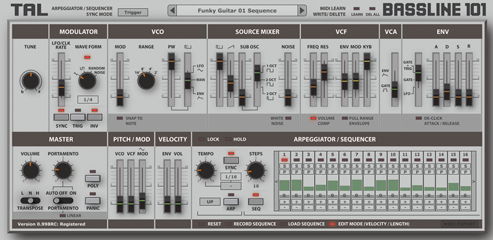
Togu Audio Line has announced the release of TAL-BassLine-101, a monophonic bass synthesizer with a classic analogue sound. The GUI is designed to be intuitive and easy to use.
TAL-BassLine-101 is designed to have a smooth and authentic analogue sounding 24dB zero feedback delay resonance low pass filter. Especially designed and calibrated for extreme settings, it sounds smooth with a lot resonance and a high oscillator pitch. Details such as envelope transitions between overlapping notes are carefully modeled. The oscillators do not use any samples. The plug-in generates all wave-forms in real time.
Features:
- Self resonating zero feedback delay filter (24dB LP).
- Calibrated and tuned after our hardware device.
- MIDI learn / automation for all controls.
- Alias free oscillators for an authentic sound also @ 44’100Hz sampling rate.
- Arpeggiator with different sync modes (host, MIDI clock, not on).
- Original (RC) and linear portamento mode.
- Built in arpeggiator with some additional modes.
- Powerful step sequencer with up to 64 steps and recording option.
- 6 voice poly mode.
- Sequencer MIDI export with drag and drop.
- Sequencer / arpeggiator MIDI out for VSTi version.
- De-Clicker mode for slower envelopes :/.
- More than 300 presets.
- All sample rates supported.
Price: $40.
YAMAHA AN1x synth demo – Ambient arpeggiator / chillout electronica
Synth demo of Yamaha AN1x synthesizer — playing ambient electronica / chillout space music using a repeating arpeggiator motif. This ambient soundscape was created using 2 oscillators, reverb, delay, aural exciter, and filter/envelope adjustments. Performed live, no external processing. Excerpt from a longer session.
About the synth:
The AN1x is a powerful retro-analog synth with a really cool new feature that lets you record real-time editing and filtering and be able to store it as part of the sound! A major contender in the new wave of analog-digital synths using DSP modeling of analog waveforms to recreate the coveted sounds of analog synths with modern digital specifications. It offers truly traditional yet modern methods of analog synthesizing, 10 notes of polyphony, 8 knobs for tweaking, and an arpeggiator with dozens of inspiring patterns!
Although the AN1x is not a follow-up to the CS1x (which has since been followed by the CS2x and the CS6x) it has borrowed many functions and technologies from the CS1x synth. First, it’s built in an almost identical case with the same layout of buttons and knobs as the CS1x. However the function of every knob and button has been greatly expanded. The AN1x also has 2 Scene memories for instant recall of any envelope and filter settings and the mod-wheel can be used to morph between the two scenes. On-board effects and a state-of-the-art arpeggiator section also are on-board for giving your sounds life and motion.
The AN1x adds a new Ribbon controller for increased real-time control. It also includes pulse width modulation, ring modulation and oscillator syncing. The AN1x may not be the next evolution of the CS1x but it is basically a more advanced synth capable of increased sound potential and quality. It has a better feeling keyboard than the CS1x as well assuming that the AN1x is for those looking for something more professional than the CS1x.
Dream Drums synthesizer – new instrument for Windows
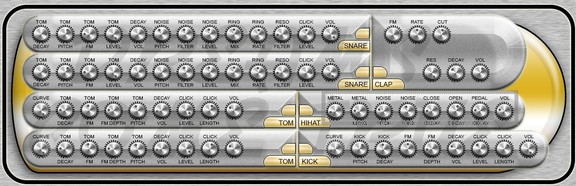
Odo Synths has launched a first beta version of its Dream Drums synthesizer instrument for Windows.
NEXT update will have a noise synth
distortion for all the synths
Multi outs
Midilearn
The beta is available to download for Windows (VST).
Closer look at the filter section of the Korg KingKORG Modeling Synthesizer
KingKORG includes filters that can model those of classic analog synthesizers. In this video, Korg USA’s Rich Formidoni highlights the characteristics of some of the various filter types
Product Highlights:
- A full-fledged, 61-key analog modeling synthesizer designed for live performance
- Powerful oscillators that are understandable to the beginner, yet satisfying for the expert
- Modeling filters that reproduce the sound of classic instruments
- Three master effect sections (each with six effect types) add the finishing touch to your sound
- Vacuum tube driver circuit adds rich overtones and powerful distortion
- New panel layout designed for intuitive operation
- CV/GATE OUT jack lets you control a Korg monotribe or MS-20
- Support for librarian software that lets you manage programs
The rare ARP 2600 Blue Meanie S&H 01
The (ultra) rare ARP 2600 Blue Meanie/Blue Marvin is under control of S&H module: EGs are fired from S&H Clock; VCO1, VCO 2 and VCF are S&H modulated. Audio signal goes straight into 2600’s spring reverb. A copy of the VCA out signal (dry) is hard switched left/right with Electronic Switch. A great synthesizer, pretty different in sound from the standard 2600 B/W and B/O.
The three square waves from (ultra rare) ARP 2600 Blue Meanie. Keyboard has a long log portamento curve. As usual, (spring) reverb from synthesizer, no external effects.
A new exploration of the John Bowen Solaris synth – Demo
Here is the second demo of the Solaris synth by John Bowen (www.johnbowen.com). Everything is played live using the keyboard, mod wheel, pitchbend and joystick.
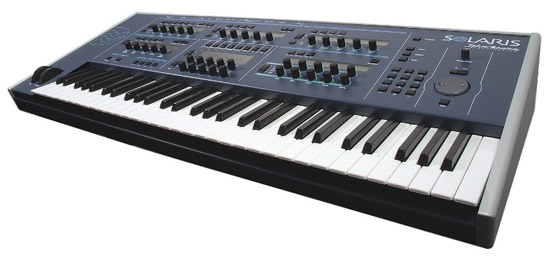
At the recent Musikmesse in Frankfurt, John was asked how the Solaris was conceived. He told us, “When I was at Korg, we were working on the software for the original OASYS card and I noticed that Creamware were essentially doing the same thing. I saw the virtual Minimoog come out on Scope and went to try a system in Canada, and when I realised that Korg was probably not going to continue with our little group, I jumped ship. After a year with Creamware and some consultancy work elsewhere, I decided to go it alone and see whether I could make it writing plug‑ins for the Scope platform. My first plug‑in had been called the Orion and, because people kept asking me to add things, it just grew and grew until, around the fourth iteration, I went bonkers and added lots of new stuff and then realised that it wasn’t the same product any more. So I gave it a new name and the Solaris plug‑in was born. I thought it wouldn’t be too shabby as a hardware instrument, and since the ex‑Creamware guys and I had remained friends and said that someday we would do something together, we decided to develop what is now the Solaris keyboard. By this time, the plug‑in had grown to over 1200 parameters, so I had to figure out a way to translate its user interface into a physical control panel. I had wanted to try multiple displays on a hardware synth for some time, and at first we were thinking of the Solaris as something with a small keyboard, but when I mocked things up to fit the available width, the front panel looked too ‘deep’. Arranging everything across a wider keyboard, it became clear that this was how the Solaris needed to be.”
Alternatives to Solaris:
One alternative to the Solaris is the Arturia Origin, which also offers vintage synth emulations and complex modulation capabilities in a flexible architecture. Indeed, the Origin is in some ways even more flexible than the Solaris because it is truly modular, in the sense that you can create whole new architectures by choosing the number and type of modules used. Another alternative is the Access Virus TI Keyboard, a synthesizer powerhouse that offers fewer programming options but a huge number of voices, a vast number of effects, and a 16‑part multi mode with dedicated effects per part.
In relation to the video:
For better audio quality go to SoundCloud: http://soundcloud.com/insanic4/solari…
MacBeth: NEXUS Test #5
Ken MacBeth tests out the prototype of his upcoming MacBeth Studio Systems Nexus touchpad synthesizer, details below:
As I finalize the design of the NEXUS synthesizer for production- I took it the prototype through to the work bench. Basically- the work/refinements are complete. This recording has no external effects- the only sounds are from the NEXUS itself! I’ve designed a synthesizer that has the type of sound, similar to that used on the David Bowie trilogy that was recorded in Berlin in the seventies- see what you think!
Closer look at the R.A. Moog 701 Drum Synthesizer
In 1970 Bob Moog built for Eric Siday an electronic drum synthesizer with the following modules:
– 701Drum Synthesizer
– 702 Percussion Synthesizer
– 903 Noise
– 912 Enveloppe Follower
– Programmer
– Wheels encoder
– Keyboard controller
The 701 and 702 modules are prototypes never and went in production.
It seems that there are some missing modules from the original configuration.
This unique system is owned now by the ” Museum of music”
located in Paris France.
About Eric Siday
Eric siday was born in the suburb of London in 1905.
When he was 14 he received the Prosper Sainton scholarship at the Royal Academy of Music, London.
His first steady bread was playing for the “local cinema” silent movies.
He was composer and arranger and realized musics for commercials and jingles for radios ( ABC / CBS / Pepsi cola / American express )
In 1947 he composed a violin concerto in the “Bop” Jazz idiom.
He created his own recording studio (surely one of the first home studio).
In the middle 50’s, he was aware of electronic music – John Cage (the prepared piano) and the French Music Concrete .
He was the fisrt to apply electronics sounds in commercials .
He used : Ondes Martenot / Ondioline / Violon amplified / Céleste / Moog Modular
and this unique Moog Percussion synthesizer.
He was the second customer of Bob Moog and bring a great support to the Moog company.
Background video description:
Here is my first video of the “R.A. Moog 701 Drum Synthesizer”. I managed to get some sounds out of it – even though it was meant to *work* with the full “one-off” system as built by Bob in 1970. I think in the system it might behave a little more “drum-like”…!?! Ha!
Checking out the new polyphonic synth Thor for iPad
A quick run through of some of the 1000 presets that come with this stunning synth from Propellerhead
Thor Polysonic Synthesizer (on the iPad) with Elektron Octatrack, Analog Four, Waldorf Rocket
Propellerhead has brought their massive Thor synth to the iPad! Although there are lots of Thor tutorials out there, this one focuses specifically on the app and its uses in an iPad environment, while figuring out what the fuck “Polysonic” actually means.
Video: Thor Polysonic Synthesizer – Available for iPad
After yesterdays announcement on Thor coming to iPad we are complementing that article with a video:
More info about Thor can be found here:
http://www.propellerheads.se/products…
Key Features:
– 1000+ expertly crafted synth patches, or create your own
– Multiple Filter and Oscillator Types
– Audiobus Support
– MIDI In allows for control from other apps or hardware controllers
– Collapse the keyboard to a scale and key of your choice, just like Figure
– Move patches back and forth between Thor on iPad and Thor in Reason
– Expressive touch interface with aftertouch and strumming
Thor is a comprehensive synth app for the iPad. Designed for mobile music making, it features a responsive interface optimized for hands on control, an innovative keyboard and the same massive synthesis engine as its desktop cousin. It’s the same semi-modular synth with the same set of selectable oscillator and filter types and the same advanced routing of audio and modulation.
Aside from a regular piano style keyboard, Thor features a keyboard that can be locked to specific keys and scales, making it impossible to hit a wrong note. This is particularly useful on a mobile device when playing directly on the screen. More than just helping the player to stay in key, this musically aware keyboard is a source of endless inspiration and experimentation.
DATAMASKIN

