
Time machine: KORG DW-6000 vintage analogue synthesizer
Korg’s first digitally controlled analog synth hybrid; 8 sampled digital waveforms, analog resonant filter with separate VCF and VCA ADBSSR envelopes. Parameters can be altered in real time via a single programmable slider. 6 voice polyphony in two modes, or one monophonic mode with all six voices stacked. 12 digital oscillators (2 per voice) with 8 simple to complex waveforms, 1 de-tunable and with programmable interval. 64 presets that can be reprogrammed by the user.
Awesome fat basses, lovely warm sounding, pulsing strings, and hard, nasal leads. Some wonderful swirling effects can be found. Imagine a Poly 800 with 8 waveforms instead of 2, and you get the picture.
Due to reliance on sampled waveforms, it does not sit well through distortion, and some waveforms do not go well in a mix when used as a pad. Overall, an exceptional and underrated bass and lead machine with some nice pad sounds to boot.
The DW-6000 was quickly surpassed by the DW-8000: it expanded it to 8 notes polyphony, 16 sampled waveforms, a velocity sensitive keyboard with programmable aftertouch, auto-bend, a simple arpeggiator and a digital delay unit.
very underrated synthesizer – the presets are quite 80’s trying to do DX7 of the time —but with the correct programming can sound huge fat and very vintage analogue — I prefer it to the similar Rolands —i.e. juno and jx3p. The resonant VCF filter is awesome and very expressive. No external effects —just the pure sound of the korg—sometimes using the stereo chorous for sting like sounds –I find a mono out with no chorous best for punchy bass like sounds
SubSonic – free subtractive synth VST for Windows
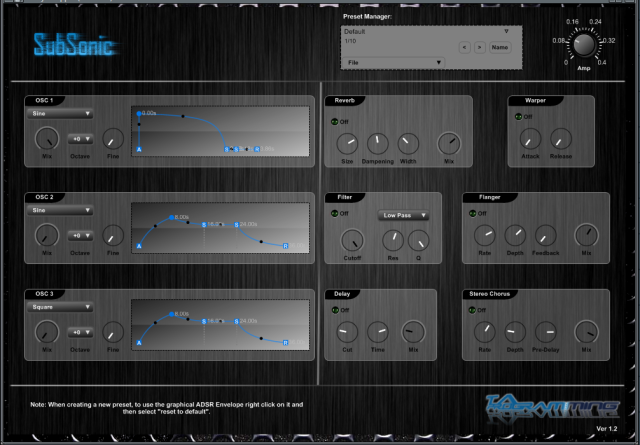
TA Programming has released a new free subtractive software synthesizer, SubSonic.
Features:
- 3 Oscillators (Sine, Sawtooth, Triangle, Square, Noise) with detune
- Graphical ADSR Envelope
- Multiple filter selection: Low Pass, High Pass, Band Pass, Band Reject, and Peaking.
- Fully customisable reverb module
- Delay Module for standard Echo delay effects.
- Stereo Chorus
- The Flanger module is versatile and powerful, combining overall sound of the 3 oscillators and using a sine wave to phase invert the sounds before adding feedback. This can give ‘unearthly sci-fi like textures’.
- The Warper: This module is an envelope modulator. Aviss notes that some ‘wacky timbres can’ be made using this.
- Amp
Spire – new software polyphonic synthesizer
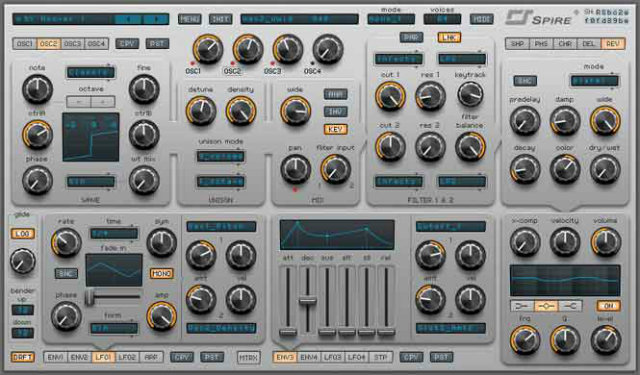
Reveal Sound tell us that they are a company founded by musicians and programmers in 2009 for creating first-class audio plug-ins. They say that the purpose of their company is to prove that the sound of soft-synths can be amazing and that they are constantly improving their algorithms to achieve the perfect result.
Their first product is Spire, a software polyphonic synthesizer that they say combines powerful sound engine modulation and flexible architecture with a graphical interface that provides unparalleled usability.
Grain Bastard – OP-1 first jam
Background video description:
I’ve just added a new instrument to my setup, the mighty OP-1 from Teenage Engineering 
This is just my first test/jam from the device manually synced to my MD SPS-1 and Borderlands Granular on my iPad, so don’t expect too much – I haven’t done any vids for a while so I just quickly put this together. Beats from the MD, Synths from the OP-1 and droney glitchyness from Borderlands.
Please also have a look over at idmfnetlabel.bandcamp.com/album/va-sounds-for-skeletons-idmf039 for a free compilation album of electronic goodness, that I’ve managed to worm my way onto somehow. Please have a listen if you enjoy electronic music.
Peace
more sounds of mine over at soundcloud.com/punisha
And while we are on the subject:
A video from Jacques Mongrel
First part in series, showing how I start writing a new song on the Teenage Engineering OP-1.
The Artemis – A Wind/String Instrument Inspired by the Ondes Martenot
Inspired by the Ondes Martenot, the Artemis is a synthesizer whose pitch is mainly controlled by a ring attached to a loop of string.
It uses breath control for dynamics and combinable trill keys for discrete pitch changes. Using these together allow for some interesting musical approaches.
When I made this instrument, I decided to expose the loop on this instrument as it is interesting to watch as the pitch changes.
The sound and control core engine were made by Nyle Steiner (it is simply one of his early analog E.V.I.s.) The Artemis was completed in April of 2013.
Studiologic Sledge Review Teaser
The yellow beast is up for a nice review – check out the teaser video for more details and sounds
Mitchell Sigman gives a quick overview of Studiologic’s new Sledge virtual analog synthesizer. Full review coming soon in Keyboard Magazine!
MacBeth: NEXUS TEST (5) WITH KORG SQ10 SEQ
Well after 5 teaser videos from MacBeth on the Nexus it sure seems like the new synth is coming together nicely
“When I’m testing gear that I’m designing- it’s quite exciting!….sometime I have to record/vid. Here is three of the NEXUS (prototype) being driven by a Korg SQ-10 sequencer- the fourth osc is cross modding the higher pitched square wave osc. It’s great fun running a three track analogue sequencer into this thing! Spacey effects are as usual with this device- the Dual Tape Delay Simulators- no other effects! Today- on screen- I basically finished the synthesizer. I’m looking forward to submitting the data to manufacture next week…! This btw is basically two different experiments filmed at different times…”
MFB Urzwerg Pro & KORG Z1 in action
MFB Urzwerg Pro step sequencer can act as a MIDI sequencer on four separate MIDI Channels; on this video, Urzwerg Pro is controlli four separate parts of KORG Z1 modeling synthesizer.
DSI Mopho x4 Demo 2 with Peter Dyer
Special thanks to Peter Dyer! Peter Dyer plays keyboard for Mariah Carey, Aloe Blacc, Van Hunt, and others.
More info at: www.peterdyer.net. Available in 1080p HD.
Peter demonstrates some Mopho x4 factory sounds. Drums provided by Tempest, some effects used where noted.
Herb Deutsch on The Minimoog Voyager
During a recent visit to the Moog Factory, Professor Herb Deutsch, synth pioneer and collaborator of Bob Moog, gave an impromptu discussion on the evolution of the Minimoog.
DATAMASKIN

