
iZotope Iris – Intro To Iris
Introducing Iris:
Unearth a world of sounds you’ve never heard before with iZotope Iris™. Driven by iZotope’s award-winning visual selection technology, Iris is a groundbreaking sample-based synthesizer that harnesses the power of both your eyes and your ears. Fuel your creativity with Iris’s new spin on sound design, perfect for musical inspiration and sonic experimentation.
- Discover what’s inside any sound: Load audio into Iris and explore spectral details that a regular waveform locks away.
- Highlight what intrigues you: Extract and isolate the most interesting sonic components with a full suite of visual selection tools.
- Combine the unthinkable: Layer completely diverse sound sources into totally unique combinations… what do a tattoo needle and a swamp bird and a slot machine sound like together?
- Stay musical: Rely on intelligent root note detection to help shape musical material from noise, ambient textures, soundscapes… even mistakes!
- Enhance and invigorate your sound: Apply world-class iZotope reverbs, distortions and delays, then take advantage of extended synth features like amp envelopes and LFOs.
- Get amazing sounds immediately: Spark your imagination with over 500 patches by world-class sound designers, or design your own with Iris’s 4 GB library of diverse sound samples.
Download the free 10-day trial of Iris here:
In this video, get a tour of the main features in Iris!
New Sounds Coming for the XW-P1
Here’s what Casio has to say about it:
We’re working on expanding the library of sounds available for the XW-P1, here is a quick look at some of the sounds we’re working on. These sounds will be available in May for free at www.casiomusicgear.com
Time machine: YAMAHA CS-10 Analog Synthesizer 1977
The YAMAHA CS-10 came out 1977. It is a monophonic synthesizer equipped with 1 VCO, 1 multimode resonant filter (highpass, lowpass, bandpass, but self oscillating of the filter is not possible – why?), 1 LFO, 1 noise generator, 2 envelopes. It also has an external signal input. This is great for processing signals – a bit like Korg MS-20 (I did this with a Roland TR-606 in the video). The LFO is very fast. It has CV and trigger inputs/outputs.
A nice little synth with some nice sounds!
“I played the CS-10 along with a Roland DEP-5 (delay) and a Lexicon MPX-500 (reverb).”
Mark Mosher improvisation on the Saurus virtual synth
My Colorado based electronic music friend Mark Mosher, sent me this nice improvisation that he has made on the Tone2 Saurus synth:
“It’s gorgeous. Checkout this improv vid I made with Saurus. http://www.youtube.com/watch?v=-scMPERoIlQ”
About the video:
This is single patch improvisation recorded in one pass with no edits using Tone2’s virtual Synthesizer Saurus. A single instance of Saurus is used with no other effects or editing other than what is built-into the synth. I’m starting with a factory patch in the “Lead” bank called “1970s Soloist H”. I only touch the computer once during the performance in the middle to turn up the gain in the mod matrix so that LFO modulates pitch.
Prior to recording I mapped all sorts of parameters to my Novation Remote SL MK II Keyboard.
– XY map to Filter and Rez
– Bank 1 of the top 8 knobs are mapped to filter parameters and OSC Balance
– Bank 2 of top 8 knobs are mapped to effects parameters
– Bottom row 8 knobs are MIDI mapped to Oscillator noise type AM/FM, LFO Speed, Glide rate
– The first 4 sliders map to the volume ADSR
– The next 4 sliders map to filter ADSR
I used my projector to paint my wall with Saurus to the knob movement you see on the wall is in real-time and corresponds to my controller movement.
Mark Mosher
Electronic Music Artist, Boulder CO
Synthesist, Composer, Performer
http://www.MarkMosherMusic.com
From our original post on the Saurus:
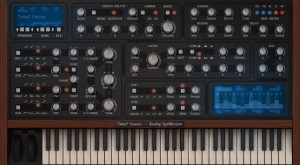
Tone2 has released a new software synthesizer for Mac & Windows, Saurus.
According to Tone2, Saurus is ‘not just another synthesizer with character, but one that truly represents the analog sound.’
Here’s what they have to say about it:
We carefully measured and modeled the circuits of many classic performance synthesizers, including even single capacitors and resistors to provide an extremely accurate analog model, faithfully capturing the spirit and character of these old machines. All without placing heavy demands on your CPU or budget.
Highlights:
- True Analog Modelling Technology
- High-end sound quality
- Low CPU and high reliability
- Easy-to-use interface
- ‘Unique sounds which no other synthesizer can create’
- Huge sonic range
- Flexibility, expandability
- Ships with 563 presets from 21 sound designers
Features:
- Covers all important aspects of traditional analog synths
- Mono, Legato & Polyphonic modes employing analog voice management
- Two Syncable Oscillators and two Sub Oscillators
- Not just standard waveforms but also a large number of exotic ones
- Pulse Width Modulation and Oscillator Sync applicable to every waveform
- Oscillator Drift, Phase and Noise Modulation controls
- Noise FM, AM and Ring Modulation for Oscillators
- Analog filter with self-oscillation, nonlinearity, 6 filter types, FM and feedback
- LFOs and modulation capable of running at audio-rate
- Arpeggiator with extensive configuration possibilities
- Flexible Modulation Matrix with new features, including a filter
- Programmable gate
- 4x Stereo Unison modes with spread and panning control
- Analog modeled Distortion and Tube amp
- Optional Psycho-Acoustic processing
- High-end quality Effects
Tone2 Saurus is available now for US $119. See the Tone2 site for details, audio samples and a demo version.
Yamaha DX7 – the 32 classic factory patches
The 32 classic factory patches of the Yamaha DX7.

One of the most popular digital synths ever was the DX7 from Yamaha, released in 1983. It featured a whole new type of synthesis called FM (Frequency Modulation). It certainly is not analog and it is difficult to program but can result in some excellent sounds! It is difficult because it is non-analog and thus, a whole new set of parameters are available for tweaking, many of which seemed counter-intuitive and unfamiliar. And programming had to be accomplished via membrane buttons, one data slider and a small LCD screen.
Still the sounds it shipped with and that many users did manage to create were more complex and unique than anything before it. Percussive and metallic but thick as analog at times, the DX-7 was known for generating unique sounds still popular to this day. The DX-7 was also a truly affordable programmable synth when it was first released. Almost every keyboardist bought one at the time making the DX-7 one of the best selling synths of all time! It also came with MIDI which was brand new at the time – Sequential had already released the first MIDI synth, the Prophet 600. Roland had just released the JX-3P with very basic MIDI implementation, and wouldn’t get around to adding full MIDI for another year with the Juno-106, and it would be three years before Roland can counter the popularity of the DX7 with a digital synth of their own, the D-50.
Saurus – new soft synth with true analog sounds
Tone2 has released a new software synthesizer for Mac & Windows, Saurus.
According to Tone2, Saurus is ‘not just another synthesizer with character, but one that truly represents the analog sound.’
Here’s what they have to say about it:
We carefully measured and modeled the circuits of many classic performance synthesizers, including even single capacitors and resistors to provide an extremely accurate analog model, faithfully capturing the spirit and character of these old machines. All without placing heavy demands on your CPU or budget.
Highlights:
- True Analog Modelling Technology
- High-end sound quality
- Low CPU and high reliability
- Easy-to-use interface
- ‘Unique sounds which no other synthesizer can create’
- Huge sonic range
- Flexibility, expandability
- Ships with 563 presets from 21 sound designers
Features:
- Covers all important aspects of traditional analog synths
- Mono, Legato & Polyphonic modes employing analog voice management
- Two Syncable Oscillators and two Sub Oscillators
- Not just standard waveforms but also a large number of exotic ones
- Pulse Width Modulation and Oscillator Sync applicable to every waveform
- Oscillator Drift, Phase and Noise Modulation controls
- Noise FM, AM and Ring Modulation for Oscillators
- Analog filter with self-oscillation, nonlinearity, 6 filter types, FM and feedback
- LFOs and modulation capable of running at audio-rate
- Arpeggiator with extensive configuration possibilities
- Flexible Modulation Matrix with new features, including a filter
- Programmable gate
- 4x Stereo Unison modes with spread and panning control
- Analog modeled Distortion and Tube amp
- Optional Psycho-Acoustic processing
- High-end quality Effects
Tone2 Saurus is available now for US $119. See the Tone2 site for details, audio samples and a demo version.
SYNTHROTEK VIRGIN HIGH QUALITY Nand Synth Sound Samples Chaos lofi synthesizer
Background data:
The 4093 NAND Synth is a super-modifiable noise generator that will knock your socks off with its sheer amount of sonic potential! Low pulsing drones, random robotic chaos, high-pitched laser sounds – it’s all here in this small package.
A great project to begin your explorations into the world of DIY sound synthesis, the 4093 NAND Synth PCB was designed with the beginner in mind: Board-mountable switches, tension-relief power supplies, socketed IC, hands-on knobs and switches for tone control, and a detailed silkscreen PCB to help you solder components right the first time. An über-cool mod section allows for all kinds of custom control – variable control voltage input, output gating, buffering, modulation; the sky’s the limit with the 4093 NAND Synth PCB.
The 4093 NAND Synth PCB was designed by our electronics engineer Steven here at Synthrotek. Powered by 9V battery, an AC Adapter rated at 5-12V 200mA Center Negative polarity can also be used.
Time Machine: Roland Jupiter 4
A voyage into the heart of the Roland Jupiter-4 from the year 1978.
The first Jupiter synth. It was among one of the first poly synthesizers (4 individual voices which could be synced together for one fat monophonic lead), it had a pitch wheel that could be assigned to the VCA, VCF, VCO or all together, there are 8 memory locations and a cool arpeggiator – the arpeggiator can in the Duran Duran classic, “Rio”. It also has a very slow LFO for those ever-so-long filter sweeps. Pretty good for 1978!
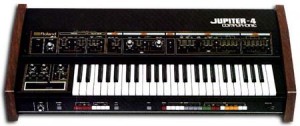
Not so cool however, are the 10 preset sounds which sound nothing like the piano, brass or strings they claim to be. The placement of all the preset buttons below the keyboard can be inconvenient, especially while playing it. And as with most old analog synths, the Jupiter 4’s tuning can go out often. Still it is a nice analog synth for creating weird trippy analog sounds.
4 Voice Polyphonic and Unisono Mode
1 VCO I 1 Sub-VCO
LFO – 1 LFO
Filter – lowpass with ADSR envelope
2 Envelopes
Arpeggiator
Chorus
It has been used by Vince Clark, Depeche Mode, Vangelis, Human League and many more!
Rob Papen Blade Introduction – Released yesterday
Rob Papen’s brand new virtual synthesizer Blade released yesterday. The price is € 99USD 119 (introduction price until end of May) and is available http://www.robpapen.com/blade.html.
At the heart of BLADE, ready to twist and transform your musical mind, lies the Harmolator. An additive synthesis system, which rather than using the system of changing additive partials, uses global controls which capture the essence of additive synth in an intuitive way making the creation of sounds much easier than using other additive synths.
The nine Harmolator controls allow you to create a vast range of sounds so you get all the amazing sounds that additive synthesis can generate with the added simplicity of traditional subtractive synthesis.
The Harmolator allows oscillator spreading, fattening the sound and also square / sine wave sub-oscillator. What’s more, the sound can be modified further by the 21 per-voice distortions types and 14 filter types.
Blade offers total control of the sound over time using an array of different modulation controls.
The most significant of these is the central XY screen. Here you can either alter things directly by moving the cursor around, or you can record paths which can be replayed.
The recorded path can be looped, bi-directional looped and tempo based as well. Even the speed of the XY recording can be modulated for dynamic changes!
So the XY pad is also an incredibly advanced “human input” modulation source.
Furthermore, Blade has the full range of other modulation sources, including a dedicated envelope, LFO and velocity as modulation source for Harmolator controls.
Two FX units featuring all the FX from other Rob Papen products, plus the Arp / Sequencer and an Easy page which allows you to easily control sounds, all add up to an amazingly flexible and useful instrument at the cutting edge of today’s synthesizers!
Sine+Noise Synthesis, featuring 3D displays
Related to this week’s buzz around the new Waldorf synth, Wolfgang Palm has shared a link with information that might give us more info on what the new project is all about:
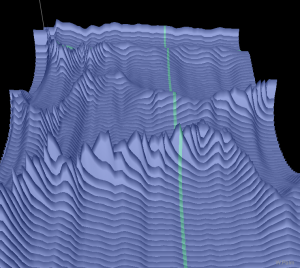
Sine+Noise modelling is an analysis/synthesis technique, where an audio signal is decomposed into sine waves plus an additional noise signal.
I started developing such a system in 2003, and refined it over the years. It is now sold to Waldorf. The release is planned later this year.
The advantages of Sine+Noise modelling:
- all audio signals can be resynthesized
- each partial sine wave can be edited individually in its loudness contour
- time/pitch manipulation in a wide range
- morphing of totally different sounds possible
- arbitrary filtering in the frequency domain
My Synthesizer features 3D displays, which allow easy editing of the audio components directly.
Sound editing in a spectral 3D displaySound editing in a spectra
Wolfgang Palm | Myspace Music Videos
DATAMASKIN

