
Moog talks synthesizers with Geoff Downes
Moog caught up with Geoff Downes during his 2011 tour with Yes to talk about synths and his ever-changing stage rig. Geoff Downes is the legendary keyboardist for Asia and the Buggles, and also holds the unofficial record for most keyboards on stage at a whopping 28.

More vintage coming your way: Roland JD-800 + SCI Pro-One + Drumtraks
Here is a nice vintage synth track by RetroSound
lead, voice and pad sounds: Roland JD-800
bass sequence: SCI Pro-One internal sequencer
drums: SCI Drumtraks
“The JD-800 was a digital synthesizer released by Roland in 1991. The synthesizer featured many knobs and sliders for patch editing and performance control – features which some manufacturers, including Roland, had been omitting in the name of ‘streamlining’ since the inception of Yamaha’s DX-7. The JD-800 became very popular with musicians who wished to take a ‘hands on’ approach to patch programming.
In the introduction to the manual, it is stated that with this synthesizer, Roland intended to ‘return to the roots of synthesis'”
more info:
http://www.retrosound.de
http://www.facebook.com/pages/RetroSound-Marko-Ettlich/265713782347
Working the Oberheim Matrix-12
About the Oberheim:
Oberheim’s Matrix 12 is a legendary analog synthesizer from the mid-eighties that is still the king of analog sounds. One of the fattest, roundest, pleasantly analog synthesizers around! It’s long been known for creating some of the thickest and best analog pads, sweeps, buzzes, basses and textures. It features Matrix Modulation for extremely wild virtual patching for almost unlimited range of sounds and modulation capabilities!
The Matrix 12 is similar to the Xpander and the lighter Matrix 6. But the Matrix 12 is much fatter and more programmable than either. Every control can have an effect on some other parameter thanks to Oberheim’s flexible design. For example, there are 15 types of LFOs and VCAs per voice! And there’s plenty of diagrams drawn out on the front panel of the synth to help you figure out some signal routing.
In this video:
This is sound demo of the Oberheim Matrix-12 synthesizer. All but two of the patches are my original creation and hopefully shows some of the ridiculously flexible sound architecture that is possible with this board. I’m playing some riffs both of my own original music and from some of the bands that have influenced me. The last bit, Intro to Gunslinger, while it is short it DID take a couple of weeks practice to get it right and is backed by a Machinedrum.
A summary of song riffs played:
G-Storm – Miranda (By The Sea)
Radiohead – All I Need
Depeche Mode – Enjoy The Silence
G-Storm – Cerulean Deraileur
Jimmy Van M ft. Terra Deva – bassline from Love Like Sleep
G-Storm – Spaced Out Beauty
New Order – Blue Monday
G-Storm – Aerial
808 State – breakdown from In Yer Face
Garbage – You Look So Fine
Sasha – Mr Tiddles
Go West – intro to Call Me
G-Storm – untitled track
G-Storm – Expectations (a really old unrecorded track of mine)
Spaced Out Beauty
M83 – You Appearing
Expectations
Immersion Domain – 1000 Images (I used the same Limuidz factory patch on the Xpander for that track)
Van Halen – I’ll Wait (Eddie used an OB-Xa, I believe)
G-Storm – Descendant
Vangelis – Blade Runner (Opening Titles)
G-Storm – Gunslinger
G-Storm – intro to Gunslinger
Recorded via Alesis Multimix-8 and into Macbook w/ only occasional additional effects from the Multimix added for select sounds.
Yamaha MOX Artist Movie
Exclusive Yamaha artists see the new MOX synth for the first time and offer their opinions!
That interest is set to soar as Yamaha announce a highly informative and entertaining Artist movie featuring some of the UK’s top players including Marcus Byrne (Annie Lennox), Take That’s musical director Mike Stevens, George Michael’s keyboard player Luke Smith, Sean Barry (Ollie Murs, Pixie Lott, Girls Aloud), Luke Juby of Mike & the Mechanics and Bob Geldof’s synthmeister Alan Dunn.
About the MOX:
For the past decade the MOTIF has been the de facto industry standard in music production synthesizers for both live performance and studio use. Combining MOTIF technology with new USB computer integration technology, the MOX series is the most powerful, mobile and affordable Yamaha music workstation ever. They are destined to bring MOTIF music production power to a whole new generation of players.
– 1,217 Voices and 355 MB of waveforms taken from the MOTIF XS
– XA (Expanded Articulation) tone generation system
– More than 256 Performances that spark your musical inspiration
– Virtual Circuitry Modeling (VCM) effects
– 6,720 arpeggiator patterns and the 4 part interactive arpeggio engine
– Direct Performance recording
– Performance Creator for quick setting of Splits, Layers, and Drum Parts
– Category Search provides instant access to the Voices you want
– Comprehensive sequencer including step recording
– New developed 61-key semi weighted keyboard for MOX6
– 88-key Graded Hammer Standard for MOX8
– Lightweight body
– Built-in 4-in 2-out USB Audio/MIDI interface
– Bundled with Cubase AI
– The YC-3B Organ Emulator soft synth and Prologue analog synth available
– Advanced Integration with PC
Wireless editor for the iPad – iMatrix-6
iControlMIDI. Plug & Play iPad Editors for Vintage & Software synths.
iMatrix-6 for Oberheim Matrix-6 / Matrix-6R
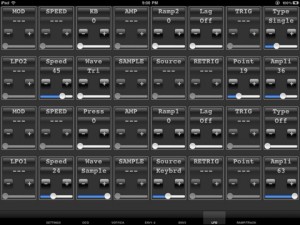
Background info:
Leveraging 2 years of experience in designing GUI for control surface and 25+ years of experience in designing synthesizers sounds, we are bringing the best of those experiences to the iPad with iControlMIDI for Oberheim Matrix-6 / Matrix-6R, namely iMatrix-6.
NOTE: Due to the limited MIDI implementation of the Matrix-6 for real-time controllable parameters, only positive modulation values are offered, the Modulation Matrix is not offered and only Patches parameters are offered (not Splits and not Master).
iControlMIDI is a UI Friendly and Workflow Efficient Solution that let you control your MIDI machines and software, simply from your iPad.
iControlMIDI is Plug & Play (actually there is nothing to plug!).
In 3-clicks on your Mac or couple of clicks on your PC, you are up and running…
iControlMIDI uses your:
• iPad with WiFi connectivity
• WiFi router (like an AirPort)
• [MAC] MacOS / Utilities / AudioMIDISetup / Network (MIDI Network Sessions)
• [PC] rtpMIDI and Apple Bonjour
iControlMIDI let you control all MIDI controllable parameters.
Parameter Name and Value displayed on iControlMIDI UI are the same as the ones displayed on your synth if you were to program it from its control panel!
Site: http://www.icontrolmididesign.com/
App Store: http://itunes.apple.com/app/imatrix-6/id435313466?mt=8
A Day Of Beautiful Synthesizers
Lots of modular goodies in this video :-). In case you are wondering what that wooden keyboard is -Tetrazzi is the newest incarnation of the Organus series, a mandala of analog oscillator circuits that can cross-modulate to form the empire of infinite circuitry known as pure sonic chaos. The tetrazzi boards shall be assembled by machine in Colorado, they will be perfect, and sonde-tested here in the workshop in Baltimore. All you need to complete it is four piezo barres, four bottons, four knobs, two output jacks, twelve studdes of brass, and a battery clip; all the hard stuff having already been done by a machine man!
A MuffWiggler meet-up for Irish modulators. A small friendly affair with some beautiful instruments. If only everyday could be like that

Synthesizing a Kick Drum with Surge VSTi
Architecturally speaking, Surge is a rather complex synthesizer. But because of how it’s put together it’s still easy to learn. Surge is an instrument capable of generating truly beautiful sequences of numbers. Synthesizing a kick drum with Surge VSTi, using the FM2 module. The principles are applicable to any decent synthesizer. The Kick is basically a sine wave pith through a short, steep pitch envelope. Some frequency modulation (FM) is added to emphasise the attack. An LFO is applied to pitch to give a little wobble. Using these parameters it’s possible to get a wide variety of tight, punchy electronic kicks. Why waste time browsing samples? Make your own! Sampled using FL Studio’s Edison and dropped into Nerve.
Specifications
General
- Synthesis method: Subtractive hybrid
- Each patch contain two ‘scenes’ which are separate instances of the entire synthesis engine (except effects) that can be used for layering or split patches.
- Quick category-based patch-browser
- Future proof, comes as both a 32 & 64-bit VST plugin (Windows PC)
- Universal Binary for both VST and AU (Mac)
Factory sounds
- 1010 patches
- 183 wavetables
Oscillators
- 3 oscillators/voice
- 8 versatile oscillator algorithms: Classic, Sine, Wavetable, Window, FM2, FM3, S/H Noise and Audio-input
- The classic oscillator is a morphable pulse/saw/dualsaw oscillator with a sub-oscillator and self-sync.
- The FM2/FM3 oscillators consists of a 1 carrier with 2/3 modulators and various options.
- Most algorithms (except FM2, FM3, Sine and Audio-input) offer up to 16-voice unison at the oscillator level.
- Oscillator FM/ringmodulation
- Most oscillator algorithms (except FM2/FM3) are strictly band-limited yet still cover the entire audible spectrum, delivering a clear punchy yet clean sound.
- Noise generator with variable spectrum.
Filterblock
- Two filter-units with arrangeable in 8 different configurations
- Feedback loop (number of variations inside the parenthesis)
- Available filter-algorithms: LP12 (3), LP24 (3), LP24L (1-4 poles), HP12 (3), HP24 (3), BP (4), Notch (2), Comb (4), S&H
- Filters can self-oscillate (with excitation) and respond amazingly fast to cutoff frequency changes.
- Waveshaper (5 shapes)
Modulation
- 12 LFO-units available to each voice (6 are running on each voice and 6 are shared for the scene)
- DAHDSR envelope generators on every LFO-unit
- 7 deformable LFO-waveforms + 1 drawable/stepsequencer waveform
- LFO1 allows envelope retriggering when used as stepsequencer
- Extremely fast and flexible modulation routing. Almost every continuous parameter can be modulated.
Effects
- 8 effect units arranged as 2 inserts/scene, 2 sends and 2 master effects
- 10 top-quality algorithms: Delay, Reverb, Chorus, Phaser, EQ, Distortion, Conditioner (EQ, stereo-image control & limiter), Rotary speaker, Frequency shifter, Vocoder
Taking iPad synths to the next level
Horizon synth for iPad – playing with some presets by Jarek J
Horizon synth is a virtual analog synthesizer that takes the definition of iOs synthesizer to the next level.
Thanks to carefully designed architecture and heavy usage of coprocessor it blurs the boundaries between iOs and hardware synthesizers.
Horizon was built to perform and works perfectly with any MIDI keyboard or sequencer. A lot of research has been done in order to achieve unheard warmth and clarity.
HIGHLIGHTS
· True SuperSaw sound emulation, first found in the legendary Roland JP-8000 synthesizer. SuperSaw is a layered waveform consisting of multiple saw waves which are detuned to create an extremely full and epic sound. It’s possible to use 2 supersaw oscillators per voice * 7 polyphony = 98 saw oscillators playing the same time!
· Two independent filters per voice with configurable routing. You can select between various filter types including classic resonant LP,HP,BP,Notch and less common like Comb and Formant.
· The Morph Group function lets you continuously morph of up to 30 parameters in a sound (including effects), using only the modulation wheel.
Horizon synth-hardsync-test by Jarek J
Horizon Synth for iPad – alpha demo by Jarek J
Soviet synths: ELEKTRONIKA EM-25 Demo
Electronica EM – 25 is a synthesizer-strings that has 3 timbre sections: stringed – contrabasses, violoncellos, violins, organ-registers (“16′”,”8′”,”4′”,”2′”), wind-trombones, trumpets.
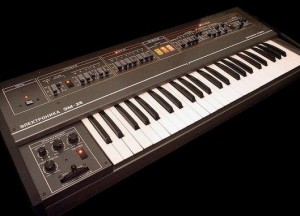
Stringed and organ sections:
- polyphonic attack and release of sound with duration control
- switching decay mode
Wind instruments section:
- generator of curved with controls: ATTACK, DECAY, SUSTAIN.
- modulator with controls: RATE, DELAY, VIBRATO
- controlled filter with controls: ENVELOPE, MODULATOR, CUTOFF, ACCENT
- filter run mode -mono or polyphonic
There is also a possibility to split the keyboard to 2 section (with setting up different timbres of sounding)
More info:
“Elektronika” was the so-called brand name for any former Soviet electronic product made in any former Soviet factory more or less involved in the manufacturing of any electronic devices and there were a whole range of electronic products released in Russia (watches, TV sets, amps, speakers, tuners, and more) that used this ‘trademark’. Bizarre but true!
Wherever it originated, the EM-25 was a polyphonic synth specialising in strings, organ and brass. Like other such instruments, it was of the ‘divide-down’ variety to give a totally polyphonic generator through a single filter, amp and envelope.
The strings section had mixable contrabass, cello and violins with variable attack and decay and the obligatory chorus unit for the rich ensemble effect.
The organ offered variable footages at 16′, 8′, 4′ and 2′ with variable attack and decay whilst the brass section offered trombone and trumpet. Of course, none of these sounds were ‘realistic’ but there were plenty of controls and facilities to coax some sonic mileage out of this trio of sounds.
There was an LFO that could be used to sweep the apparently fiercely resonant, self-oscillating filter and all the sections could be mixed and balanced – even split across the keyboard range – and so, in that respect, the EM-25 was not unlike the Moog Opus, Korg Trident and other such keyboards. To the left was a performance section with a pitchbend lever that appears to have been lifted directly from Roland’s ‘bender’ design!”
Vintage running synths in Klaus Schulze type style
A complex session in Cubase of progressive rock, inspired by Pink Floyd and Klaus Schulze of course…
DATAMASKIN

