
Synth spotting: Yes – Geoff Downes Live Rig
A quick video of Geoff Downes live rig for the 2011 YES tour – recorded at Bristol Colston Hall. Sorry but its only a very quick video – problems with my phone…. Maybe next time….
Geoffrey “Geoff” Downes (born 25 August 1952) is an English rock keyboard player, songwriter, best known as the keyboardist for the bands The Buggles, Yes and Asia, of which he is the only consistent member. When he was a keyboardist for The Buggles, he played multiple keyboards to achieve a New Wave technopop sound. He was once entered for the Guinness Book Of Records for performing with the most keyboards (28) on stage in one performance.
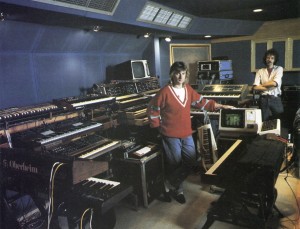
Tycho shows off vintage synths
Wired Magazine has an article out featuring synth virtuous Tycho and a set of pictures of his most precious jems, here are two of them:
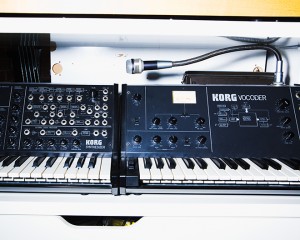
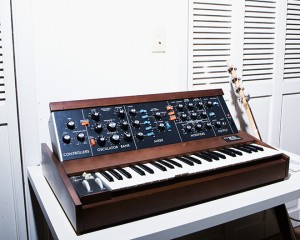
I guess these two are of no surprise to anyone 
Excerpt from the article:
Scott Hansen owns a lot of synthesizers. Moogs. Korgs. Obscure Italian synths from companies that don’t exist anymore. He loves them and protects them, because they make the music that makes him famous.
But whatever you do, don’t call Hansen, who performs under the name Tycho, a “synthesizer collector.”
Leading Wired.com through the basement studio here that houses his wares, Hansen lovingly showed off each item, but stressed that having so many synths isn’t about amassing fetish items — it’s about trying lots of machines in order to find particular sounds.

“I know it looks bad right now, but that’s why I have to get rid of some of them because there is some redundancy and waste here,” Hansen said. “I’d rather sell all of them than refer to myself as a collector. It seems sacrilegious. It’s wasteful if it’s not getting used because there are only so many of these in the world. Somebody else could put it to good use.”
That doesn’t mean there aren’t a few prized items Hansen, who is also a graphic designer under the name ISO50 (see his blog of the same name here), simply couldn’t live without. When making his latest album, Dive, which came out last week on Ghostly International, Hansen fell in love with the Minimoog and ended up using it to create many of the sounds on the record. He also used string synths to get the ambient, atmospheric vibes he was looking for.
Rob Papen in the studio – Sound design and more
Here’s a short video by synth.nl with Rob Papen in the studio talking synths and more:
A while ago Rob Papen visited my Apollo studio. Together with his crew he was filming some footage for his upcoming book and DVD about sound design on synthesizers. While they were filming in my studio I filmed them with my own camera. So this short movie is sort of a ‘making of’. More info about the DVD will follow on http://www.robpapen.com. I made all the 3D animations in this movie with Cinema 4D.
Roland Jupiter-4 and KORG DW-6000 Synthesizer Demos
Here are two videos featuring the Jupiter-4 and theDW-6000
An old demo song from 2007, that consists of Roland Jupiter-4 sounds with the use of three effects pedals. The drum samples are orginally from a ZOOM drum machine. The drums have been arranged at the computer, everything else was played by hand and recorded in realtime.
A demo song, that completely consists of KORG DW-6000 sounds with the use of only one effects pedal – a BOSS RV-5 Digital Reverb. The drums have been arranged at the computer, everything else was played by hand and recorded in realtime. Not one single melody line has been repeated.
PLEX 2 Demo
This video is showing the PLEX 2 synth, with automatied Icons on the Sound Palette.
“Wavetable synthesis is used in certain digital music synthesizers to implement a restricted form of real-time additive synthesis. The technique was first developed by Wolfgang Palm of PPG in the late 1970s and published in 1979, and has since been used as the primary synthesis method in synthesizers built by PPG and Waldorf Music and as an auxiliary synthesis method by Sequential Circuits, Ensoniq, Korg, Access and Dave Smith Instruments among others.” The PPG Webpages is a great resource for everything PPG.
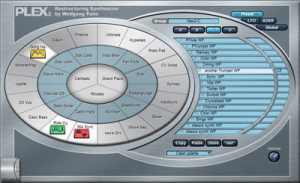
“I had done some extensions on Plex, just for myself during the last years. Doing that, I found the sounds Plex produces interesting again.
So I decided to do a new version, and offer it for free.
The new features are:
Automatisation of the icon positions on the palette.
All filters with emphasis parameter
Tools to easily change the palette content”
Tme machine – Oberheim OB-X + Roland VP330 “Zero Gravity”
Vintage synth demo track by RetroSound – “Zero Gravity”
strings and human voice choir: Roland VP330 Vocoder Plus mk2
lead and pad sounds: Oberheim OB-X 8-Voice
recording: multitrack
The Oberheim OB-X is an analog polyphonic synthesizer. It was the first Oberheim synthesizer that was created with internal prewired modules and not with the bulky SEM modules. Because of this, it was more functional for live performance, and therefore more portable. It was introduced in 1979 and was discontinued in 1981. It came in four, six, and eight-voice models. The starting price for only 4 voices of polyphony was a steep US$4,595. Besides the generous polyphony, each OB-X came with a memory capable of holding 32 user-programmable presets, along with polyphonic portamento, and polyphonic sample and hold. The OB-X was in direct competition with the Sequential Circuits Prophet-5. The OB-X would be used by artists such as Nena, Rush, Queen, Prince, and Jean Michel Jarre. It spawned more Oberheim analog synthesizers, such as the OB-Xa, the OB-8, and the Matrix series of synthesizers.
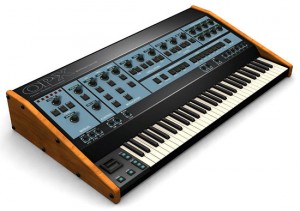
Sonicprojects have created a VSTi emulation of the OB-X, for Windows and Mac platforms called the OP-X, with near-identical sounds to the hardware version.
Korg Kronos Sounds – Vintage Synths
Want to play the classic synths on your Kronos?
Korg Kronos Volume #1 – Vintage Synths – Our first collection of sounds for the Kronos HD-1 Sound Engine is now available! An amazing collection of fully KARMA-fied Programs & Combis perfect for Producers and Keyboard Players looking for some great classic synth sounds to add to their Kronos. Included are 250MB of new samples from six classic analog synths.
More info & Demos at:
http://www.kidnepro.com/KN/Korg/Kronos/korg-kronos-v1.html
Synth spotting: Above & Beyond – You got to go (Kebu remix)
Here’s what Kebu has to say about the tune:
This is a remix I made for a competition. If you like it, please follow this link and vote for it by pressing “spin” (requires registration):
http://www.beatportal.com/remix/detail/ab-you-got-to-go-k…
I didn’t plan to make any more videos before my upcoming album is ready, but I stumbled upon a competition to remix Above & Beyond’s “You got to go”. Since I’ve recently discovered Anjunabeats and their great trance compilation Worldwide 03, which I’ve been spinning almost every day now for two weeks, I just had to take the time to give it a shot!
I saved only the vocals (sung by Zoë Johnston) from the original track and remade all music using only analog synths. The analog synths and analog drum machines were controlled in realtime by a MIDI sequencer and mixed together with the vocal using an analog mixer and hardware effects.
Equipment used: Korg Mono/Poly, Polysix, Poly-61; Roland Juno-60, Alpha Juno, TR-808 (w. MIDI); Moog Source; Oberheim Matrix 6R; Vermona DRM1 Mk III; Electro Harmonix Small Stone; Boss BD-2 (H2O mod), DD-3; Lexicon MPX500; DBX 290; Emagic AMT8; M-Audio Midisport 8×8/s; Alesis iO26; Cubase SL 1.06; Allen & Heath GS1; Yamaha S30 (as MIDI keyboard); Doepfer MCV1; Kenton Pro 2.
Camera: Canon HF100
Hope you enjoy my t-shirt! 😉
Spaceship-themed Synthesizer for Kids
“Several months ago I volunteered my skills to create a large, interactive control panel for an upcoming space-themed exhibit for the Kearney Area Children’s Museum. The project is multi-faceted and took quite a bit of time and energy to create, but in the end it came together very well!
Using the Auduino synth sketch for Arduino as a starting point, I created a synthesizer that uses two rotary potentiometers, two linear potentiometers and one infrared rangefinder to generate fun, interactive music. The sketch works best when multiple inputs are being used at once (i.e., moving your hand while moving a slider), but will generate some sort of tone regardless. The circuit board on the back is a simple class A amplifier and parallel 3.5mm audio jack to allow for more control over the volume of the synth. Now let’s just hope those kids don’t destroy the thing the first chance they get!”
Auduino: code.google.com/p/tinkerit/wiki/Auduino
Kearney Area Children’s Museum: kearneykidzone.com/
The Auduino is a sound synthesiser based on the Arduino platform. It works on all Arduinos running at 16MHz – everything from the original Arduino serial to the Arduino Mega. It uses granular synthesis techniques to generate a distinctive filter-sweep sound that had much more character than boring square waves. Sound is generated by playing the same noise (‘grain’) repeatedly at very high speed. This merges into a tone that is an audible hybrid of the repetition rate and the original grain. It sounds quite similar to an oscillator with two resonating bandpass filters, although the different architecture means there are lots of additional interesting noises at parameter extremes. The grain consists of two triangular waves of adjustable frequency, and adjustable decay rate. This is based on FOF synthesis model, but using triangle waves instead of sine and using a rectangular window. The repetition rate is set by another control.
Vintage exploration: Demo of the Synergy II+ synthesizer
This is a demo of the Synergy II+ synthesizer. Based on the Bell Labs Digital Synthesizer created by Hall Alles in 1975, the Synergy II+ remains one of the rarest and most sophisticated digital synthesizers in music history. There are only a few dozen of these left in working condition today.
Background information:
The Synergy was a push-button machine and it didn’t offer any programming like the GDS, but it had some interesting aspects to it. One is that it had a sequencer. It was the first keyboard that had a sequencer anything like this. The sequencer allowed you to overdub and play on top of the sequence. It was real easy to use.
“‘Another thing was, the Synergy provided the ability to be able to control multiple sounds [up to four] simultaneously from the keyboard – also a first. You could do that with some analog synths, but you couldn’t before actually figure out which finger on which key was going to play what sound, and have absolute control over that kind of thing. It could track your hands up and down the keyboard. You could get six floating split zones, and there were all kinds of different modes for assigning sounds to keys. The whole idea of the machine knowing things like which hand was playing what sound was very experimental. We thought it was wonderful. We would design this extensive piece of software to do this one thing, and there was really only one neat tune that you could make with it.’
“Wendy Carlos describes some of the Synergy’s controls and capabilities: ‘On the far left of the Synergy’s front panel, there’s a joystick that goes left-to-right for pitch-bend and up-and-down for modulations. I prefer the two Minimoog-style rotary wheels for pitch-bend and modulation but the Synergy had none of those. It also had some rotary knobs for globally controlling timbre, volume sensitivity, vibrato rate, amplitude, and its random rate – aperiodicity is the term they use. Threshold settings allowed keyboard velocity to dynamically control volume or timbre changes and, depending on how the voice was built, could in effect act to change the brightness or inharmonicity in the sound, or some other quality that a live [accoustic] instrument would have if it were played more forcefully.
“‘The keyboard had no aftertouch, and even though release velocity was implemented in the voices, a hardware tie-in was never made. Release velocity would have been nice, but I pushed for getting the microtonality tables, because I thought that was more important at the moment, and I guess I still do.
“‘There were 24 internal patches that you could toggle rather quickly. The Synergy was among the first synthesizers to have a memory cartridge slot. You could get a device that would let you burn your own ROM chips and you could save your own cartridges of voices. I even built DK a library of voices that they later sold when the machine was in its latter stage of being commercially available.’
“To avoid any confusion, Synergy cartridges stored patch data, not waveforms.
“Wendy continues: …’The Synergy’s oscillator table was 12-bit. Its frequency tables were specified to be 16-bit, and then they were interpolated to be 20-bit, which is how they’re able to be used on the microtonality tables. So they’re really a good bit better – and I don’t mean the pun – than the spec might look. And if you’re putting together big additive voices, 12-bit isn’t a big limitation, because you’d have to crank down the level of 16-bit oscillators so that the total didn’t exceed 16 total [at the output DAC] in the end anyway.
DATAMASKIN

