
The on-line workstation

AudioSauna is an online audio workstation for creating music on the web. No registration required – jump right in!
AudioSauna features
- Great Filters – All instruments are packed with quality high-pass and low-pass filters.
- Instrument Effects – All instruments have chorus, distortion and bitrate effects integrated to the devices.
- Jam With Computer’s Keyboard – Use your computer’s keyboard to play and record melodies with Audiosauna.
- Aux Effects – For balanced sound, mix some reverb to each channel. The Aux effects lets you do just that!
- Well-thought Presets – Pads, basses, organs, leads… The Audiosauna’s synthesizers are packed with great sounding presets.
- Channel Mixer – Pan, effect, solo and mute tracks with Audiosauna’s intuitive channel mixer.resets.
The AudioSauna public beta is now available to try.
Example Sounds of audiosauna.com by audiosauna.com
Dohi releases TableDrum iOS app
Dohi Entertainment has released TableDrum, a virtual drum app for iOS.

TableDrum is an Augmented Audio application that allows you to sync the sound of any real object and trigger a real time response of high quality drum sounds.
You can now build your own drumset from practically anything. Drum applications where users tap the screen are things of the past. This is the future!
TableDrum features
- Augmented Audio.
- Wide amplitude sensitivity.
- Real time response.
- Supports iPhone 3Gs or later.
TableDrum is available to purchase for $0.99 for a limited time (75% off regular price).
More information: TableDrum
GrainBender – sculpt your new sound directly in realtime
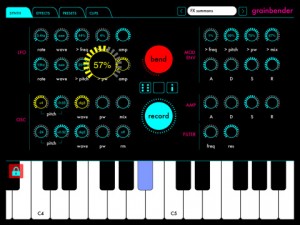
GrainBender is a new iPad synthesizer that makes designing new sounds easier than ever before. Just tap the bend button and sculpt your new sound directly in realtime. GrainBender is capable of making a wide range of sounds, from traditional analog favorites to exotic digital effects.
Key features:
– unique, intuitive sound design interface
– versatile oscillators with analog & digital waveforms
– audio clip recording and export to other apps via AudioCopy
– extensive but easy-to-use modulation
– effects ranging from chorus and delay to digital grunge
Capable of making a wide range of sounds – here are the features:
- intuitive sound design interface
- versatile oscillators with analog & digital waveforms
- audio clip recording and export to other apps via AudioCopy
- extensive but easy-to-use modulation
- effects ranging from chorus and delay to digital grunge
It’s available for $4.99 in the App Store.
Audio demos:
GrainBender sound demos by kuniklo
Jen SX3000 – new virtual instrument Native Instruments Kontakt
UK developer Synth Magic has released Jen SX3000, a virtual instrument Native Instruments Kontakt. Here’s what Synth Magic has to say about Jen SX3000:
The Graphical user interface has been designed by renowned GUI designer Anders Hedstrom(Flavours of Lime) who has done an amzing job creating the front panels and user interface. There are lots of great sounds from sound design guru Ingo Weidner who has made a batch of great sounds for the Jen sx3000-there are also sounds from Synth Magic. Over 130 presets plus random preset generator-Easily create new and exciting presets by pressing one button.
We sampled our Jen SX1000, every note, every octave to give half a Gigabyte of Jen samples(411MB zipped)and added a few twists ourselves such as interval generators, sub oscilators ,lots of effects and best of all we added our custom sequencer which has undergone a major revamp and can now store and read a number of patterns for instant playback. Sequencer can now store a number of patterns and recall them instantly,allowing you to build up your compositions. We also added random sequence generator-at the touch of a button a completly new pattern will be created and random cutoff and resonance patterns too-Very inspirational and the source of hours of fun and great patterns.
The synth section also has aftertouch to vibrato and aftertouch to filter cutoff to allow for some really great expressive sounds.
New powerful virtual synth’s been announced

Xils-Lab has announced a new software synthesizer – The Synthix.
Here’s what they have to say about The Synthix:
It is inspired by a famous and legendary Synthesizer from the 80′s, which a lot of talented guys used as their central Keyboard, including some synths Gurus.
Its a piece of history, maybe the last Vintage Analog Polyphonic synthesizer.
It has a special multitimbral mode, 5 different hi quality and hi character filters, as you could expect from a Xils-Lab synth.
It is MORE than a strict emulation.
It has many additional features compared to its glorious ancestor, as you could expect from a modern era synthesizer .
But this is NOT ENOUGH. It has also never seen features !
Details below.
Features:
- 4 ‘LFO like’ modulation sources.
- 4 envelopes ‘with a special feature, increasing far away the sound design possibilities’
- 2 oscillators : simple, but with cross modulation features.
- 1 filter – ‘not so simple!’
- 1 polyphonic sequencer (up to 4 tracks, with legato mode), part of the modulation sources.
- More than 25 modulation nodes, with 29 sources and 38 destinations.
Pricing and availability are to be announced.
Taking iPad synths to the next level
Horizon synth for iPad – playing with some presets by Jarek J
Horizon synth is a virtual analog synthesizer that takes the definition of iOs synthesizer to the next level.
Thanks to carefully designed architecture and heavy usage of coprocessor it blurs the boundaries between iOs and hardware synthesizers.
Horizon was built to perform and works perfectly with any MIDI keyboard or sequencer. A lot of research has been done in order to achieve unheard warmth and clarity.
HIGHLIGHTS
· True SuperSaw sound emulation, first found in the legendary Roland JP-8000 synthesizer. SuperSaw is a layered waveform consisting of multiple saw waves which are detuned to create an extremely full and epic sound. It’s possible to use 2 supersaw oscillators per voice * 7 polyphony = 98 saw oscillators playing the same time!
· Two independent filters per voice with configurable routing. You can select between various filter types including classic resonant LP,HP,BP,Notch and less common like Comb and Formant.
· The Morph Group function lets you continuously morph of up to 30 parameters in a sound (including effects), using only the modulation wheel.
Horizon synth-hardsync-test by Jarek J
Horizon Synth for iPad – alpha demo by Jarek J
Major update of Tone2’s ElectraX has been released
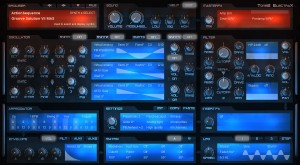
Tone2 has released version 1.2 public beta of ElectraX, a virtual synthesizer instrument for Windows and Mac.
ElectraX v1.2 will be available soon. We added a huge number of new features and improvements. This update will be for free for all ElectraX customers.
Changes in ElectraX v1.2 (public beta)
- New features:
- ‘Load patch to synth’ allows to stack up to 4 patches for fat multitimbral sounds.
- ‘Copy’ button now includes the option to create 4x stereo unison patch.
- The filter section has been extended with multiple unique Fractal Filters. These innovative, new filter types are exclusive and not available from any other company..
- Analog modeled ‘Moog’ filter (Analog controls self oscillation and non-linearity).
- Analog modeled State Variable Low-pass with ‘Filter-FM’ (analog controls FM amount).
- Nonlinear 12dB Low-pass ‘LP Shaped’ filter.
- Native PC 64 Bit standalone version.
- 20 additional patches.
- The oscillators now support drag&drop for wav and resynthesis import.
- Samples longer than 10 seconds can be loaded now.
- Loop/Single is automatically set on sample import.
- Octave/Semi is automatically detected from sample name (e.g. Piano_A-3.wav).
- Last directory is remembered on wav load and fxp load/save.
- Mod Matrix destination ‘Start’ sets OSC start phase or sample start point.
- Mod Matrix destination ‘Mix’ crossblends between filter1 and filter2.
- Mod Matrix sources ‘Midi CC’, ‘Breath’, ‘Foot’, ‘Expression’, ‘Hold’….
- Mod Matrix source ‘VoiceNr’ returns a value which depends on the current voice number.
- Mod Matrix source ‘NumKeys’ counts the number of pressed keys for more dynamic expression.
- Mod Matrix source ‘KeySat.’ returns a saturated version of key follow.
- Mod Matrix source ‘Impulse’ returns a 1ms long impulse suitable for attack sounds.
- Mod Matrix: 12 additional analog ‘Decay’ envelopes as source.
- Improvements:
- Improved graphics with 4 new skins.
- FM on/off, OSC on/off, Distortion type and Sync can also be changed during playback.
- Oscillators that are FM modulated by a deactivated source do no longer output noise.
- Many improvements in sample handling.
- Up/down controls now display an arrow and are more smooth to handle.
- Improved sound when using glide mode.
- ElectraX is more robust against broken Midi data which is sent by hosts.
- Improved CPU compatibility.
- Waiting icon is now displayed during patch load.
- ‘Analog’ psychoacoustic mode has been improved.
- Smarter installer.
- Changes:
- Trancegate is now only available as Insert Effect.
- Fixed:
- Fixed a crash which could happen if patches were loaded during playback.
- Fixed a possible problem with could result in hanging notes.
- Fixed a rarely appearing problem where the plugin did not output sound.
- Fixed a rarely appearing GUI freeze.
- Fixed a click in sample playback.
- Fixed a possible glitch in the filters.
ElectraX virtual synth gets polished
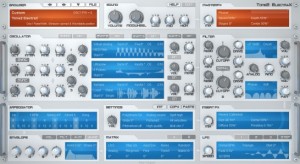
Tone2 has announced ElectraX 1.2, an update to its software synthesizer for Windows and Mac.
New in ElectraX 1.2:
- Filter section has been extended with Fractal Filters. These completely new filter types are excusive and not available from any other company.
- Native 64 Bit standalone version.
- Create 4x stereo unison patches with ‘copy’ button.
- ‘Load patch to synth’ allows to stack up to 4 patches for fat multitimbral sounds.
- The OSCs support drag&drop for wav import and resynthesis.
- Samples longer than 10 seconds can be loaded now.
- Analog modeled ‘Moog’ filter (analog controls self oscillation and non-linearity).
- Analog modeled State Variable Lowpass with Filter-FM (analog controls FM amount).
- Nonlinear 12dB Lowpass ‘LP Shaped’.
- Mod Matrix destination ‘Start’ sets OSC start phase or Sample start point.
- Mod Matrix destination ‘Mix’ crossblends between filter1 and filter2.
- Mod Matrix sources ‘Midi CC’, ‘Breath’, ‘Foot’, ‘Expression’, ‘Hold’…
- Mod Matrix source ‘VoiceNr’ returns a value which depends on the current voice number.
- Mod Matrix source ‘NumKeys’ counts the number of pressed keys for more dynamic expression.
- Mod Matrix source ‘KeySat.’ returns a saturated version of key follow.
- Mod Matrix source ‘Impulse’ returns a 1ms long impulse which can be used for attack sounds.
- 12 additional analog ‘Decay’ envelopes as sources in Mod Matrix.
- Loop/Single is automatically set on sample import.
- Octave/Semi is automatically detected from sample name (e.g. Piano_A-3.wav).
- Last directory is remembered on wav load and fxp load/save.
Other improvements:
- Improved graphics with 4 new skins.
- FM on/off, OSC on/off, Distortion type and Sync can also be changed during playback now.
- An OSC which is FM modulated by a deactived source does not longer output noise.
- Many improvements in sample handling.
- Up/down controls show an arrow and are more smooth to handle.
- Improved sound in glide mode.
- ElectraX is more robust against broken Midi data which is sent from hosts.
- Improved CPU compatibility.
- Waiting icon is show during patch load.
- Improved ‘analog’ psycoacoustic mode.
Version 1.2 is expected to be available in June 2011. ElectraX for Mac & WIndows is available for US $199/189 EUR.
Here’s a treat for all you synth and Kraftwerk fans – The Kraftworker
http://youtu.be/a0n4b_I627A
Best Service has introduced Kraftworker – a Kraftwerk inspired virtual instrument for Mac & Windows. Features Orchestron, Stylophone, Speak & Spell & More
Kraftworker includes sounds made famous by Kraftwerk, including:
- Orchestron
- TI Language Translator: german-english-french-spanish
- FX-501P Pocket Calculator
- Speak & Spell
- Stylophon
- BG Rhythm Machine
The virtual instrument comes with 1,300 electronic sounds:
- Synthesizer Sounds
- Chord Sounds
- Electronic Speech Synthesizers, Choirs, Vocoders
- Computer Sounds
- Pad Sounds
- Organic Sounds
- Basses
- EFX Sounds
- Musical Patterns and Sequences
Features:
- Digital Modular system
- Flexible routing of all modules und effects
- Extreme fast Sound-Loading average access and loading of a new instruments with all its parameters and effects in less than a second
- Direct stepping through the soundpool
- Analog reproduction of digital sounds
- Solo-Mode, Legato Mode, Portamento und Samplestart shifting
- Multi Mode Filter / Resonator
- QuickEditPage: Blue english Kraftworker interface with instant access to all important parameters
- ProEdit Page: Offers every possible parameter, FX-Rack with 46 effects, Convolution Reverb etc.
- Infinite Polyfonie
- Infinite number of modulators
- Infinite number of effects
- Extrem flexibler Arpeggiator inklusive Midifile Abspieler •Extrem flexible Arpeggiator including Midifile player
- Step und Modular Sequencer
Pricing and Availability
Kraftworker is available now for 249,00 €, inc VAT.
Link:
The poor man’s Moog has been revived
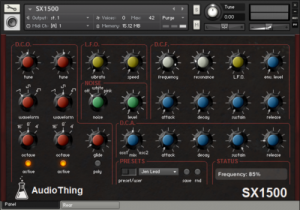
In the lab, for years, covered by other instruments and things, there was this old Italian analog synthesizer from 1979: the Jen SX1000. Monophonic with just 1 oscillator, it was often called “poor man’s Moog”. It is always hard to sample analog gears so, instead of trying to clone it (which is obviously impossible for a sampler), we decided to use the samples of each waveform to build an hybrid synthesizer taking advantage of the Kontakt Script language. It sounds both vintage and new! It is also possible to drift the oscillators to emulate the tuning problems of vintage analog synthesizers and to hear the usual knobs noise caused by dust while tweaking them. The Performance View follows the original parameters scheme adding, of course, new features.
 Documentation
Listen to it here:
SX1500 by AudioThing
About the original Jen SX1000:
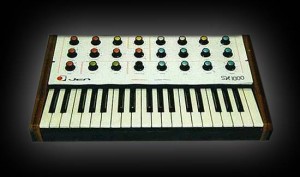
Mention the SX1000 to any serious vintage synth anorak, and you’ll be met with much laughter. But why the little Jen should have become so uniformly derided escapes me. Even in the digitally dominated days of 1985, Julian Colbeck described it as a “fine box for mucking around with, or for learning about synthesis” and “a first class first-time buy”. On its release in 1977 this might have been justified, at least in part, by its super-low recommended price of just £210. Indeed, this had dropped to £159 or thereabouts by the time that the SX1000 was discontinued in 1982, and its street price was often considerably less. But it would be unfair to suggest that the only reason for liking the SX1000 was its price. It was also a fine little synth.
At first sight, the SX1000 appeared very basic. And, on second and third sights, nothing changed this. It had a short, 37-note C-to-C keyboard, a mere 24 programming controls, no CV & Gate inputs or outputs, and no pitch-bend or modulation wheels. Indeed, it was entirely without frills: no velocity sensitivity, no pressure sensitivity, no nothing!
The sound was generated by a single oscillator, described on the control panel and the voice cards as a VCO, but by previous writers as a DCO. The truth is a strange halfway house that is neither entirely voltage-controlled nor digitally-controlled. It worked something like this… The oscillator itself was a high frequency squarewave generator stabilised by a digital circuit. So far, so DCO. The output from this was passed to a large 40-pin chip (that would now be almost impossible to replace) that shaped the wave into a wider selection of waveforms and divided it down to the standard range of audio frequencies. But what about the ‘Fine Tune’ control on the top panel? This, indeed, was a standard voltage control that affected the frequency of the high frequency oscillator. The range of its affect was rather small but it was, nonetheless, a voltage control.
Clearly, the SX1000 was a hybrid, and it suggests that, in 1978, Jen had a technological lead over much of the rest of the synthesiser industry. After all, it was to be another four years before Roland released the Juno6 – the instrument that is often credited as being the first DCO-based synth.
DATAMASKIN

