
New Java based web synth
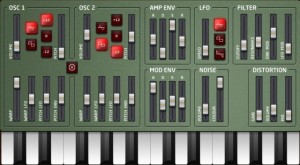
MZ-101 – a new Javascript based synthesizer that works in your Web browser:
MZ-101 is a monophonic synthesizer, modeled on the old analog synthesizers of the 70′s and 80′s. Use the QWERTY keyboard to play notes too.
Warning: this probably only works on the latest version of Google Chrome, on a fast computer. I tried it in firefox, and although it makes a sound, it doesn’t really work. Please let me know if it starts working in firefox. It’s DSP processing is quite rudimentary, but it’s just a proof of concept at the moment.
You can try it out here.
Introducing the TuneFish synthesizer by Brian Control
“TuneFish synthesizer by Brian Control. In this video i have used a random midi file.
brain control website says that tuna fish is a very tiny virtual analog synthesizer. It is developed to fit into about 10kb of compressed machine code while still producing an audio quality that can compete with commercial synthesizers and is still a work in progress.
for more information visit”
http://www.kvraudio.com/get/5189.html
http://www.tunefish-synth.com/
Tunefish is a very tiny virtual analog synthesizer. It is developed to fit into about 10kb of compressed machine code while still producing an audio quality that can compete with commercial synthesizers. This site was created to make the VSTi version of it available to the public. This VSTi, unlike the version of TF which is used in 64k intros of our group Brain Control is of course larger, mainly because it is based on the Qt framework for C++ to make the GUI possible.
The synth comes currently as more of an experimental version without any warranties. It is tested on Renoise but if you want to use it with different programs, please do so and let us know about your experience. Tunefish is an ongoing project under active development so if you have any comments or wishes, please let use know. Also, if you make some music with it or create soundbanks you’re more than welcome to share them here.
Arctic Keys soon to be released for iOS

One Red Dog Media has announced that their new virtual analog synthesizer for the iPad, Arctic Keys, has been submitted to Apple for approval.
Arctic Keys is a four-voice synth, offering extensive modulation capabilities, an arpeggiator, a sequencer and deep MIDI options.
Details:
Tweak. With all the synthesizer parameters immediately available on one page, you get instant feedback as you tweak.
The two LFOs each have three modulation destinations. Each LFO may also be free running or sync’ed to tempo and the timing rate adjusted.
The modulation matrix allows for deep routing between the Mod Wheel, aftertouch and 16 x 4 analog-style gated step-sequencer.
Perform. The classic arpeggiator is complimented by the 16 x 4 gated step-sequencer. Play a note to trigger the sequencer.
Step through a sequence to play short melodic lines or let it modulate the synthesiser. Each of the 4 tracks have an assignable modulation destination and loop point.
Adjust the velocity by tapping along the length of the key from top to bottom. Change the key mode to mono for retro lead lines.
Share. The live phrase recorder lets you save your performances as 44.1KHz 16-bit WAV files and as a Standard MIDI File.
The MIDI File includes all the knob’s control change information along with the notes you play.
Use Sonoma AudioCopy or Intua Audio Sharing to paste recorded audio directly into other apps.
E-mail the patches you make or share them over Wi-Fi
Pricing and availability are to come.
Specifications:
- Synthesis: analog modelling
- Polyphony: up to 4 voices
- Oscillators: 2 per voice, alias free, saw, triangle and square with pulse width, hard sync, ring mod, noise generator
- Filter: 1 multi-mode resonating filter with 4 filter types
- Envelopes: filter and amp ADSR envelopes
- Modulation: 2 LFOs with multiple wave shapes, sample and hold, 3 routable destinations per LFO
- Effects: master effect processors: 3-band EQ, Distortion, Chorus, Stereo Delay
- Arpeggiator: classic apreggiator with octave shift, MIDI-sync-able
- Sequencer: 16×4 gated step sequencer with multiple modulation destinations, MIDI-sync-able
- Keyboard: glissando, scroll, multi-touch poly pitch bend and aftertouch
Features:
- KORG WIST
- Sonoma AudioCopy
- MIDI Learn
- Live phrase recorder with audio and MIDI export
- File and patch sharing via iTunes File Sharing, e-mail and Wi-Fi
- Supports external MIDI in and out via CoreMIDI Networking and USB with the Camera Connection Kit
- Audio background operation
- Virtual MIDI cabling
- Open Music App Collaboration compliant
Kairatune – crisp and tight electric sounds
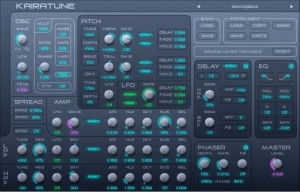
Developer Matti Jokipii has released a new soft synth for Windows, Kairatune:
Kairatune is designed to produce crisp and tight electric sounds for electronic music production. Kairatune is engineered for the demanding producer who needs to push the sound to extremes without compromising audio quality.
Kairatune offers fast and intuitive sound design workflow. The user interface is designed for a musician rather than an engineer and is based on the concept of pitch and beat in contrast to frequency and time. Kairatune lets you travel in the world of beats, notes and intervals instead of the logarithmic mathematics of frequencies and the rarely useful absolute time.
Kairatune is not your all-in-one synthesizer. It’s designed and engineered to be as powerful and versatile as possible in it’s target role as your source for tight bass, unique lead and shiny SFX sounds. At the same time it makes all the effort to be simple enough to use, enabling you to add your personal touch and flavor to the sound and seek for the perfect fit to your mixing preferences.
Kairatune is a free download (VSTi) from the Futucraft site.
Arturia’s Minimoog V has been thoroughly updated
Arturia has released a major update to its virtual take on the Minimoog synthesizer, the Minimoog V.
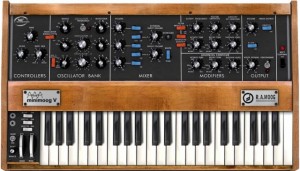
Here’s what’s new in Minimoog V 2.5:
- Support for 64-bit VST and Audio Unit
- Support for Pro Tools 9
- MIDI Control Assignment Improvement
- Update of toolbar look and feel
- Added support for NRPN MIDI controls
- Added triangle LFO waveform
Features:
- All the parameters of the original minimoog V
- Advanced automation mode
- Revolutionary preset navigation system called the SoundMap
- New formant-based FX called the Vocal Filter
- New Chorus and Stereo Delay Effect section
- More than 1000 presets created by talented artists and sound designers,
Minimoog V 2.5 is a free upgrade for all registered users.
How to use Slide Control FS & virtual midi
This is a video who explain how use virtual midi with NLog, MoDrum & BassLine. Virtual midi is very very COOL !!
NLog:
Professional Virtual Analogue Synthesizer supporting Core MIDI, WIST and interfaces from Akai, Alesis, Line6, IK Multimedia & others
::: Demo videos on YouTube channel nlogmusic ::: Check Mac & Audio Unit version in Mac App Store :::
Most versatile iOS synth with professional grade virtual analogue low latency sound engine:
– Play it from on-screen keyboard
– Use MIDI keyboards & controllers via MIDI interfaces
– Connect to your digital audio workstation via MIDI interfaces
– Play NLogSynth from other iOS apps like SoundPrism, polychord or Genome Sequencer via virtual Core MIDI
– Synchronize via Korg’s WIST to other iOS devices running iElectribe, iMS20 or other WIST compatible apps
– Synchronize NLog to beat-oriented apps like MoDrum, Molten or Funkbox running on same device via virtual Core MIDI
– Share patches with NLog Audio Unit Mac version
– Make audio or MIDI recordings on the run and share your files
– Export patches & recordings to iTunes, SoundCloud, Email, WiFi, Beatmaker & Sonoma AudioCopy pasteboards
MoDrum – Synthesis-based Drum Machine for iOS
An 808 style percussion synthesizer that offers pure electronic drum sounds, plenty of editing capabilities, effects, audio sharing, and state of the art MIDI support.
Key Features
Ten real time operating synth modules (no sampled sounds are used): Bass Drum, Snare Drum, Low Tom (∗), Mid Tom (∗), High Tom (∗), Rim Shot, Cowbell (∗), Closed Hi-hat, Open Hi-hat, and Cymbal
Programmable sequencer with 32 steps and global accent pattern
Beat clock with tap tempo and rhythmic shuffle (swing)
MIDI Clock sync/generate, Note in/out (GM drum mapping)
Dotted 8th delay effect unit
Hard knee dynamic range compressor
Tube amp overdrive effect processor
Audio sharing via General Pasteboard, AudioCopy by Sonoma Wire Works, E-Mail or iTunes File Sharing
Universal support for iPod touch, iPhone and iPad
Background Audio/MIDI Processing
Including twenty patterns by DJ/producer Myagi (www.popandlockrecords.com)
Charlatan – free polyphonic, subtractive virtual analog soft synth
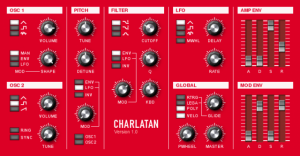
BlauKraut Engineering has released Charlatan – a free polyphonic, subtractive virtual analog software synthesizer for Windows.
Charlatan is a polyphonic, subtractive virtual analog software synthesizer plugin whose design focuses on sound quality and easy usability. The design philosophy was to provide a feature set just large enough to cover a wide range of sounds rather than an infinite number of parameters and modulation options cluttering the user interface and distracting from the creative process. That said, Charlatan’s synthesis architecture is flexible enough to create all kinds of sounds, from conventional classic leads, basses and pads to weird blips and noises.
While making no compromises about sound quality, the algorithms have been optimized for efficient CPU usage making Charlatan well suited as a ”bread and butter” synth even in projects with a large number of plugin instances.
Charlatan is available for free download via BlauKraut Engineering.
Features
Main features of Charlatan:
- 2 oscillators with triangle, sawtooth, rectangle and noise waveforms
- oscillator pulse-width modulation (PWM) and slew rate modulation (morphing between triangle and sawtooth)
- oscillator hard synchronization and ring modulation
- 2 ADSR envelope generators
- 1 LFO
- 3 filter types emulating nonlinear characteristics of classic hardware: 4-pole (24 db/oct) and 2-pole (12 db/oct) lowpass, bandpass
- 3 voice modes: Monophonic with retriggering, Monophonic Legato and 8-voice Polyphonic
- low CPU usage
- 100% coded in C++
- native 64-bit support
Updated: Jamstix – virtual drummer instrument for Windows
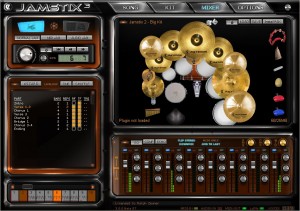
Rayzoon has updated Jamstix, a virtual drummer instrument for Windows.
This update offers various enhancements and fixes and is available now to all Jamstix 3 owners at no charge. The demo version has also been updated.
Changes in Jamstix v3.2.0
- While in preview loop, the current bar can now be changed via clicking on the bar timeline.
- Added ‘End Crash’ sound selection option to fill generator and global action menu.
- Added ‘Send Whole Kit To MIDI Channel’ function to kit menu.
- Sound selection menus now also show related kit piece name.
- Added options to ‘Global Actions’ in song menu to enable/disable start crash and end crash options for fills.
- Added velocity offset for Jamcussion. Hold ALT while in JC mode and the song power knob will show and adjust this offset. Turn left to reduce JC power and vice versa.
- Added ‘Position-Based Dampening’ to kit menu, saved to project.
- AUTO and BAR settings now save globally.
- Added ‘List Brain Elements’ to brain menu.
- Groove brain elements can now be moved (left-click header).
- Added missing value display for several brain controls.
- Added list of installed expansions to ABOUT screen (click on JAMSTIX header).
- Added ini file option ‘LargeTuningRange’. If set to 1, kit editor tuning will be +/- 80% versus the default 20%.
- Velocity line color in the bar editor can now be changed in ini file as BGR value (i.e BEVeloColor=$00FF00 is green).
- Locked note color in the bar editor can now be changed in ini file as BGR value (i.e BELockedColor=$FF0000 is blue).
- Fixed copy/paste of multiple parts.
- Fixed problem with spaces when renaming Jamstix classic controls.
- Fixed fill settings resetting when adding groove or accent brain elements.
- Fixed GUI confusion when re-opening JS in Jamcussion mode with GUI caching disabled.
- Fixed mixer being bypassed when ‘Never Downmix’ is enabled.
- Fixed ‘Behavior’ and ‘Alternating’ not updating in GUI when changed via MIDI controller.
- Fixed groove weights resetting when reloading non 4/4-projects.
- Fixed problem in the ‘Freestyle’ hihat opening element.
- Fixed problem when loading liveloop songs.
- Fixed ‘Turn Groove Into Style’ not working with groove-changing players.
- Fixed ‘Auto Snare’ not working with ‘Jamstix Classic’ style.
- Fixed static tom usage in “Tom Groove” element.
- Fixed graphic overlap in Jamstix Classic brain controls for non-4/4 meters.
- Fixed error when changing hihat sound.
- Fixed problem with excessive snare notes with certain styles.
- Fixed groove functions of player models creating notes in intro parts.
- Locked notes are no longer suppressed by blocking functions such as ‘Early Downbeat’.
Jamstix 3 is available to purchase for Windows PC, starting at $99 USD.
More information: Rayzoon
Image-Line releases Harmor – new virtual synth
Just like it’s predecessor Harmless, Harmor is powered by a powerful additive synthesis engine. Its modules will look familiar to subtractive synthesizer enthusiasts: oscillators, filters & phasers, these are featured in Harmor but, because they are performed through additive synthesis, offer more freedom.
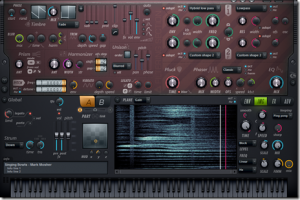
Get Harmor here – http://www.image-line.com/documents/harmor.html
Harmor – featuring a unique and modern additive synthesis engine that emulates classic subtractive synthesis as well, taking sound generation to the next level.
Additive / subtractive emulation – generating sounds not possible with traditional synthesis methods, including the ability to draw custom filter shapes, and offering precise control over every aspect of the sound conception. Image & Audio Resynthesis – allowing a faithful, sampler-quality resynthesis of audio, not a vague sound-alike often met in additive synthesizers. Images too can be imported and turned into sound. Envelopes and articulation – as originally seen in Image-Line’s flagship synthesizer Sytrus, are taken to new levels of features, flexibility and GUI integration. Sound creation – possibilities are endless, but not bewildering. Stutter, mangle, stretch, pitch and manipulate both audio and images beyond recognition.
List of known issues they are going to fix:
- the VSTi installer still has the beta warning from the previoius beta installer saying this is a sneak peak
- it crashes in Live 8.2.5
- The FL Studio version will be included in the next FL Studio release ( 10.0.8 ) which is available only to
Harmor users for now until it’s picked up by our hosting services.
First ever virtual synth plugin based on advanced pulsar synthesis
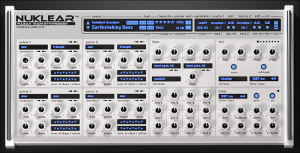
From Hamburg-Audio comes Nuklear, the first-ever virtual synthesizer instrument plugin to be based on advanced pulsar synthesis.
According to the maker of the new plugin, Nuklear comes with unique pulsar oscillators and enriches classic sound synthesis with essential new parameters; by disassociating the note pitch from the waveform length it is possible to create new, previously unheard sounds.
As opposed to classic sound synthesis repetition rate rather than waveform length is solely responsible for the resulting pitch. As Hamburg-Audio notes, the length of the individual “pulsaret grains” is controlled and modulated by a separate parameter, the “pulsaret frequency.”
Overall, the new soft synth offers advanced pulsar synthesis with 4 pulsar train generators and up to 16 voices, 26 pulsar waveforms and 4 pulsar envelope waveforms, 8 low frequency oscillators, 8 ADSHR envelopes, a built-in delay effect with sync option, a built-in distortion effect with 3 distortion types, and a 16-step sequencer with 8 programmable patterns for note and multiple parameter modulation control.
The Nuklear plugin is available in Audio Units, VST2, and VST3 formats for Windows (32-bit and 64-bit) and Mac (Intel).
Hamburg-Audio Nuklear features at a glance:
- Advanced pulsar synthesis with 4 pulsar train generators and up to 16 voices
- 26 Pulsar waveforms and 4 pulsar envelope waveforms
- 8 Low frequency oscillators
- 8 ADSHR envelopes
- Built-in delay effect with sync option
- Built-in distortion effect with 3 distortion types
- 16-Step sequencer with 8 programmable patterns for note and multiple parameter modulation control
Nuklear is now available to purchase for Windows and Mac (VST / AU) for 169 EUR (approximately $236). For more information on Nuklear, please visit Hamburg-Audio’s Web site, hamburg-audio.com.
DATAMASKIN

