
iZotope Iris – Intro To Iris
Introducing Iris:
Unearth a world of sounds you’ve never heard before with iZotope Iris™. Driven by iZotope’s award-winning visual selection technology, Iris is a groundbreaking sample-based synthesizer that harnesses the power of both your eyes and your ears. Fuel your creativity with Iris’s new spin on sound design, perfect for musical inspiration and sonic experimentation.
- Discover what’s inside any sound: Load audio into Iris and explore spectral details that a regular waveform locks away.
- Highlight what intrigues you: Extract and isolate the most interesting sonic components with a full suite of visual selection tools.
- Combine the unthinkable: Layer completely diverse sound sources into totally unique combinations… what do a tattoo needle and a swamp bird and a slot machine sound like together?
- Stay musical: Rely on intelligent root note detection to help shape musical material from noise, ambient textures, soundscapes… even mistakes!
- Enhance and invigorate your sound: Apply world-class iZotope reverbs, distortions and delays, then take advantage of extended synth features like amp envelopes and LFOs.
- Get amazing sounds immediately: Spark your imagination with over 500 patches by world-class sound designers, or design your own with Iris’s 4 GB library of diverse sound samples.
Download the free 10-day trial of Iris here:
In this video, get a tour of the main features in Iris!
World Sound Mix – based on the uploaded sounds on Freesound.org
The installation and sound mix project:
“World Sound Mix for BankART LIFE3″ is a sound visual installation, generating new soundscape around the world. This work continues mixing the sounds at selected two points somewhere in the world from the database of huge quantities of environment sounds and generating new soundscape.
For this exhibition, we set up a magic box that resonates mixed soundscape in Sapporo and somewhere in the world. During the exhibition, a globe in the box keeps turning and resonating sounds in real time.
About sounds data:
World Sound Mix is based on a sound database from Freesound project, its sounds have been recorded and gathered by sound hunters around the world. The use of sound data is under the CreativeCommons Sampling+ 1.0 License. By the username and “freesound sound ID” shown on the globe, listener can refer to original content.
Interview with Kraftwerk’s Ralf Hütter following their shows in NYC
New interview with the remaining original member of Kraftwerk – where Ralf among other things let’s know a new album is in the making and will be released soon:
Last week Ralf Hütter, the singer and founder of the pioneering German electronic band Kraftwerk, recalled the first time the band came to New York City: in 1975, for an American tour to promote “Autobahn,” an unlikely hit sung in German and backed by electronics. The group members were carrying, he said, a few suitcases, some synthesizers in padded boxes they had built themselves and, for visuals, a slide projector.
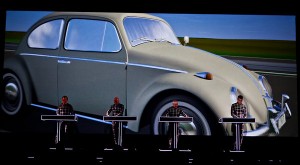
Things have changed. For Retrospective 1 2 3 4 5 6 7 8 at the Museum of Modern Art — eight sold-out concerts that conclude Tuesday, with Kraftwerk playing through each of its eight studio albums from 1974 to 2003 — Kraftwerk deploys 3-D video projectors that send images leaping forward from the stage, along with a custom surround-sound installation including overhead speakers and a sleekly concealed wall of woofers at the front of the stage. (A multimedia exhibition at MoMA PS1 continues through May 14.)
Yet after three-and-a-half decades of tech upgrades Kraftwerk probably sounds less futuristic than it did on first exposure. That’s because Kraftwerk’s future became pop’s present. The group’s avant-garde ideas — making music inseparable from new technology, building songs from synthetic sounds and electronic rhythms, using repetition and robotic voices — have taken over much of mainstream pop. Its deadpan lyrics about transportation, media and ubiquitous technology are still tersely prescient. Back when it made its 1981 album “Computer World,” Kraftwerk didn’t own computers. “It was all done on analog sequencers,” Mr. Hütter said.
Kraftwerk, which bills itself as the Man-Machine, doesn’t show its human side very often. Through the years the band has largely shunned pop’s cult of personality. Onstage Kraftwerk’s four members perform standing behind mysterious matching consoles, their faces impassive. The band members call themselves operators, not musicians; one of them, Stefan Pfaffe, actually operates videos, not sounds, from his console. (Mr. Hütter said he provides vocals and keyboard lines onstage, while Henning Schmitz controls bass lines and equalization, and Fritz Hilpert controls rhythms and percussive sounds.)
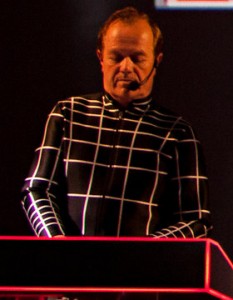
Offstage Kraftwerk rarely participates in promotion and publicity. But every once in a while Mr. Hütter, the band’s sole remaining original member, grants an interview, as he did on Friday afternoon in an office at MoMA. He was accompanied and occasionally translated by the curator of the museum’s events, Klaus Biesenbach.
Mr. Hütter, 65, is trim and energetic; he’s a dedicated cyclist, regularly making 125-mile excursions. “You have to find your tempo,” he said. He was sometimes affable, sometimes wary. He bristled at the suggestion that Kraftwerk had pop ambitions, although songs like “Autobahn” and “The Model” were international hits.
“We are fine when the idea comes to a clear statement,” he said. “It could be short, it could be long. We also have structure that’s very minimal, so it’s not drama. It’s more modular, minimal. It’s components, it’s conceptual. There’s development, gradual. Whereas in classical music there is drama. That’s not our thing.”
Kraftwerk is usually translated as “power plant,” but Mr. Hütter said the band’s name can also be pulled apart for meanings: “kraft” is energy and dynamics, “werk” is simply work, or labor, and also (as “werke”) an artist’s oeuvre. Kraftwerk records on its own open-ended schedule; it hasn’t released a new studio album since “Tour de France” in 2003. It has, however, been touring and frequently revamping its older songs with newer technology and ideas.
“Kraftwerk is a living organism,” Mr. Hütter added. “Music is never finished. It starts again tomorrow. The record is just a record, but for us it’s nearly boring. We like better the programs that we can operate with. So we are operating, we are upgrading, we are updating continuously. There’s continuous reprogramming going on, and composition and new concepts are also coming.”
Read the rest of the article here >>
Via: The New York Times
New Sounds Coming for the XW-P1
Here’s what Casio has to say about it:
We’re working on expanding the library of sounds available for the XW-P1, here is a quick look at some of the sounds we’re working on. These sounds will be available in May for free at www.casiomusicgear.com
New album from Empire State Human
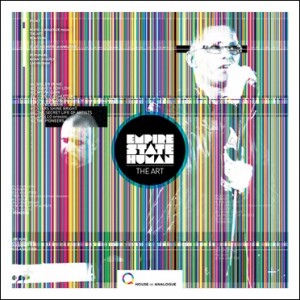
Irish synthpop band Empire State Human have announced the release of their 6th studio album “The Art”. Released on the bands very own label House of Analogue,
“The Art” is what the band calls ‘a celebration of electronic pop music as an art form’. The album features the single “Search for Love”, as well as the next single “The Pioneers”. Artwork was designed by Fontpusher in London and the material was mastered by Idle Mastering, Denmark.
Says lead singer Aidan Casserly: “We feel it’s the natural follow on album, in terms of pop song content, to our very successful debut CD “Pop Robot” fom 2002. It feels like a 10 year cycle has concluded wit this release in many ways, in terms of songwriting, influence and style. We’re had 16 releases since 2002 and this is by far our favourite one. We’re extra delighted to be able to release in on our very own label House of Analogue too.”
Jim’s Tips & Tricks: VIDEO SONG – RAKTATAK
Rock Video Song Features Face-Melting Moog Synth, Hammond Organ, Fender Guitar & iPad
Background data:
My first video song, an original I called RAKTATAK. What you see is what you hear, and everything you hear is seen.
Using some of my favourite instruments, this song came out of jamming on my Moog Little Phatty. Layed down the groove and added instruments – arranged with Fender Strat guitars, Fender Jazz Bass, Nord C2 Organ and Ipad Apps M3000HD and Animoog.
Drums programmed in Boom and Addictive Drums.
For lesson information in the Vancouver area, please visit:
https://jimmclaren.musicteachershelper.com/
A couple of new electronic music videos
Killers available April 12 through Evenco on Spotify/Itunes worldwide.
http://itunes.apple.com/se/album/killers-single/id517824677?l=en
Video directed by Robin Kempe Bergman of Robinovich.
Music produced by Andreas Dahlbäck.
Backing vocals by Nina Kinert.
Contact: http://www.dimbodius.com
Ostrich – “Lonely Ghost” from the album “THE OSTRICH EFFECT” (2012)
Music: Marcus Mattsson & Martin Eliasson
Lyrics: Marcus Mattsson
https://www.facebook.com/Ostrich71
http://ostrich.se
http://www.myspace.com/ostrich71
Director: Michael Axelsson
http://www.facebook.com/axelssonfilm
Cinematography: Andreas Hall
http://www.aptass.com
Editor: Trond Lindblom
Prod.ass: Jon Pettersson
http://glimmerfilm.com/
Fan video by HC.Carbo
Music & Pictures By METROLAND
http://www.facebook.com/pages/Metroland/279266788757361
http://soundcloud.com/metroland
Released on: sounds-from-the-matrix-012 (Alfa-Matrix)
http://itunes.apple.com/be/album/sounds-from-the-matrix-012/id513035879?l=nl
New free app lets you create audio time-lapses

phonoLapse is a free desktop app for Mac and Windows that lets you create audio time-lapses.
The software records slices of audio and compiles them into an audio file, much like time-lapse photography. You can control the length of the audio slices and the interval between samples.
It’s available to download at the soundplusdesign site.
“This time lapse follows 24 hours of my life. I wrote a Max/MSP patch to capture a 100ms slice of sound and a frame from my webcam every 144 seconds.
I call it time lapse phonography because the focus is on sound, not on the visuals. I added the visuals because I find it interesting to see and hear the space rather than just hear it.”
Modular Beginnings
New modular DIY video uploaded:
Two-part exploration of a new device I’m building, first showing the oscillator control that feeds “robot voice” chip, and then using various parts of my modular synth to control the pitch/speed of the modulation effect.
Microphone Transformer – effect unit which simulates microphones’ sound
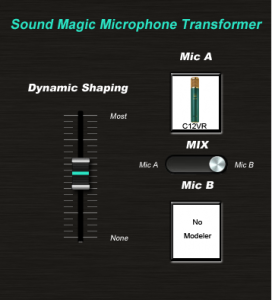
Sound Magic has released version 1.1 of Microphone Transformer, an effect unit which simulates several acclaimed microphones’ sound.
From Neumann M149 to U87, AKG C12VR to C414. Microphone Transformer gives you more choices on sound. By using Sound Magic Award Winning Modeling Technology, Microphone Transformer not only simulates the frequency response of different microphones, but also their dynamic response with high-end amps. What is more, Sound Magic provides a special feature which you could choose to mix two different types of microphone together by moving a simple slider. Microphone Transformer is best used when you want a different style of sound in your mix.
Changes in Microphone Transformer v1.1
- Fixes Automation names.
- Fixes possible swap between left and right channel.
- Improved Mixing Behavior.
- Fixes slider range on GUI.
- Many minor changes.
Microphone Transformer for Windows (VST/Supreme Pianos add-on) is available to purchase for 19.90 EUR. Existing Sound Magic customers pay 15 EUR.
DATAMASKIN

