
ginas brain – analog synths
EMS VCS3 as featured on Mark Lawson’s summary of TV in 1973, which was just on telly
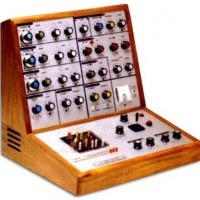
The VCS3 (nicknamed the Putney) is an analog monosynth housed in a distinctive angled wooden case, a truly classic synth. EMS (Electronic Music Studios) was created in England back in 1969. The VCS3 was one of their first synths and it is still a great, unique, funky little unit! Pictured above is the Mark I model. Pictured is another unit with the small wood-cased DK2 voltage-control keyboard required to play the VCS3.
It has three oscillators, and a unique matrix-based patch system. Instead of patch wires, the VCS3 uses a patchbay grid in which the synth components are laid out, and signal routing is accomplished by placing small pins into the appropriate slots. The VCS3 was, in actuality, a modular type synthesizer reduced down to an extremely portable size.
It generates familiar sci-fi sounds (Dr. Who) and other truly analog sounds. Unfortunately, the oscillators tend to drift out of tune. There’s a Noise Generator, 2 Input Amplifiers, 1 Ring Modulator, 1 Voltage Controlled Low Pass Filter (VCF), 1 Trapezoid Envelope Generator, Joy-Stick Controller, Voltage Controlled Spring Reverb unit and 2 Stereo Output Amplifiers.
Additonally, the VCS3 was also sold in a plastic breif-case and called the Synthi A. The major Synthi 100 system was based on three VCS3’s strung together. Some ultra-rare commercially unavailable synths EMS made include the VCS4 in 1969 which was basically 2 VCS3’s plus a keyboard. And the Synthi Keyboard 1 of 1970 was just a VCS3 with a mini 29-note keyboard.
Reason Refill Review: eXode Dubstep Bass & Synth
A new Steelberry Clones review featuring eXode’s latest Reason Refill “Dubstep Bass & Synth” for the Propellerhead Reason DAW. The Refill consists of 64 carefully crafted Combinator patches, in about a 50/50 split between bass sounds and synth lead sounds. Dubstep is a genre of electronic dance music that originated inthe UK. Its overall characteristics sound has been described as “tightly coiled productions with overwhelming bass lines and reverberant drum patterns, clipped samples, and occasional vocals”. I believe this definition is quite critical when reviewing eXode’s Refill since it is very much tailored to work smoothly and be easily incorporated into Dubstep productions.
When we walk through the different Combinator presets the first thing that strikes us is the crispness of the sound; all CMBs uses all the right effects, including several of the new additions in the latest R6 release, such as the Echo; and the tight feeling you get when listening both in headphones and speakers. The Dubstep bass synth sounds stand out us the most creative part of eXode’s Refill, several of the bass sounds – often coupled with arpeggio effects – gnerate their own little sound universe. Robotic sounds, synthetic noise, paired with that characteristic and often evil sounding bass commonly heard in Dubstep productions. The Dubstep bass sounds are truly a treat for anyone doing Dubstep and as we mentioned in the beginning these hard, noisy bass sounds do incorporate that tight level of intensity that we would look for if we would make a track in this genre, not saying that you cannot use them elsewhere.
The Synth section is overall good and will fit many electronic tracks, however they do somewhat lack that creativity that eXode has become renown for. They are all high quality tailored and easy to configure and adapt to suit your needs, whether it be lead sounds or simply flavoring the overall mix. Something that would be a good complement to this section of the Refill would be if eXode actually also could include some of his effect settings in a separate folder, like an mixing and mastering effects folder. Since a good portion of the strength in eXode’s Refills is his work on the overall sound quality and tight use of dynamics.
Below are a couple of sound examples from the Refill, both from the bass section and the synth section.
Overall verdict then: Definitely a very tight and powerful Dubstep Refill and as eXode puts it himself:
“These sounds are sick, brutal, raw and in your face!”
JP80 + JP8 + JP6 + Ion “3 Jupiters”
Here we have a Jupiter 80, Jupiter 8, Jupiter 6 and Alesis Ion. The Ion is being used for the Arpeggiator. The patch on the Ion is called “Infrastructure”. The patch on the Jupiter 80 is called “Big Mouth Pad” which is the first patch of the new 2.0 version.
Akai Pro MPC Software: Overview and Tutorial
Akai Pro Product Specialist, Andy Mac, takes you through the new MPC Software. This is the platform that will drive the MPC Renaissance and MPC Studio.
Features:
- 128-track sequencing capability
- Massive 6GB+ sound library, including all of the sounds of the classic MPC3000
- Instant mapping and real-time adjustment of VST plug-ins
- Record each track as an MPC drum program, Keygroup program or VST plug-in
- Works alone as your main DAW or works seamlessly with your current studio as a VST/AU/RTAS plugin
- Supports WAV, MP3, AIFF, REX and SND
- Supports samples and sequences from any MPC ever made
- Mac and PC-compatible
This is the platform that will drive the new MPC Renaissance and MPC Studio Music Production Controllers.
Electronic music with Battery Operated: Girls Only
What’s Battery Operated Girls Only?
We are a group of female music composers exclusively uses the battery operated electronic musical instruments, such as KORG DS-10, KORG M01, monotron, monotribe, kaosillator, mini-KP, microKORG, and so on, to make music.
Official Website:
http://denchikudoushiki.web.fc2.com/
SoundCloud:
http://soundcloud.com/battery-operated
Ableton Korg Monotron Delay Emulation
Ableton Live Instrument rack Emulation of the Korg Monotron Delay. Create with samples from the Korg Monotron, this Ableton Synthesizer has effects built in to model the Monotron Delay. Fun and diverse synth with great sound design potential. The Monotron Delay Rack has 8 macro controls that allow you to greatly alter its sound. It features controls for the synth’s filter and an LFO that is modulating the filter frequency. There, of course, is plenty of control over the delay. You can alter the amount of delay, the time between each delay, and a band-pass filter to change the character of the delay. I have set the delay itself to repitch mode, which emulates analog tape delays.
Free Download @ http://bit.ly/freesynth54
Zira Demonstration
A quick run through of Zira and it’s features.
Background data:
Zira came out of an idea I had to see how small I could build a synth and still get it to sound good. The prototype is based on the Korg NJM2069AD Filter/VCA chip, the reason for this being I had 8 lying around I bought a while back from Korg to build a polysynth with.
There are a small number of these being made, I will be selling these as fully assembled modules with a case.
However, I fully intend to try and replace the NJM2069AD with a discrete filter and VCA of some kind (currently a 2 pole State Variable Filter based VCF and simple VCA is looking good) and turn this into kits in much the same way as I did with GorF.
A quick summary of it’s features;
- Two oscillators, each with 48 waveforms
- One Sub oscillator
- Hard Sync of oscillators
- Two ADSRs, one VCF, one VCA
- One LFO
- Multiple routing options
- 64 patch memories
- MIDI updatable firmware
For more detail see the specifications page and for demo sounds, see the sounds page.
Karl Bartos and the voice of technology: An exclusive interview with Karl Bartos
Some of weeks ago Karl Bartos toured a couple of cities in Sweden and Steelberry Clones, got an exclusive interview with the synth pop pioneer. Karl, being one of the four members of the classic Kraftwerk line-up and with several legendary compositions on his track record, i.e. Computer World, The Man Machine, Electric Café. To recap some of the more important activities it is worth mentioning that Karl founded the group Elektric Music in 1992, releasing the album Esperanto, and he have collaborations along the way with Bernad Sumner, Johnny Marr and Andy McCluskey. And since Steelberry Clones are in fact based out of Sweden it is worth mentioning his guest appearance with Swedish synthpop act Mobile Homes. After leaving Kraftwerk, some 25 years ago, the music that he and the rest of the band created is still a great inspirational source across numerous musical genres.
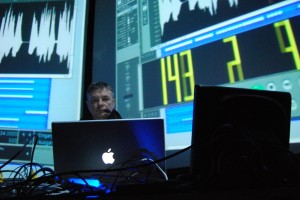
Karl has ventured into many different fields since the Kraftwerk days and has delivered highly acclaimed albums along the way, such as Communication – featuring such songs as “I’m the Message,” “The Camera,” and “Ultraviolet.
In awaiting his new album, due early next year, we wanted to dig a little deeper into the mind of Karl, by asking him about the music creation side of things.
The new album in the works
Karl is now producing a new album, but working in the studio is being like a scientist, tweaking and tuning – composing is the pleasure part! The production process involves starting with beta versions and then continues to work with the songs, improving them and making new versions – even though all twelve songs where set at demo stage. Here Karl adds a remark that stems from his German and Kraftwerk roots – “I go into the studio 8 hours every day”. Producing your own work requires making final decision, fighting yourself.
Being a director and the use of computers
Composing is being like a director of drama – there are roles and dialogue. Making electronic music is like making and acoustic film. For Karl melody and harmony are key ingredients. And while composing the sound is and integral part of the composition. Working with synthesizers for more than thirty years Karl has built up a pallet of sounds in his head which he uses as basis while composing. Whilst there are infinite sound possibilities using electronic instruments – “there are so many sounds, I can’t listen to all of them”, only adding new sounds occasionally. Regarding electronic instruments Karl hasn’t sold any of the his synthesizers and still prefers the old analogs. But just like computers – they are only tools. Like a craftsman that needs different screwdrivers but then he doesn’t love them – “computers are just eating my time”. Many musicians today turn to analog gear as they miss the tactile experience while creating but for Karl the important composing process is done in his head – not turning knobs or clicking on computers. That said the computers are used heavily during production of audio and video, sampling sounds.
Regarding computers, Computer World, the eights studio album to come out of the Kling Klang studio, in these Twitter days we can assume that all these sound bytes like “It’s more fun to compute” would make efficient and highly acclaimed Twitter posts today :-). However, what is more interesting to know is that at the time of the making of the Computer World album Karl and the others had never actually owned or used a computer themselves. “During the making of Computer World we had a closer look at those incredibly smart machines at the IBM affiliate in Düsseldorf”. Remember that the PC was just launched and home computers was if not science fiction very exotic at the time.
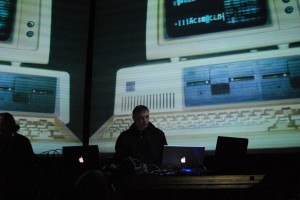
I robovox
The robot voices are a trademark of Bartos music and appears on all his albums where he uses both vocoders and synthetic made voices. They are used for the dramaturgic effect – as “the voice of technology it self, or like the voice God”. The robot voices are then not him self singing and can be used just like the narrator in a film. The voice technology has advanced tremenously the last years with products like Antares Auto Tune, Melodyne, Vocaloid etc and they are used in numerous pop hits, but few has put them as permanent tool on their artistic palette.
Audio information : Kraftwerk’s World Tour 1981
Live at Nagoya Shi Koukai Do, Nagoya, Japan, 13/09/1981
Read the full interview here >>
DEWANATRON! A 3D Stereoscopic Documentary (Official Teaser)
http://youtu.be/owJSMPYZR1Q
Check out the IndieGoGo here: http://www.indiegogo.com/dewanatron3D?a=490342
DEWANATRON! is the struggle of two inventors, cousins Brian and Leon Dewan to design, manufacture, sell, and play unique analogue synthesizers in an overwhelmingly digital world.
Cool Sound and Water Experiment!
This is really simple but has such an awesome effect. Fill a bucket full of water and place it about 5 feet off the ground. Place a subwoofer about 1 foot lower than the bucket. Run a plastic tube from the top bucket down in front of the subwoofer. Tape the tube to the front of the speaker. Then aim the end of the tube to an empty bucket on the floor. Get the water flowing from the top bucket. Now just generate a 24 hz sine wave and set your camera to 24 fps and watch the magic happen. Basically your cameras frame rate is synced up with the rate of the vibrations of the water so it appears to be frozen or still. Now if you play a 23 hz sine wave your frame rate will be off just a little compared to the sine wave causing the water to “move backward” or so as it appears. You can play a 25 hz sine wave and cause the water to move slowly foward.
Really fun experiment. You should definitely give it a try.
Thanks to JacobTMcgarry for giving me the OK to create my own version based on his original video:
http://www.youtube.com/watch?v=8GkHePfcpbY&context=C40ee253ADvjVQa1PpcFPc…
DATAMASKIN

