
Neo Harmonic – new equalizer/exciter hybrid effect plug-in
Sound Magic has released Neo Harmonic, an equalizer/exciter hybrid effect plug-in for Windows featuring a custom shaped filter response curve.
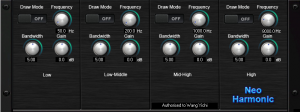
There’s an EQ theory called “Yin and Yang” which says that adjusting one band will automatically influence the others. Neo Harmonic takes this theory to a new level by not only boosting/cutting the selected frequency, but also exciting the harmonic partials of that frequency, extending changes throughout the whole audible frequency band. The result is a unique sound which traditional parametric EQs would be hard pressed to achieve.
Neo Harmonic will give you a fuller sound, with more detail and clarity than is possible with a traditional parametric EQ.
Neo Harmonic features
- Innovative Harmonic Excite Technology.
- Innovative Custom Curve Shape enables users the define their own harmonic curve to achieve unique sound.
- Super Wide Bandwith adjusting range gives users more controls on final sound.
- Sample and hold fuction enables users to analyze an audio signal first, then hold its harmonic information and apply to another audio track.
- Up to 32Bit/384KHz resolution.
Neo Harmonic for Windows (VST/Supreme Piano 2 add-on) is available to purchase for 49 EUR.
Check out the Droner for iPad
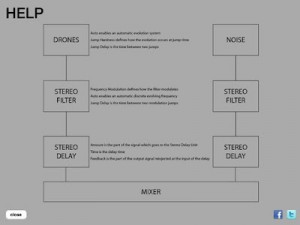
Welcome to The Droner, experimental noise & drone station for iPad. On the left, you can see the routing schematics of the synthesizer. Be careful, you don’t have a classic or a regular machine in your hands. Indeed, it can produces very unique and strange sounds textures and you have to learn to handle it.

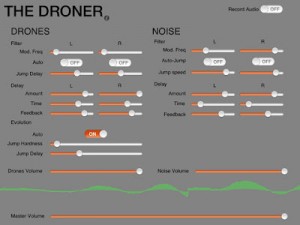
You have to use it with earphones or to use a line input on your sound-system in order to render the best results.
You can record while playing with it. The PCM file will be saved in the document folder of The Droner application on your iPad. You use iTunes to manage the files in this folder to backup them on your computer, or remove them.
ATARI POKEY 8-bit Computer Sound on PIC32
Background information:
I successfully compiled the ASAP (Another Slight Atari Player) library [1] for a PIC32MX795F512H. ASAP emulates a 6502 CPU and the famous POKEY sound chip [2] used for example in the ATARI 400/800 and XL/XE 8-bit computers. To say it with Wikipedia’s words: POKEY’s sound is distinctive 
About 60 tunes (worth about 2.5 hours of music) taken from ASMA (Atari SAP Music Archive) [3] are included and stored in the PICs flash memory. D0 is the left and D1 the right PWM channel.
The source code is available here: http://dangerousprototypes.com/forum/viewtopic.php?f=56&t=3944
[1] http://asap.sourceforge.net/
[2] http://en.wikipedia.org/wiki/POKEY
[3] http://asma.atari.org/
“Roland Jupiter 80” Distorted Polysynth
Short description:
What’s even more apparent is that the Jupiter 80 is not based on any conventional synth architecture, because it eschews the conventional patch and performance structures that have dominated synth architectures for the past 20 years or so. The lowest level (or so Roland claims) is the ‘Tone’, and there are two distinct Tone generators: Supernatural Acoustic (which, confusingly, also contains the APS sounds) and Supernatural Synth. The next level up is the ‘Live Set’, which can comprise up to four Tones in ‘Layers’. The top level is the ‘Registration’, which comprises four ‘Parts’: a single Tone in the Perc Part, a Live Set in the Lower Part, another Live Set in the Upper Part, and another Tone in the Solo Part.
Audio demo of the new Subsonic Labs Wolfram VST and Audio Units plugin.
Subsonic Labs has released Wolfram, which they describe as an advanced sound manipulation device. Nice retro video BTW 😀
“This is the device for you who aren’t satisfied with the few options on your average plugin. You wish to take that extra step, to twist that extra knob in order to achieve instant sound processing gratification – Now you can…We took your average plugin, doubled the voltage, drilled (virtual) holes for essential buttons and rewired it beyond recognition.Smoking hot from our Subsonic Laboratories, it can be the subtle, ear tingling touch of Dr. Jekyll…But Wolfram is equally capable being the frequency devastating abomination of Mr. Hyde. All this with a light touch on the well polished user panel.
Get that vintage vibe with a modern twist – Delays, pitch shifting, distortion, chorusing, phasing, panning, filtering, cabinet emulation and all strange combinations in between. Do you need Wolfram today? Well, you will ask yourself why you didn’t buy it yesterday!”
Teaser for the soon-to-be-released interactive granular sampler for iPad
A “grain cloud” may be added to the screen under the current mouse position with the press of a key. This cloud has an internal timing system that triggers individual grain voices in sequence. The user has control over the number of grain voices in a cloud, the overlap of these grains, the duration, the pitch, the window/envelope, and the extent of random motion in the XY plane. By selecting a cloud and moving it over a rectangle, the sound contained in the rectangle will be sampled at the relative position of each grain voice as it is triggered. By moving the cloud in along the dimension of the rectangle that is orthogonal to the time dimension, the amplitude of the resulting grain bursts changes.
We will provide more details on this as soon as we have them
Enjoy for now
Dual Synth Tech Test 01
Background data:
I build up a one of a kind Buchla format “Dual Synth Tech” module.
Basically I made a Buchla style panel based around 2x Synthesis Technology “Eurorack” modules:
1x E560 Deflector Shield
1x E580 Resampling Mini Delay
This is a video of my 1st test of the final module . . . . this is just a “fun test” as I just hopped through a few different settings at random.
Mostly focusing on the “Delay” and “Tap” outputs of the E580, which gives the nice strong stereo effect . . . so when you hear the Frequency Shifting (briefly) of the E560, you are only hearing the mono “Up” output.
Honestly, this combo of modules works and sounds AMAZING with the Buchla . . . I was really blown away – audio levels match great, and CV control works nice especially when using a Control Voltage Processor (like the Verbos 254).
Experimental: Magnetovore Presents the Magnetic Cello
The Magnetic Cello is an analog electronic musical instrument created by Cal Poly SLO student David Levi. After three years of development, the finished instrument is available for reservation for its summer 2012 release. Those who reserve a Magnetic Cello now will have the first opportunity to own the instrument.
Whether you’re an established musician looking for a change of pace or a student just beginning to experiment, you’ll find new musical possibilities with the Magnetic Cello.
Playing the Magnetic Cello:
- Shape volume using a magnetic bow. Moving the bow in space around the copper coil induces an electrical signal to magnetically articulate the instrument.
- Control pitch by pressing down on an electrically resistive ribbon. This ribbon, mounted to the neck of the instrument, is continuous and can perform the same glissando and vibrato of a traditional stringed instrument.
- Select strings by rolling your right thumb. With a small switch mounted on the bow under the right thumb, a musician can instantly switch strings.
Michael Evans is a cellist of 9 years. http://www.youtube.com/vgcellomusic
David Levi is a cellist of 2 years, and the creator of the Magnetic Cello.
Tristan Paul is a cellist of 10 years.
Visit Magnetovore.com to reserve your Magnetic Cello!
Subscribe for more
Twitter.com/Magnetovore
Facebook.com/MagneticCello
Diskonnekted – Neverland – official video
Details below:
Buy album: http://www.alfa-matrix.com/shop_comments.php?id=2155_0_8_0_C
Buy ltd 2cd box: http://www.alfa-matrix.com/shop_comments.php?id=2156_0_8_0_C
FREE DOWNLOAD: http://soundcloud.com/diskonnekted/neverland
Official video by Romuald ‘Ishoothorizon’ Swieconek
4 years! Some 48 months… It’s the time it took for Belgian artist Jan Dewulf to redefine the DISKONNEKTED concept and return with an all new philosophy, new sound, new image…
Strong and combative, DISKONNEKTED proudly presents on his 4th studio album “Hotel Existence” a new formula that brings the band through raving breaks, deep and stuttering bass, catchy poignant vocals and electronic soundscapes. Inspired by a Paul Auster novel, the new songs reflect the general idea of the inner fantasy that promises you a better world, but becomes a cancer of unfulfilled expectations.
Apart from being an explosive intermix of styles that’s never been heard before in the contemporary industrial/electro scene, ‘Hotel Existence’ is also an emotional quest that will shake your inner world.
You can’t place DISKONNEKTED’s music in one specific genre, since every challenging genre is reflected in this album: from drum ‘n bass and dubstep, to floating electronics and solid EBM. A true clash of styles exploring different electronic genres and offering what might be the freshest album of the year! Fans of PENDULUM’s raving breaks or the uncompromising cross-over of CELLDWELLER will be delighted to see those elements being also introduced in a modern electronic hybrid style.
The album is also released as a double-CD limited carton box edition including remixes by LIQUID DIVINE, PAUL UDAROV, ESSENCE OF MIND, PSY’AVIAH, SLEEPLESS, etc.
iZotope Iris Synth Plug-in Review
In this video see an extended explanation and review of the amazing Iris synthesizer plug-in from iZotope.
Description:
Unearth a world of sounds you’ve never heard before. Driven by iZotope’s award-winning visual selection technology, iZotope Iris™ is a groundbreaking sample-based synthesizer that harnesses the power of both your eyes and your ears. Fuel your creativity with Iris’s new spin on sound design: a “visual instrument” that’s perfect for musical inspiration and sonic experimentation.
KEY FEATURES
- Discover what’s inside any sound: Load audio into Iris and explore spectral details that a regular waveform locks away.
- Highlight what intrigues you: Extract and isolate the most interesting sonic components with a full suite of visual selection tools.
- Combine the unthinkable: Layer completely diverse sound sources into totally unique combinations… what do a tattoo needle and a swamp bird and a slot machine sound like together?
- Stay musical: Rely on intelligent root note detection to help shape musical material from noise, ambient textures, soundscapes… even mistakes!
- Enhance and invigorate your sound: Apply world-class iZotope reverbs, distortions and delays, then take advantage of extended synth features like amp envelopes and LFOs.
- Get amazing sounds immediately: Spark your imagination with over 500 patches by world-class sound designers, or design your own with Iris’s 4 GB library of diverse sound samples.
DATAMASKIN

