
Moog Voyager Filter Step Sequencing
A quick inspirational video showing a nice result from step sequencing the Moog Voyager’s filter cutoff.
First look at Cakewalk Sonar X3
Cakewalk shows us their brand new Sonar X3 release. Big news is the unlimited track, buss and aux count in the entry level version, watch for other details. Create music in any style with cutting-edge instruments, effects, and creative tools. Thanks to the award-winning Skylight user interface, SONAR X3 lets you move seamlessly in your production workspace, instantly going from recording to editing to mixing and back again. Produce flawless tracks with the 64-Bit Double Precision audio engine and upload polished mixes directly to YouTube and SoundCloud. Plus, SONAR X3 let’s you do it all without limiting the number of tracks and plugins; all while supporting the latest technologies like VST3, multi-touch, and Gobbler cloud save.
Eowave Launches Spatiolab Capsule TITAN
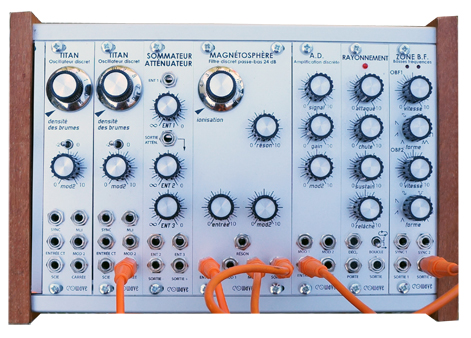
Eowave crew is proud to announce the release of the Spatiolab Capsule TITAN, also available in individual modules. Because Titan has a thick atmosphere able to carry sound waves, the moon is a noisy place…
For a long time, we’ve imagined the music of the space to be a sweet song of gods, crystalline magical sounds. And we thought that the space was a silent place, cold and empty. Since 2004, the Cassini-Huygens mission has recorded some sounds of the space, different from everything we’d imagined before, shock of particles launched in the space at a prodigious speed, a deep chaos, unexpected, which the ESA/NASA has sometimes called « alien sounds »… The Cassini-Huygens mission started the exploration of Titan in 2007.
Since 2000, Eowave designs instruments for electronic music. The Titan Capsule is a fascinating and immersive experimentation mixing space mysteries and music. It will make you explore sound dimensions that are still unknown.
Titan has a very thick atmosphere able to carry sound waves. With the Capsule TITAN, we’ll get onboard to explore how the sound goes across Titan orange thick atmosphere. In a way, the Capsule Titan is a simulation station able to reproduce the journey of the sound waves crossing Titan’s atmosphere and offer the possibility to modulate parameters like the thickness of the haze, the ionisation of the magnetosphere, Titan’s magnetic glow, or low frequency zones.
Price : 699 euros incl VAT / 549 euros (without case, no MIDI interface, no patch cables, no PSU).
Aleph – new open source all inclusive machine
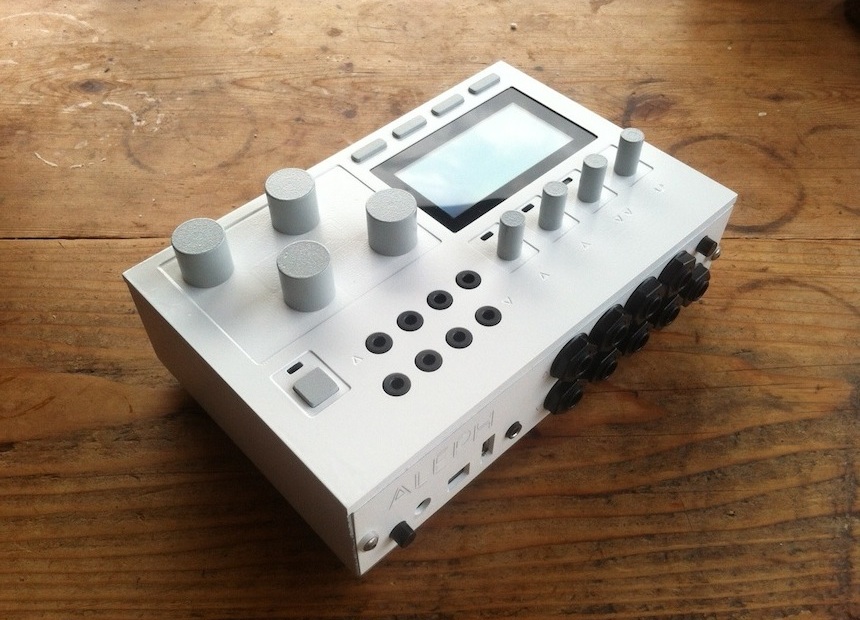
Ezra Buchla (son of Donald) and Brian Crabtree of Monome have made a Linux based open source device for “everything” called Aleph.
with connectors for monome, soundplane and shnth
100 will be made – it will be $1.4k – and it has 4 CV outputs as well.
runs BF533 DSP, programmed in C under Linux –
first in will be:
a looper,
a digital synth,
a sampler and
a drummachine
-> Forum • Aleph Crabtree/Buchla.
-> http://monome.org/aleph
filmed by emily lacy and kelli cain. edited by kelli cain.
performed by ezra buchla and brian crabtree.
Drum computer MFB Kult – Demo
MFB Kult, a sample based drumcomputer that collect many samples of famous drummachines from the 80’s
In MFB’s own words about the machine:
On the occasion of MFB’s 25th anniversary, we are proud to announce something special. Since 1979 four rhythm machines were developed and produced: MFB-301, MFB-501, MFB-512 and MFB-612. In Germany these devices are very popular, since the inexpensive machines contained interesting rhythms for rock musicians. MFB digitized some of these sounds, and a multiple sounds of other far common rhythm machines. All these samples are packed into the memory of the MFB-KULT. The 192 sounds are divided in 16 sets, whereby each set contains 12 sounds. Since not every each rhythm machine had 12 sounds, a set consists of sounds of up to three rhythm machines. On a keyboard each set has one octave, so that a 4 octave keyboard or each MIDI channel has four sound sets.
Sounds from following drummachines and devices are available: Boss 55, Casio PT-68, Casio VL-1, CR-78, CR-8000, Drumtracks, Drumulator, El. Harmonix, Hohner, Korg DDD1, Korg-220, KPR-77, Linn 1, MFB-401, MFB-501, MFB-512, MFB-612, Pearl SC-40, Rhythm Ace, Simmons Clap, Simmons SDS, TR-606, TR-727, TR-808, TR-909 and Vermona.
With each sound the volume and the panorama can be programmed. Beyond that the Attack time and the release time can be programmed for each sound. Since the sounds cannot be longer than the original sample, with longer release the compression is increased. The sounds can be played naturally also individually over the tracer. The sound can be stopped with an automatic controller .
Additionally an integrated Sequencer is available, which can play some rhythms of the MFB-501. The speed is adjustable. The MFB-KULT has an stereo output. Additionally there is the MIDI IN. As current supply a plug power pack is provided.
Taking a tour on the KORG Polysix
The synthesizer’s main features are six-voice polyphony (with unison and chord memory voice assignment modes), 32 memory slots for patches and cassette port for backing up patches, and an arpeggiator. On its release it was, along with the Roland Juno 6 which was released around the same time, one of the first times a polyphonic analog synthesizer was available at a cost effective price ‘for the masses’. It cost about twice as much as the competing Juno 6 but had far more features and ‘real’ VCOs in place of the Juno’s DCOs. It also had on-board patch storage and back up which the cheaper Juno lacked until the upgraded Juno 60 model.
Korg developed the Polysix with an eye on the Sequential Circuits Prophet 5, trying to provide some of the features found on the more expensive synth in a compact, reliable and much cheaper design. While not as powerful, it used SSM2044 4-pole voltage-controlled, giving the Polysix a warm, rounded and organic sound. Although the Polysix only had one oscillator per voice, it also featured built in chorus, phaser and ‘ensemble’ effects (using a ‘bucket brigade’ analog delay line design), to provide a fuller sound.
Vintage synthesizer demo track by RetroSound
“Primabella”
all synthesizer sounds: KORG Polysix analog synthesizer (1982)
I use the internal arpeggiator for the bassline. The P-6 bass is in unisono mode.
drums: LinnDrum
recording: multi-tracking without midi
fx: a bit reverb and delay
Waldorf Pulse II Demo
Drums: LXR, all the rest: Waldorf Pulse II
i tried to use some unusual sounds for a monophon analog synth, like Sax, Piano, Bells, String-Pad, Brass (all paraphonic)…
Em One – Jaded Mirrors (Propellerhead Figure Remix)
Mobile music maker Em One made this cover of his original track ‘Jaded Mirrors’ by using Figure as the only sound source besides the vocals, video details below:
I have to say, Figure is certainly more powerful than I thought. I was able to recreate this original of mine with ease with the incredibly intuitive interface and amazing sound bank.
Get to know more about Figure here, and then buy it! http://www.propellerheads.se/products…
Recorded, arranged, mixed and mastered in Propellerhead Reason 6.5
Filmed using a Canon EOS 650D
Footage edited with Sony Vegas
Listen to nice synth covers of classic YMO hits
Background video description (Googlish from Japanese):
We are doing synthesizer and longing for Professor Sakamoto.
That there is no “VOCO” from once in a while because it is doing just drum.
Professor says that recalls, but the tone change is busy anyway.
I would easy if you driving in advance a program change,
It does not do it by following the professor at the time.
Amiability Misutatchi is (^ ^ Isuzu
Elektron Analog Four Demo by Jens Aderholz
In this video:
Elektron Analog Four Demo
Sounds = Analog Four
Beats = MFB Tanzbär
DATAMASKIN

