
In the studio with the classic vintage sampler Emulator II
A quick demo of one of ‘SynthMania’s’ “vintage sampler” setups in his studio.
“The E-mu Emulator II is a classic ’80s machine, and one of my favorite samplers. With a Macintosh SE and a Macintosh Classic running Sound Designer. Rhythms by LinnDrum. The effects are Lexicon model 200 reverb and AMS DMX15-80S delay. Tracked on a 1984 Soundcraft Series 1600 24ch. mixing console.”
TrueGrid – Web based modular synth
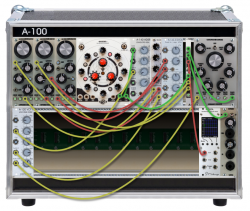
ModularGrid – a site that lets you design modular synthesizers, based on existing modular modules – has introduced a new feature. TrueGrid is a web-based modular synthesizer which lets you create, listen and share modular synth patches. You can create your own patches by dragging cables from module outputs (green) to module inputs (blue) sockets.
So far only Google Chrome is supported
MOVE YOUR ASS new single from German electro/EBM act Full Contact69
Full Contact69 – MOVE YOUR ASS taken from the new album WOMAN MACHINE
Akai AX60 – VCO Modulating the VCF
One unique feature on the Akai AX60 that is not commonly found on synthesizers is VCO Mod to VCF. You can create some FM-like timbres with this feature when the VCF Resonance is turned up.
The creator of this video ‘zibbybone’ has added a tiny bit of reverb with his Roland Fantom X6.
The AX60 is among some of the last true analog polysynths of the mid-eighties. It was Akai’s answer to the hugely successful Roland Juno series and Yamaha’s new digital DX-series. The AX60 is a programmable six-voice synth with a nice LFO, lowpass (VCF) filter, envelope sections, and more. An eight-voice version, the AX80, was already available. Programming this synth is easy using dedicated sliders, knobs and/or buttons for its parameters. It also has a useful noise generator and some other cool functions that include auto-tuning, chorus, a multi-mode arpeggiator and a keyboard that can be split into two key-zones, making it somewhat bi-timbral. All six voices can be stacked in unison mode for a powerful and thick lead sound. Its features and sound make the AX60 a worthy alternative to Roland’s Juno 106.
Listen to a new song entirely built on the Roland System 100M
This is a demo from the Roland System 100M. The entire track was made with this system. As usual a multitrack recording + some FX.
Roland had offered 3 modular systems. The Roland System 700, the half-modular System 100 and this one.
Beside the large expensive System 700, this was more affordable for the customers…
This is the System D with the modules 112,121,130,140 and 150.
Eight Bit Machine – new chip/multimedia project
Eight Bit Machine is an electronic music/multimedia project started by Chris Kobusch (also ‘Distorted Reality’) in September 2013. It combines classic sounds, themes and visuals from the early digital age with electronic music and IDM. The first release is the digital single “80s Child” which was officially released October 6, 2013.
The official music video for “80s Child” incorporates audio and video fragments from a lot of 1980s movies, songs, computer games and even a political speech, reflecting the spectrum of 80s zeitgeist and future visions of the 80s. Says Chris Kobusch: “Musically ’80s Child’ is a potpourri of influences – it combines fast break beat type rhythms, an Acid bassline and a catchy synth hook which is inspired by a tune from an 80s computer game. Further the incorporated vocal samples of the video version are reminiscent of the early days of sampling technology.”
The single is available on iTunes, Amazon, Spotify, Shazam and other platforms and was released on Kobusch’ own digital label Clock Rate Productions.
The never ending expandable modular synth from 4ms
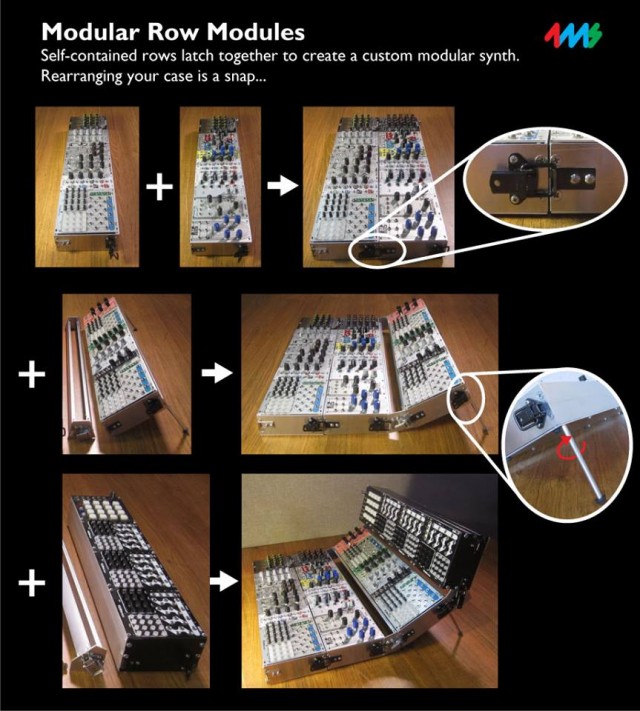
4ms has announced a new case solution for Eurorack synths – Modular Row Modules. Each row is an independent Eurorack case and can be latched together to form any size or shape system you need. Table top. Vertical wall. Console style. Angles and curves. No screwdrivers or tools are needed – you just snap the rows together and add angle pieces and support legs where you need them.
Here are the details:
- Connecting Rows
- Each Row Module can be a stand-alone unit
- Rows connect directly to each other with built-in latches (no tools required!)
- Angled connectors allow for 30 and 45 degree angles
- Support legs screw onto any Row
- Specifications
- Row Modules come in two sizes: 2″ deep or 3″ deep
- All-metal construction, and light weight (about 2.5 pounds)
- Plain aluminum sides, or a variety of colors/finishes will be available (powdercoated colors, anodized black)
- Wooden end caps and angle pieces will also be available
- Power
- Available with busboards, flying bus cables, or without power
- Barrel plug jack on the side of each row, or on a 4HP panel. For vertical configurations, 4HP panel can be mounted to the rear.
- Two barrel jacks on each row allow for daisy-chaining and/or directly powering each row
- Compatible with the 4ms ultra-isolated power system (forthcoming).
Pricing and availability info are to be announced.
New video from ex machina – drifting
The official video to the ex machina track “no one” out of the album “no one” – www.exmachinaproject.com
download the album here:
http://www.exmachinaproject.com/music…
hear the entire album right here:
http://www.exmachinaproject.com/liste…
http://www.facebook.com/exmachinaproject
Live performance on the Radikal Technologies Spectralis 2
The Spectralis 2 in action, for more info on the machine read below:
Spectralis 2 is the even more powerful successor of Radikals sophisticated Hybrid Synthesizer. With up to 4 GB sample memory and tons of new features Radikal raises the bar again for our competition. Never stop the sequencer engine again with our fully redesigned sequencer engine that allows for on the fly realtime sequencing.
Quick Sound Selection for every part – your most favorite sounds are just one fingertip away. Transpose your patterns and step sequences with the attached keyboard. There is only one thing, we left untouched in our new design – the sound engine. Still the warmest and richest sound out there with the power of a modular synthesizer in a box.
The Spectralis 2 hybrid synth, fueled by the latest DSP- and true analog technology, delivers maximum tonal capabilities and leads you into a radical new world of sounds full of life and animation. The Spectralis 2 oscillator section takes sound design to new extremes. The 4 oscillators offer continuously variable waveshapes plus time linearity modulation, FM, PM, oscillator synchronisation, bit reduction and independent pitch and volume envelopes. The self resonating filters, a 4 pole lowpass and a 2 pole multimode filter with LP, HP, BP and notch outputs, use two highly improved true analog circuit designs to overcome the restrictions of modelling based synths.
The way players can interact with the destinc-tive user interface makes the Spectralis 2 hybrid synthesizer a killer live instrument with unbeatable richness and stunning flexibility. The synthesis engine takes advantage of a sophisticated step sequencing system – 32 independent parameter control lines with up to 192 steps let you explore an universe of previously unheard rhythmic effects and atmospheric textures. Punchy high resolution envelopes, are the cutting edge of todays synthesizer technology. They are the perfect weapon for the creation of floor pounding kicks, state of the art sequencer staccatos and numerous percussion effects.
MAXCAL Organ Clone
Massimo Caldonazzo in Rome has started a FPGA based Hammond clone project.
“On this (distorted) video, Riccardo Fassi and Marco Quagliozzi plays the soon-to-be-released baby. Sadly, the video shooting was done with a mono smartphone, in a very adventurous mood with wrong level settings ad several crude distortions. That’s is: a sneak preview of the machine. Maybe, in a next meeting with our usual recording equipment, it will be possible to fully evaluate the sound quality of the Maxcal clone. The third keyboard drives a Dominion MFB synthesizer encapsulated in the main body of the instrument. Many thanks to Riccardo Fassi and Marco Quagliozzi for playing, Massimo Caldonazzo for engineering and Attilio De Simone for video shooting.”
DATAMASKIN

