
Modulating Another Synth with Atruria MicroBrute’s LFO
Background video description:
In my last video, I showed how the Microbrute’s LFO will sync to external MIDI clock and used the LFO to modulate the MicroBrute itself. But using the LFO CV OUT from the Micro, you can also modulate another synth. In this video, I’ve got the Micro’s LFO modulating the filter on the MiniBrute. You’ve probably notices I’m using a Leatherman multi-plier to hold down keys on the MicroBrute to allow the sequence to run “hands-free”. I have been told that Arturia is releasing a software update on Nov. 12 that will allow the sequencer to run hands-free using a MIDI CC command. Until I get the update, I’ll be using the weight of the tool to hold keys down.
John Bowen Solaris Demo
Another demo of the Solaris synthesizer by John Bowen. Everything is played live using the keyboard, joystick, ribbon controller, modulation wheel and assign buttons. Lots of real-time performance controls on this synth 

The general concept behind the Solaris synthesizer is to implement something like a giant wall-sized modular system entirely in software where you can select among several completely different types of oscillators and filters, exquisitely modelled after the components culled from a variety of legendary vintage synthesizers of yesteryear and even some current virtual analog innovations of today. With up to four oscillators, four filters, four amplifiers, four four-input mixers, six envelope generators, one looping envelope generator, five LFOs, two vector mixers and still more of these software modules available in each program, the Solaris synthesizer becomes absolutely unrivalled in terms of versatility and programmability.
Roland Juno 60 single synth demo: The Lost Weekend
All sounds from the Roland Juno 60, no midi.
The Roland Juno-60 is a popular analogue 61-key polyphonic synthesizer introduced by Roland Corporation in 1982 and a successor to the slightly earlier Juno-6. Like its predecessor, the Juno-60 has some digital enhancements, used only for clocking the oscillators and for saving and loading patches. This instrument was succeeded by the Roland Juno-106 in 1984. Roland was losing market share with the Juno-6 in competition against the Korg Polysix. Related in features and price-class, the Polysix featured external control and patch memory, which the Juno-6 lacked. These features were quickly added to the Juno-6’s design, which sonically and architecturally did not change notably between the two versions, and then released as the Juno-60.
The Juno-60 synthesizer is a six-voice polyphonic synthesizer. The single digitally controlled oscillator (or DCO for short) per voice gave the Juno-60 a high degree of stability in maintaining tune; most analogue voltage-controlled oscillators (VCOs) of the time would tend to drift in pitch and require re-tuning of the oscillator. The DCO provides sawtooth and square/pulse waveforms as a sound source, in addition to white noise and a square-wave suboscillator pitched one octave beneath the key played. Both of these additional sources can be mixed in with dedicated sliders.
The filters and envelope on the Juno-60 rely on control voltages sent by depressing the keys on the keyboard and were thus analogue. The Juno-60 features a rather distinctive-sounding 24 dB/octave lowpass filter with resonance. Unlike other VCF’s of the day, the Juno-60’s is capable of self-oscillation and thus could be used to some degree as a tone generator in and of itself. The filter section also features controls for envelope amount and polarity, LFO modulation, and keyboard tracking. In addition, a three-position non-resonant highpass filter is provided to thin out lower frequencies.
The signal is then sent through a voltage-controlled amplifier (or VCA) and a simple four-stage ADSR filter envelope.
The Juno-60 provides limited options for modulating the audio signal. A single triangle-wave variable-rate LFO is provided as a modulation source; this can be mixed into the DCO to create vibrato or into the lowpass filter to generate a tremolo effect. The LFO can either be triggered manually by the left hand using a large button above the pitch bend lever or set to engage automatically whenever a key was pressed.
BIAS – Transformer
BIAS is an Amp Processor for iPad, it’s the most complete, accurate, and versatile modeling available in the world. Coming in 11.13.2013.
Signup: www.positivegrid.com/bias
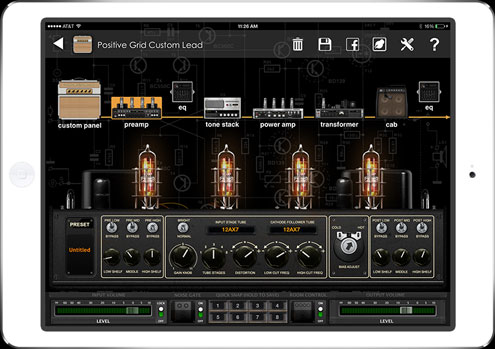
Create totally new sounds by designing your custom dream amp. It’s as easy as tap and drag.
Using Bias’ highly intuitive and lightning-fast interface, it’s child’s play to instantly swap out colorful tube preamps, lush distortion circuits, classic tone stacks, boutique power stages, custom-built transformers and cabs loaded with specially matched speakers.
The result is a depth and range of tones not possible using traditional guitar amps or other static modelers.
Features
- The most complete, accurate, and versatile amp modeling available in the world
- 36 amp models included with the introductory release
- Factory categories organize amps by music genre and sonic impact: clean, blues, twang, crunch, metal, acoustic and bass
- Fully customizable preamps, tone stacks, power amps, transformers, cabinets and mic selection and placement—mix and match!
- Customize the look and feel of your own amp panel, change name, tolex, panel and knobs.
- Works the way guitarists think: tweak gain and overdrive, swap out tubes and transformers, change the cabinet and mic position, and shape the tone with different tone stacks and two 8-band equalizers
- Included noise gate and room simulator
- Create a virtually unlimited number of custom amps
- Quick preset to recall each of your 8 favorite settings in turn with just one tap
- Seamless integration with JamUp XT and JamUp Pro XT, open and save your amp models inside JamUp with one tap
- Works with GarageBand and other audio apps via Inter-App Audio and Audiobus.
Metaphysical function from Reaktor 5
Sergio Rodríguez playing metaphysical function ensemble from Reaktor 5 Native Instruments.
http://structweird.wordpress.com
http://soundcloud.com/structweird
Vintage exploration: Roland Jupiter-6
The baby brother of the Jupiter-8. Still a pretty great machine, with an awesome arpeggiator and the cool Jupiter sound.
Italo-Disco style live improvisation with JP-6, TR-707, SH-101. Leveraging the power of the JP-6’s sweet sounding multi-mode filter
Roland Jupiter-6 = BPF pad, portamento brass
Roland TR-707 = rhythm
Roland SH-101 = sequenced synth bass
The Roland Jupiter-6 (JP-6) is a synthesizer manufactured by the Roland Corporation introduced in January 1983 as a less expensive alternative to the Roland Jupiter-8. The Jupiter-6 is widely considered a workhorse among polyphonic analog synthesizers, capable of producing a wide variety of sounds, such as ambient drones, pads, lead synthesizer lines, and techy blips and buzzes. It is renowned for its reliability and easy, but sophisticated programmability.
The JP-6 has 12 analog oscillators (2 per voice), and is bitimbral, allowing its keyboard to be “split” into two sounds – one with 4 voices, and one with the remaining 2 voices (either “Split 4/2” or “Split 2/4” mode). “Whole Mode” is also available, dedicating all 6 voices to single (monotimbral) sound across the entire keyboard.
The JP-6 was among the first electronic instruments (alongside the Roland JX-3P and the Sequential Circuits Prophet-600) to feature MIDI, then a brand new technology. Sequential CEO Dave Smith demonstrated MIDI by connecting the Prophet to a Jupiter-6 during the January, 1983 Winter NAMM Show.
Europa, a popular firmware replacement available from ‘Synthcom Systems’ adds modern enhancements to the instrument’s MIDI implementation, user interface and arpeggiator, turning the Jupiter 6 into a contemporaneously adaptable machine
Arturia Microbrute Jam with Roland TR-909 and Strymon TimeLine
More noodling around with the Arturia MicroBrute and one of the factory programmed sequences.
“One of the best features of the MiniBrute and MicroBrute is the Metalizer function on the triangle wave. Since the LFO can sync to the sequencer and the sequencer is being synced to the 909, the LFO is now synced to MIDI clock and the rate knob now acts as a clock divider for the LFO as I modulate the filter with the various waveforms and speed intervals. The camera stopped recording about halfway though, which I guess is alright since it was getting rather repetitive.”
Close encounter with littleBits Synth Kit
The littleBits synth kit is an incredibly powerful, easy to use modular synthesizer. The Synth Kit enables amateur and professional musicians to easily explore the iconic synthesizer instrument, allowing you to build your own sound machines (with signal generators, modifiers, modulators and controllers) and put on your own performances – all with little to no engineering or musical knowledge.
Developed to inspire innovation in hardware, littleBits lets users create circuits in seconds, with no soldering, no programming and no wiring required. littleBits has been recognized as “LEGO for the iPad generation” and has been heralded as the most extensive, modular and accessible electronics platform in the world. The brand’s Bits™ modules revolutionize the way people interact with technology by breaking down electronics into their very basic parts (lights, sounds, sensors, motors, programmable circuits), and making engineering fun and accessible to “non experts” of all ages including children , teachers, artists, designers, makers, hobbyists and tech-enthusiasts.
littleBits makes an open source library of electronic modules that snap together with magnets for prototyping, learning, and fun.
Find out more at littleBits.cc
Credit: Reggie Watts: youtube.com/reggiewattsjash
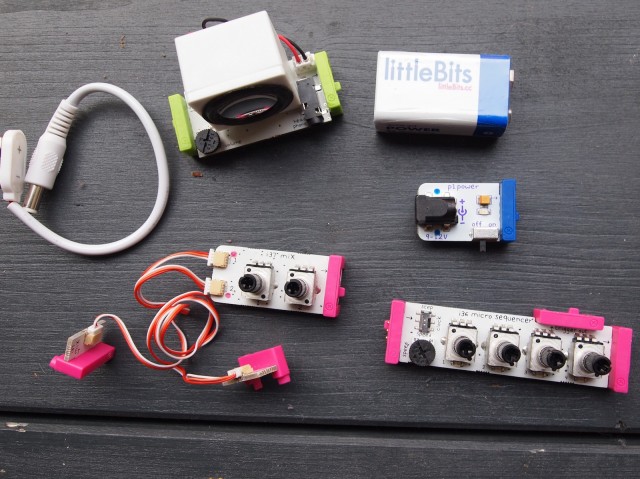
Power: On/off switch, 9-volt battery connection (included)
Oscillator: (2x) Single oscillator source, switchable to square and saw, with pitch knob (plus tune, which works when you plug in the keyboard)
Random: Noise oscillator. Switchable to two modes: “Noise” outputs white noise; “random voltage” is used for control (playing random pitches – think a sample & hold generator)
Keyboard: 13 switches give you an octave of notes; there’s a dial for register. “Press” mode is momentary; “hold” sustains the pitch. You actually get two outputs: the pitch output, but also a trigger output for controlling other modules.
Micro sequencer:Step through four sequence values, each set by a knob. You can clock the sequencer either using the knob or externally (in step mode). That means you can trigger steps (via the keyboard, for instance), or send a pulse for external clock.
Envelope: Attack and Decay knobs, for a simple two-stage envelope.
Filter: Cutoff, Peak (Resonance); with Peak all the way up, the filter will self-oscillate (which means you have a third oscillator, if you like).
Delay: Time, Feedback.
Mix: Two inputs, one output. You also can use the Mix module two combine the two oscillators.
Split: (2x) One signal input, two signal outputs.
Synth Speaker: This module has a small speaker atop it, plus a volume control, but it also has a 3.5mm minijack output for headphones or line output.
Reason Rack Extension: Red Queen 10-Band 3-Mode Equalizer
New in the Propellerhead Shop—Red Queen 10 Band 3 Mode Equalizer. 10 Bands, 3 Modes, 9 filter types and various internal processing paths are at your disposal, plus the ability to record non-destructive MIDI automation with the additional Consort MIDI Recording Control Unit—Red Queen has far more to offer than most.
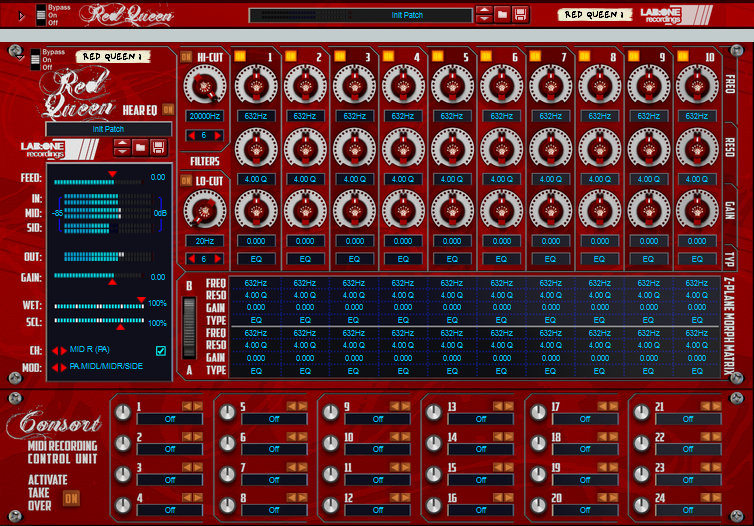
Red Queen 10-Band 3-Mode Equalizer, brought to you by LAB:ONE RECORDINGS, is a totally new powerhouse EQ for the rack; a unit designed to cover all your possible needs, including colouring your sound to give it character, surgical corrective work for those tricky frequencies, and to become a creative filtering device for those extra special effects.
10 Bands, 3 Equalizer Modes, 9 filter types, and up to 6* internal processing paths per EQ mode are at your disposal, plus the ability to record non-destructive MIDI automation with the additional Consort MIDI Recording Control Unit, Red Queen has far more to offer than most – totalling more than 800 controls under the hood, Red Queen is one for your toolbox, whatever you use her for – totally your freedom to colour, control and create.
Modular Sequence: Urzwerg controls Doepfer A-100
1st voice: VCO Tiptop audio Z3000, you hear some FM Modulation, 2nd Voice: MFB Microzwerg. Whole sequence done with the Urzwerg Analog Sequencer, no midi involved. Added some delay in Ableton Live. No additional effects.
DATAMASKIN

