
Delight Delay – free effect ensemble for Reaktor
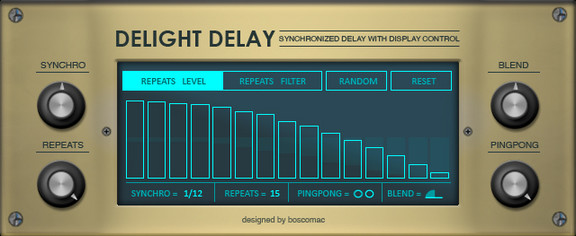
Boscomac has announced the release of Delight Delay, a free delay effect ensemble for Native Instruments Reaktor.
DELIGHT DELAY is a pattern-based delay controlled by a sequencer.
A central display allows you to set the level and filtering rehearsals and so draw a pattern. You can set the number of repetitions (1 to 15) determine the tempo (1/4 to 1/32), adjust the stereo (mono or pingpong) and adjust the blend.
Very easy to use, this delay grooves with guitars, runs with synths, installs synchronized vibes and many other things …
The ensemble is a free download for Reaktor (requires full version). Donations are appreciated.
Teaser for the new Intellijel Metropolis Sequencer
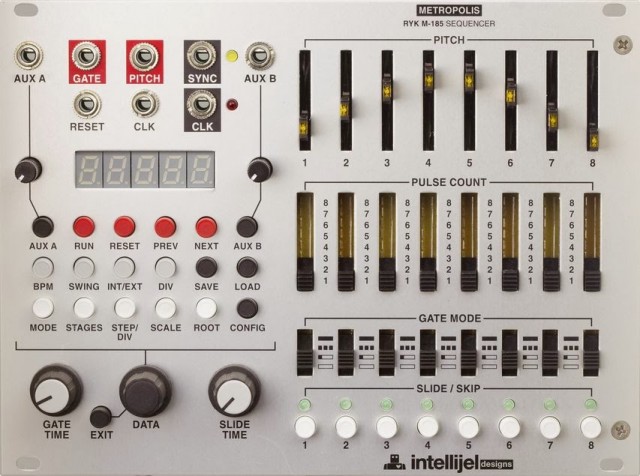
This is a teaser image of the Intellijel Metropolis Sequencer – a new Euro step sequencer, based on the RYK M-185 sequencer.
Features:
- Sequencer modes:
- Forward, Forward-fixed, Reverse, Reverse-fixed, PingPong, PingPong-Fixed, Random, Random-fixed, Brownian, Brownian-fixed
- TB-303 style slide (constant time portamento) with adjustable time
- Stage skipping (double click slide buttons)
- Internal quantizing with selectable scales and keys
- Can act as a master clk with BPM control or slave to an external (using clk src function)
- Save/load panel settings
- shuffle
- Internal clock divider
- Sync output (sets output pulse on last clock step of a sequence, used to slave other sequencers via reset)
- Two assignable AUX inputs which can control: gate length, transpose, key shift, root shift, sequence length, and step divisor.
- config menu to set slider pitch range, clock div type, clock offset
- tap tempo when in internal clock mode and tempo lock with bpm detect in external mode.
- All menu actions are one level deep. i.e. press the menu button and spin the encoder. There are no hidden levels or sub menus.
First go around with the Intelljel Metropolis. This is a pretty basic setup; I didn’t get into using the aux inputs to modulate things within the Metropolis. I’ll try that next! As you can see though, the Metropolis really lends itself to performing and improvising. Very hands-on and easy to go all sorts of crazy ways, melodically. Similar to the Rene, in that regard, but from a totally different point-of-view.
Patch notes. Pamela is sending clock to Metropolis, Trigger Riot, Modcan Dual Delay, and Sound of Shadows.
Metropolis is sending the same note info to three different oscillators. The third one going through a uScale first to create intervals. All going into the Dubmix. The Trigger Riot is controlling Tiptop drums, mixed through a VCA Matrix then an M277 for a little grit. That’s into channel 2 on the Dubmix, where I add a little Spring Reverb at one point.
The kik and snare are ultimately doubled with the Cwejman BLD and DPO. Lastly, I dialed into some sustained notes on the Pressure Points and a Modcan Triple OSC. The uStep is advancing the Pressure Points.
I had some troubles with the Trigger Riot losing sync when I would change presets. I’ll have to delve into that some more.
Sound Demo : Theis Modular Synthesizer – Soft Filter
WAV- file download link below:
https://app.box.com/s/prtaik828mc3fy9…
My first Patch on my TMSS (Theis Modular Synthesizer System) with the Soft Filter.
Sequenced by Theis Dual Skip Sequencer, LFOs from my Curetronic Modular.
Bass Station II Self Oscillating Filter Demo
John Keston explores the Bass Station II, below his report:
I have recently been trying out a Novation Bass Station II monophonic analogue synthesizer. I am quite impressed with this big sounding synth in a small package. While digitally controlled, Novation have focused on packing in proper synthesis features rather than trying to gloss over the sound with onboard effects. For example, as I have illustrated in the video, the filter self oscillates nicely with a clean sine wave that can be modulated in unique ways especially with distinct features like oscillator slew.
The video starts with the self oscillating filter getting modulated by LFO 2 using the triangle wave. After that I switch to using the sample and hold setting creating the well-known 60s computer sound of random notes. Here’s where it gets interesting though. Once I switch the LFO to sample and hold I start turning up the oscillator slew I mentioned earlier. What this does is variably smooth the wave shapes created by the LFO. You’ll hear this come in at 0:28. It sounds like portamento. At 0:35 I switch the LFO to the square wave, but with the slew on it sounds more like a sine. As I reduce the amount of slew the square wave regains its recognizable character. Next I switch it to the saw tooth wave. The nice thing here is that the LFO amount can go into negative values allowing the saw to be reversed.
Another distinctive feature is the oscillator filter mod setting. This modulates the filter with oscillator 2. Since the oscillators range from subsonic to almost supersonic this feature offers modulation effects that are not possible with the LFOs. At 1:29 you will start to hear the oscillator filter mod come in using a pulse waveform. What makes this interesting is that while oscillator 2 is modulating the filter it can also have the pulse width modulated by LFO 1. This can cause bit-reduction-like effects that can be heard between 1:49 and 2:19. At 2:20 I start tapping the octave and waveform buttons on oscillator 2 illustrating what happens when the modulation source is instantly shifted an octave at a time. After a bit more messing around I added a final, manual filter sweep at 3:20.
http://audiocookbook.org/novation-bas…
David Bowie performing Love Is Lost
Steve Reich Mix by James Murphy
Music video by David Bowie performing Love Is Lost. (C) 2013 ISO Records, under exclusive license to Columbia Records, a Division of Sony Music Entertainment
New material from Röyksopp coming soon

On December 16th the Norwegian electronic duo Röyksopp will present “Running To The Sea”, their first new single since 2011. “Running To The Sea” features vocals by Norwegian artist Susanne Sundfør. Note that it was Sundfør who also collaborated with the band in creating a cover version of Depeche Mode’s “Ice Machine”. The singing on the b-side “Something In My Heart” is provided by Jamie of The Irrepressibles.
With this new single the duo Svein Berge and Torbjørn Brundtland offer an insight in what to expect from their 5th album. “Running To The Sea” will be released on Röyksopp’s label Dog Triumph, via Wall of Sound and Cooking Vinyl in the UK.
Tobias Studio tour – Synclavier
Background video description:
Here’s a quick tour of my studio, including the Synclavier, Radio Baton and the Kyma system. This video was made for the Swedish magazine “Studio”. Sorry, no English, only Swedish and the language of gear =)
In-depth encounter with Maschine Studio – Overview and review
Discover Maschine Studio’s ultra-intuitive beatmaking and production workflow in this short overview video. http://www.native-instruments.com/mas…
MASCHINE STUDIO keeps you laser-focused on the quest for the perfect groove. Its pattern-based sequencer and high-performance sampler, exemplary drum synths, incredible suite of creative effects and pro instruments, and acclaimed sound library deliver ultimate production power. All with a fully tactile, hardware-focused workflow that puts you in total control of the groove.
With two new AMOLED screens and a more integrated control surface, Maschine Studio is now the flagship hardware in the range, with a major software upgrade in V 2.0 which also is compatible with the existing Maschine Hardware, there’s a lot to digest. Gaz Williams takes us for a deep appraisal of the two new components.
Waldorf PULSE 2 — 1st Encounter — Real Time ARPEGGIO Tweaking
BRANDNEW WALDORF PULSE 2
1st Encounter Session Outtake
ARPEGGIO
Pulse 2 Analog Synthesizer is proof positive that good things can come to those who wait. For ever since this high-quality synthesizer developer discontinued its original rack-mountable Pulse and Pulse+ programmable analogue monosynths boasting ballsy bass tones and legendary leads beyond compare, those Nineties electronic music dominating sounds have been severely sought-after by those in the know. Which was exactly what drove us into development overdrive to produce an all-new Pulse fit for the 21st Century.
As an all-new, all-analogue synthesizer design, Pulse 2 flawlessly delivers exactly what synth connoisseurs around the world have been truly craving for quite some time — three analogue oscillators living in perfect harmony with a VCF (VoltageControlled Filter), yet we did not stop there: the fresh filter circuits in the Pulse 2 now offer 12dB Highpass and Bandpass modes in addition to 24dB/12dB Lowpass for strengthened sound-sculpting flexibility, while we added analogue Filter FM, two Overdrive circuits, and Ring Modulation from OSC 3, together with Paraphonic and Unison modes allowing up to eight-voice chords — a fantastic feature found on our recently-released Rocket Synthesizer.
- 3 analog oscillators + 1 noise generator
- Pulse width modulation
- Hard sync
- Filter FM from Oscillator 3
- Ring Modulation from Oscillator 3
- XOR Osc Mode
- 8/4 Voice Paraphonic modes
- Cascade Filter
- 24dB/12db Lowpass, 12db Highpass/Bandpass filter modes
- Powerful Arpeggiator
- 8-slot Modulation Matrix
- USB
- MIDI
- External analog signal input
- Stereo line out
- Headphone out
- Backwards compatible with classic Pulse
- 128×64 character backlit LCD
- 8 stainless steel knobs
- 500 Sound Programs
- Electron-absorbing black case
Tune made with SCI Prophet VS & Pro-One
Vintage synthesizer demo track featuring two classic synths
pad, fx and lead sounds: Sequential Circuits Prophet VS (1986)
bass: Sequential Circuits Pro-One (1981)
drums: Roland TR-707
recording: multi-tracking without midi
fx: reverb and delay
DATAMASKIN

