
Microbrute Modular Demo and Brute heaven
Just a quick demo experimenting with the arturia microbrute patched up to my modular synth.
depeche mode cover -electribe emx-arturia minibrute-er 1
The Cellular Automated Buchla
A cellular automaton consists of a regular grid of cells, each in one of a finite number of states, such as on and off (in contrast to a coupled map lattice). The grid can be in any finite number of dimensions. For each cell, a set of cells called its neighborhood is defined relative to the specified cell. An initial state (time t=0) is selected by assigning a state for each cell. A new generation is created (advancing t by 1), according to some fixed rule (generally, a mathematical function) that determines the new state of each cell in terms of the current state of the cell and the states of the cells in its neighborhood. Typically, the rule for updating the state of cells is the same for each cell and does not change over time, and is applied to the whole grid simultaneously, though exceptions are known, such as the stochastic cellular automaton and asynchronous cellular automaton.
What is Cellular Automata?
http://en.wikipedia.org/wiki/Cellular…
http://mathworld.wolfram.com/Elementa…
The idea is to let the individual cells interact with one another.
Patterns change with minimal external intervention
Parsec Additive Synthesis – Reason Micro Tutorial
Parsec Spectral Synthesizer — the futuristic sound of additive synthesis for the Reason Rack. With two independent sound engines, up to 1024 oscillators per voice, a wide range of sound sculpting tools, built-in effects and free modulation routing
Parsec is Available in the Propellerhead Shop:
http://shop.propellerheads.se/product…
Download the song file from this video here:
http://www.propellerheads.se/stuff/Pa…
Additive Synthesis is an entirely different type of synthesizer technology than most of us use in our music. Historically speaking, that’s because Additive Synthesis has been hard to understand and a heavy burden on computers to keep up with the hundreds of oscillators needed to make complex sounds.
Well we’ve fixed that. Parsec is our latest Rack Extension instrument for Reason and it brings a completely new and musical approach to Additive Synthesis.
In this Micro Tutorial, you’ll learn all about how Additive Synthesis works and how you can experiment with Parsec to bring new sounds to your music.
Time machine: ROLAND D-70 Digital Synthesizer 1990
Taking a closer look at the vintage synth Roland D-70, video details below:
I played the Roland D-70 without any additional effects or eq. All you hear is coming straight out of the Roland D-70.
The fully digital Roland D-70 employs a LA (Linear Arithmetic) sound engine. It contains samples which can be filtered with lowpass/bandpass/highpass filters. The oscillators can be modulated via DLM (differential loop modulation). This can produce weird sounds, like heard in the video. A pity, that the JD-800 does not have this feature. It also has a multi effect processor built in (reverb, chorus, delay…). It has TONE PALLETE sliders, which help a lot to tweak the sounds.
In my opinion, the D-70 is more a “live performance synth” than a studio synthesizer. That’s the reason why a rack version never appeared.
The D-70 is very complex. But not exactly the synthesis engine – rather the performance functions: splits, MIDI functions, controller maps, master keyboard functions and that sort of things…. but I must admit, sometimes it sounds beautiful.
It was used by Michael Cretu (Enigma, Sandra).
All you need to know of the upcoming Moogfest 2014 – feat. Laurie Anderson, Giorgio Moroder…
Moogfest 2014 organizers have announced their lineup of daytime presenters, which includes a kick-ass lineup of futurists, musicians, scientists, authors, filmmakers and pioneers of electronic music instrument design.
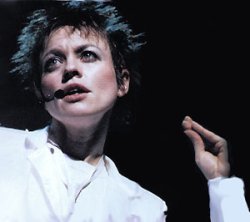
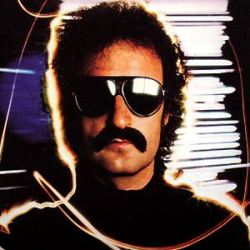
The lineup includes multimedia artist Laurie Anderson, disco pioneer Giorgio Moroder, film composer Cliff Martinez, futurist thinkers Jerome Glenn, Nick Bostrom, and George Dvorsky plus MIT Media Lab’s Joseph Paradiso, Sonification Professor Bruce Walker, and more from Make Magazine, OMNI, and SETI (Search of Extraterrestrial Intelligence).
And then there’s the Electronic Music Instrument Pioneers: Herbert Deutsch, Roger Linn, Don Buchla, Tom Oberheim, Dave Smith, Malcolm Cecil, Keith Emerson and more.
Moogfest takes place April 23-27th, 2014 in downtown Asheville, NC.
Here are the details:
Moogfest 2014 Daytime Presenters
Moogfest is a five-day festival dedicated to the synthesis of technology, art and music.
The daytime conference is guided by pioneers of music and technology with a participatory program of intervention and collaboration:
- 5 days of talks, presentations, and film screenings with futurist thinkers, inventors, entrepreneurs, designers, engineers, artists, and musicians
- 5 days of New Media art installations and interactive technology experiences/exhibitions
- Synth building workshops and other interactive education
Here is the list of confirmed presenters:
- Laurie Anderson – Musician, composer, pioneer in electronic music and one of the great experimental performance artists.
- Giorgio Moroder – Record producer, songwriter, film score composer and pioneer of disco and electronic music.
- Cliff Martinez – Composer best known for his epic and haunting film scores, which include Drive, Solaris and Traffic.
- Jerome C. Glenn – Co-founder and Director of The Millennium Project, a renowned expert on Future Studies.
- Dr. Nick Bostrom – Futurist and philosopher at the University of Oxford. Director of the Future of Humanity Institute and the Program(me) on the Impacts of Future Technology.
- George Dvorsky – Futurist concerned with the ethical and sociological impacts of emerging technologies.
- Dr. Joseph Paradiso – Associate Professor at MIT Media Lab’s Media Arts and Sciences program and Co-Director of the Things That Think Consortium, which examines the extreme future of embedded computation and sensing.
- Bruce Walker – Associate Professor at the Schools of Psychology and Interactive Computing at the Georgia Institute of Technology.
- Mark Frauenfelder – Founding Editor-In-Chief of MAKE magazine, founder and Co-Editor of the weblog/print zine Boing Boing and Editor-In-Chief of Cool-Tools.org.
- Claire Evans – Musician, artist and science writer. Editor-In-Chief at the science fiction magazine OMNI, investigating the intersection of art and science.
- Forrest M. Mims III – Author, researcher, lecturer and columnist. Written more than 60 books about science, lasers, computers and electronics.
- Charles Lindsay – Photographer and artist, is the first of its kind, Artist in Residence at the SETI (Search of Extraterrestrial Intelligence) Institute.
- Hans Fjellestad – Director, producer, writer and editor of the 2004 documentary Moog and producer and writer of 2009′s The Heart Is A Drum Machine.
- Herbert Deutsch – Composer, educator and inventor. Professor Emeritus of Electronic Music and Composition at Hofstra University. Collaborated with Bob Moog in the development of the Moog Synthesizer in 1964.
- Roger Linn – Industrial designer of electronic drum machines and guitar effects pedals. His products are used on countless famous recordings.
- Don Buchla – Synthesizer pioneer and founder of electronic music equipment company Buchla and Associates.
- Tom Oberheim – Audio engineer and maker of analogue synthesizers, effects processors, sequencers and drum machines.
- Malcolm Cecil – Creator of TONTO, the world’s first multi-timbral, polyphonic analog audio synthesizer.
- Dave Smith – Engineer and musician. Known as the “Father of MIDI” for his role in the development of MIDI.
- Keith Emerson – English keyboardist and composer. Founder of Emerson, Lake and Palmer. Acknowledged as one of the most technically accomplished keyboardist in rock history.
- Jason Amm – Filmmaker, music producer, remixer. Performs as Solvent, co-owner of record label Suction. Amm is also the producer of the independent documentary “I Dream Of Wires” which explores the history, demise and resurgence of the modular synthesizer.
In addition to the daytime lineup, Moogfest by night will offer five evenings of musical performances by new trailblazers, early pioneers of electronic music and major headliners in over ten venues across the city, including arena concerts and new music showcases.
Additional daytime programming, and nighttime performing artists will be announced shortly.
Ticket Info:
General Admission and VIP tickets for Moogfest are available now at Moogfest.com. Phase 1 tickets start at $199 for 5-Day General Admission, plus a limited number of $499 5-Day VIP Admission (while supplies last) through December 19 when Phase 2 GA tickets go up to $299. All ticket prices are exclusive of applicable fees.
Moogfest also hosts free events throughout the festival which are open to the public:
- 4 day street festival, including new media art installations and live music
- 2 day North Carolina Tech Expo & Interactive Job Fair
- 5 day new electronic instrument pop-up shop
Bermuda – Heartbeat (Anthony Seeha Remix)
Korg M01 is a music workstation for the Nintendo DS based on the classic Korg M1.
The Korg M1, released in 1988, sold for over $2,000. Korg M01 is designed to emulate the Korg M1 – at least many of its features and sounds – as a $60 app that runs on a $130 handheld computer.
Background video description:
A remix of a friend of mine. Korg M01 is an awesome piece of software. For some reason, I’m actually overwhelmed by all the extra polyphony in Korg M01D. I experienced the same thing when I first tried out Dual Mode in Korg DS-10 Plus! I’ll get used to it soon. Please enjoy the music and montage! =)
Listen to the original by Bermuda:
https://soundcloud.com/bermuda-music/…
Morphing with the new Cylonix/Intellijel Shapeshifter VCO module
Demo of preset stepping and morph on the Cylonix/Intellijel Shapeshifter VCO module
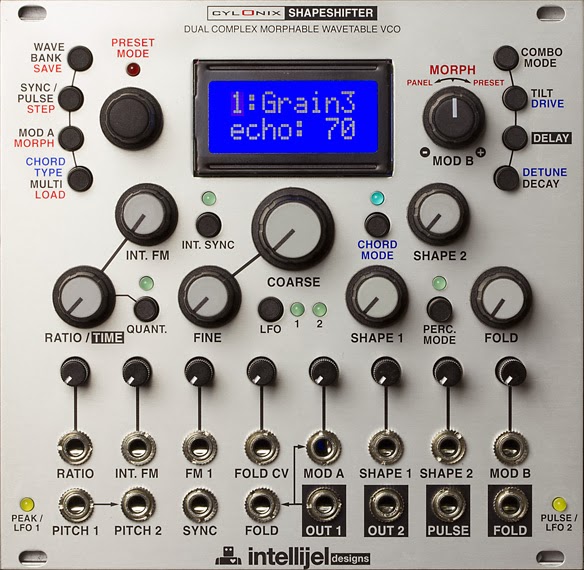
Cylonix and Intellijel have collaborated to bring you a very sophisticated and deeply complex Wavetable VCO. At the core of this module is very powerful FPGA board that he has pushed to the absolute max of its capabilities and crammed full of features. We wanted to create a module that really worked well in the modular context so there are a lot of modulation and control possibilities.
Features at a glance:
preset sequencing and morphing,
delay based resonator,
64 band vocoder mode
special audiorate modulation modes (MOD A)
analog wavefolder
extensive sync, pulse and modB options
detuneable 8 note chords and tons more
WAVETABLES
Each VCO can select from 128 banks of wavetables , each with 8 individual 512-sample waveforms for a total of 1024 waves.
The choice of waveform within the currently selected bank is under voltage control. There is smooth interpolation between the waveforms within a bank, allowing a very wide range of different possible waveshapes.
CHORDS
Oscillator 1 can be operated in a CHORD mode, which runs 8 copies of the oscillator in parallel with adjustable detuning, leading to very fat, rich waveforms. The oscillators have extensive modulation capabilities including audio rate (98KHz) Frequency and Phase Modulation (FM and PM) via external sources. Nonlinear combination processes allow the outputs of the two oscillators to interact to generate complex timbres and sonic textures.
There are 64 user selectable chords.
WAVEFOLDER
The SHAPESHIFTER module also includes the analog wave folder circuitry from
module to add analog warmth and metallic rasps to the digital oscillator output.
External signals can also be patched in.
PRESETS
The module includes a sophisticated preset mode where panel settings can be stored. There are 12 user-programmable preset slots and another 52 volatile slots that can be used as a scratchpad. These scratchpad slots are initialized to interesting presets on module powerup. The capabilities of the preset mode is not limited to mere passive storage of settings, however. In this mode the user can also step through, or sequence, the settings, either in order or randomly in response to pulses input to the external sync input. This gives the user the ability to generate complex sequences of sounds. The preset mode also allows the user to morph between the current panel settings and a preset providing a very powerful real-time performance tool.
SYNC
8 Different sync modes: HARD, SOFT, REV, HOLD, BUMP, 2=1, 1=2, OFF
with the ability to internally sync to a sub oscillator
PULSE
User selectable modes for the PULSE output: OR, AND, XOR, GLCH, +OSC1, EOC, +OSC2, -OSC2
MOD A modes: (audio rate modulation)
COMBO IN, SHAPE IN, PHASEMOD, VOCODER
MOD B options (all with CV control)
-Combo modes for OSC1 and OSC2:
NORMAL, RING, MIN, PONG, INLV, AND, XOR, GLCH
-Waveform TILT
-Chord mode overdrive
-Delay depth and FB
-Percussive mode decay time
There is so much more but it is better covered in the manual and suite of demos.
New Arturia Microbrute Demo
This is a quick demo of the new Arturia Microbrute’s sonic capabilities.
MAIN FEATURES:
- Monophonic synthesizer
- 100% Analog Audio Signal Path
- Steiner-Parker Multimode Filter (LP, BP, HP)
- Voltage Controlled Oscillator with new Overtone Sub-Osc
- Oscillator Mixer (Sub, Sawtooth, Square, Triangle)
- LFO with 3 waveforms and destination attenuator
- Brute Factor™ delivering saturation and rich harmonics
- Ultrasaw generating shimmering sawtooth waveforms
- Metalizer bringing extreme triangle harmonics
- Fast Envelope Generator
- 25 note mini Keyboard
- External Analog Audio Input (level pot on rear)
- CV Inputs: Pitch, Filter, Sub-mod, Pulse, Saw animator, metalizer, gate in.
- CV outputs: Pitch, Gate, Env, LFO
- MIDI Inwith 5-Pin DIN connector
- USB MIDI In/Out
- 1/4” Audio Output and 1/8” Headphone Output
- Free Editor Software
- Step Sequencer :
- 8 sequences stored on power down
- Rate control
- Sync to MIDI clock
- Multiple modes (via software editor)
- Tap tempo/rest insert
Yamaha CS80 Presets From Vangelis
We start with a great demo of the Yamaha CS80 illustrating how Vangelis used presets for many of his signature sounds, music for free – NJ White AKA Whitey lets of steam about an approach from Betty TV, Cassette documentary in the making and finally the panel is split on news of the new Yamaha Tyros 5.
Ghuna X Plays the Philicorda – vintage transistor based organ
From the album: “Ghuna X Plays the Philicorda”
http://ghunax.bandcamp.com/album/ghun…
The Philicorda is a 1960s transistor based organ that has found favour with producers in recent times ; one was used on the album ’19’ by Adele by producer Jim Abiss. The instrument has a built in spring reverb, vibrato and 5 switchable stops. There is also an extra ‘voxchord’ setting, which splits the lower half of the keyboard into single-key chords, for left hand accompaniment. It has a thick, smooth sound that can give just the right atmosphere to certain productions.
DATAMASKIN

