
Analog Signature v4 – five vintage beasts for the Reason Rack!
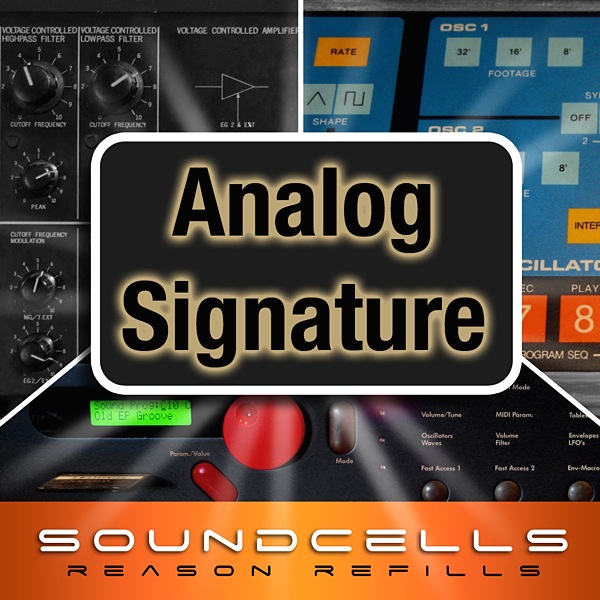
With version 4 of Analog Signature a new member is added to the family: the ROLAND Jupiter 6!
Moog Source, Korg MS20, the Waldorf Microwave 1, the Waldorf Pulse 1, and – from version 4 onwards – the Roland Jupiter 6 have been accurately sampled in such a way that their charming inaccuracies are still there in this perfect Reason environment in which Soundcells took their chance to add polyphony and velocity. A good balance of retro 1970′ s and 80′ s analog / digital sounds with modern programming makes this ReFill versatile for current styles of music as well as retro …
Analog Signature v4 Contents:
• 540 combinator patches.
• 276 NNXT patches containing the basic patches which were used to build the combinators.
• 1792 samples, 44 khz / 24bit.
• Samples coming from five classic synthesizer.
• 10 demo tracks in Reason format included.
TED Talk: Chip Music
Arturia Microbrute + Modular Synth experiment
Saturns Knight Microbrute patch…
Another auditory experiment featuring the Arturia Microbrute and analog modular synth.
This Microbrute patch is being clocked by the modular via Gate in on the Microbrute.
The Microbrute’s gate out is triggering an Envelator eurorack module.
The Microbrute’s CV/Gate out multed to all the eurorack oscillators 1v/oct in.
Microbrute’s Mod matrix LFO out multed to Filter in and Metalizer in.
Fender Rhodes: Forgotten sounds of yesteryear
Improvisation with Rhodes SeventyThree Mark I, ARP Omni-2, and Roland SH-1000.
Effect: Eventide H3000-D/SE patch 155 “ANALOG DELAYS2”.
The Fender Rhodes product line evolved quickly as the 1970’s began. The 73-key Electric Piano was renamed the Fender Rhodes Suitcase Piano in 1969, featuring a black harp cover and a stereo 80W amp, and by 1970 the Fender Rhodes Mark I Stage Piano was available. The Stage Piano was the piano top from the Suitcase model, modified for use with an external guitar or bass amplifier. The Stage model featured detachable legs (parts from a Fender pedal steel guitar), a sustain pedal and pushrod (part of a Rogers hi-hat stand), and a simplified front panel with only volume and bass EQ controls. Internally, the Stage Piano was nearly identical to the Suitcase model.
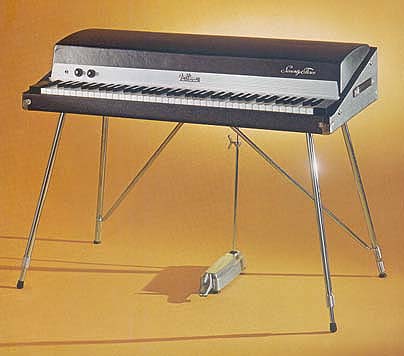
Major changes were made to the piano action between 1969 and 1971. Around 1970, the wooden teardrop piano hammers used in previous models were replaced with hybrid wood-plastic hammers. These new hammers were designed with replaceable tips, because the teardrop hammers were prone to developing grooves over time and were difficult to repair. Originally the tips were made of felt-covered wood and glued into a slot in the hammer head. In early 1971 the factory switched to using Neoprene (rubber) tips, which were proven to be more durable.
The tone generators were also greatly improved during this time. The tonebars were redesigned to be thinner and lighter, with the lower octaves having a 90-degree twist in the middle. This helped to both reduce the weight of the piano and improve tone quality overall. Additionally, the tines were tapered using a “centerless grinding process”, making them hundreds of times more durable than the original Raymac tines. These tines produced a more stable sound while retaining much of the bell-tone that characterized the Rhodes. But the biggest accomplishment was the introduction of full-size, 88-key pianos in 1972. The Rhodes engineers had finally found ways to stabilize the tone and pitch of keys in the extreme registers of the piano, with the lowest bass notes not needing tonebars and the highest notes requiring wood-core hammer tips.
Oberheim Four Voice with Pyxis Aftertouch
This video shows an Oberheim Four Voice Synthesizer with a NEA Modular Expander Cabinet and Pyxis Aftertouch.
“In this clip, all filter, pitch and volume modulation is being done with the aftertouch controller. When the aftertouch is engaged, vibrato is added to the VCOs, and the speed of the vibrato is proportional to the pressure applied. The VCF is also set to open up a little when the aftertouch is engaged. For more info on the aftertouch or the modular cabinet, check out our website www.NewEnglandAnalog.com or give our shop a call.”
A big step forward after the initial Oberheim SEM and Two Voice synthesizers came from the bigger and better Four Voice. Four dual-oscillator SEM modules each with its own filters and envelopes are joined together along with a simple analog mixer and 49-note keyboard to give you a polyphonic/polytonal Obie-beast!
This combination gives you eight oscillators and four voices of polyphony because there are basically four discrete mono-synths all connected together. This has its pros and cons. What is cool is that this was a lot of simultaneous voices for the mid-seventies. And the ability to craft a different sound on each voice led to some diverse and complex sounds. However, it also meant you have to program each voice independently. Each voice also has its own independent audio output.
The Polyphonic Synthesizer Programmer, released in 1976 and added to the Four Voice stores 16 patches per voice (all of which can be different). The Four Voice could accommodate an additional four SEMs, making it just like the Eight Voice model which officially appeared in 1977.
Unfortunately the Four Voice was blown out of the competition by the release of the polyphonic Sequential Prophet-5, which offered true polyphony with a single set of sound shaping controls and comprehensive patch memory.
Korg Volca Beats and Waldorf Pulse 2 goes vintage
The Klark-Teknik DN27A 1/3rd octave graphic equaliser is the successor of the widely acclaimed DN27. It is a totally professional unit which combines the ease of use and reliability of its predecessor with many new features and improvements, to give uncompromising performance and maximum possible flexibility.
Considerable experience in the field of equalization coupled with a philosophy of continual research and development, has enabled the realisation of a product which meets the design criterion; simply the best.
Use of the highest quality materials and components is maintained throughout: Precision, ground air-gap ferrite cores and custom-wound coils are combined to produce the inductors required in each filter; the faders are oil-damped for smooth, positive operation.
The construction is completely dependable and robust, every unit being thoroughly tested both electronically and subjectively before leaving the factory.
More vintage flavors:
Waldorf Pulse 2 +++ Vintage Treats +++ Klark-Teknik DN27 +++ Urei Model 537
Sunday morning electro tunes for your listening pleasure
Karl Bartos Crosstalk
Great Kraftwerkish Sounds from 1996, Komputer with ‘Komputer Krash’,
Available on the album “Orchestral Manoeuvres In The Dark” (Dindisc / Virgin Records / 1980).
Juno 106 Analog Pad for Ableton Live
Free Ableton Live Pack #95 features samples of the Roland Juno 106. Those samples were constructed into an Ableton Live instrument rack to create a lush beautifully vintage sounding pad.
Free Download: http://bit.ly/freesynth95
Collection of over 20 Roland Juno 106 Ableton Instrument Racks: http://afrodjmac.com/2012/04/14/rolan…
Visit his site for more stuff like this, including Live Instrument downloads, tutorials and music! http://www.afrodjmac.com
Alesis Andromeda A6…The Return
The second video in series demoing the Alesis Andromeda A6 analog synth.
— Fx’s Used —
DAW Fx: Synapse Audio Diffuse Delay
A6 Fx: Reverb, Analog Distortion
SH Poly – new classic analogue subtractive synth for Native Instruments Kontakt
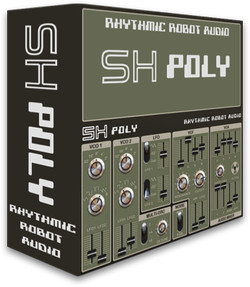
Rhythmic Robot has released SH Poly, a classic analogue subtractive synth for Native Instruments Kontakt, sampled from Roland’s 70′s flagship synthesizer, the SH7.
It features two main oscillators accessing six different waveforms between them, plus a white / pink noise generator, dual LFOs with sine, ramp or randomised output, and a host of modulation possibilities.
The two main oscillators can be thickened further using the Multi-Osc feature, which adds multiple extra detonable oscillators – up to a maximum of ten, for an intense, stacked, “supersaw” style sound. SH Poly also features a selection of 70s-inspired effects and Rhythmic Robot’s trademark Glitch button, which randomises the instrument in a musically-aware fashion, making generating your own patches extremely simple. The user interface is closely modelled on the classic Roland signature graphics and colour palette.
The original SH7 was a powerhouse monosynth that crowned Roland’s lineup in the late 70s. SH Poly takes that amazing sound and crams it into a poly machine: rich, lush pads and thick basses can be dialled up with ease; bubbling leads and squelchy riffs are right there too. The sound is characteristically dense, warm and rich, especially with the Over Load control turned up and a little dose of Multi-Osc.
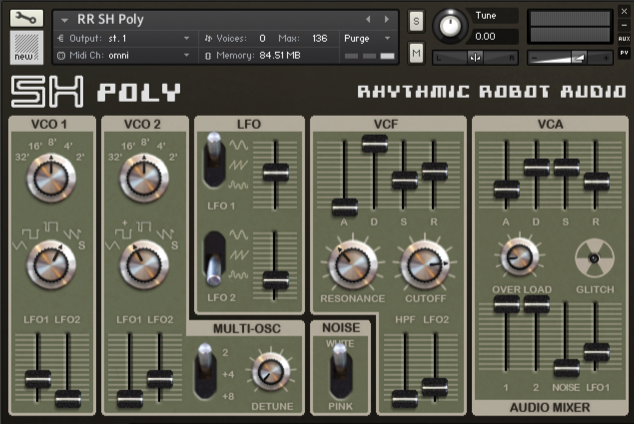
SH Poly features
- Classic twin-oscillator subtractive synthesis in a Roland-inspired framework.
- Multiple samples of authentic SH7 oscillators.
- 58 factory patches to start you off.
- “Multi-Osc” allows extra oscillators to be switched in for a hugely rich, intense sound.
- “Glitch” button for instant, musically-randomised inspiration.
The Poly SH for Kontakt is available to purchase for the introductory price of £13.45 GBP (regular £14.95 GBP).
DATAMASKIN

