
J74 Volca Control – three editors and control surfaces for the Korg Volca series
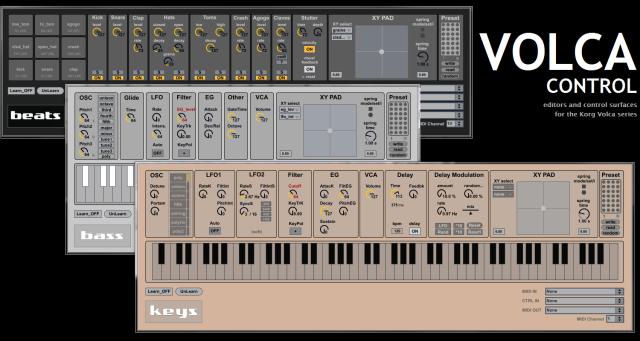
J74 Volca Control – an $8 package that provides you with three editors and control surfaces for each of the members of the Korg Volca series: the Volca Keys, Volca Bass and Volca Beats.
The tools let you control, store and modulate all Volca native MIDI parameters, while adding a bunch of new features for synthesis and performance, such as: filter KeyTracking (both VKeys and VBass), Chorus-like effects (VKeys), additional tempo sync LFO (VKeys), Pitch Tuning and modulation modes (VBass), 3x note Polyphony emulation on VBass, MIDI velocity emulation on VBeats, LFO auto-tuning modulation (VBass and VKeys) and Solo/Mute controls on VBeats.
All devices also offer presets storage (load, save, recall), a X/Y Panel for modulation of two parameters simultaneously and a parameter randomizer.
The devices come in the format of Standalone desktop applications for Mac and PC (integrating via MIDI communication to controllers and DAWs, with no additional license required) and in Ableton’s Live Max for Live format (integrating directly in Ableton Live, in this case a Max for Live license is required).
Supported versions:
- Standalone tested on MAC OSX 10.7, 10.8, 10.9 and Windows 7 and 8
- Ableton Live 9 / M4L versions require Live 9.0.6 or higher + Max 6.1.x
- Ableton Live 8 / M4L versions require Live 8.3 or higher + Max 5.1.9
The J74 Volca Control package can be purchased for US $8 and comes in the form of Standalone (both Mac and Windows) and as Ableton Live / Max for Live plug-ins. The package includes all formats and control surfaces. More info here >>
Feature set:
Volca units standard functionality mapped via MIDI:
- VKeys: VCO (OSC) Modes, Detune, Portamento, Pitch Envelope
- VKeys: LFO Rate, modulation intensity for both Cutoff and Pitch
- VKeys: VCF Cutoff and Envelope amount
- VKeys: Envelope (EG) Attack, Decay/Relase, Sustain
- VKeys: Delay Time
- VKeys: Delay Feedback
- VKeys: VCA Volume
- VBass: VCO (OSC) Pitch tuning for OSC 1, 2 and 3
- VBass: LFO Rate, modulation intensity for VCF Cutoff
- VBass: VCF Envelope amount (on Cutoff)
- VBass: Envelope (EG) Attack and Decay/Relase
- VBass: VCA Volume
- VBeats: Part Level (Kick, Snare, LoTom, HiTom, ClosedHats, OpenHats, Claps, Agogo, Crash)
- VBeats: PCM Speed (Claps, Agogo, Crash)
- VBeats: Tom’s Decay
- VBeats: ClosedHats Decay
- VBeats: OpenHats Decay
- VBeats: Hats Grain
- VBeats: Stutter Time
- VBeats: Stutter Depth
Additional features given by the VKeys, VBass and VBeats software:
- VKeys: Delay Modulation for Chorus-like effects
- VKeys: KeyTracking on VCF Cutoff
- VKeys: Additional LFO (LFO2) which is software-based and tempo synchronized
- VBass: OSC Pitch Tuning modes (unison, octave, third, fourth, fifth, major-chord, minor-chord and three auto-detune options)
- VBass: 3 note Polyphony emulation (paraphony), as OSC Pitch Tuning mode “poly”
- VBass: KeyTracking on EG/Cutoff level
- VBeats: MIDI velocity dynamics (emulates MIDI velocity support)
- VBeats: MIDI controllable pads with velocity emulation
- VBeats: Solo/Mute mixing controls
- All devices: X/Y Panel for modulation of two parameters simultaneously
- All devices: Parameter Randomizer
- All devices: Presets storage (load, save, recall)
What the VKeys, VBass and VBeats do NOT control:
- VKeys: VCF Peak (not hardware/MIDI implemented by Korg)
- VBass: VCF Cutoff (not hardware/MIDI implemented by Korg)
- VBass: VCF Peak (not hardware/MIDI implemented by Korg)
- VBeats: Kick click/pitch/decay (not hardware/MIDI implemented by Korg)
- VBeats: Snare snappy/pitch/decay (not hardware/MIDI implemented by Korg)
- VBeats: Tom’s Hi/Lo pitches (not hardware/MIDI implemented by Korg)
- All devices: Any FUNC[tion] setting on the units (not hardware/MIDI implemented by Korg)
Arturia Jupiter 8V – The Sound of the 80’s
Background video description:
Hey guys! Here is my 2nd attempt to make a better video of the Arturia Jupiter 8V. I finally figured out a better way to capture the video! This is a split patch that I created on the Jupiter 8V using an arpeggio saw wave patch on the lower half and a brass patch on the upper half. I added a touch of delay as well. I really like this software!
New December series: 12 days of Modular 2013 – Day 1 Wavetables
First in a series of 12 videos during the month of December. Each video’s music started with a different foundation of Modular Sounds. This video began as an exploration of wavetables. Sound and Video by Raul Pena.
Checking out Logic Pro X – Review
Reviewer John Krogh expands on the December 2013 print review of Apple Logic Pro X with a screen video tour of new and useful features.
Logic Pro X has more than just a new look — it gives you new options you’ve never had before. You can work the way you always have, with the full power and depth of Logic Pro. Or if you’re exploring ideas, you can choose to work with a more streamlined set of controls to keep things moving right along. You can also personalize Advanced Tools to make your workflow match your creative flow.
The new design also makes it easier to get things done. Transport controls are now located right at the top of the main window. You can easily browse and add more sounds from the Sound Library, conveniently placed next to other track-related controls. Visual snap guides help you quickly align and edit regions. A more responsive, more accurate tuner is just a click away. And Autosave keeps all your work safe and sound. Want to know how something works? Just hover your cursor over any part of the interface for Quick Help tips. To dive deeper, pull up the relevant section of the user manual with a single keystroke.
LanaDelRey: VideoGames – VintageElectronicaMix
Nord Modular + Boss DR660 _________ Tascam 22-2
DIY time: Home made Touch Synthesizer
HandmadeElectronicInstruments.com
This handmade synthesizer is played by bridging the contact points. There are 15 contact points, each of which plays a higher pitch. It is monophonic and will sound the highest pitch being played and 2 effect points.
There is controllable LFO that is activated by pressing the far left contact point and is fed to the square-wave oscillator producing quick modulation, or an almost distorted throaty sound. In addition to LFO speed there is a low pass filter and volume control. Also the far right contact point will create some interesting effects, responding well to light touches that can zap the frequency well out of audible range.
The contact strip is sensitive to pressure and even the resistance of a particular player’s skin. For example someone with sweaty hands will produce a higher frequency. Please note with excess sweat on the contact points you will find a slight decay, however it’s quirks are easily learned and tamable.
It has a 1/4″ output and is powered by an included 9volt battery. The copper finish will have an aged look especially after being played a bit.
Music on the experimental side of things
The accelerating oscillations of the washing machine spin cycle are mimicked with the Korg Monotribe. The dual speed setting on the LFO allows the performer to push the speed up into the audio range allowing for FM synthesis like textures. This piece was shown, along with similar work, at my MFA thesis exhibition in May 2013.
NOTE: This is a binaural recording mixed with a monophonic, analog, synthesizer performance. Please use headphones to experience the binaural effect. For more info please visit http://audiocookbook.org/duet-for-syn…
This is a binaural recording mixed with a monophonic, analog, synthesizer performance. Please use headphones to experience the binaural effect.
This video created by Caleb Coppock (vimeo.com/calebcoppock) illustrates the time scope (from dusk until dawn) of the “In Habit: Living Patterns” performance at Northern Spark, June 2012. The music for the video was composed by John Keston for the sixteenth and final vignette in the sequence titled, “Energy.”
In the video I have focused on illustrating how one might use two iPad synthesizer apps and a hardware synthesizer together including Cassini, Sunrizer, and the MKS-80. The BS3X is used as both the iPad interface and MKS-80 controller. No computer is required, but a simple change of cable allows for a computer to be integrated into this setup because the MOTU UltraLite interface and standalone mixer has MIDI I/O. In other words two MIDI interfaces are still necessary with a computer, but prior to this experiment I was only using the BS3X as a controller for the MKS-80 and bypassing the class compliant USB MIDI interface functionality. Since the USB hub was required I also added the QuNexus to the setup. This was dedicated to feeding notes into the arpeggiator in Cassini. The keyboard controller was split so that in the low end I could play the MKS-80 effect then tweak it with the BS3X knobs and sliders as it decayed. In the upper end of the same keyboard I played a lead sound programmed in Sunrizer.
Prophet 08 First Experiment
The Prophet ’08 truly signals the return of the classic Sequential Circuits Prophet synthesizers, in a beautiful, modern and ultra-stable programmable analog synthesizer! Building on the Poly Evolver keyboard, the Prophet ’08 offers eight voices of polyphony with a 100% analog signal path. The look is spot-on! Brand new, the Prophet ’08 already looks like it’s a classic vintage piece of history. And its sound really does blow you away!
Dave Smith is considered a legendary figure in the synthesizer world, he founded Sequential Circuits and designed such classics as the Prophet 5 and Prophet VS, and he was a pioneer in bringing MIDI to synthesizers. The new for 2007 Prophet ’08 brings back much of the original technology from those old Prophets (like Curtis filters and analog oscillators), updated of course, to meet today’s musicians needs.
While it doesn’t sound exactly like an original P5, it does sound and behave more like one than any other pretender. It’s cleaner, purer and a little more predictable than its 25 year old predecessors. Actually, it sounds just like the Poly Evolver, minus the digital oscillators.
Regardless, the Prophet ’08 is truly a modern day Prophet series synth. Unlike many (Roland) synths that are attaching vintage model names to their current synths even though they are almost nothing alike (Juno, SH, etc.), the Prophet ’08 is the real-deal next generation version of its predecessors. As DSI says, the Prophet ’08 is the product of evolution, not nostalgia. Of course, it includes features we now take for granted, like velocity and aftertouch. Add to that performance features like an arpeggiator, gated step sequencer, and the ability to split and layer sounds. The modulation possibilities are much deeper than anything Sequential ever produced, making it capable of producing sounds the “classics” simply could not.
Background video description:
This is the first video I’ve made with the Prophet 08. It’s a chord sound inspired by a demonstration of the 8-voice SEM. Just playing a chord progression with it. I hope you like!
Sunday electronic music video show – Part 2
The Human League – Black Hit Of Space (1980)
Music video by Orchestral Manoeuvres In The Dark performing Electricity. (P) 1980 The copyright in this audiovisual recording is owned by Virgin Records Ltd
The information comes from WIKIPEDIA
In March 1980, Vince Clarke, Martin Gore and Andy Fletcher formed a band called Composition of Sound, with Clarke on vocals/guitar, Gore on keyboards and Fletcher on bass.
Depeche Mode Shout! live in studio @ L’Écho Des Bananes, France, 1981 (2/3)
Official video for “Afraid” by The Mobile Homes.
This video has been authorized for upload by The Mobile Homes.
Scanned for themobilehomes.se
For more information, visit themobilehomes.se
Sunday electronic music video show – Part 1
From the RAI program “Discoring” (1981), by Luigi Bonori.
Alphaville’s demo song A Victory Of Love from the Dreamscapes box that was released 1999
Music video from Rheingold
Boytronic You 80s Cult…Featuring Holger Wobker….
Video of ‘Ricocheted Love’ by DATA. Words and Music by Georg Kajanus. All the videos on the Georg Kajanus Channel (bwbarb) were uploaded by the songwriter and performer for promotional purposes under the “fair usage” provision. DATA = Frankie Boulter and Georg Kajanus. Kajanus also penned the Sailor hits ‘Traffic Jam’, ‘A Glass of Champagne’, ‘Girls Girls Girls’, ‘La Cumbia’ and ‘The Secretary’ and the DATA hits ‘Living Inside Me’ and ‘Ricocheted Love’. Recent Kajanus covers are ‘La Cumbia’ by Cuba Club and Scooter’s ‘Jumping All Over the World’ a reworking of ‘Champagne’.
DATAMASKIN

