
Traktor DJ Cable – the entry-level Traktor DJ solution
Traktor DJ Cable is an ideal solution for beginner DJs starting out with Traktor DJ.
Traktor DJ Cable lets you pre-listen to your next track for smoother mixing. Unlike standard splitter cables, it splits your A and B decks onto separate outputs, so you can listen to each one independently. With a standard splitter cable, you’d hear the same audio from both outputs.
More about Traktor DJ. http://www.native-instruments.com/tra…
TouchKeys: polyphonic aftertouch and the CS-80
Polyphonic aftertouch is a rare feature on modern keyboards, but the TouchKeys can map any sensor dimension (X or Y position, contact area) to polyphonic aftertouch. This makes the TouchKeys great for controlling classic synth sounds like the CS-80 (emulated here by Arturia). But the possibilities also go beyond the capabilities of the original CS-80 to include full polyphonic control of the pitch and timbre of each note.
Kirlian Camera – Black August
Taken from the album “Black Summer Choirs”.
Buy it here: https://www.outoflineshop.de/catalogs…
or on iTunes: https://itunes.apple.com/album/black-…
Directed by Carlo Roberti / Solobuio Visual Factory
Benge gives us: Moog Modular pure 901 oscillators
The Moog modular synthesizers use the 900-series of modules. These modules, many of them designed entirely by Robert Moog, are examples of analog synthesis at its finest. The modules are actually quite musician-friendly with straight forward input and output jacks and clearly labeled knobs. There are no technical electronic diagrams silk-screened all over them or esoteric controls. They were very easy to grasp conceptually, making them perfect candidates for music labs and professional musicians alike.
The voltage-controlled oscillator modules produce stunning tones with only one real drawback…drift. Revised VCO modules (the 921-series) were eventually released that offered more stable tuning. But the legend of the Moog sound truly comes from the 24 dB/oct lowpass filter (the 904A). To this day, no one has come close to improving upon the original Moog filter and its patented ladder design. Additional modules include VCAs, envelope generators, highpass filters, equalizers, noise generators, a sequencer, and utilitarian modules such as audio mixers, control voltage processors and power supplies. There is no dedicated LFO module, however. Instead, one of the VCO modules has a rate slow enough (0.1 Hz) that it can be used as an LFO instead of a sound source.
Background video description:
Here is a little demo of the majestic R.A.Moog 901 VCO – the original and BEST VCO ever made! I’m really happy because this 901 (not to be confused with the 901 A B combo VCO) came with my original modular IIIC system that I bought in 1994, but it NEVER WORKED. Thats right – I tried a few times over the years to get it fixed but it seemed to beat the fixers – until last week when I took it to my friend. He fathomed it out and also did a simple mod to it on my request – I have added pulse width modulation on the square wave – something that Robert Moog himself didn’t think of implementing on the first generation of VCOs. So for the first time I have a 901 VCO with PWM and it sounds spectacular. In this patch I am using the 901 and two 901B oscillators mixed together, and a third 901B saw wave to modulate the pulse with of the 901. Unfortunately the MP3 encoding on the MOV file does terrible things to the purity of these sounds, it sounds nothing like the real thing, in fact nothing sounds as good as these up close
Continuum – new abstract House/Minimal Techno soundset for Massive
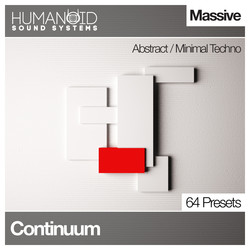
Humanoid Sound Systems has announced the release of Continuum, a new Abstract House/Minimal Techno soundset for the Massive software synthesizer by Native Instruments.
Continuum offers 64 inspirational patches for Native Instruments Massive, perfect for Abstract House, and Minimal Techno. You may also find this sound set perfect for chillout, and atmospheric music.
Special care was taken in designing these patches with forward abstract thinking in mind. We hope you find that little bit of character in each and every patch.
Continuum features
- 64 patches for Massive (NMSV).
- Includes 18 basses, 9 FX, 11 leads, 5 pads, 21 sequences.
- Suitable for Abstract House, Minimal Techno
- Sounds designed by Hermie.
- Requires NI Massive 1.3.0.
The soundset costs $19.95 USD.
SAMO Frustration
Here’s some studio footage from the SAMO Frustration recording session from last Saturns day night.
analog modular synth, apc40, ableton live featuring a jean michel basquiat interview.
Dromeda Strains – Demo of microtape 18 from Tronsonic
All sounds made with microtape 18 – Dromeda Strains, for Native Instruments Kontakt 5.1.0 (full version)
Tritone digital API560 eq used on master bus.
135 different sci-fi synth effects mapped to every key, made with the Korg Polysix – in WAV format.
Inspired by the soundtrack by Gil Mellé to the 1971 cult sci-fi classic ‘The Andromeda Strain’,
much sonic mileage can be attained from these
samples through experimentation with the various microtape controls and effects.
Contains 24 presets (both looped and un-looped
versions of the sounds).
Recorded to vintage tape at 7ips .
KONTAKT 5.1.0 ONLY (FULL VERSION)
www.tronsonic.com
Bitwigseq
Livid shows off the Bitwig Studio, details below:
We’ve been working hard integrating the Base (and our other controllers) into the upcoming Bitwig Studio. We’re pretty excited that with the latest beta, we were able to get an easy-to-use step sequecer up and running with their JavaScript API. This will ship natively in future Bitwig releases. This video shows how some of this stuff works along with some of the other bells and whistles that you’ve come to expect!
NanoStudio – Basic Tones for Eden Synth
Live Session, playing with some easy synth patches of the sound collection “Basic Tones”, 128 presets for NanoStudio by Blip Interactive.
More infos: www.app-sound.com
Back to the 80s: Dalek I (love you) ♠ The world
Background video information:
You know, I was originally going to kick-start the weekend with another mindless Italo-disco dance number for today’s 80sObscurities piece. Then I happened to read today’s “Us Vs. Them” editorial on I Die: You Die. From an FGFC820 perspectiv, “us vs. them” typically refers to the common citizen vs. an unending layer of bureaucracy and government hell bent on oppressing such for personal or political gain. Clearly, such divisions – on a lesser scale – have existed in the music scene for, well, ever. It’s not unique to our scene, or ID:UD’s preferred nomenclature of “Our Thing”, but it’s as prominent here as anywhere. I don’t know why that is, entirely, but considering that when it comes to “my” music I myself can possess the predilection for being an elitist prick on occasion – and a penchant, obviously, for run-on sentences – I can only address it from my own perspective. When you’ve suffered so much for something for so long, not only are you inclined to want to protect it, but you’re also predisposed to discredit those who, in your view, haven’t.
I first began spinning what I’ll loosely call “scene music” – not listening to, but actively promoting it to others professionally – almost thirty years ago. THIRTY YEARS. That’s a long time to love something; and serving this scene has sometimes felt like one giant, unending, unreciprocated affair. (In fact, perhaps obsession is a better word.) It’s easy, I think, to understand why someone like me might be dubious of “the next big thing” – whatever it might be – emanating from an artist or movement that’s existed less than a fraction of that time.
That the new is often championed by the even newer – often with this sense of sanctimonious swagger that only the young and naïve can muster with such sure – well, it triggers something in my aural gag reflex that’s hard to suppress. Now, I recognize both the fault and the irony in taking such a stand. People can’t help when they were born or what they’ve been exposed to. Accordingly, it’s not always been easy, but some time ago I decided it would be more productive – for me and the artists I advocate – that rather than rail against the “musical ignorance” of others, I do my part to educate them. Not condescendingly, I hope, but in a way that communicates the love I have for this style of music (and its subsequent offshoots), in the hopes that others might love it, too.
With that in mind, whatever it is you’re currently listening to… whether it’s Covenant or Cut Copy, Hurts or Howard Jones… turn it off and go check out Liverpool’s Dalek I Love You and 1979’s “The World.” That’s not where this all started, but it’s pretty important stuff. Thank you. Sincerely, Your Humble 80sObs Host.
DATAMASKIN

