
Oberheim OB8 with Pyxis Expression System
This video demonstrates the New England Analog Pyxis Expression System.
This adds expressive aftertouch to the keybed as well as a removable pressure sensitive pad that can both control the VCOs, VCF, and VCA in the synth. By pressing down on keys, or by pressing on the pad, players can bend one or both VCOs, swell the volume or open the filter of the synth. The Pyxis also has its own internal triangle/square wave LFO. The LFO is free running, and has the option of being modulated by pressure. The LFO amount can be dialed in to the VCOs, VCF, and VCA, and LFO will only be sent to these if pressure is being applied. The Pyxis LFO runs through 3 voltage controlled attenuators that are controlled by pressure. As the player presses harder on the sensors, more LFO will be sent to the modulation destination. This allows for an amazing array of interesting and organic sounds to be created.
The Pyxis is available as an internal installation or in a separate wood enclosure. It has the option of having aftertouch installed in the keybed of the synth (we must do this at our shop), or the pressure sensor pad. The sensor pad has a magnet underneath it to secure it to metal surfaces. It also sits firmly on any other flat surface. As shown in the video, a synth can have both the pressure pad and keybed aftertouch installed. The installation of the Pyxis varies from synth to synth. Monophonic and Duophonic synthesizers take the least time to install the system in, while polysynths usually take a few hours to do the installation in. The aftertouch installation also varies as well. Small keyboards like the ARP Odyssey, Pro One, Minimoog, Prodigy, Multimoog, etc. will take less time than Jupiters, OBX/OB8, Polysix, Monopoly, etc. We offer custom installations of aftertouch, breath control, and pressure controllers for all analog systems. For more information, please check us out at www.NewEnglandAnalog.com. Thanks for watching!
Yamaha CS-80 With MIDI Analog Synthesizer
A song made with sounds from the Holy grail of Synthesizers, the Yamaha CS-80.
No more sound sources than this CS-80 is used on the track. This CS-80 is also equipped with MIDI. It receives polyphonic aftertouch from the Roland A-80 and responds as if you were playing on the real thing !
The song is called Ode to the Holy Grail and has a romantic but melancholic touch from the middle of Sweden.
Madrona Labs Aalto – A Synth REAKTOR Users Will Love
Brent Kallmer explores the Madrona Labs Aalto synth, details below:
Aalto is a synth lover’s synth, one that brings together extraordinarily expressive (and powerful) sound with a spirit of sonic adventure. This turns out to be an addictive combination. Check out this overview—I think you’ll agree.
Moog Sub Phatty Square Wave Test
Background video description:
As requested in other video, I’m posting a square wave test with the Moog Sub Phatty. Exploring the sound of the square wave and PWM. Nothing really deep or musical…
Intro to iVoxel: A vocoder for iOS
In this video Ryan Hemeon demos and do a quick walkthrough of the iOS vocoder iVoxel.
“This is the best vocoder I have ever used, which may not be saying very much because I haven’t used very many but I really like this app. In the video I show a lot of the options and what they do as well as showing how to make your own “voxel”. There is A LOT more to the app then I could show you in 15mins but I hope this gives you some insight. ”
For more info please visit www.iosmars.com
E-MU Emax SE Sampler – Sample Library (1988)
Vintage sampler demo by RetroSound
The Emax from the year 1986 is the follower of the Emulator II. A 12 bit sampler with analog filters (SSM 2047). The sound is vintage, organic and really cool. The next generation the Emax II has unfortunately digital filters and the sound is very different to the Emax. Depeche Mode used the Emax in the studio and at the 101 tour.
more info: http://www.retrosound.de
Reason Refill: Peff – the Poly Ensemble refill for Reason 7
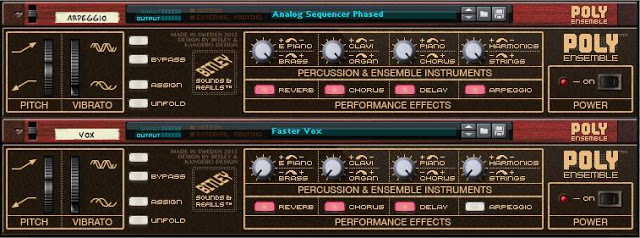
Poly Ensemble gives you expertly multisampled and looped sounds from the venerable Korg Lambda, utilizing all sorts of tricks and possibilities with Reason 7 without the need for extra rack extensions.
“The Combinator graphics took us quite a while to design, making it possible for the user to experience even more than the original (1979) Lambda provides, by laying out all the 8 base sounds / sound types across the four knobs. It’s then very easy to tweak it ‘on the fly’ while producing music. The button assignments have also been carefully done and the arpeggios are playing in different speeds and types to create really lush arpeggiated sounds.”
The refill is now available as a preorder, and while it is cheaper than the final version, it will of course include the final update. The current revision is number three, and it comes with just about everything the final version will have, only that the final version will contain more patches. The current patch count is 132. The refill also contains a few drumkits to really make it like a complete “Poly Ensemble workstation”.
Here’s the brand new demo track, “Emotional”.
The refill is available here: http://bitley.laconicsounds.net/“
Co|de – new electro act on the Swedish electronic music scene

Co|de is a new band featuring Ulrika Mild (Compute) and Deadbeat (the guy also known for his work with The Girl and the Robot, where the girl in that constellation was none other than Frl Plastique from Welle: Erdball)
Ulrika aka Compute was also part of the Friends of Electronically Yours 70’s album, an album featuring several classic synthtronica acts from Sweden; PAGE, Joakim Montelius (Covenant), Steelberry Clones etc
Listen to songs available on SoundCloud from Co|de below:
Winkl – new free foldback distortion effect plug-in from Tek’it
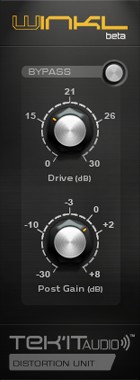
Tek’it Audio has announced the release of Winkl, a free foldback distortion effect plug-in for Windows and Mac.
Winkl is not a subtle distortion, this is well suited for bass and leads, made to make scream your sounds.
Winkl features
- Foldback distortion.
- Drive and Output Gain controls.
- Bypass switch.
- x16 Oversampling.
- 64-bit internal processing.
- Full MIDI automation support.
- Works in mono or stereo.
- Zero-latency.
Winkl for Windows and Mac (VST/AU) is available to download as freeware.
Byetone speaks on mimimalism and Raster Noton
Video details below:
“I like it when music makes you nervous or agressive.”—BYETONE feature, taken from Slices Issue 4-12. Available in 1080p full HD video.
More info: http://www.electronicbeats.net/videop…
About the artist:
olaf benders (aka byetone) experimental work with film material started during school time. the casual finding of a complete 16mm movie equipment gave the initiation. from this time on started an intensive dealing with the medium »film« as well as the raw material »film«.
technical limitations forced special methods: he scratched directly on the footage with objects to create geometrical figures. the results were archaic motion patterns. due to the experiments he came into contact with the east-german underground band AG-Geige.
in 1988 he became a permanent member of AG-Geige.
by working with this group he got into musical aspects. home computer made it possible for autodidacts like him to work multimedial without knowledge of practical musical skills.
after the falldown of berlin wall in 1989 he was working with a music distributor. the work experiences he collected there led to the idea of publishing own musical projects by himself.
together with frank bretschneider he founded the recordlabel rastermusic in 1996. rastermusic wanted to publish their own electronic music projects and those of other similar working artists. the special process of creating electronic sound should be reflected also in the graphical presentation of the label and his products.
one of the earliest rastermusic productions was the project signal, which olaf bender has been continuing together with bretschneider and nicolai until today. nicolai owned the sublabel noton, which finally merged with rastermusic to raster-noton in 1999.
beside the management of raster-noton he is responsible for graphic design and public appearance of the label. additionally bender performs solo under the pseudonym byetone.
bender creates his music digitally. he assembles sine tones to complex sound fabrics. digital clicks and effect plug-ins are essential to create the rhythms. all this is brought in a timely relation and so a track is born — an artificial world without any physical effort.
computer music is often hard to perform in front of an audience. although possibilities seem almost unlimited it is difficult to present this music in a concert setting without an immense deal of technology.
bender therefore uses visuals in the sense of animated light. abstract animations support the abstract pieces of music — in this way the rhythm of music is transformed into a graphic equivalent. by using the computer bender controls the animations in realtime. in connection with sound effect processing this enables him to interact live on stage.
1968 born in karl-marx-stadt / GDR
1974 – 87 secondary school and apprenticeship as tailor
1990 – 93 work as graphik designer with different agencys
1993 – 95 agent in mediadistribution
1996 founded rastermusic, works independently in chemnitz
1999 rastermusic and noton, merged in raster-noton
for more information and releases see http://www.myspace.com/benderbyetone
DATAMASKIN

