
Freeware bus compressor effect plug-in for Windows
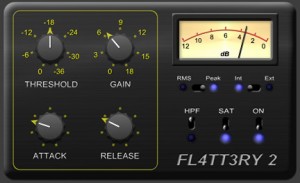
Platinumears has released version 2 of FL4TT3RY, a freeware bus compressor effect plug-in for Windows.
This is a gentle squashy compressor intended for use on busses, though it also works well on channels. It has a very soft knee, with a ratio that gradually increases to hard limiting, and a choice between RMS based level detection (with a window size that depends on the attack time) or a brand new peak sensing algorithm.
This unit is inspired by a particular bit of hardware that I know quite well. Its not “modelled” however: I came up with the algorithm first, thought it sounded similar, so then skinned the plug to resemble the hardware. It is definitely not a proper model, so I’m not going to name the unit in question.
Changes in FL4TT3RY 2
- Slightly gentler transfer curve brings it (subjectively) closer to the hardware that inspired it.
- Tweaked attack smoothing to make it a little more aggressive with the fastest settings.
- Tweaked release smoothing to make it pump less with the fastest settings.
- New peak sensing mode.
- External sidechain inputs.
- Left click the meter to toggle the range between 6, 12 or 18dB.
- Right click the meter to switch between Gain Reduction metering, or Gain change metering (which includes make-up gain).
FL4TT3RY 2 for Windows (VST) is available to download at no cost. Donations are appreciated.
More information: Platinumears
Compression Tips for the Best Mixes
New tutorial from the Prop guys on compression
For many people, compressors are the biggest obstacle between them and a professional mix. But if you know how to use them, compressors are your best tool to achieve that professional mix. Most early interactions with compressors involve cranking them up until they sound horrible and then removing them – wondering why anyone would even want to use them in the first place. This week I’ll explain what a compressor’s actually doing and how to make it work the way you want.
New compressor effect released – the SKWOSH
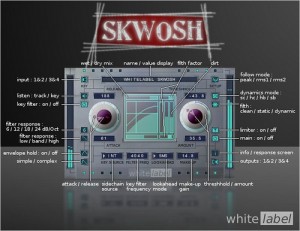
whiteLABEL unveils SKWOSH, a VST Compressor Effect for Windows.
“SKWOSH, is a versatile compressor offering 4 main modes of hard and soft; compression and signal-boosting. Envelope following comes in a choice of peak or 2 RMS modes with optional peak-hold and simple or complex follow modes.
The sidechain can be either internal (1&2) for regular stereo operation, or external; (3&4) for keyed operation. The sidechain filter offers high, low and band-pass with upto 4 poles for a maximum response or 24dB/octave. There is of course a monitoring switch to hear the filtering applied to the sidechain signal too. “
Features:
- Output wet / dry mix control.
- Input / output flip: 1&2 / 3&4.
- Chain audition: on / off.
- Output limiter: on / off.
- Character: clean / static drive / dynamic drive – with controls for filth level and drive factor.
- Lookahead: 1, 2, 5, 10, 20, 40ms with additional match / half / double modes.
- Key filter: LP / BP / HP: 6/12/18/24 dB/oct – 80hz to 8khz.
- Sidechain: internal or external (2 stereo inputs).
- Operation: hard knee / soft knee / hard boost / soft boost.
- Envelope: peak / RMS 1 / RMS 2 …
Price: £25
New vocal plug-in called Nectar
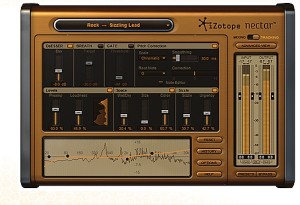
Izotope will be releasing a vocal plug-in this month called Nectar. The software will have Pitch Correction, Breath Control, Compressors, a DeEsser, Doubler, Saturation, EQ, Gate, Limiter, Delay and a Reverb. It will be $199 at launch then jump to $299 shortly after. As with other Izotope plug-ins there will be an extensive preset browser too.
“Nectar offers dozens of professionally designed vocal production styles powered by eleven processing modules. Users will select an included style and then customize it with faders tailored to that style. For further customization of their vocal sound, users can switch to the Advanced View and access all of the controls of the underlying modules that power the plug-in… iZotope Nectar is ideal for audio engineers, voice over artists, singer/songwriters, recording enthusiasts, podcasters, and anyone else who records sung or spoken vocals. Its dozens of styles cover genres including: Alternative & Indie, Blues/R&B, Classical, Country, Dance & Electronica, Hip Hop & Rap, Jazz, Pop, Rock, and Spoken Word.” – izotope.com
For more info: izotope.com/products/audio/nectar/
Side chain compression in Ableton
Here is the first in a sequence of three videos showing a tutorial on side chain compression
In this video (part 1 of 3 focusing on Sidechaining) Dubspot instructor and Ableton Live expert Steve Nalepa shows how to use the Compressor-Sidechain audio effect in Ableton Live. Put simply, Sidechain Compression allows “different elements of your songs to essentially dance together.” Professor Nalepa starts by creating a simple dubstep drum pattern (kick and snare), adds a couple of synths which overpowered the drums, basically drowning the kick and snare. To remedy this imbalance, Nalepa select the synth tracks and grouped them together, and worked on the tracks/elements individually, reducing volume and adding effects. The popular effect has been used by a number of unique electronic and dance music producers from Daft Punk and Justice to newer artists like Baths and Nosaj Thing extraordinary results.
New effect plug-in in the Vengeance Mastering Suite

Vengeance has released Multiband Compressor, a new effect plug-in in the Vengeance Mastering Suite series.
Multiband Compressor features
- Multiple band modes: 1, 2, 3 or 4 bands.
- High quality filter models, from 6db to 96db – without any phasing issues.
- Up to 4 independent compressors (one per selected band).
- Hard-/softknee mode, optional autogain, optional autorelease for every compressor.
- Graphical Ratio/Treshold curve display.
- Up to 4 limiters (one for each band) + 1 mastering limiter (sum), also with autorelease.
- New York Compression: MIX knob, to bring back some original dynamic.
- Live waveform scopes for every channel.
- Realtime FFT analyzer (in-/output overlay to compare dry and wet signals).
- Unique new feature: the “DPC” (dynamic pattern compressor).
- Anti distortion filters for ultra-short releasetimes.
- Many cool presets included: ranging from complete masterings to special fx.
- All parameters are automatable (host).
- Copy Protection: elicenser USB Dongle required! (www.elicenser.net)
The Vengeance Mastering Suite – Multiband Compressor is available to purchase for PC and Mac (VST/AU) for $199 USD / 149 EUR / £135 GBP.
More information: Vengeance
ButterComp, a digital compressor effect plug-in for Mac.
Airwindows has released ButterComp, a digital compressor effect plug-in for Mac.

ButterComp, digital compressor effect
Like Desk, rather than apply color to the sound, ButterComp does its thing by using a better algorithm, a peculiar approach to compression that hasn’t been done before to my knowledge. Some bits of it are inspired by remarks from Alexey Vaneev, and some bits of it are strange Airwindows things he knows nothing of
the upshot is, this compressor produces virtually no high frequency hash, and sounds bloom out of it in a delicious way.
ButterComp is available to purchase as an Audio Unit effect plug-in for Mac, priced at $59.99 USD.
More information: Airwindows
Reason tutorial: Mastering EQ compressor equalizer
Thisclip is a small review clip from a full length Training DVD available at www.proaudiodvds.com Over 5 hours of awesome tips and tricks from renowned host David Wills (Michael Jackson, Whitney Houston, Mary J. Blige, Earth, Wind & Fire, Chicago, etc) Imagine how cool it would be to totally master Reason in just a few hours. Join our hundreds of thousands of satisfied customers and see why we are the leader in Pro Audio Training at www.ProAudioDVDs.com
Use of compression in your music production
Compression

Compressors and limiters are specialized amplifiers used to reduce dynamic range–the span between the softest and loudest sounds. All sound sources have different dynamic ranges or peak-to-average proportions. An alto flute produces a tone with only about a 3dB difference between the peak level and the average level. The human voice (depending on the particular person) has a 10dB dynamic range, while a plucked or percussive instrument may have a 15dB or more difference. Our own ears, by way of complex physiological processes, do a fine job of compressing by responding to roughly the average loudness of a sound. Good compressor design includes a detector circuit that emulates the human ear by responding to average signal levels. Even better compressor designs also have a second detector that responds to peak signal levels and can be adjusted to clamp peaks that occur at a specific level above the average signal level.
Download tutroial here (pdf) >>
[youtube=http://www.youtube.com/watch?v=qtX_gRDvcug]
DATAMASKIN

